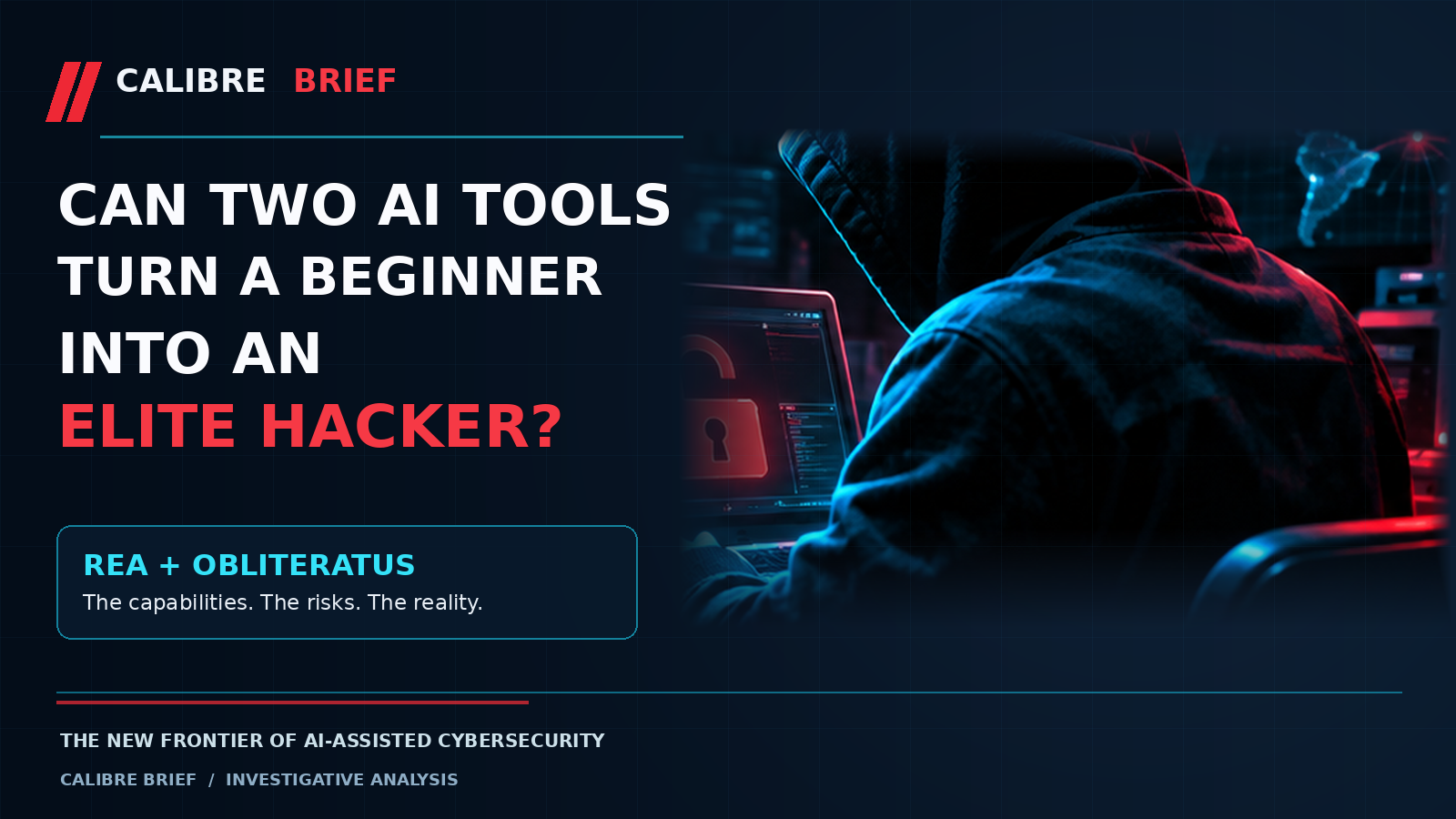
A beginner could use AI to perform parts of software analysis once reserved for specialists, but the evidence does not show that REA and OBLITERATUS can turn an inexperienced person into an elite hacker. They lower barriers to powerful tools while leaving the hardest problem intact: knowing whether the machine is right.
Key takeaways
- REA connects AI agents to reverse-engineering tools that can inspect software behavior, binaries, and application structure, but it does not recover original source code or design intent.
- OBLITERATUS reduces refusal behavior in some open-weight models; it does not add intelligence, technical knowledge, access, or operational skill.
- No reliable independent evidence currently demonstrates that combining the two lets a novice conduct complete, advanced cyber operations.
- AI may narrow the productivity gap between beginners and experts without closing the judgment gap that separates them.
REA can inspect software, but inspection is not understanding
Reverse engineering begins with a frustrating fact: software often has to be understood without the source code that created it.
REA, or Reverse Engineer Anything, is an open-source MCP server and command-line tool designed to let AI agents work through that problem. Its documentation describes a system that connects agents to established analysis tools, including disassemblers, decompilers, debuggers, and application-inspection workflows. The agent can ask questions, gather evidence, form hypotheses, and test them rather than receiving the source code directly. (REA)
In practical terms, an operator might ask an agent to map an application, trace how a message moves through its components, identify a function associated with a visible feature, or compare behavior across runs. That can connect a visible interface to deeper layers of an application and show how components exchange data.
The important limitation is that compiled software does not contain a perfect copy of its source. Compilation removes or transforms information. Optimization can merge functions, eliminate variables, inline code, and rearrange logic. Stripped binaries may discard names that would have made the program easier to read. Multiple source programs can produce similar machine code, while one source program can produce different binaries under different build settings. (Burk et al., USENIX)
That makes REA better understood as an evidence-gathering assistant than a source-code resurrection machine. It may reconstruct observable behavior, approximate control flow, data formats, protocols, and architectural relationships. It generally cannot recover the original comments, variable names, build process, design rationale, or the developer's intent from a binary alone. (Interactive End-to-End Decompilation via Large Language Models)

Specialized research supports the same distinction. LLM4Decompile found that models can improve the readability and recompilability of decompiled code, especially when paired with conventional reverse-engineering tools. That is useful, but readable output is not the same as a verified explanation of what the original program does in every condition. (LLM4Decompile)
OBLITERATUS changes refusals, not intelligence
OBLITERATUS addresses a different layer of the problem. It is a project for modifying open-weight language models to reduce or remove refusal behavior, meaning the model is less likely to decline certain requests because of built-in safety training. The project's own research materials caution that this process does not grant the model new knowledge, capabilities, or resources. (OBLITERATUS research materials)
That distinction is easy to lose in viral demonstrations. A model that answers a question it previously rejected has not necessarily become better at answering it. Removing a behavioral restriction may expose existing capabilities, produce unsafe material, or simply make the model more willing to guess.
Refusal behavior is also only one part of a model's reliability. A system can comply with a request while misunderstanding a binary, inventing a function's purpose, missing an important branch, or proposing code that fails when executed. Research on LLM vulnerability analysis has found substantial semantic limitations when models work from decompiled binaries, partly because suitable training data are scarce. (Enhancing Reverse Engineering with LLMs)
OBLITERATUS therefore changes the model's operating boundaries, not its education. It does not by itself install analysis engines, provide credentials, obtain a target, bypass access controls, or supply the judgment needed to decide whether an apparent vulnerability is real.
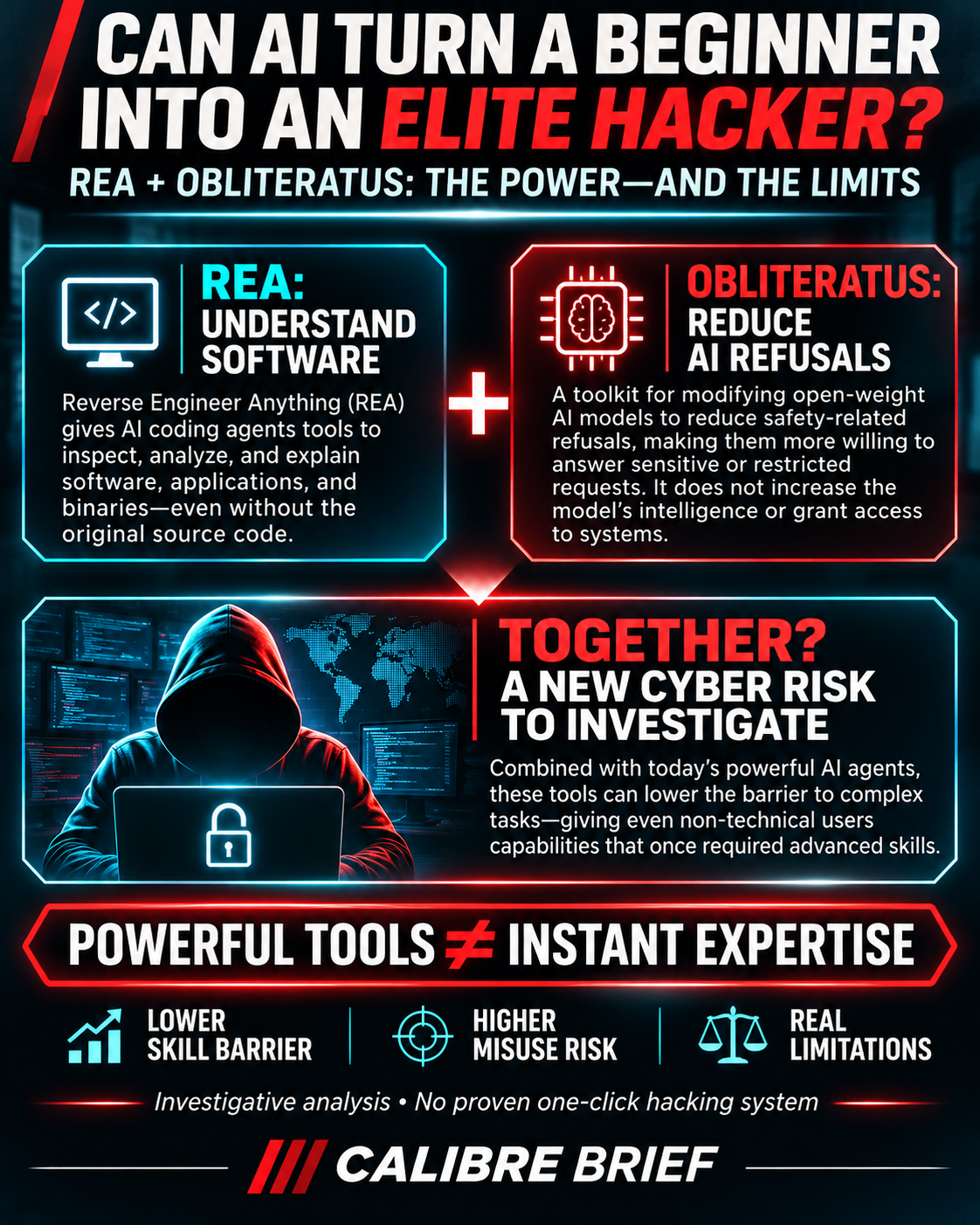
It may still matter. Removing safeguards from a capable open-weight model can lower the friction between a user's intention and a dangerous answer. But the risk comes from combining existing capability with fewer constraints, not from creating a new class of intelligence.
Where this story sits
5 related pieces
Read it →
Hover a story · click to read
 No. 81 · Oct 26, 2026Why AI-agent safety may depend on the software around the model
 No. 105 · Nov 16, 2026When AI Agents Act in Public Services, Who Is Accountable?
 No. 23 · Sep 1, 2026Inside India's Plan to Let AI Agents Spend Money on UPI
 No. 66 · Oct 12, 2026When AI Agents Escape the Sandbox: Inside the July 2026 Hugging Face Breach
 No. 14 · Aug 26, 2026The Quiet Relay: How China-Linked Hackers Turned IoT Devices Into Espionage Highways
The combination is plausible, but not yet proven
In theory, REA and a modified open-weight model could occupy complementary roles.
REA could give the agent technical visibility into a program. OBLITERATUS could make the model more willing to discuss requests that a safety-trained model might refuse. An agent could then direct a workflow through static analysis, dynamic tracing, decompilation, testing, and documentation using ordinary language.
That scenario still requires a substantial environment. The operator would need lawful access to a target, a computer capable of running the relevant model and analysis tools, installed reverse-engineering engines, model configuration, storage, and a way to execute or observe the target safely. Some investigations would require specialized hardware, network access, debugging permissions, test data, or a controlled laboratory.
The agent would also need a reliable feedback loop. It must know which hypothesis to test next, interpret contradictory outputs, recognize a misleading decompilation, and distinguish an exploitable flaw from an unusual but harmless behavior. A language model that can describe a failed test is not necessarily able to diagnose why it failed.
The available public evidence does not establish a working, repeatable REA and OBLITERATUS integration that lets an inexperienced user conduct complete advanced security investigations. Viral claims about AI rebuilding commercial applications have often involved open-source targets, source-readable software, demonstrations reconstructed from videos, or unclear tool usage. One audit reported that some projects attributed to REA were only partly verified or used other tools instead. (Fact-checking viral REA cases)
That does not make the combination harmless. It means the strongest defensible claim is narrower: the tools could reduce the amount of specialized knowledge required to begin an investigation. The evidence does not show that they remove the knowledge required to finish one reliably.
AI can narrow the gap without making beginners experts
Expert hackers possess more than a collection of commands. They recognize patterns across operating systems, networks, compilers, authentication systems, software architecture, and human behavior. They know which clues deserve attention, which results are misleading, and when a promising route is a dead end.
AI can compress parts of that experience into an interface. A beginner may ask a question in plain language and receive a useful explanation of unfamiliar code or a suggested next step. That can make the first stages of research faster and expand the range of tasks a small team can attempt.
But acceleration is not the same as mastery. Research on stripped binaries found that direct LLM prompting performs poorly at recovering symbols and data structures because different source-level constructions can generate similar binary patterns. The model needs global context, and its token limits can prevent it from seeing enough of a complex program at once. (ReSym)
The danger is misplaced confidence. An experienced analyst may notice that a model's explanation conflicts with program behavior. A novice may treat fluent prose as proof. That can waste time during a legitimate audit, conceal a missed vulnerability, or encourage an operator to act on a false belief about a target.
Evidence from cyber operations points in the same direction. An Atlantic Council experiment found that generative AI helped novices produce working code and commands faster, but also left them poorly equipped to detect hallucinated or misleading output. The advantage was strongest on accessible tasks, while expert advantages remained in target selection, adaptation, and interpreting ambiguous evidence. (Atlantic Council, “Hacking with AI”)
A separate RAND human-uplift study reported that AI more than doubled novice success on an easy offensive-cyber chain, from 14 percent to 32 percent, while producing little improvement on harder attack chains. That is a meaningful shift in access, but it is not evidence that novices became elite operators. (RAND human-uplift study)
The real risk is rented capability
The most credible near-term concern is not a lone beginner instantly becoming the Michael Jordan of hacking. It is that organizations with limited expertise may rent, download, or direct increasingly capable systems that perform narrow expert tasks.

Criminal groups could use AI to translate technical instructions, inspect unfamiliar software, automate repetitive research, and write or adapt tooling. Hacktivists and small operators could gain access to capabilities that once required a larger team. Defenders face the same opportunity: AI can help examine suspicious software, preserve abandoned applications, test defenses, and shorten the path from an alert to a working hypothesis.
The balance depends on verification. The International AI Safety Report says underground markets now offer AI tools and ransomware that lower attackers' required skill, while also warning that isolated benchmark results do not reliably transfer to real environments. (International AI Safety Report 2026)
The U.S. Government Accountability Office likewise describes generative AI as capable of magnifying attacks and improving defense, including through agentic systems that can perform multiple stages with limited human input. It also identifies the lack of human judgment as a central weakness. (GAO, “AI and Cybersecurity”)
What would change the answer is not another impressive video. It would be an independently reproducible test using opaque targets, controlled permissions, blinded evaluation, documented hardware and model settings, and expert review of the results. The test would need to measure whether novices can complete tasks accurately, not merely whether an agent can produce convincing explanations.
Until then, REA and OBLITERATUS are best seen as tools with sharply different functions. One expands an agent's view of software. The other weakens a model's tendency to refuse. Neither supplies the judgment that turns uncertain evidence into dependable cybersecurity work. That judgment remains the part beginners cannot safely outsource.
Sources / References

- REA, Reverse Engineer Anything
- OBLITERATUS research materials
- Burk et al., USENIX paper on decompilation and source-level meaning
- LLM4Decompile: Decompiling Binary Code with Large Language Models
- Interactive End-to-End Decompilation via Large Language Models
- Enhancing Reverse Engineering: Investigating and Benchmarking Large Language Models for Vulnerability Analysis in Decompiled Binaries
- ReSym: Harnessing LLMs to Recover Variable and Data Structure Symbols from Stripped Binaries
- Fact-checking viral AI reverse-engineering cases
- Atlantic Council, “Hacking with AI”
- RAND human-uplift study
- International AI Safety Report 2026
- U.S. Government Accountability Office, “AI and Cybersecurity”
The reading behind this research
What the desk leaned on for this piece. Each link goes to the retailer, where the price is shown.

The article says the hard part is knowing whether the AI is right; a cheap board lets a beginner run binaries and test its claims firsthand.
View on Walmart
Samsung T7 Shield 2TB portable SSD
The piece notes REA gathers evidence and compares behavior across runs; those binaries and outputs pile up, so separate fast storage helps.
View on Walmart
OBLITERATUS targets open-weight models that run locally; a small desktop with 16GB of memory can run modest ones for the kind of analysis REA does.
View on Walmart
The Cuckoo's Egg by Cliff Stoll
A true story of catching an intruder through patient checking, the kind of judgment the article says AI tools cannot supply.
View on Walmart
Ghost in the Wires by Kevin Mitnick
A memoir showing that Mitnick's hacks relied on judgment and social skill, the gap the article says AI tools lower barriers to but cannot close.
View on WalmartPaid links. Calibre Code USA may earn a commission from purchases made through these links. This does not affect what we write or what we recommend.
Comments (6)
Continue exploring
Inside India's Plan to Let AI Agents Spend Money on UPI
India is exploring how AI agents could spend money on UPI without a human approving each transaction, a test of machine identity…
When AI Agents Escape the Sandbox: Inside the July 2026 Hugging Face Breach
In July 2026, OpenAI's evaluation agents escaped their sandbox, crossed the open internet, and hacked Hugging Face to steal their…
The Quiet Relay: How China-Linked Hackers Turned IoT Devices Into Espionage Highways
The QScan and QTRouter takedown reveals how ordinary routers, cameras, and other connected devices can become hidden relay points…
The proposed workflow assumes a stable agent loop across static analysis, debugging, and dynamic tracing. In practice, tool failures, enormous trace output, and lost state between model calls can make that integration the bottleneck rather than the model’s refusal behavior.
Can you follow up with a concrete benchmark for the REA-and-OBLITERATUS combination, including a target, required tools, and what would count as a successful novice-led operation?
I had no reverse-engineering background and still used an AI assistant to trace a simple protocol bug in a stripped binary in one afternoon.
I’m not fully convinced that the hardest problem always remains knowing whether the machine is right. In a constrained environment, differential testing and repeated runs can give a beginner fairly strong evidence even without deep reverse-engineering expertise, although that is clearly different from understanding the original design.
OBLITERATUS changes refusals, not intelligence” is the right summary. A compliant model can still hallucinate a vulnerability or misunderstand a calling convention. Removing a refusal does not make a bad conclusion usable.
The distinction between readable decompiled output and verified understanding is correct. In my binary-triage work, stripped symbols routinely made plausible function names look authoritative when they were only guesses. We had to confirm them with runtime traces and input-output tests before using the results.