
In April 2026, in Montréal, negotiators concluded the charter of a bank that does not yet exist. On 29 April, nineteen founding member nations chose a home for that future bank: Canada, subject to ratification. The lead negotiator was Isabelle Hudon, chief executive of the Business Development Bank of Canada, and several Canadian cities are now competing to host the headquarters. The institution is the Defence, Security and Resilience Bank, almost universally shortened to the DSRB, and its backers aim to have it operational by the end of 2026 (The Power Curve, June 2026; Collins and O'Sullivan, via the Cascade Institute).
The pitch is disarmingly simple. Pool the credit of allied democracies. Borrow at AAA rates most members could not reach on their own. Lend that money, on terms measured in decades rather than budget cycles, to governments building arms factories and to companies building weapons. Guarantee the commercial bank loans that those companies cannot currently get at any price.
The timing explains the ambition. World military expenditure reached roughly $2.7 trillion in 2024, a rise of 9.4% in one year, the steepest increase the Stockholm International Peace Research Institute has recorded in nearly four decades (SIPRI; The Power Curve). At The Hague in June 2025, NATO's members, Britain included, committed to spending 5% of GDP on defence and security by 2035, split between 3.5% for core military needs and 1.5% for resilience, infrastructure and the industrial base (NATO Hague Summit Declaration; The Power Curve). Yet in allied wargames, precision munition stockpiles are typically exhausted within days (The Power Curve; CSIS, January 2023). Governments have voted through the spending faster than industry has found the motors, explosives and guidance kits to spend it on.
Which raises the question this article sets out to answer. The DSRB is not a Whitehall scheme; it is a multilateral project that Britain has so far watched from an ambivalent distance. But its promise speaks directly to the UK's most persistent military failure: the decades-long gap between a technology that works and a technology that is actually fielded. Could this bank create a financial pipeline that moves startup-developed military technology from private capital to the battlefield faster than the Ministry of Defence's procurement machine allows? The honest answer, on the evidence published so far, is that it can build roughly half of that pipeline. The other half runs through a door that no bank can open.
What is the DSRB?
The bank's lineage is more personal than institutional. Its concept was developed by Rob Murray, formerly NATO's head of innovation and the man credited with designing the alliance's defence accelerator, DIANA, and its sovereign-backed venture vehicle, the NATO Innovation Fund. Murray began sketching the idea inside NATO in 2018, set it out in an Atlantic Council paper published in late 2024, and then spent 2025 assembling a coalition around it (Cascade Institute; CISDS, January 2026; The Power Curve).
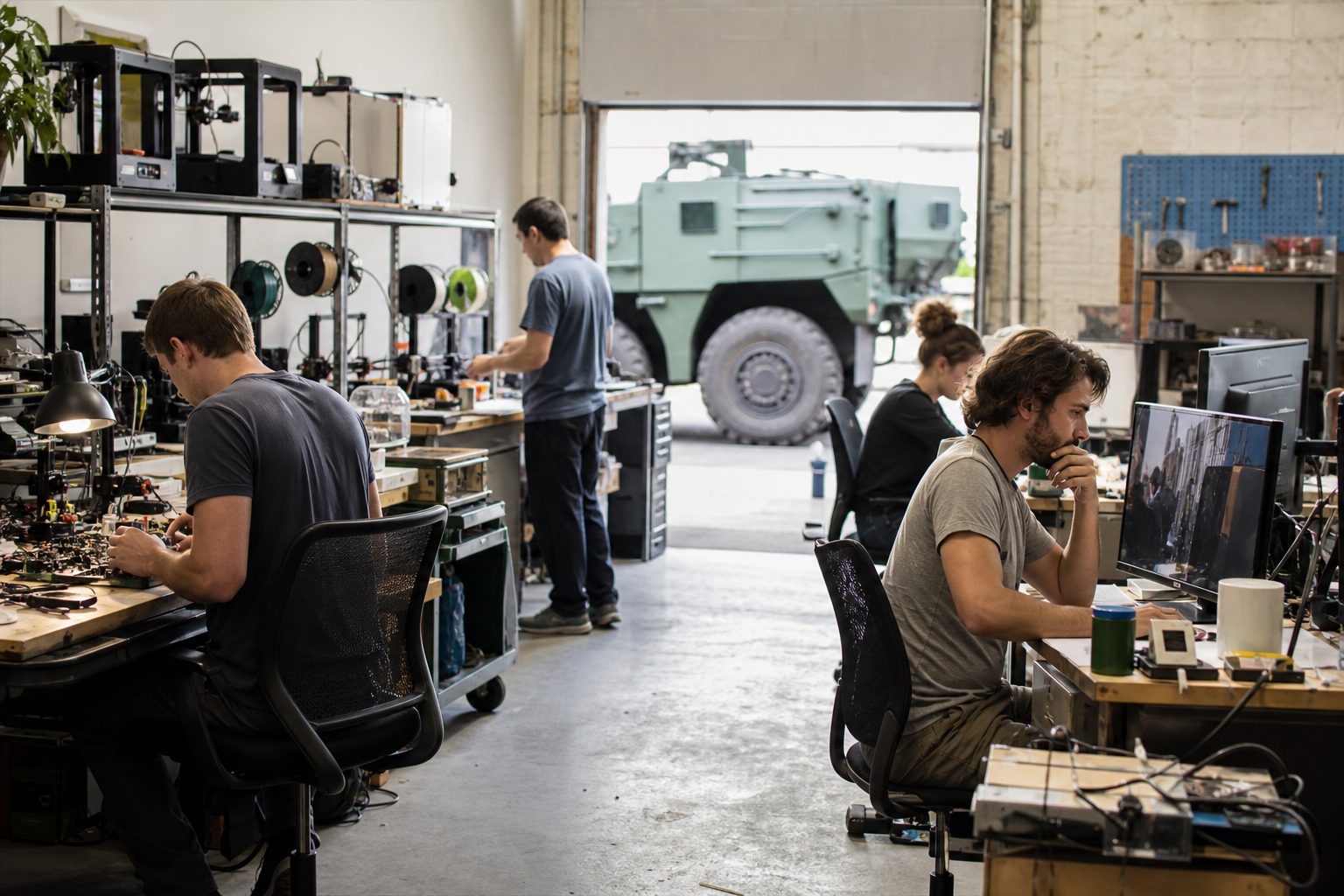
The assembly process moved unusually fast for multilateral finance. A temporary, not-for-profit DSRB Development Group formed under Murray's leadership, backed by an array of major financial institutions. In September 2025 it gathered representatives of 37 nations, including every G7 member, alongside the European Commission, NATO, the European Parliament, global banks and credit ratings agencies, in the City of London. By April 2026 the charter negotiations were done (CISDS; The Power Curve).
The design deliberately mimics the post-war multilateral development banks. Member states subscribe capital in two tranches: roughly 20% paid in as real money, and roughly 80% as callable capital, a standing promise to pay more in a crisis. It is that callable backstop, treated by ratings agencies as equivalent to strong sovereign support, on which the AAA rating would rest. Advocates point out that in more than seventy years of multilateral banking, callable capital has never actually been drawn. On the working design, with £20 billion of paid-in capital against an initial balance sheet of about £100 billion, around $135 billion, the bank could turn each unit of sovereign capital into five to eight units of financing through bond issuance (The Power Curve).
Three features of the lending model matter for the startup question.
First, the bank would lend to sovereigns for national defence and resilience projects: the unglamorous enabling layer, from munitions plants to military mobility, energy and logistics infrastructure, that national budgets perpetually defer.
Second, it would lend directly to companies, primes and small firms alike, that hold government contracts. That is working capital against a signed order.
Third, and most consequentially, it would guarantee commercial bank lending to the defence supply chain. This matters because of how bank capital works. Under the incoming Basel IV rules, loans to small defence suppliers consume expensive capital against risk; a multilateral guarantee lowers that risk weight, and with it the price and scarcity of credit to the sector (The Power Curve).
Eligible projects span munitions, drones and maritime autonomy, resilient infrastructure, and dual-use technologies including artificial intelligence and space. There would be no joint debt and no shared liability of the kind that makes northern European treasuries flinch: each country answers only for its own equity stake (The Power Curve; Cascade Institute).
The gap the bank is meant to close

Europe's existing instruments mostly pull on the wrong side of the problem. The European Commission's Readiness 2030 plan seeks to mobilise up to €800 billion, and the EU's SAFE programme earmarked €150 billion in cheap, long-maturity loans so member states can borrow to buy equipment. SAFE has been heavily oversubscribed, which the bank's advocates read as proof of unmet demand. But SAFE is a demand-side tool: it helps governments borrow to purchase, and does nothing to make the industrial base capable of being purchased from. The European Investment Bank quadrupled its defence-related spending to €4 billion, yet its own policies still bar it from financing weapons and ammunition. As the EIB's own president has put it, the bank "is not a defense ministry" (Cascade Institute).
Private capital, meanwhile, surged and then stalled at a specific point in the pipeline. Since Russia's full-scale invasion of Ukraine in 2022, defence technology has become one of the fastest-growing corners of venture funding. Anduril raised $2.5 billion in June 2025 at a reported valuation of $30.5 billion; the same month, Europe's Helsing raised €600 million at a reported €12 billion valuation (Reuters, June 2025). But venture money is priced for exits, and in defence the exit usually runs through a government contract. For growth-stage firms, those too mature for early-stage venture cheques but too small, too collateral-poor and too geopolitically exotic for conventional bank lending, the money thins out. European commercial banks spent years retreating from defence under ESG investment orthodoxies, and lack both the appetite and the in-house expertise to lend against weapons programmes without guarantees. Europe never built the growth funds that scale such companies in the United States (Cascade Institute; CISDS).

This is the gap the DSRB's guarantee book is engineered to fill. It is a supply-side instrument in a policy ecosystem crowded with demand-side ones.
Where this story sits
5 related pieces

Hover a story · click to read
 No. 21 · Aug 30, 2026The air base decides: Niger's 24-hour mutiny and the technology of regime survival in the Sahel
 No. 31 · Sep 3, 2026The Case for Roe v. Wade: What Fifty Years of Evidence Says About Women's Lives
 No. 17 · Aug 27, 2026The Kidnappers Outsmart Nigeria’s Surveillance State
 No. 37 · Sep 5, 2026U.S. Grid Cyber Rules Are Finally Catching Up With Virtualized Operations
 No. 40 · Sep 7, 2026The Army's launched-effects bet: a faster upgrade cycle for autonomous strike systems
Where the British clock actually sits

If money were the only bottleneck, the story would end there. It is not, and Britain's machinery shows why.
Inside the Ministry of Defence, every major investment decision passes through a deliberately cautious institutional machine. The Defence Board, chaired by the Secretary of State, sets strategic direction. Beneath it, the Executive Committee directs the annual budgeting cycle and multi-year spending reviews. Major investment proposals route through the Investment Approvals Committee, chaired by the Permanent Secretary as Accounting Officer, the civil servant personally answerable to Parliament for value for money, and the hardest cases are taken in committee, once a month (MOD, "Our governance").
This machine has been reformed, repeatedly, for decades. In June 2011 Lord Levene's independent review of the MOD's structure handed ministers more than fifty detailed recommendations on acquisition, head office and financial management (Defence Reform report, 2011). The treadmill kept turning. The National Audit Office's December 2024 assessment of the Equipment Plan, the MOD's ten-year shopping basket, concluded the plan remained unaffordable, with a central-estimate gap between ambition and budget of around £17 billion.
The Ajax armoured vehicle programme is the standing exhibit. Ordered under a firm-price contract in 2014, with first deliveries due in 2017, Ajax spent years halted after troops in trials suffered noise and vibration injuries; the House of Commons Defence Committee catalogued the Army's wider armoured vehicle failures in its 2021 report "Obsolescent and outgunned". More than a decade after the contract was signed, the Army is still working through test and fielding milestones towards full operating capability. Ajax matters here not because it is unusual, but because it is normal: a British armoured vehicle and a Ukrainian FPV drone now live on different clocks.

The government's own review process says as much, in its own words. The Strategic Defence Review launched on 16 July 2024, led by Lord Robertson with General Sir Richard Barrons and Dr Fiona Hill, was tasked within the spending trajectory to 2.5% of GDP and told to examine "modernisation and transformation, and greater productivity, including through the rapid and consistent application of Digital Age technologies" (SDR terms of reference). When the review reported in June 2025, the government accepted all 62 of its recommendations, including the creation of a new body, UK Defence Innovation, consolidating the innovation work of the Defence and Security Accelerator (DASA) and the Defence Science and Technology Laboratory with a ring-fenced budget of at least £400 million a year (The Strategic Defence Review 2025, June 2025, via GOV.UK).
That reform exists because the existing channels run too small and too slow. DASA, born of the £800 million Defence Innovation Fund announced in 2016, runs themed competitions and hands out grants typically measured in the hundreds of thousands of pounds: enough to prove a concept, rarely enough to scale a factory. Downstream of the money sit the other clocks that run independently of any bank: List X facility clearances and personnel vetting that take months, security accreditation of software and hardware, and integration into a force structure that plans in decades. Meanwhile the technological half-life on the battlefield has collapsed. Field research by the Royal United Services Institute describes drone and electronic-warfare adaptation cycles in Ukraine measured in weeks, and President Zelensky said in late 2024 that Ukraine could produce four million drones a year (RUSI; Reuters). The MOD plans its equipment in ten-year plans. Its intended adversaries iterate in weeks.
What the allied experiments show

Four allied experiments, run over the past decade, allow a real test of what money can and cannot do.
The Pentagon's Defense Innovation Unit, founded in 2015, attacks the problem through contracting law rather than finance: its Commercial Solutions Openings award Other Transaction agreements in months, sidestepping the years a conventional federal contract can take. Congress judged the mechanism valuable enough to raise DIU's budget to roughly $1 billion for fiscal year 2024, transforming it from a scout into a buyer at scale. But DIU's long experience documents the choke point precisely: prototypes proliferate while transitions into funded programmes lag (DIU).
The Replicator initiative made the same point from the opposite direction. Announced in August 2023, it committed the Department of Defense to fielding attritable autonomous systems in the multiple thousands within 18 to 24 months, using technologies that mostly already existed commercially; a second tranche, announced in September 2024, targets counter-drone defences. What accelerated those systems was not a new lender. It was a defence ministry acting like a certain customer, pre-committing demand and budget lines before asking industry to build. Money followed the purchase order. That sentence is most of the DSRB debate in miniature (US Department of Defense announcements, 2023-2024, defense.gov).
NATO's own instruments show the same division of labour. DIANA, headquartered in London, runs cohorts of dual-use startups through accelerator sites and a network of more than a hundred test centres, and hands out modest non-dilutive grants. It de-risks prototypes; it does not buy products. Beside it, the €1 billion NATO Innovation Fund, backed by roughly two dozen allied treasuries, writes venture-scale cheques and began disclosing its first direct investments in 2024. Its portfolio companies still wait, like everyone else, for governments to sign contracts (NATO DIANA; NATO Innovation Fund).

Australia's Advanced Strategic Capabilities Accelerator, funded at about A$3.4 billion over a decade (Australian Department of Defence), and Israel's model of embedding defence scientists directly with operational units, both pair money with an empowered, proximate customer. The counter-examples make the negative case. The European Defence Fund committed roughly €8 billion for 2021-2027 to co-fund research and development, with no purchase obligation attached, and has not visibly pulled products into service. The EIB's policy exclusions show what happens when an institution is permitted to fund almost everything except weapons. And Britain's own grant instruments have repeatedly stranded proven concepts in the valley of death between demonstration and contract (European Commission, EDF documentation, commission.europa.eu).
The pattern across all of these is consistent: capital accelerates only when a buyer has already decided to buy.
Can a bank build a startup-to-battlefield pipeline?

It helps to map the actual pipeline. A startup weapon reaches a soldier through roughly four gates:
- Research and proof of concept, financed by grants and seed money: DASA, DIANA, university funds.
- Prototype and demonstration, financed by venture capital, the layer that has boomed since 2022.
- Manufacturing scale-up, financed by growth equity or bank credit against expected orders.
- Sustained production, financed by company balance sheets and long-term supply contracts.
The DSRB's instruments do not touch the first two gates, which are noisy but comparatively well fed. They bear directly on the third and fourth, the stretch where European defence startups currently go to wait. A government contract that once unlocked a slow, grudging bank loan could, under a DSRB guarantee, unlock credit quickly and at scale. A sovereign loan could fund the enabling infrastructure, the explosives line or the test range, that no individual company can finance. CISDS's analysis of the proposal goes further: the bank could pioneer long-tenor products such as lease financing and mezzanine debt for the sector, take equity stakes, hold a "golden share" veto where conditions demand, and, by lending only to firms meeting its standards, build an auditable benchmark that could coax ESG-shy institutional capital back into defence (CISDS).
Here is the boundary, and it runs through a claim sometimes made on the bank's behalf, that its real power would be to pre-commit multi-year offtake contracts, letting private capital underwrite startups without waiting for Whitehall's approval cycles. Nothing in the published design gives the DSRB that power. It lends against contracts governments have already signed, and guarantees loans to suppliers of those contracts. It cannot write requirements, run competitions, sign purchase orders, clear facilities, accredit software or force a capability into a force structure. The offtake authority remains exactly where it always was, inside the procurement signatures of member states.
The strongest version of the idea that the evidence actually supports is subtler: if member states chose to attach multi-year framework contracts as a condition of the bank's guarantees, sovereign credit would function as quasi-offtake certainty, and private capital could underwrite production years earlier than it does today. That is a decision for ministries and treasuries, not for the bank. Whether the founding nineteen wrote any such condition into the charter is not yet in the public record.

Regulation would still tax the pipeline from the other side. US export controls under ITAR have historically made some investors treat dual-use startups as radioactive; the AUKUS exemption that took effect in September 2024 eased licensing among the US, UK and Australia, but European dual-use rules under Regulation (EU) 2021/821 and national licensing still turn cross-border defence supply chains into legal engineering. No lender in London, Toronto or Montréal can shorten that queue.
There is also a fair question about fit. The categories on the DSRB's eligibility list, munitions, drones, autonomous systems, AI, space, are precisely those where commercial iteration is genuine and Ukraine has provided a brutal existence proof. Startup technology there does match frontline requirements, and increasingly defines them. Crewed platforms, nuclear propulsion and high-end air defence do not share those economics, and a bank designed around fast categories will not move them.
What happens next
As of late August 2026, the DSRB is a concluded charter text, a chosen host country and nineteen ratification processes, not yet a lender. The questions that will determine whether it becomes a battlefield pipeline or a very patient industrial financier are now visible.
First, ratification and the first bond issue: an AAA rating without joint liability is the design's boldest financial claim, resting on the seventy-year reassurance that callable capital has never been drawn. That history is comfort, not proof, and it has never been tested by a bank whose business is war.
Second, European alignment. Germany says it prefers the EU's existing SAFE loans, an awkward stance given that Deutsche Bank is among the DSRB's own partner institutions. France, home to Europe's strongest national defence industry (Naval Group, Dassault, Thales, MBDA) and ranked by SIPRI's five-year trend data as the world's second-largest arms exporter, has barely commented; the op-ed's authors read that silence as internal argument, which is plausible but unproven (Cascade Institute).
Third, Britain. The Treasury's public position is that the bank would not deliver sufficient value. The authors report that more than 800 British defence companies have publicly disagreed. If Whitehall holds that line while the bank stands up, British startups would watch a capital pipeline being built around them, at the same moment the government's own Strategic Defence Review reforms try to fix the demand side from inside the MOD.
And fourth, the tell that will answer this article's title. Watch the first loan book, and specifically the contracts behind it. If those contracts are one-year orders renewed by annual budget cycles, the bank will be a useful supplier of credit and no more. If they are multi-year commitments, the kind the Pentagon's Replicator experiment showed actually pull technology onto battlefields, the DSRB will have built the back half of a genuine startup-to-front-line pipeline: everything from the signature onwards, at bank speed.
The signature itself is the one thing the bank cannot supply. A lender can move at the pace of a credit committee. A democracy's decision to buy weapons moves at the pace of ministers, parliaments and, in Britain, an Accounting Officer personally on the hook for every penny. The DSRB's real product was never going to be money. It is time. Whether it can sell that depends on decisions it has no power to make.
Sources

- Brendan Hart, "The Capital Layer of Deterrence", The Power Curve, 30 June 2026. https://brendanhart.com/reports/the-capital-layer-of-deterrence
- Christopher Collins and Mike O'Sullivan, "Europe Needs to Get Serious About Its Defense. A New Bank Is the Answer.", Cascade Institute (version of record: Barron's), accessed 30 August 2026. https://cascadeinstitute.org/europe-needs-to-get-serious-about-its-defense-a-new-bank-is-the-answer/
- Tanweer Ali, "Building a New Financial Architecture for Defence and Resilience", Centre for International Security and Defence Studies, 26 January 2026. https://cisds.org/blog-tanweer-ali-building-a-new-financial-architecture-for-defence-and-resilience/
- UK Ministry of Defence, "Our governance", GOV.UK, accessed 30 August 2026. https://www.gov.uk/government/organisations/ministry-of-defence/about/our-governance
- UK Ministry of Defence, "Strategic Defence Review 2024-2025: Terms of reference", GOV.UK, July 2024. https://www.gov.uk/government/publications/strategic-defence-review-2024-2025-terms-of-reference/strategic-defence-review-2024-2025-terms-of-reference
- Lord Levene of Portsoken et al., "Defence Reform: An independent report into the structure and management of the Ministry of Defence", June 2011. https://assets.publishing.service.gov.uk/government/uploads/system/uploads/attachment_data/file/27408/defence_reform_report_struct_mgt_mod_27june2011.pdf
- UK Ministry of Defence, "The Strategic Defence Review 2025: Making Britain Safer, Secure at Home, Strong Abroad", June 2025, via GOV.UK.
- National Audit Office, "The Equipment Plan 2024-2034", December 2024. https://www.nao.org.uk/
- House of Commons Defence Committee, "Obsolescent and outgunned: the British Army's armoured vehicle capability", March 2021. https://www.parliament.uk/
- Stockholm International Peace Research Institute, world military expenditure data and 2024 trends release, April 2025. https://www.sipri.org/
- NATO, Hague Summit Declaration and associated spending commitment, June 2025. https://www.nato.int/
- Center for Strategic and International Studies, "The First Battle of the Next War: Wargaming a Chinese Invasion of Taiwan", January 2023. https://www.csis.org/
- US Department of Defense, Replicator initiative announcements, August 2023 and September 2024. https://www.defense.gov/
- Defense Innovation Unit, organisational history and fiscal 2024 budget documentation. https://www.diu.mil/
- NATO Innovation Fund, fund structure and initial investments. https://www.nif.fund/
- Royal United Services Institute, field research on tactical adaptation in the Russia-Ukraine war. https://rusi.org/
- Reuters, reporting on the June 2025 Anduril and Helsing financings and on Ukrainian drone-production statements, 2024-2025. https://www.reuters.com/
- European Commission, European Defence Fund programme documentation. https://commission.europa.eu/
- Australian Department of Defence, Advanced Strategic Capabilities Accelerator programme statements, 2023 onwards. https://www.defence.gov.au/
- US Department of State, International Traffic in Arms Regulations: AUKUS licensing exemption, Federal Register, effective September 2024. https://www.federalregister.gov/
- Regulation (EU) 2021/821 on dual-use export controls. https://eur-lex.europa.eu/
Comments (5)
Continue exploring
The Kidnappers Outsmart Nigeria’s Surveillance State
Nigeria has more tools to track kidnappers than ever, but fragmented data systems and slow institutional response leave criminal…
U.S. Grid Cyber Rules Are Finally Catching Up With Virtualized Operations
FERC now lets U.S. grid operators virtualize critical control systems; whether resilience outpaces the new risks depends on…
The Army's launched-effects bet: a faster upgrade cycle for autonomous strike systems
The Army's 2026 plan to field long-range launched effects from AEVEX, Griffon and Dragoon is a test of whether modular, competing…
If callable capital has never actually been drawn in more than seventy years of multilateral banking, how confident can anyone realistically be that ratings agencies will keep treating it as equivalent to sovereign support once the DSRB starts guaranteeing loans for things like guidance kits or explosives? A bank whose entire leverage trick rests on a backstop nobody has ever tested feels like building a tower on permafrost.
Reading the section about precision munition stockpiles being exhausted within days in allied wargames gave me actual chills, because I watched that exact failure mode play out at our small drone startup last year. We had a working counter-jamming prototype, signed a development contract, and then sat for fourteen months waiting on a procurement office to decide which procurement category it belonged to. The fact that the bank would lend directly to companies holding government contracts is the single most useful idea in this whole piece, because it would have kept us alive through that gap.
The section laying out the three lending channels was the most useful for me, though I am still not sure how many small firms actually hold signed MoD contracts today, which would limit how much of that second channel gets used in practice.
The core takeaway, as I read it: money is finally becoming the easy half of getting startup tech onto the battlefield, but unless Whitehall fixes the procurement half the DSRB's callable-capital trick will just mean allied taxpayers subsidise larger bond portfolios rather than faster drones.
You say the DSRB can build roughly half of the pipeline and the other half runs through a door no bank can open, but you never really tell us what is on the other side of that door. Is it certification, operational testing, or the single-customer problem of having only the MoD as a buyer? I'd like to know which specific procurement bottleneck you think will still strangle a well-funded startup even after the financing problem is solved, because otherwise the central claim is just a nice-sounding hedge.