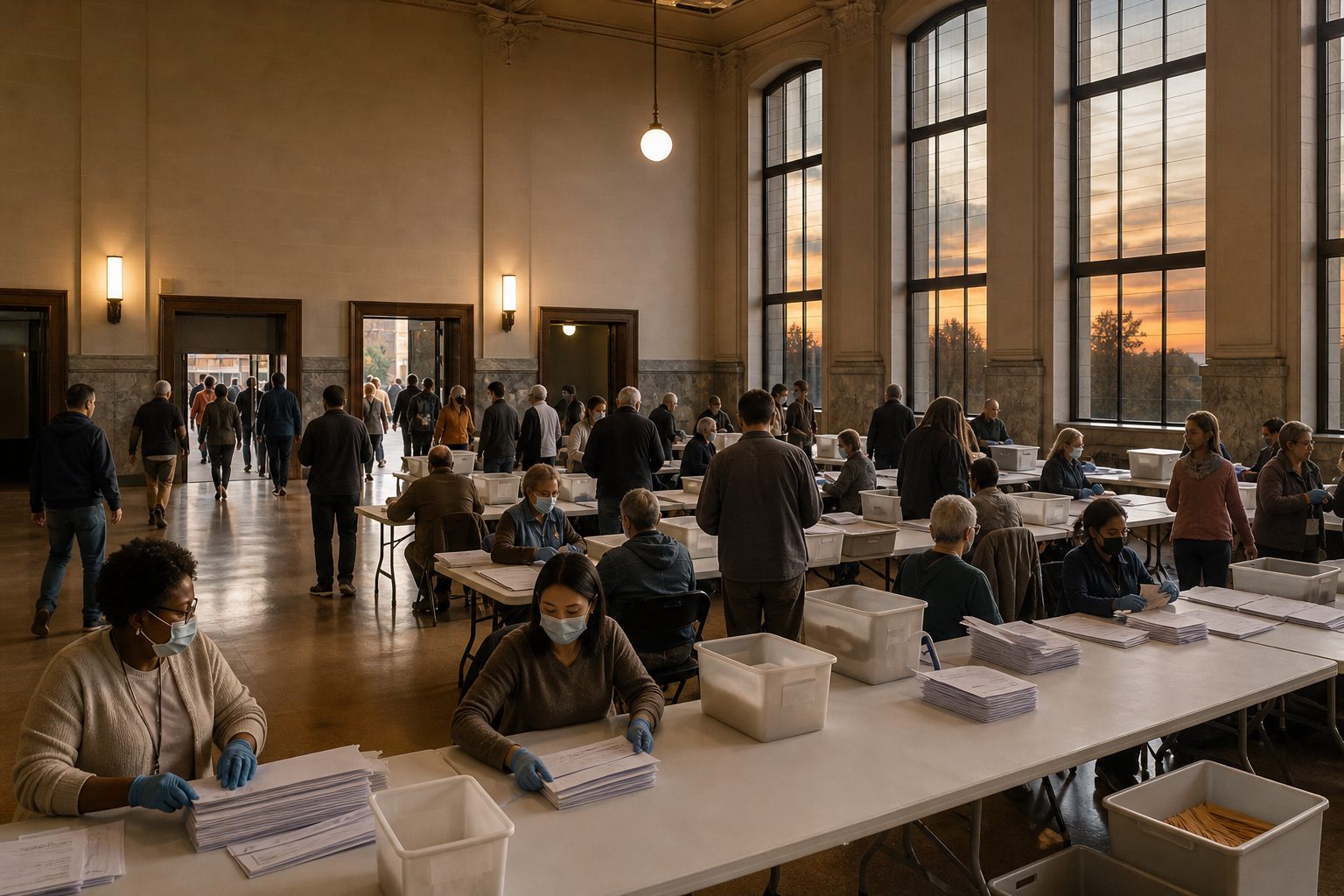
Millions of voters across Brazil, Israel, and the United States have delivered results that look different on the surface but share a difficult political reality: winning an election does not necessarily mean winning public confidence.
Brazil’s Luiz Inácio Lula da Silva won a fourth presidential term on October 25 with 51.79 percent of the vote, defeating Flávio Bolsonaro after trailing him in the first round. Yet Lula still faces a fragmented Congress and no clear legislative mandate. (Brazilian Superior Electoral Court; BTI 2026 Brazil Country Report)
Israel’s election produced a similar institutional problem from a different political starting point. Benjamin Netanyahu’s bloc finished first with 53 of the Knesset’s 120 seats, but the 61-seat majority required to form a government remained out of reach. Arab parties won 19 seats and became potential coalition kingmakers. (Associated Press; Anadolu Agency fact box)
In the United States, voters returned Congress to Democratic control in the November 3 midterm elections, creating divided government under President Donald Trump. The result gives Congress greater power over funding, oversight, confirmations, sanctions legislation, and military policy, even though the White House retains major authority over diplomacy, tariffs, and military operations. (Council on Foreign Relations)
The common thread is not a uniform movement to the left or right. It is weaker political permission. Voters punished incumbents, denied governing majorities, or shifted allegiance without embracing a stable alternative.
That is a real pattern. It is not a single global realignment.
The results point to frustration, but not the same kind of frustration
The three elections were fought under different rules and political conditions. Brazil held a presidential contest with a two-round runoff. Israel elected a parliament through a proportional system, making coalition bargaining unavoidable. The United States held legislative elections in which voters chose a new congressional majority without changing the presidency.
Those differences matter. A close presidential runoff, an inconclusive parliamentary vote, and a midterm congressional reversal cannot be treated as interchangeable evidence.
Still, the results reveal a shared shift in voter behavior: elections are becoming less reliable as instruments of political consolidation.
Brazil’s result gave Lula another term but not a broad endorsement. The final margin was narrow, and the Brazilian election authority described the contest as a reversal of the first-round ranking, when Bolsonaro had led. (Brazilian Superior Electoral Court)
Israel’s result weakened Netanyahu’s ability to govern through the bloc that had previously supported his government. His bloc fell from 64 seats in 2022 to 53, while Arab representation rose from 10 seats to 19, according to a comparison of the final results. (Anadolu Agency fact box)
The American result was more direct: voters used a midterm election to constrain the president’s party. The precise policy consequences will depend on the final organization of Congress, but the political signal is clear. The executive branch will face stronger scrutiny and more bargaining pressure.
In all three countries, voters changed the balance of power without necessarily settling the underlying conflict.
Economic anxiety travelled farther than ideology
Cost of living was a central political pressure in Brazil and the United States, even where national economic indicators were not uniformly weak.
In Brazil, Reuters reporting cited frustration over accumulated price increases despite low unemployment, easing inflation, and other favorable economic measures. Voters were responding less to a single economic collapse than to the feeling that ordinary household budgets had not recovered from years of rising costs. (Reuters via MarketScreener)
That distinction matters. People do not experience inflation as an abstract annual rate. They experience the cumulative price of food, rent, transport, energy, and services. A decline in inflation means prices are rising more slowly. It does not mean that prices have returned to where they were.
The same political gap appeared in the United States. An Ipsos survey found that 47 percent of registered voters identified the cost of living as the single most important factor in their midterm decisions. A Washington Post/Ipsos survey found 54 percent citing the economy and high prices as major determinants. (Ipsos; Washington Post/Ipsos)

A separate Marist poll found that 34 percent of voters said their family finances had worsened, compared with 20 percent who said they had improved. (Marist Poll)
The figures do not prove that economic anxiety alone decided either election. Voting is rarely reducible to one variable. But they show why favorable national indicators failed to guarantee political support. Voters judged the economy through their own budgets, not through the language of recovery.
In the United States, foreign policy also became an economic issue. The Chicago Council on Global Affairs reported that 86 percent of Americans believed the Iran war had harmed the cost of living, while 81 percent said tariffs had worsened household costs. (Chicago Council on Global Affairs)
The war therefore entered the price debate. Food, fuel, trade, and military spending connected foreign policy to household finances.
Israel’s election weakened Netanyahu’s coalition position
Israel does not fit neatly into the same economic-voting story.
The election took place amid unresolved questions about security policy, wartime decision-making, and the future of Netanyahu’s governing coalition. Netanyahu’s bloc remained the largest grouping, but it lost the ability to translate first place into a governing majority. The outcome suggests that voters were not united behind one alternative. They were instead rearranging the political field around the question of who should govern during wartime.
The final distribution left Netanyahu’s bloc with 53 seats, the opposition bloc with 48, and Arab parties with 19. Every potential governing coalition remained short of 61 seats. (Anadolu Agency fact box)
That result has two implications.
First, dissatisfaction did not produce a clean transfer of power. Netanyahu’s bloc was weakened, but the opposition did not automatically inherit a majority.
Second, Arab parties gained leverage in a system where they have often been excluded from national governing coalitions. The Associated Press described them as potential kingmakers after expanding their representation. (Associated Press)
The election therefore reflected both protest and strategic calculation. Some voters may have wanted to deny Netanyahu a governing majority without agreeing on a single replacement. That is different from a coherent ideological realignment.
Where this story sits
5 related pieces
Read it →
Hover a story · click to read
 No. 72 · Oct 19, 2026Three Months After the Hugging Face Breach: What AI Agent Sandboxes Are Still Leaking
 No. 63 · Oct 7, 2026After the Indictment: Three Years of Named Cyber Attributions, Measured
 No. 41 · Sep 7, 2026Stress-Testing the American Empire: Real Decline or Cyclical Strain?
 No. 27 · Sep 2, 2026Three Mile Island Can Restart in 2027. The Grid May Not Take Its Power Until 2031.
 No. 33 · Sep 5, 2026U.S.-China AI talks could make autonomous cyberattacks a matter of strategic stability
Strategic voting mattered in Brazil and Israel
The results also challenge a simple theory of polarization. Polarized electorates do not always produce more unified governments. They can produce tactical voting designed to block an opponent.
An Oxford analysis of Brazil’s runoff found late strategic consolidation among right-wing voters. Roughly three-quarters of voters who initially supported candidates other than Flávio Bolsonaro moved toward him in the runoff. Yet that coordination did not produce victory. The analysis attributed part of the remaining resistance to concerns about Bolsonaro’s institutional and democratic implications, as well as Lula’s broader coalition. (University of Oxford)
This does not mean that Lula won because voters embraced his entire program. It suggests that a portion of the electorate treated the runoff as a choice between risks, not as a straightforward policy referendum.
Israel showed a related pattern. Analysts at the Konrad-Adenauer-Stiftung described the election as a strategic effort to deny Netanyahu another governing majority rather than a coherent ideological shift. (Konrad-Adenauer-Stiftung)
In both countries, voters used the ballot to limit a political outcome. That is a weaker form of consent than an affirmative mandate, but it is still politically consequential.
The American coalition moved, especially among younger voters
The United States showed the clearest evidence of changing party loyalties, particularly among young voters.
Harvard’s fall youth poll found Democrats ahead by 37 points among likely young voters. The Democratic advantage was 80 percent to 10 percent among Black youth and 59 percent to 24 percent among Hispanic and Latino youth. (Harvard Institute of Politics)

Post-election reporting also found that young Black and Latino voters shifted toward Democratic House candidates, with Democratic support reaching 79 percent among young Black voters and 71 percent among young Latino voters. (Axios)
The movement should not be treated as proof of a permanent realignment. The Washington Post reported evidence that young voters were reacting to living costs, distrust, and opposition to the administration’s foreign-policy choices. (Washington Post)
CIRCLE estimated that young voters made up only 11 percent of the electorate, down slightly from 12 percent in 2022. Their partisan shift was strong, but their smaller share of voters limited their overall weight. (CIRCLE)
That combination matters. A group can move sharply without determining an election on its own. The larger question is whether its movement changes the behavior of older voters, working-class voters, and minority communities that decide whether a temporary backlash becomes a durable coalition.
Preliminary post-election data suggested that Democrats drew even with working-class voters nationally and that Hispanic voters shifted substantially back toward Democrats. (Washington Post)
The evidence points to coalition instability rather than a settled ideological map.
Digital politics made trust harder to recover
A second cross-border pattern involved the information environment.
AI-generated political content appeared in the United States campaign, including fabricated videos portraying Texas Senate candidate James Talarico making statements he never made and synthetic footage placing other candidates in misleading contexts. Reporting on the campaigns warned that the damage could extend beyond individual falsehoods. When voters cannot tell which videos are real, they may begin to doubt authentic material as well. (Reuters via Investing.com)
The scale of political advertising also raised questions about transparency. Fortune reported that researchers tracked roughly $80 million in spending on nearly 170 AI-based ads, with Republicans responsible for about 83 percent of the documented expenditure. That estimate describes the advertising identified by the researchers, not all political spending or every use of AI. (Fortune)
Regulation remained uneven. Axios reported that four states prohibited certain political deepfakes, more than two dozen required disclosures, and federal legislation was largely absent. (Axios)
The Institute for Strategic Dialogue also reported that the lack of a searchable, cross-platform political-ad archive made independent verification difficult. (ISD Global)
These findings do not establish that AI misinformation decided the American election. They establish a growing verification problem. When realistic false material circulates alongside authentic recordings, journalists, election officials, and voters face greater difficulty determining what they are seeing.
That problem is not confined to one party or one country. But the available evidence is strongest for the United States in this election cycle. There is not enough evidence here to claim that AI manipulation played an equivalent role in Brazil or Israel.
The more measurable risk is institutional: repeated exposure to false content can weaken confidence in the possibility of knowing what happened. X reported that AI-assisted Community Notes writers helped roughly double the number of notes published over the preceding year, but the effectiveness of that response would depend on platform rules and public trust in the people doing the checking. (The Atlantic)
Divided government will turn frustration into bargaining

The immediate consequences of these elections will appear in governing, not just in vote totals.
In Brazil, Lula will need to negotiate with a fragmented Congress. That may encourage pragmatic bargaining, but it also makes legislative action more dependent on shifting alliances. Economic measures, budget decisions, and institutional reforms could become negotiations over support rather than expressions of a unified electoral program. (BTI 2026 Brazil Country Report; The Media Line)
In Israel, the first task is coalition formation. A government that depends on a narrow or unconventional alliance may struggle to maintain a consistent position on military policy and economic priorities. The election did not resolve those conflicts. It moved them into coalition negotiations.
In the United States, Democratic control of Congress will create several points of confrontation with the White House. The Council on Foreign Relations identified likely areas of oversight including the Iran war’s authorization, conduct, costs, intelligence, civilian effects, and defense contracting. Congress can use hearings, subpoenas, appropriations, confirmations, sanctions legislation, and provisions in defense bills to constrain or investigate executive action. (Council on Foreign Relations)
Divided government can restrain abrupt policy changes. It can also produce shutdown threats, debt-limit confrontations, and uncertainty over fiscal policy. The German Marshall Fund identified government funding, the debt ceiling, defense appropriations, and discretionary spending as likely bargaining points. (German Marshall Fund)
The Wells Fargo Investment Institute similarly warned that markets may view divided government as limiting large spending legislation while still worrying about shutdowns, debt-limit disputes, and policy uncertainty. (Wells Fargo Investment Institute)
The result is a paradox. Voters may use elections to make leaders less powerful because they distrust them. But weaker governments can also find it harder to address the economic and security problems that produced the distrust.
What to watch over the next six months
The strongest warning signs will not be another dramatic election result. They will be measurable evidence that political frustration is becoming institutional paralysis.
1. Whether economic dissatisfaction persists
Track food, fuel, rent, and household-cost measures rather than inflation alone. The political question is whether voters feel that their finances are improving, not merely whether price increases have slowed.

In the United States, the relationship between the Iran war, tariffs, and consumer prices will be especially important. In Brazil, Lula’s support will depend partly on whether favorable employment and inflation indicators become visible in household budgets.
2. Whether coalition bargains produce governing majorities
Brazil’s Congress and Israel’s coalition negotiations will show whether fragmented elections can still produce workable governments. The test is not ideological agreement. It is whether governments can pass budgets, sustain leadership, and make decisions without repeated crises.
3. Whether oversight becomes policy or spectacle
In Washington, investigations into war policy, spending, and executive authority could establish accountability. They could also become another source of partisan deadlock. The difference will be whether oversight produces documents, legal findings, funding changes, or policy corrections.
4. Whether young and minority voters remain aligned
The American youth vote shifted sharply, but turnout remained limited. Future elections will show whether the movement reflects durable changes in party identity or a temporary response to costs and war.
The same question applies to Arab voters in Israel and to the coalition that carried Lula through the Brazilian runoff. Representation can increase without producing lasting influence if governing parties do not deliver tangible benefits.
5. Whether political misinformation changes trust in authentic evidence
Watch for the number of documented synthetic ads, the speed of platform corrections, disclosure enforcement, and the public’s willingness to accept verified election results. The central danger is not simply that voters believe one false video. It is that they stop believing any video can be verified.
The message is constraint, not convergence
The 2026 elections do reveal a broader pattern of political frustration. Economic pressure weakened incumbents. War reshaped political judgments. Younger and minority voters changed direction in the United States. Strategic voting mattered in Brazil and Israel. Digital misinformation made trust harder to maintain.
But the elections do not show that voters across three continents have adopted one ideology or one shared program.
Brazil’s voters chose Lula while denying him a clear mandate. Israeli voters weakened Netanyahu’s bloc without creating a governing alternative. American voters changed Congress while leaving the president in office.
Those outcomes are different because the political systems are different. Their shared feature is more limited and more revealing: voters increasingly use elections to impose constraints. They punish, block, divide, or redirect power, often without agreeing on who should exercise it.
That may be a sign of democratic correction. It may also become a governing problem if institutions cannot convert public dissatisfaction into workable decisions.
The next six months will show which interpretation is stronger. If divided governments respond to economic anxiety, conduct credible oversight, and restore confidence in basic political facts, the elections may represent pressure for adjustment. If they produce only vetoes, coalition breakdowns, and competing claims about reality, voters may conclude that elections can change who holds office without changing what government can do.
Sources / References

- Tribunal Superior Eleitoral. “Presidente do TSE anuncia reeleição de Lula e faz balanço do 2º turno das Eleições 2026.” 2026. https://www.tse.jus.br/comunicacao/noticias/2026/Outubro/presidente-do-tse-anuncia-reeleicao-de-lula-e-faz-balanco-do-2o-turno-das-eleicoes-2026
- BTI Transformation Index. “BTI 2026 Brazil Country Report.” 2026. https://bti-project.org/en/reports/country-report/BRA
- MarketScreener. “In Brazil, frustration over cost of living undermines Lula's reelection bid.” 2026. https://www.marketscreener.com/news/in-brazil-frustration-over-cost-of-living-undermines-lula-s-reelection-bid-ce785adcd981f627
- Associated Press. “Arab parties extend a hand to try to topple Netanyahu but challenges remain.” 2026. https://apnews.com/article/090e48de53e8c12dc0bccb63353a9aa1
- Anadolu Agency. “Factbox: With all votes counted, how Israel’s legislative election results compare with previous vote.” 2026. https://cdnassets.aa.gss.superonline.net/en/middle-east/factbox-with-all-votes-counted-how-israel-s-legislative-election-results-compare-with-previous-vote/4106721
- University of Oxford. “Expert Comment: Is democracy really what matters to Brazil's voters?” 2026. https://www.ox.ac.uk/news/2026-10-23-expert-comment-is-democracy-really-what-matters-to-brazils-voters
- Konrad-Adenauer-Stiftung. “Elections in Israel: One Winner, Many Losers.” 2026. https://www.kas.de/documents/252038/40211523/Elections%2Bin%2BIsrael%2B-%2BOne%2BWinner%2C%2Bmany%2BLosers.pdf/c97a3f27-6e2c-3898-3f8b-ea9956e0eff6?t=1793367525749&version=3.0
- Ipsos. “Cost of living remains top of mind for voters heading into 2026 midterms.” 2026. https://www.ipsos.com/en-us/cost-living-remains-top-mind-voters-heading-2026-midterms
- Washington Post/Ipsos. “Americans’ economic frustrations to loom large in 2026 midterms.” 2026. https://www.ipsos.com/en-us/Washington-Post-Ipsos-Poll-July-2026
- Marist Poll. “September 2026 Midterm Elections Poll.” 2026. https://maristpoll.marist.edu/polls/2026-midterm-elections-september-2026/
- Chicago Council on Global Affairs. “Americans, Foreign Policy, and the 2026 Midterms.” 2026. https://globalaffairs.org/research/public-opinion-survey/americans-foreign-policy-and-2026-midterms
- Harvard Institute of Politics. “Democrats Lead by 37 Points Among Likely Young Voters.” 2026. https://iop.harvard.edu/press-releases/harvard-youth-poll-democrats-lead-37-points-among-likely-young-voters
- CIRCLE, Tufts University. “The Youth Vote in 2026.” 2026. https://circle.tufts.edu/2026-election?trk=article-ssr-frontend-pulse_little-text-block
- Axios. “Gen Z dumps Republicans.” 2026. https://www.axios.com/2026/11/05/gen-z-voters-2026-midterms-democrats-house
- The Washington Post. “Young voters swung toward Democrats in House races, fueling midterms sweep.” 2026. https://www.washingtonpost.com/politics/2026/11/04/young-voters-swung-toward-democrats-house-races-fueling-midterms-sweep/
- The Washington Post. “Ten key factors behind Americans’ midterm votes.” 2026. https://www.washingtonpost.com/politics/2026/11/04/ten-key-factors-behind-americans-midterm-votes/
- Reuters. “AI deepfakes blur reality in 2026 US midterm campaigns.” Investing.com, 2026. https://www.investing.com/news/politics-news/ai-deepfakes-blur-reality-in-2026-us-midterm-campaigns-4586491
- Fortune. “Researchers tracked $80 million in political ads using AI, and Republicans were behind 83% of them.” 2026. https://fortune.com/2026/10/06/political-ads-ai-republican-no-disclaimer/
- Axios. “AI attack ads.” 2026. https://www.axios.com/newsletters/axios-indianapolis-02a5f43f-3367-4882-98ee-a39a593eb415
- Institute for Strategic Dialogue. “US Election Platform Preparedness 2026.” 2026. https://www.isdglobal.org/wp-content/uploads/2026/10/US-Election-Platform-Preparedness-2026.pdf
- The Atlantic. “The Election Lies Are Already Starting on X.” 2026. https://www.theatlantic.com/technology/2026/10/x-midterm-election-ai-fact-check/689245/
- Council on Foreign Relations. “Democrats Win Control of Congress. Here’s How That Could Affect U.S. Foreign Policy.” 2026. https://www.cfr.org/articles/democrats-win-control-congress-heres-how-that-could-affect-u-s-foreign-policy
- German Marshall Fund of the United States. “Divided We Stand? Implications of the 2026 Midterm Elections for Transatlantic Security.” 2026. https://www.gmfus.org/news/divided-we-stand-implications-2026-midterm-elections-transatlantic-security
- Wells Fargo Investment Institute. “2026 Midterms.” 2026. https://www.wellsfargoadvisors.com/research-analysis/reports/policy/2026-midterms.htm
- The Media Line. “Lula Won, but Brazil Elected ‘a Divided Government,’ Analyst Says.” 2026. https://themedialine.org/top-stories/lula-won-but-brazil-elected-a-divided-government-analyst-says/
The reading behind this research
What the desk leaned on for this piece. Each link goes to the retailer, where the price is shown.

As the article notes, rising prices strained household budgets in Brazil; this software can help track savings and spending.
View on Walmart
P3 Internatoinal P4400 Kill A Watt Energy Monitor
The article notes voters feel the piled-up cost of energy and other bills; this shows how much each appliance actually adds to your own bill.
View on Walmart
The article says people feel inflation as cumulative energy and other bills; this helps cut one of those costs by trimming wasted heating.
View on Walmart
The article notes households feel the cumulative cost of energy; a plug that cuts power to idle lamps and fans is one small way to trim that bill.
View on Walmart
The article says voters feel the cumulative cost of energy and other bills; this shows where a home's electricity actually goes, hour by hour.
View on Walmart
The article says voters feel food's cumulative price, not inflation rates; cutting spoilage at home is one small way to ease that grocery strain.
View on WalmartPaid links. Calibre Code USA may earn a commission from purchases made through these links. This does not affect what we write or what we recommend.
Comments (8)
Continue exploring
Stress-Testing the American Empire: Real Decline or Cyclical Strain?
Interest costs, gold hoarding and allied rearmament say decline; chips, energy and capital markets say resilience. Here is the…
Three Mile Island Can Restart in 2027. The Grid May Not Take Its Power Until 2031.
Constellation plans to restart Three Mile Island in 2027 to power Microsoft data centers. PJM says the grid may not take its full…
U.S.-China AI talks could make autonomous cyberattacks a matter of strategic stability
Reuters reports the U.S. and China are preparing a mid-September AI safety dialogue. What it can realistically deliver: an…
The core takeaway is that voters can change the balance of power without resolving the conflict that produced the vote. Brazil delivered Lula another term without a clear legislative mandate, Israel produced a 53-seat bloc short of the 61 needed, and the United States created divided government. In practical terms, governments will need to deliver on household costs while negotiating across institutions, because electoral victory alone will not restore trust.
Could you follow up on how “public confidence” should be measured across these systems? Approval ratings, trust surveys, turnout, and coalition stability would produce very different comparisons between Brazil, Israel, and the United States.
I am not fully convinced that all three outcomes demonstrate “weaker political permission.” Lula did win a runoff with 51.79 percent, and the U.S. result was a deliberate midterm check on the president, so these may reflect different forms of electoral authorization rather than one common decline in legitimacy.
It is not a single global realignment” is the strongest line here. The three elections do not point neatly left or right, and the article is right to resist that shortcut. But the shared pattern still feels underproved: three cases can illustrate a question, not settle it.
The section on economic anxiety was the most useful part for me. The distinction between inflation slowing and prices actually falling makes the Brazil and U.S. examples much clearer, especially alongside the figures that 47 percent of U.S. voters ranked cost of living first and 34 percent said their finances had worsened.
The article’s emphasis on weaker mandates fits the broader development I have been following: coalition bargaining and divided government are becoming more common even in systems designed to produce clear winners. Israel’s 53 seats for Netanyahu’s bloc and the United States’ congressional reversal show how institutional fragmentation can now matter as much as the headline winner.
The claim that elections are becoming less reliable as instruments of political consolidation seems broader than the evidence presented. What data beyond these three contests supports treating this as a durable trend rather than a description of three unusually unsettled elections?
The practical challenge is turning the cost-of-living diagnosis into relief people can actually feel, especially when Lula faces a fragmented Congress and the U.S. has divided government. That will require coalition-building and budget trade-offs, not just better messaging, but it is an exciting test of whether governments can convert narrow victories into tangible gains.