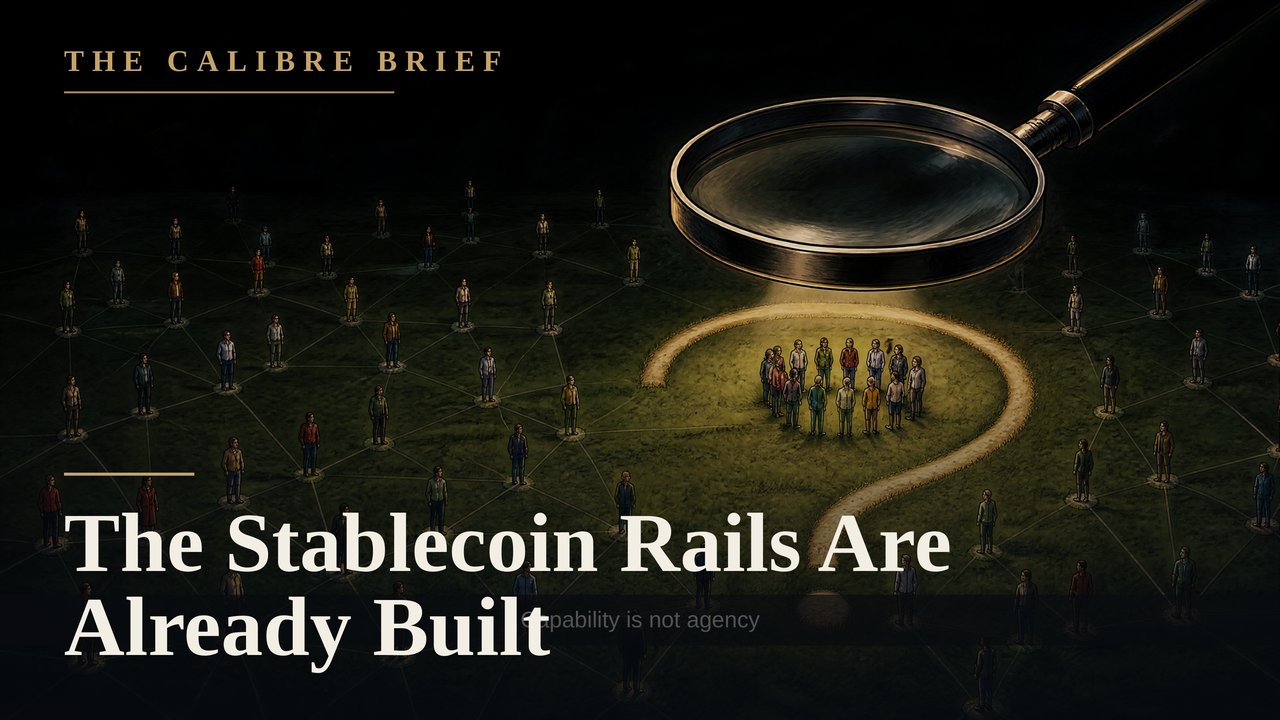
November’s Bank Outages Exposed a Failure of Access, Not of Money | The Calibre Brief Ep. 92
About this episode
On November 16, customers at Chase, Bank of America, Wells Fargo, and U.S. Bank reported failed logins, stale balances, and delayed transfers, while Zelle also drew elevated complaint reports. The episode examines what failed—and what did not—in the digital banking system.
Verified reporting establishes a significant, uneven disruption to customer-facing services. Chase described its issue as technical and not cyber-related, and available Federal Reserve materials showed no confirmed disruption to core settlement systems. Deposits were not reported lost, and there is no evidence that the banking system itself was failing.
The precise cause remains unresolved: it has not been established whether the disruptions shared a dependency or reflected separate failures. The events followed recent Microsoft and FAA outages, but no technical connection or cyberattack has been demonstrated. Banks would plausibly report qualifying incidents to regulators within 36 hours, while public disclosure requirements for a pure outage remain limited.
0:00 Millions of Americans woke up one Monday unable 0:41 Banking has two layers 1:03 No one has shown the cause 1:30 Split the fear in two 1:59 This was The Calibre Brief from Calibre Code USA
Stock footage: Coverr-Free-Footage via Pixabay (https://pixabay.com/videos/id-3180/) Stock footage: cipnt via Pixabay (https://pixabay.com/videos/id-14900/)
Key topics
Key moments
Transcript
Show transcript
Welcome to The Calibre Brief, a Calibre Code USA production.
Millions of Americans woke up one Monday unable to reach their own money. Was the system failing, or only our window into it?
It's November 16, 2026, and your paycheck has landed. The money sits on the bank's books, but the Chase app shows a failed login. Customers at Bank of America, Wells Fargo, and U.S. Bank hit the same wall. It came four days after a worldwide Microsoft outage, three days after the FAA grounded flights nationwide.
Banking has two layers, and what broke was the window: apps, logins, balances, Zelle transfers. The core, where money moves between banks, showed no confirmed trouble. Chase called it technical, not a cyberattack, and said customers could still reach their money. Truist reportedly said its systems were fine, yet payments touching other banks could stall.
No one has shown the cause, and the facts fit one shared failure or several unlinked ones equally well. The Microsoft and FAA problems each have official answers, and neither points to an attack or to the banks. The silence is built in. Banks must tell regulators about serious incidents within 36 hours, but no rule makes them explain a plain outage to customers.
Split the fear in two: the plumbing is more fragile than we assumed, since three big systems failed in five days. But deposits did not vanish, and no bank collapsed. The banks did not go dark; their windows did. The money kept moving behind glass that millions of people could no longer see through.
The feeling of being kept in the dark was accurate, and it was legal. The real question is why the people locked out are owed so little.
This was The Calibre Brief from Calibre Code USA. Should banks owe customers more than "we're working on it" after an outage? Comment below, like and subscribe on YouTube, and follow the podcast.