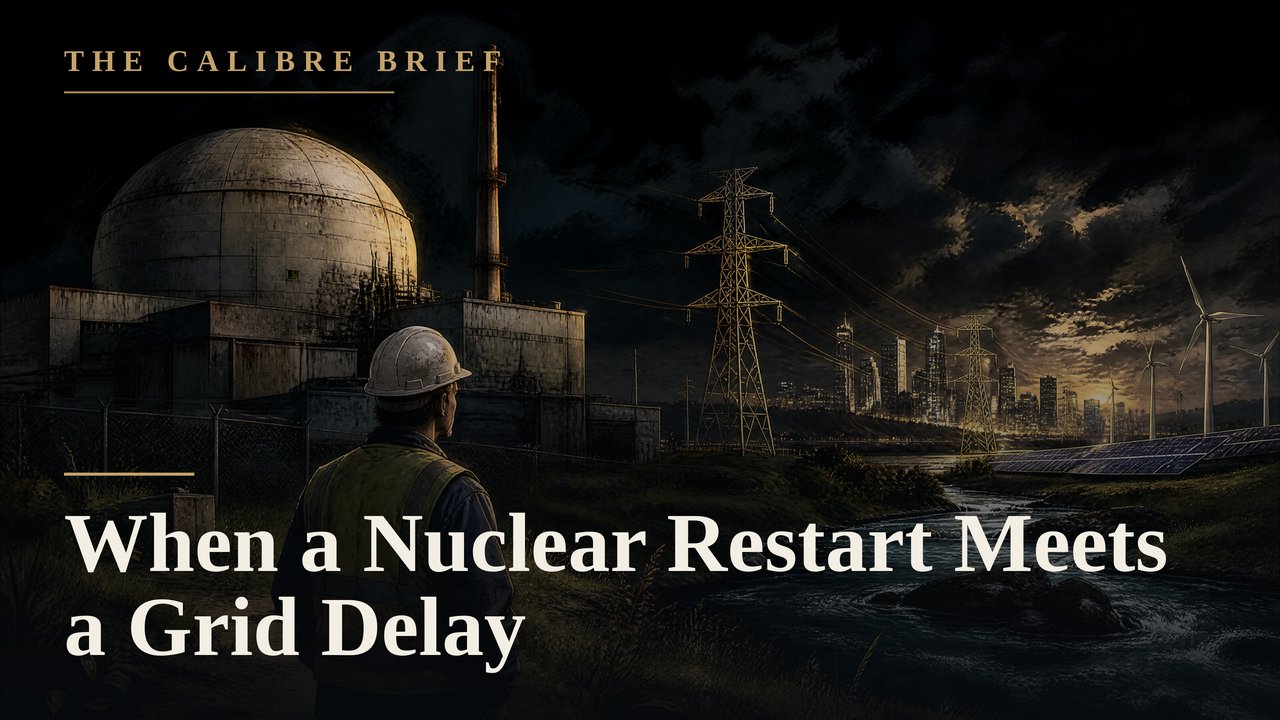
Portsmouth AI Campus Raises Questions on Cost Isolation and Energy Supply | The Calibre Brief Ep. 18
About this episode
This episode of The Calibre Brief examines the ambitious 10-gigawatt AI campus being developed at the former Portsmouth uranium-enrichment site in Pike County, Ohio. The initiative promises to leverage private financing to manage risks, avoiding the imposition of costs on Ohio households and regional grid users.
Our reporting confirms that the project includes large commitments from entities like OpenAI, NVIDIA, and SB Energy, alongside substantial planned infrastructure for energy generation and transmission. However, the claim of 'no cost to American families' remains conditional, hinging on a constellation of future developments including building timelines, firm fuel supplies, and regulatory approvals.
Key unresolved questions involve whether the infrastructure necessary to support this massive AI campus will be completed in tandem with server demands, and if the financial structures in place can truly insulate public ratepayers from potential costs. As we explore these developments, the need for robust regulatory scrutiny becomes apparent, specifically focusing on enforceability and transparency in the project's promises and obligations.
Key topics
Key moments
- 0:07 A former nuclear site in Ohio is being recast as an AI power center
- 0:19 Near Piketon, federal officials broke ground in March 2026 on the…
- 0:47 The proposed bargain is to build power alongside the computers
- 1:11 That structure is a plan, not yet a proven shield for households
- 1:43 The outcome will be decided in regulatory and financing documents…
- 2:07 Portsmouth is not yet proof that AI can power itself
- 2:23 This is The Calibre Brief from Calibre Code USA
Transcript
Show transcript
Welcome to The Calibre Brief, a Calibre Code USA production.
A former nuclear site in Ohio is being recast as an AI power center. The promise is simple: private money, private risk. Can it hold?
Near Piketon, federal officials broke ground in March 2026 on the fenced grounds of a decommissioned uranium-enrichment complex. SB Energy plans to turn the federal brownfield into a 10-gigawatt AI campus. Its eventual appetite could approach the peak demand of all AEP Ohio customers, placing one proposed development beside an entire utility service territory.
The proposed bargain is to build power alongside the computers. OpenAI has agreed to lease about eight gigawatts for 20 years. NVIDIA supplies the computing infrastructure and carries specified payment obligations. AEP Ohio is part of a $4.2 billion transmission buildout. The plan also calls for roughly 10 gigawatts of generation, mostly gas-fired.
That structure is a plan, not yet a proven shield for households. If server demand arrives before plants and lines, the campus could draw on the regional grid. The gas fleet needs fuel when winter heating and electricity demand collide. The public record does not establish finalized pipeline capacity, emergency-curtailment duties, or financing for every phase. Federal coordination does not erase Ohio's permitting authority.
The outcome will be decided in regulatory and financing documents that assign costs and obligations. Transmission orders, utility tariffs, permits, and disclosures can show whether private sponsors pay for the capacity they seek, or whether unmet construction, fuel, or demand risks move outward through a shared grid.
Portsmouth is not yet proof that AI can power itself. It is a testable promise: each expansion must bring its paid-for power, wires, fuel, flexibility, and responsibility with it.
This is The Calibre Brief from Calibre Code USA. What should regulators require in public filings before Portsmouth can claim risks will not reach ratepayers? Comment, like and subscribe on YouTube, and follow the podcast.