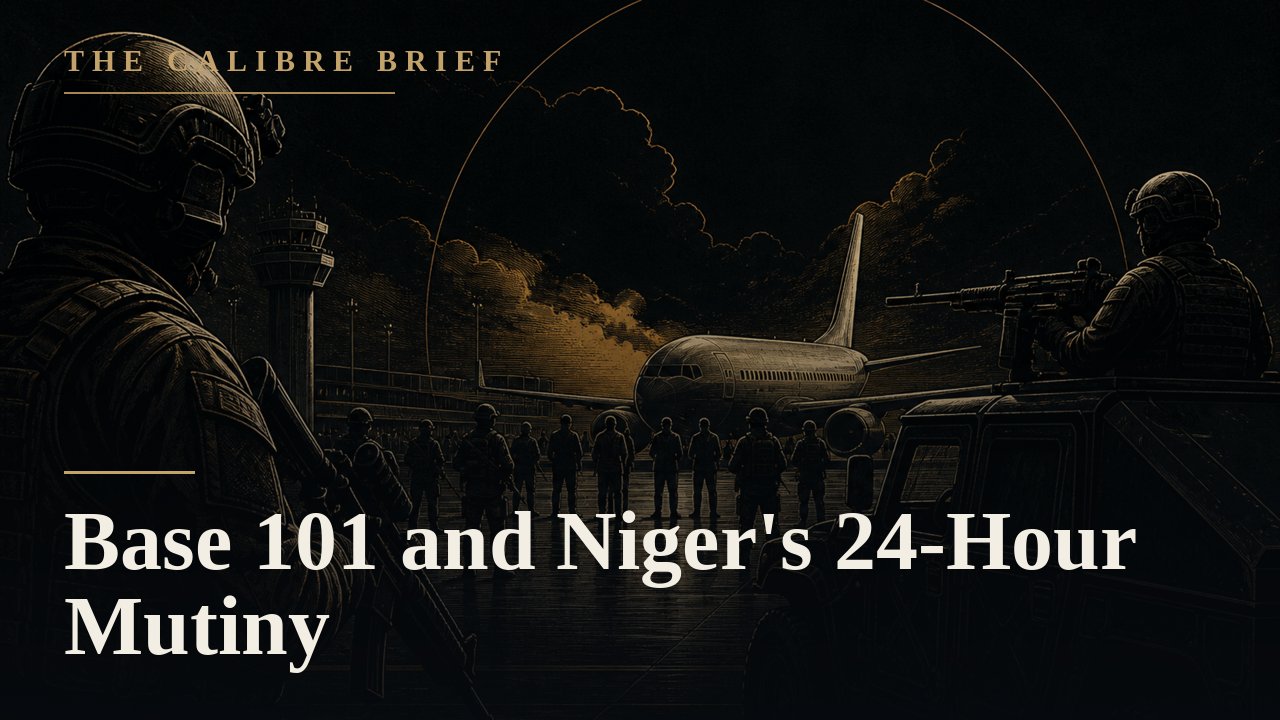
Sahel Juntas' Arsenal: Drones Protect Regimes, Not Territories | The Calibre Brief Ep. 48
About this episode
This episode of The Calibre Brief examines the military transformations in Mali, Burkina Faso, and Niger following the expulsion of Western forces. Using verified inventories of Turkish drones and Russian contractors, the juntas have built a sovereign armed drone fleet, marking a first in regional history.
Despite the arsenal's existence, its efficacy in securing Sahel territories remains questionable. Burkina Faso has seen an increase in terrorism-related deaths, and insurgents continue to challenge the juntas’ control. The security void created by Western withdrawal has not been filled, and civilian safety continues to degrade.
While the arms pipelines from Russia are established, the impact on territorial security is not. Allegations of Ukrainian mercenaries and civilian casualties from drone strikes lack independent verification, leaving questions unanswered about the real benefits of this arsenal.
The report highlights the suppressed monitoring infrastructure and unresolved issues within regional security dynamics. Ultimately, the ability of these new military assets to transform regime survival into meaningful territorial control is yet to be seen.
Key topics
Key moments
- 0:07 The juntas expelled Western forces and bought Russian weapons and…
- 0:18 Niger's Air Base 201 was a $110 million American drone hub
- 0:56 The new inventory runs through three documented channels
- 1:39 The arsenal protects the capitals
- 2:24 The juntas achieved sovereign armed drone fleets and a Russian…
- 2:54 The juntas got what they ordered
- 3:16 That is The Calibre Brief, a Calibre Code USA production
Transcript
Show transcript
Welcome to The Calibre Brief, a Calibre Code USA production.
The juntas expelled Western forces and bought Russian weapons and Turkish drones. The arsenal is real. But who does it actually protect?
Niger's Air Base 201 was a $110 million American drone hub. By September 2024, it was empty. France, the UN, and the United States all left between 2022 and 2024. What replaced them is real. For the first time in the region's history, all three juntas field sovereign armed drone fleets—Turkish Bayraktar TB2 and Akinci models confirmed by SIPRI. They achieved independence from Western architecture. What that independence protects is a separate question.
The new inventory runs through three documented channels. Turkish drones in all three capitals. Russian contractors in Africa Corps, the Defense Ministry successor to Wagner, mostly the same personnel. And weapons convoys tracked from Baltic shipyards through Guinean ports to Bamako—documented by AP and The Sentry—carrying armored vehicles, artillery, a Su-24 fighter-bomber. The monitoring infrastructure meant to track these flows, the UN Panel of Experts and ECOWAS oversight, was removed by Russian veto and the juntas' exit. Independent eyes on the arms pipeline are fewer than in a decade.
The arsenal protects the capitals. The juntas remain standing. But Kidal tells a different story. The city drones helped capture in November 2023 was abandoned under insurgent pressure in April 2026. Africa Corps controls less of Mali's north than Wagner did. Burkina Faso ranks second globally in terrorism deaths for the second consecutive year. The weapons convoys are documented. Whether they produced territorial security is not. The monitoring system designed to track these flows no longer exists. That distinction—between documented arrivals and verified outcomes—matters more than any single shipment.
The juntas achieved sovereign armed drone fleets and a Russian security relationship no longer mediated through a nominally private company. Moscow acknowledged its forces in Niger. Every loss is now a Russian state outcome. That is the sovereignty of force they asked for. What it did not buy is territorial control, civilian security, or a reversal of Sahel violence. The arsenal is better described as regime insurance than counterinsurgency.
The juntas got what they ordered. What the evidence shows they did not get is a path from regime survival to territorial control. An arsenal optimized to defend installations against coups is structurally misaligned with a war fought by insurgents who hold ground the drones cannot occupy.
That is The Calibre Brief, a Calibre Code USA production. If an arsenal that defends capitals but cannot hold territory is not making civilians safer, what metrics should determine whether the juntas' security gamble is working? Share your analysis in the comments, and like and subscribe on YouTube to follow the podcast.