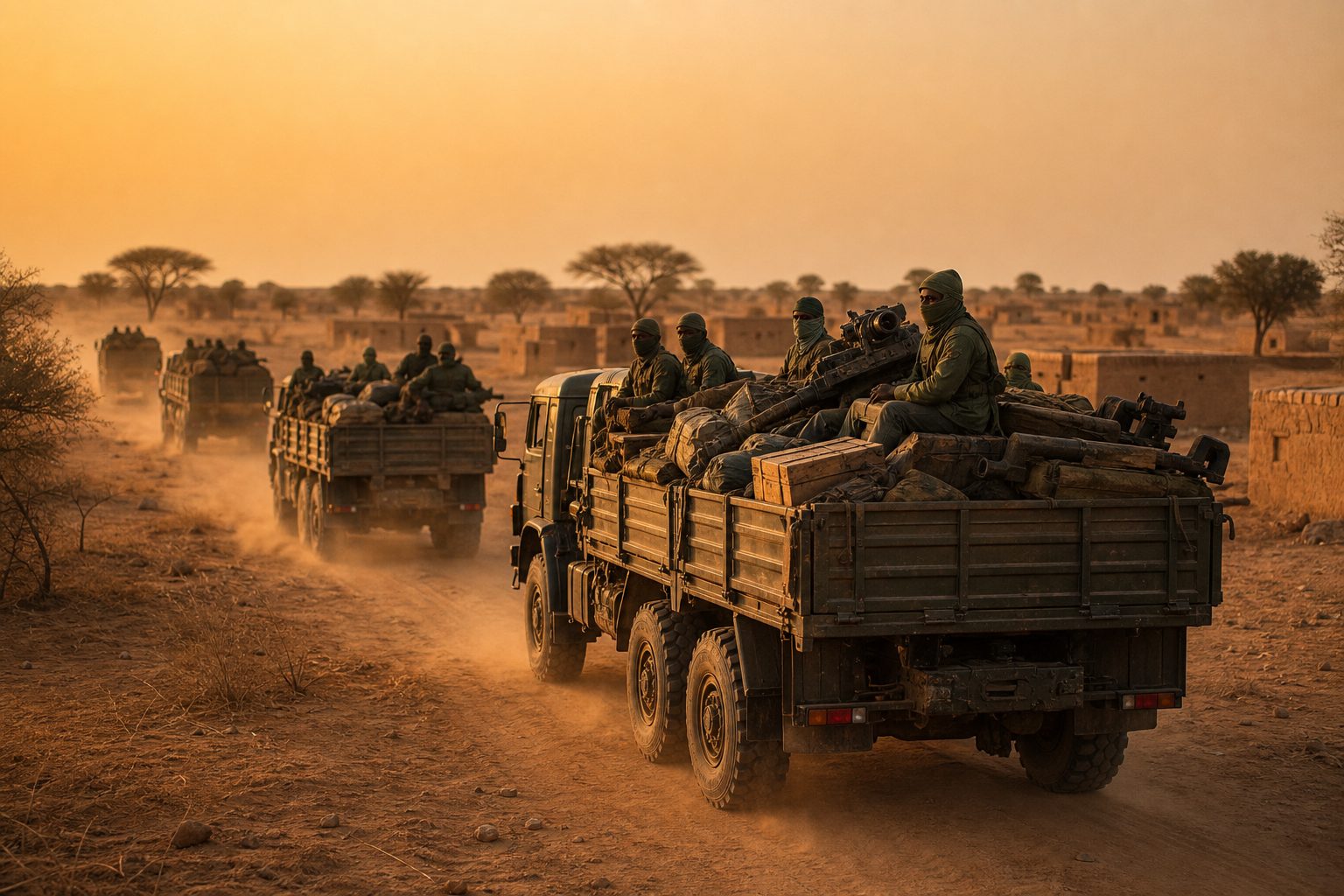
On the weekend of April 25, 2026, hundreds of masked Russian soldiers rumbled out of Kidal, the northern Malian city their predecessors in the Wagner Group had helped capture with a flag-raising photo op less than three years earlier. Militant videos that week showed what they left behind: weapons caches, armored vehicles, a downed helicopter, and what appeared to be a drone operating station. The pullout came amid a coordinated offensive by Tuareg separatists and jihadist fighters that also struck Bamako and other towns, an assault the Malian government called an attempted coup. Africa Corps, the Russian Defense Ministry's successor to Wagner, called the withdrawal a joint decision with Bamako and described the situation as "challenging."[9]
Kidal's fall landed on a decade's worth of strategic bets. Between 2022 and 2024, the military juntas of Mali, Burkina Faso and Niger expelled French forces, ended a UN peacekeeping mission, and pushed out the United States, wagering that a self-owned arsenal of drones, jets and Russian security contractors could replace Western air power and surveillance. That arsenal is real, and parts of it are documented in detail. But the Kidal withdrawal is a forcing event for a sober question: what exactly is in the juntas' technology inventory, and what has it actually changed for the more than 70 million people living under it? What follows is an audit of the evidence, distinguishing what is verified from what is claimed, and what the inventory means for the region after the Western exit.
What left with the French, the UN and the Americans
The departures the juntas engineered were unusually comprehensive. France completed its withdrawal from Mali in August 2022, ending its Operation Barkhane deployment there, pulled its Sabre special forces task force out of Burkina Faso by February 2023, and flew its last troops out of Niger in December 2023, stripping the region of French combat aircraft, logistics and signals intelligence.[10] The UN mission in Mali, MINUSMA, completed its withdrawal on December 31, 2023, ending a decade-long presence that included its own intelligence and surveillance capabilities.[11]
The American exit carried a specific technological cost. The United States had built Air Base 201 outside Agadez, at a reported cost of around $110 million, as a hub for MQ-9 Reaper drones that gave Western and regional forces persistent surveillance over the central Sahel. After Niger's junta revoked the status-of-forces agreement in March 2024, Washington handed back Air Base 101 in Niamey and then Agadez; the Defense Department announced the withdrawal complete on September 16, 2024.[12] For the first time since the French colonial era, no Western power maintained a major military footprint in the central Sahel, and no one replaced the surveillance architecture they took home.
The drone fleet the juntas own
The clearest documented line item in the new inventory is Turkish. Mali ordered Bayraktar TB2 armed drones in 2021, under the transitional government of Colonel Assimi Goïta, and added the heavier Akinci in 2023; both appear in the SIPRI Arms Transfers Database and were displayed by Malian state media.[3] The drones were not decorative. In November 2023, armed drones played a decisive role in the army's capture of Kidal from Tuareg-led rebels, a symbolic centerpiece of Goïta's legitimacy. "Drones offer a major operational gain," one Malian officer told Le Monde. "It's even thanks to them that we're still holding out."[7]

Burkina Faso quietly built something similar. Le Monde located a secret drone base on the southern outskirts of Ouagadougou, constructed out of sight in 2021 under the elected government of Roch Kaboré and made fully operational in late 2022 after Captain Ibrahim Traoré's coup. As of November 2024, it housed at least six TB2s and two Akincis, plus surveillance drones flown by the national intelligence agency, all tasked against jihadist groups controlling portions of the country's territory.[7] Niger fielded Turkish-made Anka drones before its 2023 coup and has, like its neighbors, added to its Turkish drone fleet, according to arms-transfer records.[3]
Two qualifications matter here. First, the juntas accelerated programs they did not invent: Burkina Faso's drone base was initiated by an elected president whom the military later deposed, and Mali's first purchases came in the first year of its post-coup transition, before the current leadership had finished consolidating power.[7][3] Second, the strikes have documented civilian costs. Human Rights Watch and other monitors have documented civilian deaths from Malian drone strikes, and the same weapon that captured Kidal has repeatedly hit the wrong targets in contested areas where insurgents blend into the population.[13]
One widely repeated claim does not hold up under inspection: there is no publicly verified record of Iranian combat drones or loitering munitions transferred to any of the three juntas. Documented Iranian drone flows elsewhere in the region center on Sudan. The confirmed strike fleets in Bamako, Ouagadougou and Niamey are Turkish-made.
What came in the Russian crates

The mercenary layer of the inventory changed its legal wrapper, not its core contents. Wagner deployed to Mali in December 2021 under a contract that U.S. State Department officials put at about $10 million a month. After Yevgeny Prigozhin's June 2023 mutiny and his death in a plane explosion two months later, the Defense Ministry absorbed Wagner's African portfolio into Africa Corps, a structure commanded, according to widespread reporting, through Deputy Defense Minister Yunus-Bek Yevkurov and military-intelligence general Andrei Averyanov. When Wagner formally announced it was leaving Mali on June 6, 2025, its fighters had not gone anywhere: Reuters reported that 70 to 80 percent of Africa Corps personnel were former Wagner, and estimates of the Mali deployment cluster around 2,000 to 2,500 men. Smaller contingents serve in Niger, where Russians moved into Air Base 101 as the Americans left, and Burkina Faso.[4][5][6][1]
What did change is the supply chain, and it is now documented convoy by convoy. An Associated Press investigation tracked Russian-flagged cargo ships on a nearly month-long voyage from the Baltic to West Africa carrying tanks, armored vehicles and artillery in circumvention of Western sanctions. A separate investigation by The Sentry established that three major convoys reached Bamako in the first five months of 2025 through the Guinean port of Conakry, docking at terminals operated by ACG-Fria and CBK, both subsidiaries of the Russian aluminum giant Rusal, whose rail infrastructure moved the equipment to Guinea's highways and on to landlocked Mali. The January convoy alone contained roughly 50 transport vehicles, 60 armored combat vehicles, two boats and three artillery systems; reporting on the March and May convoys points to missiles, additional artillery and vehicles fitted with radio-jamming gear. Malian officials publicly described the shipments as destined for the national army, but military sources in Bamako told The Sentry the actual recipient was Africa Corps. Satellite imagery published by AP showed a Russian-made Su-24 fighter-bomber at a Bamako airbase on April 14, 2025, and the sanctions-skirting sea route through Conakry was still in use as recently as March 2026, when France 24 tracked a sanctioned ship from Kaliningrad along the same path.[2][5][6]
The composition of those crates is analytically important. The Sentry frames Africa Corps as something more than a relabeling, arguing it "is not just a rebranding of Wagner, it is a fundamentally different force," because the state now commands it outright; the Vigil Consilium assessment, by contrast, grades most of the transition as continuity in people, missions and bases, with the change concentrated in who owns the presence.[5][1] Justyna Gudzowska, The Sentry's executive director, said the three convoys "layer up a set of capabilities: base protection, artillery fire support, air support, and anti-aircraft coverage," equipment her organization assessed as better suited to defending bases than to offensive desert operations, a more risk-averse posture shaped by Wagner's heavy losses.[6][5] Vigil Consilium's flight-tracking tally identified 75 Russian military-linked flights to the three capitals between January 2025 and July 2026, with the Defense Ministry's own transport unit the largest operator.[1] The force that left Kidal in April 2026 was thus not a raiding party. It was a garrison, built to defend installations and escort the regime, at a price still reported at roughly $10 million a month, now flowing to the Russian state rather than a private company.[1]
Other suppliers sit at the margins. Chinese-made armored vehicles reached Burkina Faso in a large convoy in January 2024. Belarus has signed defense-cooperation agreements with the juntas, though documented deliveries are modest. No verified recent North Korean transfers appear in the public record.
The insurgents built a cheaper stack
The most consequential technology race in the Sahel is not being won by the side with the most money. The Azawad Liberation Front, the largely Tuareg rebel coalition in northern Mali, became the region's earliest sophisticated drone adopter through a documented relationship with Ukraine: an envoy of Ukrainian military instructors visited the group in 2024, a batch of rebels trained inside Ukraine itself, and returnees taught fellow fighters first on computer simulators and then with real drones. The FLA now flies armed drop-drones and fiber-optic first-person-view models immune to radio jamming, though its operators remain inexperienced, accuracy is poor, and targets skew toward stationary objects like drone relays, fuel tankers and barracks.[8] The relationship had diplomatic consequences. After a Ukrainian intelligence official suggested Kyiv had enabled the July 2024 ambush at Tinzaouatène, which killed dozens of Malian soldiers and Wagner fighters, with Russian war bloggers reporting at least 20 Wagner dead, Mali severed ties with Ukraine in August 2024 and Niger followed.[14][9]
The jihadist main force, al-Qaeda's Sahel affiliate JNIM, has adapted differently. Lacking a state sponsor, it fields mostly unarmed quadcopters and uses them as flying command posts: operators watch assaults on military bases from above, guide mortar fire onto defenses and direct ground fighters by radio in real time, while the footage doubles as recruitment propaganda. Fronts' assessment is that this reconnaissance layer, not JNIM's armed drones, is the counter-intuitively consequential change. The group's armed drones, first seen in northern and eastern Burkina Faso, fit 3D-printed or cheaply bought release mechanisms onto aircraft usually captured from security forces during raids.[8] JNIM's reach extends well beyond drones: it claimed the September 17, 2024 attack on Bamako's airport and gendarmerie school that killed dozens, and a jihadist militia fought alongside Tuareg secessionists in the April 25, 2026 offensive that drove Africa Corps from Kidal, with the Tessalit and Aguelhok garrisons also handed over that month under what the available reporting describes as negotiated terms.[9][1] Africa Corps claimed it faced 10,000 to 12,000 attackers, including Ukrainian and European mercenaries; that claim could not be verified.[9] What the record does support is that since the June 2025 handover, Africa Corps has lost aircraft in April and July 2026, has shifted from ground assaults to air support, escort duty and its own FPV drones, and has seen its recorded engagements in Mali fall by a third.[1]
One further shift deserves notice because it inverts the old relationship. Formal deniability is gone. Moscow has publicly acknowledged its forces fighting in Niger in January and August 2026, which makes every reverse a Russian state outcome rather than a contractor's.[1] Practical deniability still lingers where convenient: the Defense Ministry has not commented on helicopter losses in Mali, and neither government has answered two documented civilian-harm cases.[1] The Sentry attributes recent incidents of rape, torture and summary executions to Africa Corps, and under the new structure those are also Russian state outcomes.[5]
The layers that never arrived
Two components of the much-trumpeted inventory remain aspirational or undocumented. In September 2024, the three juntas, organized as the Alliance of Sahel States, signed space-cooperation agreements with Russia's Roscosmos covering telecommunications and remote-sensing satellites.[16] As of September 2026, there is no public evidence that any AES-owned satellite has been launched or is operational; the juntas' imagery still comes from their drone fleets, not from orbit.

The communications layer is similarly thin in verifiable fact. Starlink service has spread commercially across West Africa, and satellite terminals of various kinds circulate in the region, but no verified documentation shows junta forces or Africa Corps operating Starlink-derived military networks in the Sahel. The idea that the juntas have fielded a hardened, satellite-backed command-and-control web, what military analysts sometimes call anti-access bubbles, networks that raise the cost for outsiders to operate overhead, exceeds what the public record supports. What the record supports is narrower and still significant: short-range air defenses and jamming equipment around key bases, attack jets, and armed drones over the capitals and main garrison towns.[5][2]
Who pays for it, and who is left to watch
The funding streams are partly sovereign and partly opaque. Mali rewrote its mining code in 2023 to increase the state's take from gold, its largest export sector, while Niger moved against French-linked uranium interests. How much of that revenue feeds the arsenal is not publicly documented; the Russian arrangement itself, at a reported $10 million a month, is the largest known line item and would historically have consumed a substantial share of a national defense budget.[1]
The monitoring picture is the quietest and perhaps the most durable change. Mali, Burkina Faso and Niger formally left ECOWAS effective January 29, 2025, and the bloc has announced plans for a standby counterterrorism force that does not yet operate on AES territory. The UN Security Council's Panel of Experts on Mali, which tracked arms flows and sanctions violations, ceased to exist after Russia vetoed the renewal of the sanctions regime in August 2023. In practical terms, the region's arms transfers are now less visible to independent scrutiny than at any point in the past decade, at exactly the moment the documented volumes are largest.
Does the arsenal make anyone safer?
The fairest reading of the evidence is that it protects the juntas' capitals better than their territory. Drones over Bamako, Mopti and Ouagadougou, layered with Russian base defenses, make a lightning seizure of power harder; the juntas remain standing, which is the outcome their procurement was primarily designed to guarantee. But the territorial picture has deteriorated. The Sahel accounted for more than half of all terrorism deaths worldwide in 2024, according to the Global Terrorism Index, with Burkina Faso the most affected country for a second consecutive year.[15] Insurgents struck Bamako in September 2024 and again in April 2026.[9] Africa Corps holds less of Mali's north than Wagner did, and its reduced engagement tempo looks more like consolidation around a defensible core than pacification.[1]
For France and the United States, the arsenal changes little on its own; Turkish drones and Russian short-range air defenses were never the binding constraint. The binding constraint is the absence the juntas created: no Western ISR architecture over the central Sahel, no bases to return to, no UN observers, a neutered sanctions panel, and an ECOWAS without jurisdiction over the very states where the violence concentrates. The juntas asked for sovereignty of force and they received it. They can now surveil, strike and garrison their own territory without asking Paris or Washington for anything, which is genuinely new since independence in one narrow sense: no prior government in the central Sahel fielded an armed drone fleet of its own at this scale.
What Kidal showed in April 2026 is the limit of that achievement. Sovereignty of force is not territorial control, and an arsenal optimized to defend installations is poorly shaped for a war against enemies who watch the battlefield through a cheap commercial quadcopter. Whether the next change, integrating the Russian contingents into the host armies' own command structures, alters that balance remains, as the analysts who graded the Wagner-to-Africa Corps transition put it, the unresolved question.[1]
Sources / References
- Vigil Consilium, "Africa Corps in the Sahel: what changed, what did not," September 9, 2026. https://vigilconsilium.com/notes/sahel-africa-corps-what-changed-2026-09/
- Monika Pronczuk, John Leicester and Michael Biesecker, "Russia skirts Western sanctions to ramp up its military footprint in Africa," Associated Press, 2025. https://apnews.com/article/russia-africa-weaponry-ships-mali-ukraine-f3383b5bbc8120b445d3df9062bf7f14
- SIPRI Arms Transfers Database, entries for Mali, Burkina Faso and Niger, 2021 to 2024. https://www.sipri.org/databases/armstransfers
- "Africa Corps to stay in Mali after Russia's Wagner mercenary group leaves," Reuters, June 6, 2025. https://www.reuters.com/world/africa/russias-wagner-mercenary-group-says-it-is-leaving-mali-after-mission-2025-06-06/
- The Sentry, "Russia Doubles Down in West Africa: New Military Deliveries, a Guinea Maritime Hub, and Africa Corps' Expanding Footprint," April 21, 2026. https://thesentry.org/2026/04/21/80961/russia-doubles-down-in-west-africa-new-military-deliveries-a-guinea-maritime-hub-and-africa-corps-expanding-footprint/
- Brawley Benson, "Russian Businesses Helping Funnel Military Equipment to Wagner Successor Group in Mali – Report," The Moscow Times, April 21, 2026. https://www.themoscowtimes.com/2026/04/21/russian-businesses-helping-funnel-military-equipment-to-wagner-successor-group-in-mali-report-a92553
- Benjamin Roger, Thomas Eydoux et al., "Turkish drones and Russian planes: Aerial warfare comes to West Africa," Le Monde, November 20, 2024. https://www.lemonde.fr/en/le-monde-africa/article/2024/11/20/turkish-drones-and-russian-planes-aerial-warfare-comes-to-west-africa_6733455_124.html
- Paweł Wójcik, "Drones are Transforming the Sahel Conflict. Here's How," Fronts, September 3, 2026. https://fronts.co/article/drones-are-transforming-the-sahel-conflict-heres-how/
- Mike Eckel, "Russia Hoped Africa Corps Would Replicate Wagner's Success. It's Not Going Well," RFE/RL, April 28, 2026. https://www.rferl.org/amp/russia-africa-corps-mali-withdrawal-wagner-mercenaries/33744461.html
- French withdrawal timelines from Mali (August 2022), Burkina Faso (February 2023) and Niger (December 2023), as reported by Reuters and official French government statements.
- United Nations, MINUSMA withdrawal completion, December 31, 2023.
- U.S. Department of Defense announcement on the completed withdrawal of U.S. forces from Niger, September 16, 2024.
- Human Rights Watch reporting on Malian drone strikes and resulting civilian casualties, 2024.
- Reuters reporting on Mali severing diplomatic relations with Ukraine, August 2024, and Niger's subsequent decision.
- Institute for Economics and Peace, Global Terrorism Index 2025.
- Roscosmos and Alliance of Sahel States government announcements of satellite cooperation agreements, September 2024.
Comments (1)
Continue exploring
AI Wingmen at the Merge: How Autonomous Drones Are Reshaping Airpower
The U.S. Air Force's AI wingmen have flown. The harder question now is who owns the software at the controls, and what that…
Mamdani's 9/11 Records Release: What New York Officials Knew About Ground Zero's Toxic Air
Twenty-five years after the attacks, Mayor Mamdani released 170,000 pages of NYC 9/11 records. Here is what they reveal about the…
How drones, Starlink and covert flights through Chad and Libya are redrawing Sudan's war
What began as a power struggle in Khartoum is now a drone war supplied through Chad and Libya, connected by smuggled satellite…
The article claims the Western exit left no replacement surveillance architecture in the central Sahel. I'm skeptical of that sweeping conclusion given that French and American drones still operate from bases in neighboring countries and EU missions continue nearby. What specific evidence supports the claim that the gap has gone entirely unfilled? The article notes Burkina Faso's drone base was initiated by the elected government of Roch Kaboré and made fully operational under Captain Ibrahim Traoré after the 2022 coup. I'd like to understand how that handover actually worked in practice, whether the trained operators and intelligence pipelines stayed in place, or whether the new junta effectively had to rebuild the program from scratch. The distinction matters a great deal for assessing whether the documented fleet of six TB2s and two Akincis reflects inherited capacity or new investment under the military government. The article focuses on the three junta states, but the Tuareg separatists and jihadist fighters named in the Kidal assault operate across borders into Algeria, Libya, and northern Niger. I wonder whether the inventory audit adequately accounts for the drone and counter-drone capabilities those non-state actors have quietly accumulated over the same period. Without that comparison, it is hard to judge whether the juntas' arsenal represents regional air superiority or merely a marginal edge against insurgent groups that are themselves adapting. I spent time in northern Mali in late 2024 and spoke with several community leaders who described a sharp rise in artisanal gold smuggling along routes that MINUSMA convoys used to patrol. That experience cuts against the framing of a tidy Western withdrawal with a sovereign replacement, since what I observed looked more like a security vacuum being exploited by armed groups than a self-owned arsenal filling the gap. The inventory audit feels accurate on hardware but understates how much ground-level policing the