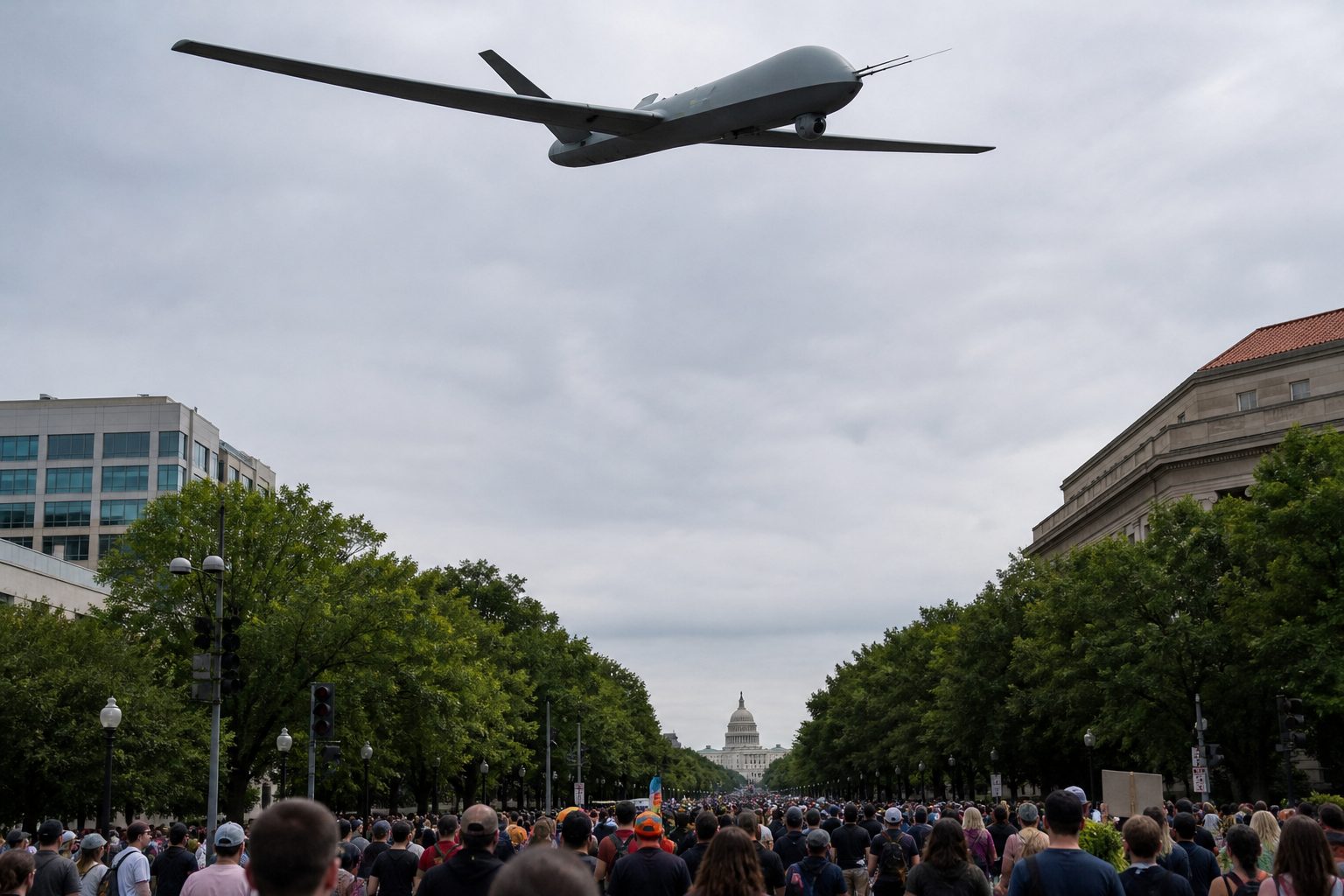
In early June 2025, an unmanned aircraft with a 66-foot wingspan began tracing slow loops high above Los Angeles while protests against federal immigration raids spread through the streets below [1]. It was a Customs and Border Protection MQ-9 Reaper, the drone the Air Force uses for long-duration surveillance, built to stay aloft more than a day and to carry a sensor ball of high-resolution video, infrared imagery, and laser designators [2]. Flight trackers saw it. A Department of Homeland Security spokesperson described the flights as situational awareness, part of protecting federal buildings and personnel [3]. Below it, the Los Angeles Police Department flew its own, much smaller drones over some of the same marches [1].
The question moved through the crowd faster than the aircraft overhead: can it see me? Follow me? Match my face to my name, so that an investigator comes looking weeks later?
The answer assembled from camera optics, court decisions, regulators' rulings, and departments' own published policies has three parts. A drone can follow one person through a crowd, and departments do it. The public record contains no verified case of a drone identifying a protest crowd face by face, in the United States or in France, where the issue has been fought over hardest. And people do get named weeks later, but the naming usually happens on the ground, through a pipeline of body cameras, fixed cameras, license plates, and social media that the drone merely feeds. The rules allowing all of this are thinner in the United States than most marchers assume, and sharper in France than most Americans would expect.
What follows is what the tools can actually do, what current rules let them do, and what an ordinary person can do once the footage exists.
What kind of drone is over the protest?
Most of what police fly over a crowd is unglamorous. The workhorse is a quadcopter the size of a large toolbox, stabilized by a gimbal and carrying two or three cameras: a wide lens for context, a zoom lens for detail, and a thermal imager that shows people at night as bright bodies on a dark field. The most common police models stay airborne roughly half an hour to just under an hour per battery, according to the manufacturers' spec sheets. Video streams live to a command station, a detective's laptop, or an officer's phone, and it is recorded as it streams.
The fastest-growing use of these aircraft is not protest monitoring at all. It is the Drone as First Responder model, in which a drone launches to a 911 call before officers arrive. Chula Vista, California pioneered the approach in late 2020 and reports thousands of flights [4]. The New York Police Department launched its own Drone as First Responder program in April 2024, on top of a small unmanned-aircraft unit it had run for years [5]. More than a thousand U.S. public-safety agencies have acquired drones, by the counts kept by the Electronic Frontier Foundation's Atlas of Surveillance and by researchers at Bard College [6][7].
At the far end of the scale sits what circled Los Angeles. A Reaper is not a quadcopter with a zoom lens. It is a military aircraft that happens to have no pilot, with endurance measured in days and sensors built to track vehicles and people from high altitude [2]. CBP flies them along the border and, in June 2025, over an American city in the middle of a political crisis [1].
What all these aircraft share matters more than the differences. Every one of them produces the same product: hours of steerable, timestamped video of a public place, taken from an angle nobody on the ground controls.
How close does a drone have to be to read a face?
The numbers need nothing classified. From 300 feet up, a wide camera with an 80-degree lens and a frame 4,000 pixels wide sees about 150 meters of ground. Each pixel covers a little under four centimeters. The distance between a person's eyes is about six centimeters, so from that altitude the two most useful points on a face sit roughly two pixels apart. Face recognition systems are trained and tested on images with dozens of pixels between the eyes. Two pixels is not a face. It is a smudge.
Zoom fixes that, at a price. At 20 times magnification the same lens sees about seven meters of ground, and the eyes of anyone inside that narrow window land more than thirty pixels apart, enough for automated matching to attempt. But the frame now holds one person, not a march. There is no middle setting. A camera can watch the crowd or study the individual, never both at once, and flying lower does not break the trade-off. Even at 100 feet, the wide view keeps the eye-to-eye distance near five pixels while the zoom view narrows to a doorway.
Geometry compounds the problem. From directly overhead, a camera photographs hair and shoulders, not faces, and matching software needs a frontal image. Thermal imagers help an operator follow a body through a dark crowd and help with nothing else; a typical 640-by-512-pixel heat image cannot resolve a face, let alone identify one. Zoom lenses can sometimes read a license plate on a parked car from surprising distances, but a plate is flat, still, and high-contrast. A moving face under a cap is none of those things.
This is the physics behind an otherwise strange fact: no U.S. or French police department, and no manufacturer selling into those markets, claims live face recognition over a protest crowd from drone altitude in any policy, procurement record, or audit reviewed here. The capability circulates in protest-season rumors and in some other countries' marketing brochures. In the documented programs of the United States and France, it does not exist.

Read it →
Hover a story · click to read
 No. 50 · Sep 19, 2026AI Wingmen at the Merge: How Autonomous Drones Are Reshaping Airpower
 No. 18 · Aug 28, 2026How drones, Starlink and covert flights through Chad and Libya are redrawing Sudan's war
 No. 52 · Sep 21, 2026The Sahel Juntas' Post-Wagner Arsenal: Drones, Air Defenses and What They Changed
 No. 43 · Sep 8, 2026Mamdani's 9/11 Records Release: What New York Officials Knew About Ground Zero's Toxic Air
 No. 17 · Aug 27, 2026The Kidnappers Outsmart Nigeria’s Surveillance State
What facial recognition adds, and where it breaks

Face recognition works by turning a photograph into a mathematical template and searching a database for similar templates. On sharp, frontal, well-lit images, the best modern algorithms are close to infallible. The National Institute of Standards and Technology, which runs the U.S. government's benchmark testing program, has found that error rates climb as images get smaller, blurrier, or more angled, and that many algorithms produce false matches at rates differing by factors of 10 to 100 across demographic groups [8].
False matches are not theoretical. Robert Williams was arrested at his home in a Detroit suburb in January 2020 after a blurry surveillance still was matched against a database and returned his name; the case collapsed once a human looked at the evidence [10]. Porsha Woodruff, eight months pregnant, was arrested in Detroit in 2023 after a similar mis-match from grainy video [11]. Georgetown Law's Center on Privacy and Technology documented departments feeding sketches, distorted screenshots, and low-quality stills into commercial face searches and pursuing prosecutions on the results [9]. Those searches ran on ground cameras, at close range, with subjects often facing the lens. Move the camera 300 feet up, add motion, crowd density, and top-down angles, and the input quality falls off a cliff.
The scale of the databases is the other half of the story. Clearview AI scraped billions of photos from social networks and sold police a search box over them, with hundreds of U.S. agencies signing up before journalists exposed the company [12]. Face recognition does not need to be bolted to the drone to matter to a marcher. It needs to be bolted to the pipeline.
Which is why the departments' own rules deserve attention. The NYPD's published impact statements say its drone program responds to calls for service and that face recognition is not run on the video [5]. California bars police from running face recognition on body-worn camera footage altogether [13]. San Francisco banned most government use of the technology in 2019, the first major city to do so [14]. No public audit, court ruling, agency disclosure, or credible news report reviewed for this piece documents a face match made from drone footage at a U.S. or French protest. The claim that the sky names everyone is, on the current record, a rumor of technology rather than a documented one.
Can one drone follow a whole march?
One operator, one target. That is the documented practice: a drone follows a single person of interest through a crowd until officers on the ground can take over, which is exactly what Chula Vista trains its pilots to do [4]. Software sold with police drones can draw a box around every moving figure in the wide view, and some systems can hold several boxes at once. A box is not a name. It is a moving point on a map, and the number of points one operator can meaningfully follow is small.
Battery life sets the next limit. The most common police quadcopters fly roughly half an hour to just under an hour per battery, so a single aircraft cannot hold an orbit through an all-day demonstration without crews swapping airframes. Departments work around this with multiple drones, but the constraint shapes everything: watch one group closely, or sweep the whole march at low detail, not both.
The only aerial surveillance documented to track everyone at once is not a drone at all. Baltimore flew a light plane carrying a 192-megapixel camera array that could blanket tens of square miles in an orbit, recording continuously so analysts could rewind the archive and trace any car or pedestrian across hours. The imagery was sharp enough to follow every moving object in the city and too coarse to identify a single face or read a plate [15]. Baltimore secretly tested the system in 2016, brought it back publicly in 2020, and shut it down in 2021 after community opposition and city reviews found little investigative value [15]. The technology matters here as a boundary marker: mass tracking of everyone's movements from the air is already possible. Mass identification is not.
The Supreme Court has begun writing that gap into constitutional law, indirectly. In Carpenter v. United States, it held that tracking a person's location over time through cell phone records is a Fourth Amendment search [16]. Persistent aerial tracking of an individual has not reached the Court, but legal scholars were warning years before the hardware arrived that cheap, quiet drones would eventually collide with the old doctrine that the sky is always public [17].
Do police need a warrant to fly over a protest?
The Federal Aviation Administration controls where aircraft may fly, not what cameras may look at. Its Part 107 rule set covers the common civilian path for small drones, including the 2021 amendments that let certified pilots fly at night without a special waiver [19]. Most police departments take the other path: they register as public aircraft operators, obtain a Certificate of Waiver or Authorization from the FAA, and in exchange certify their own safety procedures [18]. Either way, the FAA's involvement ends at safe navigation of the national airspace. Nothing in its rulebook limits surveillance [18][19].
The Fourth Amendment, as the Supreme Court has applied it to aircraft, mostly does not either. In California v. Ciraolo, it held that police did not need a warrant to observe a fenced backyard from a fixed-wing aircraft at 1,000 feet [20]. In Florida v. Riley, it found no search in a helicopter hovering at 400 feet to peek through missing greenhouse panels [21]. The doctrine is simple: what you expose to public view from a place the public can lawfully be is not protected, and the sky is public. Kyllo v. United States drew one line, holding that thermal sensors aimed at a home from the street become a search [22]. A protest march, by design, exposes its participants to public view. Watching one from the air, for now, needs no warrant in most of the United States.
The constraints that exist are mostly written below the federal level. More than a dozen states have their own drone statutes, and a subset of those require warrants for most law enforcement drone use; Virginia, in 2013, was the first [24]. Florida's law goes further, making evidence from warrantless drone surveillance inadmissible outside narrow exceptions [25]. Massachusetts' highest court held in 2022 that a low-altitude drone sent over a private yard without a warrant violated the state constitution, reasoning that the aircraft's quiet, hovering persistence was nothing like the noisy helicopters of the old cases [26]. On the federal side, a 2015 presidential memorandum ordered agencies using domestic drones to publish privacy rules and weigh civil-liberties safeguards [27]. New York City's POST Act requires the NYPD to publish an impact statement for each surveillance technology, which is why the drone program's retention rules are public at all [5]. And CBP, the agency whose Reapers circled Los Angeles, asserts operating authority across a 100-mile band around the border, a zone the ACLU notes covers roughly two-thirds of the U.S. population, Los Angeles included [28].
The international yardstick is stricter than the constitutional one. The UN Human Rights Committee, interpreting the right of peaceful assembly, has told governments that surveillance of assemblies must be justified case by case, that indiscriminate monitoring is incompatible with the right, and that face recognition belongs only in situations of strict necessity [23]. Under U.S. law, though, the honest summary is this: no warrant to watch a public march, warrant requirements only in some states and some situations, and a Supreme Court that has not yet decided what persistent aerial tracking means.
Where drones have actually flown over U.S. protests
The documented cases are few, recent, and mostly known because of reporters rather than disclosures. In July 2020, local reporting and flight data showed a CBP drone monitoring the crowds outside the federal courthouse in Portland as agents clashed with protesters night after night [29]. That summer, Baltimore's surveillance plane, freshly relaunched and publicly announced, was flying over a city full of George Floyd protests, an aircraft capable of following every moving person for hours but incapable of naming one [15]. In April 2024, weeks after launching its Drone as First Responder program, the NYPD flew drones over Columbia University's campus as officers cleared occupied Hamilton Hall [5][30]. In June 2025 came Los Angeles: CBP Reapers circling high, LAPD quadcopters lower, thousands of marchers in between [1][3].

What is missing from that list matters just as much. No general requirement to publish protest flight logs exists anywhere in the United States, so where the public knows a drone was present, it is usually because a journalist, a watchdog, or a flight tracker noticed. The agencies' stated reasons, where given, run to protecting officers and lawful marchers by spotting people throwing objects and coordinating responses [3][5]. Those purposes are real. So is the fact that the flights are governed almost entirely by internal policy rather than external law.
What happens to the footage afterward
The FAA's Part 107 rulebook regulates altitude, lighting, and right of way. It says nothing about how long video must be kept, who may review it, or whether it must ever be deleted [19]. The only ceilings on storage are the departments' own posted policies, and those vary widely, from short windows for routine flights to years for anything flagged as evidence [6]. The NYPD's impact statement sets a three-year default retention for drone recordings unless they become evidence in a case, in which case they last as long as the case does [5].
Access follows the case. Operators see the feed live. Desk officers in real-time crime centers pull it up during events. Detectives request segments afterward, and prosecutors file whatever helped. In most states, flight logs, launch records, and retention schedules are ordinary public records, obtainable on request. Whether a specific person appears in a specific clip is a harder question, and no rule in either the United States or France requires telling someone that they do.
How people get named weeks later
The knock on the door, weeks after the march, is the part of the story with thick documentation. In France, after the nationwide unrest of June 2023, interior ministry figures reported by Reuters showed nearly 4,000 arrests, most of them made after the fact, as investigators worked through CCTV, police camera footage, and social media clips in the weeks that followed, often collecting people at home in the morning [32]. The CNIL, France's data-protection authority, later described in its own decision how aerial images captured at gatherings fed police files [35]. After the June 2025 protests in Los Angeles, city prosecutors and the U.S. attorney's office brought charges against dozens of people in the months that followed, built largely on video review, aerial and street level [34]. And the largest demonstrated version of the pattern is January 6: more than 1,500 people charged over years, with the FBI describing face-recognition searches, including against state driver's-license photo databases, as one identification method [33].
The consistent detail in all of it is what the drone contributes and what it does not. Drone footage in these records works as vantage and timestamp: proof of who was where, when, and how the crowd was moving, checked against faces caught at ground level by body cameras and store cameras, plate numbers caught by readers, and posts people made themselves. The claim that the aircraft itself matched every face to every name appears nowhere in the case files, the audits, or the regulator decisions. The naming still happens. It happens the slow way, after the march, by people with files and time.
How France drew a red line around demonstrations
France has flown drones over protests since the Yellow Vest era, first without any statute written for the purpose, which is what eventually drew the regulator in [35]. But the French fight over protest surveillance landed somewhere unexpected. The law written for the 2024 Paris Olympics, passed in May 2023, authorized something the United States has never authorized or banned at the federal level: algorithmic video surveillance, computers watching camera feeds for patterns [36]. The 2023 law permits it only at large sporting and cultural events, only to detect things rather than people, and only for a fixed experimental period that expired in March 2025. Political demonstrations are excluded from its scope outright, and biometric processing of any kind is banned within it [36]. The Constitutional Council blessed the system in April 2023 only in that narrowed form [37].
The CNIL then wrote the operator's manual. Its published rulebook limits the algorithms to noticing events, not identities: crowd movements, abandoned objects, vehicles where they should not be, fires, falls [38]. The systems ran during the Games under that framework, and the exclusion of demonstrations survived every public version of the subsequent fight over making the tool permanent through 2025 [38].
The French case is worth taking seriously on both sides. Drones remain legal over French protests, and they fly there routinely; the state's constraint on them is paperwork, transparency, and impact assessments, the violation of which draws fines [35]. Algorithmic identification of protesters, by contrast, was made unlawful before it was ever deployed. A democracy can, it turns out, write down in advance what the cameras may not be used for. The United States, where the rules are mostly departmental policies and a Supreme Court doctrine from the helicopter era, has not.
What the watchdogs found
The LAPD's own inspector general reported in 2024 that the department had deployed drones over protests dozens of times, including at First Amendment assemblies, despite a 2019 policy that confined the aircraft to emergencies like barricaded suspects and hazardous-materials calls. The department argued the flights fit the policy's emergency language; the watchdog found the pattern reason to tighten the rules [39]. Baltimore's surveillance plane was shut down after its audits found little investigative value and community hearings turned against it [15]. The CNIL fined the Paris police prefecture €15,000 in October 2023 for years of drone surveillance at public gatherings conducted without the required transparency to the public, without a completed impact assessment, and on an inadequate legal footing [35].
The pattern across all three is the same, and it is the quiet lesson of the records: oversight of aerial surveillance almost always arrives after the flights. DHS, for its part, continued to describe the Reapers over Los Angeles as situational awareness, and through late 2025 had released no public log of what the aircraft recorded [1][3]. The tools documented themselves. The public record exists because regulators, inspectors, and reporters went and built it.
Drones, helicopters, and body cameras
Drones sit in the middle of a surveillance stack that already covers most marches. Helicopters have circled American protests for decades. An ACLU of Southern California analysis of LAPD flight data found helicopters spending disproportionate time over Black and Latino neighborhoods, and a helicopter announces itself with rotor noise that changes a crowd's behavior as much as it observes it [40]. A drone is quiet enough that most marchers never look up, and cheap enough to keep airborne all afternoon.
Body cameras supply what the air cannot: close-range frontal faces, voices, badge numbers, locations. After New York's roughly 2,000 arrests during the June 2020 protests, footage of exactly that kind drove the cases, most of which prosecutors later declined or dismissed [31]. California banned face recognition on body cameras precisely because the footage is identification-grade [13]. The drone's distinct product is neither the helicopter's noise nor the body camera's detail. It is the aerial track and the archive: where a person went, who moved with them, and a rewindable record of the whole event [15].
What you can do if a drone tracked you

The practical options are limited but real. Start by finding out what your local department actually operates; the EFF's Atlas of Surveillance documents drone programs by agency and links to many of their policies [6]. Then use your state's public records law to ask for flight logs, launch times, retention schedules, and protest-related deployments, the disclosure the ACLU has recommended since drone programs began spreading [41]. Where oversight bodies exist, complaints have force: the Los Angeles Police Commission's inspector general produced its protest findings because complaints prompted the review [39], and the CNIL's €15,000 fine came through the French complaint process, which anyone can invoke [35].
If you were charged after a march, the footage is evidence you are entitled to see, and courts have shown willingness to draw lines; Massachusetts' drone ruling is the state-constitutional precedent to know [26]. The longer game is policy: New York's POST Act shows what transparency looks like when a city mandates it [5], and the UN Human Rights Committee's standard, necessity case by case and no indiscriminate surveillance of assemblies, is the yardstick civil liberties groups push governments toward [23]. Nobody in the United States or France will notify you that you appeared in drone footage. Finding out is a records request, a courtroom, or a knock on the door.
What the record actually supports
Weeks after the Reapers left Los Angeles, the question they raised had been answered by everyone except the authority best placed to answer it. The aircraft could follow people; DHS said so [3]. No one involved claimed they could name a face from that altitude, and the pixel arithmetic explains why no one would [2]. In Paris, the regulator had already written down what the cameras over protests could not be used for and fined the police for the paperwork they skipped [35][38].
The record answers the original question plainly. A drone over a protest can track a person, and the rules that permit it are mostly internal policies and a forty-year-old aerial doctrine, with warrants required only patchily by state law. A drone cannot track everyone at once, and no document in the public record shows one identifying a crowd face by face, in the United States or in France. The people who get named are named weeks later, on the ground, through a fusion of body cameras, store cameras, plate readers, and photo databases. What the drone changed is not whether the naming happens but how cheap and complete the raw material has become: hours of overhead video of every march, stored for years, waiting for someone with a case to build.
The sky has not learned your name. The ground has. The records say so.
Sources / References
- Los Angeles Times, reporting of June 2025 on CBP MQ-9 Reaper flights over Los Angeles protests and on LAPD drone deployments during the unrest.
- U.S. Air Force, "MQ-9 Reaper" fact sheet. https://www.af.mil/About-Us/Fact-Sheets/Display/Article/104470/mq-9-reaper/
- U.S. Department of Homeland Security, spokesperson statements to press, June 2025, describing drone flights over Los Angeles as situational awareness in protection of federal buildings and personnel.
- Chula Vista Police Department, Drone as First Responder program documents, flight statistics, and operational policies (2020-2024).
- New York City Police Department, POST Act impact statements for Unmanned Aircraft Systems and the Drone as First Responder program, published at nyc.gov (2021-2024).
- Electronic Frontier Foundation, Atlas of Surveillance. https://atlasofsurveillance.org
- Center for the Study of the Drone, Bard College, public-safety drone program data and surveys. https://dronecenter.bard.edu
- P. Grother, K. Ngan, and K. Hanaoka, "Face Recognition Vendor Test (FRVT) Part 3: Demographic Effects," NISTIR 8280, National Institute of Standards and Technology, December 2019. https://nvlpubs.nist.gov/nistpubs/ir/2019/NIST.IR.8280.pdf
- Clare Garvie, "Garbage In, Garbage Out: Face Recognition on Flawed Data," Georgetown Law Center on Privacy and Technology, May 2019.
- American Civil Liberties Union, Williams v. City of Detroit, case page and complaint materials (filed 2020). https://www.aclu.org/cases/williams-v-city-detroit
- Reuters, March 2023, reporting on the wrongful arrest of Porsha Woodruff based on a facial recognition match from low-quality video.
- Kashmir Hill, "The Secretive Company That Might End Privacy as We Know It," The New York Times, January 18, 2020. https://www.nytimes.com/2020/01/18/technology/clearview-privacy-facial-recognition.html
- California Assembly Bill 1215 (2019), prohibiting law enforcement use of biometric surveillance with body-worn cameras.
- San Francisco Board of Supervisors, ordinance restricting government acquisition and use of facial recognition technology, May 2019.
- Bloomberg Businessweek, Associated Press, and Baltimore Sun reporting on Baltimore Police Department aerial surveillance, including the secret 2016 pilot, the public 2020 program, and the 2021 decision to end it (2016-2021).
- Carpenter v. United States, 585 U.S. 296 (2018). https://www.oyez.org/cases/2017/16-402
- Ryan Calo, "The Drone as Privacy Catalyst," 64 Stanford Law Review Online 29 (2011).
- Federal Aviation Administration, "Unmanned Aircraft Systems." https://www.faa.gov/uas
- 14 C.F.R. Part 107, including operations over people and night operation amendments effective April 2021. https://www.ecfr.gov/current/title-14/chapter-I/subchapter-F/part-107
- California v. Ciraolo, 473 U.S. 207 (1986). https://supreme.justia.com/cases/federal/us/473/207/
- Florida v. Riley, 488 U.S. 445 (1989). https://supreme.justia.com/cases/federal/us/488/445/
- Kyllo v. United States, 533 U.S. 27 (2001). https://supreme.justia.com/cases/federal/us/533/27/
- UN Human Rights Committee, General Comment No. 37 on the right of peaceful assembly, CCPR/C/GC/37 (2020). https://undocs.org/CCPR/C/GC/37
- National Conference of State Legislatures, "Current Unmanned Aircraft State Law Landscape." https://www.ncsl.org/technology-and-communication/current-unmanned-aircraft-state-law-landscape
- Florida Statutes § 934.50, "Freedom from Unwarranted Surveillance Act." https://www.flsenate.gov/Laws/Statutes/2023/934.50
- Commonwealth v. Frashure, Massachusetts Supreme Judicial Court (2022), holding that warrantless low-altitude drone observation of a private yard violated the state constitution.
- Presidential Memorandum, "Promoting Economic Competitiveness While Safeguarding Privacy, Civil Rights, and Civil Liberties in Domestic Use of Unmanned Aircraft Systems," February 15, 2015.
- American Civil Liberties Union, "The Constitution in the 100-Mile Border Zone." https://www.aclu.org/other/constitution-100-mile-border-zone
- Oregon Public Broadcasting and other Portland local reporting, July 2020, on a CBP drone monitoring crowds outside the federal courthouse.
- The New York Times and Gothamist, reporting of April 30 to May 1, 2024, on NYPD drones flown over Columbia University during the clearing of Hamilton Hall.
- THE CITY (New York), reporting 2020-2021, on the roughly 2,000 NYPD arrests during the June 2020 protests and the subsequent dismissal or declination of most cases.
- Reuters, July 2023, reporting interior ministry figures of nearly 4,000 arrests following the June 2023 unrest in France, largely through after-the-fact video review.
- Court records and contemporaneous reporting, 2021-2023, documenting the FBI's use of face recognition, including searches against state driver's-license photo databases, to identify January 6 suspects, in prosecutions exceeding 1,500 defendants.
- Los Angeles Times and Associated Press reporting, summer to fall 2025, on prosecutions brought after the June 2025 Los Angeles protests based on review of aerial and street-level video.
- Commission nationale de l'informatique et des libertés (CNIL), decision of 25 October 2023 imposing a €15,000 fine on the Paris Police Prefecture over its drone surveillance processing at public gatherings, including failures of transparency and impact assessment.
- Loi n° 2023-445 du 19 mai 2023 relative aux Jeux Olympiques et Paralympiques de 2024 et à diverses autres dispositions, article 7 (algorithmic video surveillance experimentation, excluding demonstrations and biometric processing, expiring 31 March 2025), Légifrance.
- Conseil constitutionnel, décision n° 2023-839 DC du 20 avril 2023.
- CNIL, référentiel unique establishing the framework for algorithmic video surveillance, including the authorized detection categories and the prohibition of biometric processing (2024).
- Los Angeles Board of Police Commissioners, Office of the Inspector General, 2024 review of LAPD drone deployments at First Amendment assemblies, reported by LAist.
- ACLU of Southern California, 2021 analysis of Los Angeles Police Department helicopter flight data, finding disproportionate flight time over Black and Latino neighborhoods.
- Jay Stanley and Catherine Crump, "Protecting Privacy From Aerial Surveillance: Recommendations for Government Use of Drone Aircraft," American Civil Liberties Union, December 2011.
Comments (7)
Continue exploring
The Sahel Juntas' Post-Wagner Arsenal: Drones, Air Defenses and What They Changed
Mali, Burkina Faso and Niger expelled Western forces and built their own arsenal. The documented inventory shows what arrived…
Mamdani's 9/11 Records Release: What New York Officials Knew About Ground Zero's Toxic Air
Twenty-five years after the attacks, Mayor Mamdani released 170,000 pages of NYC 9/11 records. Here is what they reveal about the…
The Kidnappers Outsmart Nigeria’s Surveillance State
Nigeria has more tools to track kidnappers than ever, but fragmented data systems and slow institutional response leave criminal…
The article stresses that no verified case exists of a drone identifying a protest crowd face by face, but during a 2023 records request I helped audit, a regional agency produced flight logs showing targeted zoom passes on identifiable individuals as they dispersed. That suggests the narrow, individual-scale identification the piece describes is already being requested by line officers, even if the crowd-scale version is not.
The geometry math in 'How close does a drone have to be to read a face?' — four centimeters per pixel at 300 feet, with eyes only two pixels apart — was the single most useful paragraph in the piece because it turns a vague surveillance worry into numbers a non-specialist can actually argue with.
The line 'Two pixels is not a face. It is a smudge' is vivid and probably right for the wide camera case, although I'm not fully sure it survives the 20x zoom scenario the article itself describes, where pixel counts apparently cross into the thirty-pixels-between-eyes range.
Strong piece overall, though I think it slightly overstates how settled the France-versus-US contrast is — the claim that French rules are 'sharper than most Americans would expect' draws on a handful of well-publicized rulings rather than a systematic survey of how ordinary municipal departments operate day to day, and a side-by-side of those authorization practices would test the contrast more honestly.
The Chula Vista Drone as First Responder pilot in late 2020 and the NYPD expansion in April 2024 connect neatly to the protest question: once a department owns the aircraft, the flight manual, and the trained pilots, deploying them over a march is essentially a paperwork decision rather than a new policy choice.
Agree strongly on the claim that people get named weeks later through a pipeline on the ground — in our office's last protest-related audit, detectives attributed identifications to Instagram screenshots more often than to any aerial source.
Could you do a follow-up on what the National Institute of Standards and Technology testing actually says about modern face-matching accuracy on low-resolution, off-angle imagery, since that benchmark data feels like the linchpin for the 'smudge' argument?