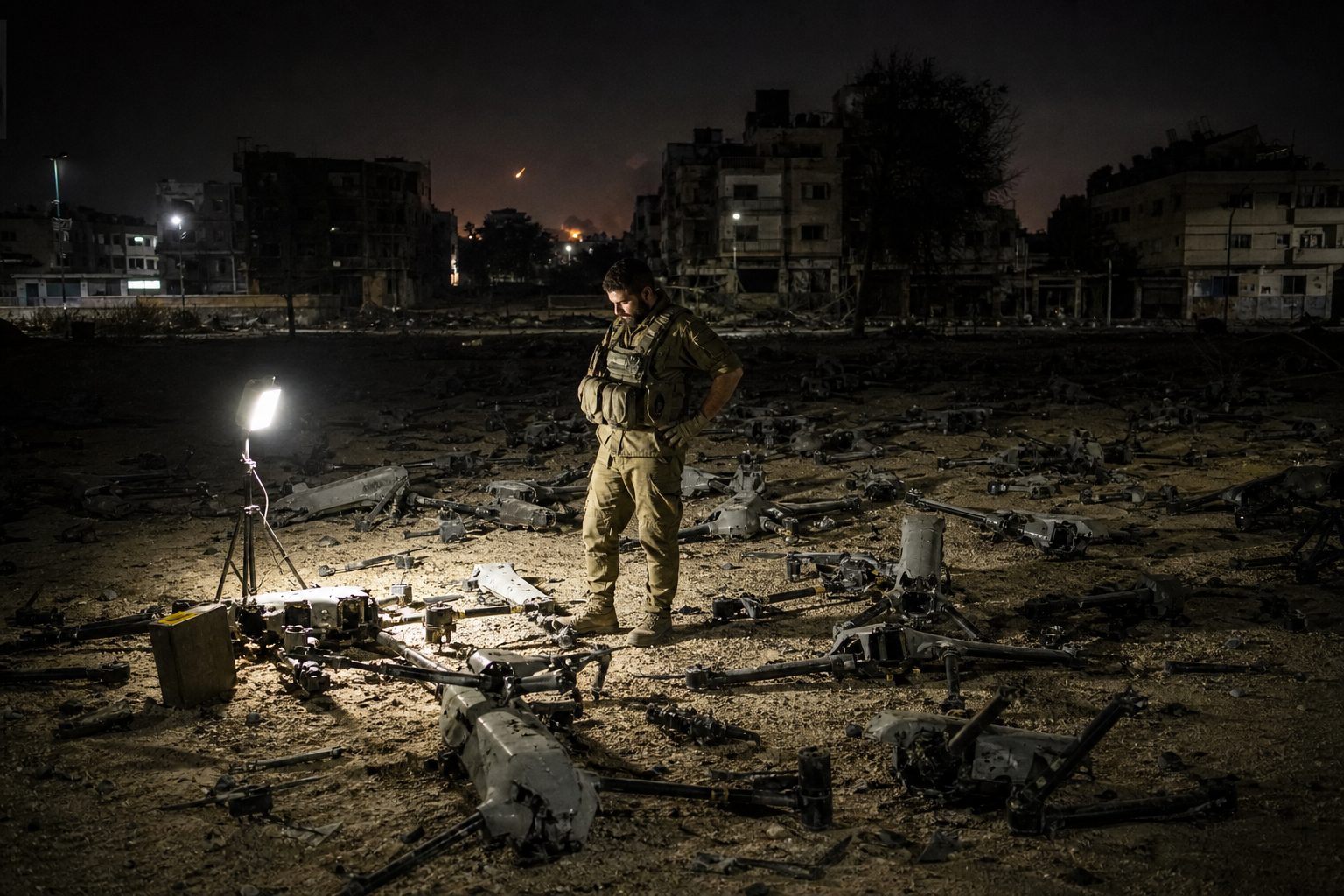
The first drone arrived around 3 a.m., announced not by light but by the rip of antiaircraft fire rolling through the blacked-out boulevards of Obeid, the besieged capital of Sudan's North Kordofan state. By spring 2026, near-daily drone barrages had scorched the highways, markets and a university campus there, turning simple errands into life-or-death gambles. In a Los Angeles Times photograph from the city, an army engineer stands in a graveyard of downed drones, the wreckage of this new air war gathered into a single frame.
Obeid is where a war many people stopped watching became hard to ignore. Sudan's civil war, now in its fourth year, has cost at least 150,000 lives and driven more than 14 million people from their homes, and it has done so lately by converting itself into one of the most drone-saturated conflicts on earth. Between January and April 2026, drone strikes killed at least 880 civilians in Sudan, more than 80 percent of all conflict-related civilian deaths recorded in that period, according to the United Nations. The UN's human rights chief, Volker Türk, calls armed drones "by far and away the leading cause of civilian deaths" in the conflict.
What began on April 15, 2023, as a power struggle between two generals, Abdel Fattah al-Burhan of the Sudanese Armed Forces (SAF) and Mohamed Hamdan "Hemedti" Dagalo of the Rapid Support Forces (RSF), over the paramilitary's absorption into the national army, no longer resembles that feud. It is now a network conflict. Its nervous system runs on imported unmanned aircraft, satellite communications, commercial satellite imagery and covert cargo flights, and its logistics web spans the Gulf, North Africa and the Sahel. The question that matters in 2026 is not only who is winning inside Sudan. It is whether the technology chain sustaining the war has already dissolved the country's borders, and what happens to Chad, Libya and the millions of civilians beneath the flight paths when it does.
A war measured in drone strikes
Al Jazeera has counted more than 1,000 drone attacks since the war began. The conflict monitor ACLED recorded a 600 percent increase in drone-related deaths in 2025 over the year before. The carnage concentrates in Kordofan and Darfur, in markets, hospitals, aid convoys and schools, a distribution that human rights groups read as strategy rather than accident.
Sudan's terrain made it easy prey. The country runs about 1,250 kilometers north to south and 1,390 kilometers east to west, most of it flat and offering little cover. Weapons that reach 2,000 kilometers or more, now fielded by both sides, can range across all of it. Drones have, in Al Jazeera's phrase, killed scores of civilians, crippled infrastructure and plunged Sudanese cities into darkness, knocking out fuel depots and power plants as readily as front-line positions.
Where the air forces come from
A UN arms embargo has formally covered Darfur since 2004, expanded in 2005 and policed since by a panel of experts whose reports catalog violations largely without consequence. It covers Darfur alone, a twenty-year-old map drawn for a war that has since gone nationwide and airborne. The embargo's fiction is visible in the inventories.

The SAF flies Iranian Mohajer-6 combat drones, supplied from late 2023, airframes that carry surveillance payloads and precision munitions over ranges near 2,000 kilometers. It fields local copies of Iran's Ababil-3 under the name Zajil-3, Turkish Bayraktar TB2s Egypt reportedly donated, Turkish-Pakistani YHIA-III systems and off-the-shelf DJI Mavic quadcopters. According to analysts at the American Enterprise Institute, Tehran's interest is a naval foothold on Sudan's Red Sea coast, the same prize for which Russia, after initially arming the RSF through its Wagner ties, switched sides in 2024 to back the army that controls the relevant shoreline.
The RSF has no air force at all, as a 2024 Amnesty International report documented. It has a drone fleet anyway: Chinese kamikaze drones with ranges up to 2,000 kilometers, the Chinese Wing Loong II, Serbian Yugoimport vertical-takeoff drones modified to drop mortar shells, and cheap commercial quadcopters carrying 120mm mortar rounds. By late 2024, humanitarian organizations had spotted heavy Chinese FH-95 drones, airframes rated to carry 200 to 250 kilograms and able to drop laser-guided bombs, parked at Nyala Airport in South Darfur. By 2026, Chinese BZK-005 aircraft had been reported in Nyala as well, the largest drones acquired by the RSF to date and evidence, ACLED says, that the UAE has sustained at least part of its supply pipeline despite the economic pressures of the ongoing conflict in the Middle East.
The results arrive by name and date. In April 2025, RSF drones struck the Sidon fuel depot in Atbara, in the army-held River Nile state, in a strike Al Jazeera's Sanad team verified on video. The same month, a video appears to document an RSF suicide drone that crashed into a home in al-Dabba, in Northern State; the post said it killed six people from one family, two of them children. In May 2025, days of RSF strikes hit Port Sudan, the de facto seat of the SAF government, damaging the airport and fuel and power infrastructure. By mid-2025 the RSF's long-range reach had become such a problem that the SAF withdrew aircraft to Eritrea for shelter, according to ACLED.
Then, on May 23, 2026, came a scene out of another century's fiction: a SAF Akinci fired a missile to intercept an RSF Akinci in mid-flight, only the second recorded case of drone-on-drone air combat in the war. Both sides fly the same Turkish-made aircraft, supplied through different intermediaries. ACLED called it "the clearest illustration of how arms flows bypass embargoes and geopolitical alliances."
The southern corridor: Libya to Nyala

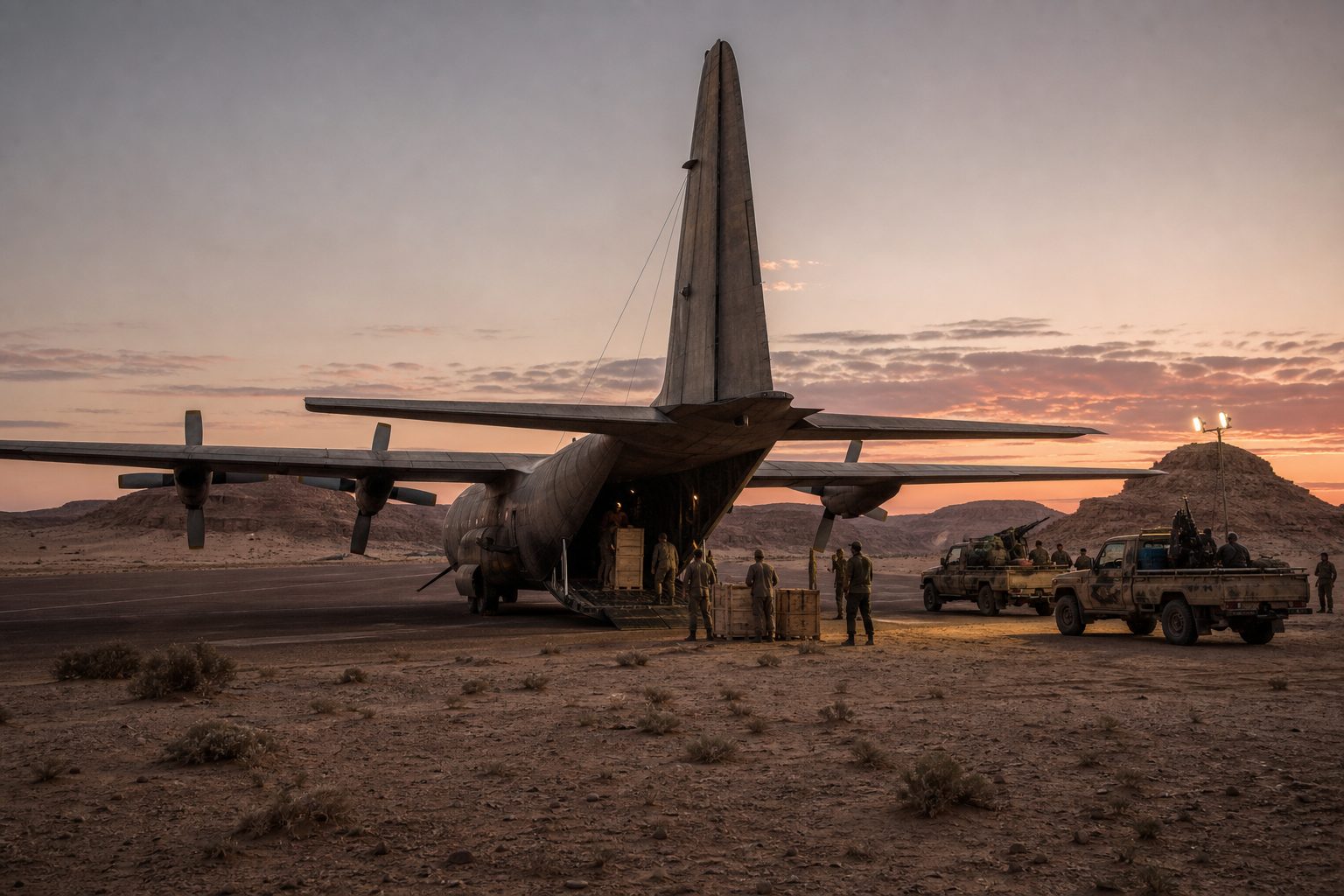
Ask investigators how a stateless paramilitary acquired strategic drones and they describe a corridor, not an order form. Since late 2024, the RSF has relied on an Emirati-backed supply network funneling Chinese hardware through Libya and Chad, ACLED reports, with foreign expertise to match: Ukrainian, Spanish and Colombian operators have been embedded in RSF units since mid-2025, most likely to run the drones. In August 2025, the SAF intercepted UAE-affiliated cargo flights carrying Colombian mercenaries at Nyala airport, a snapshot of how globalized the pipeline had become.
The route map keeps changing because it is hunted. The Global Initiative Against Transnational Organized Crime traces a base that hosted RSF-linked brokers around Amdjarass, just inside eastern Chad, from mid- to late 2023, with arms moving through the Chadian settlements of Bao and Kariari into Darfur. The New York Times and The Washington Post, drawing on US and UN officials, documented Gulf cargo flights into Amdjarass across 2023 and 2024; the UAE has repeatedly denied arming the RSF. As anti-RSF coalitions ambushed the corridor at Bir Mazza, Kulbus and Sayah inside Sudan, the network adapted by dispersing its transfer points, standing up a new hub at Bir Mirgui closer to the Libyan border.
The fuel trade shows what the whole system is made of: a high-volume smuggling operation in contraband Libyan fuel toward Sudan, controlled by actors tied to Khalifa Haftar's Libyan Arab Armed Forces on one side and the RSF on the other. In the borderlands, the Global Initiative notes, "the core commodity is permission itself," the fee for passage, the escort, the checkpoint stamp. War raised the price of permission, and raised the value of the men with guns who guarantee it.
The fight has therefore migrated to the plumbing. In May 2026, the SAF flew 70 air and drone strikes, steady with the two previous months, but aimed with new discipline at the arteries: 17 strikes in Nyala alone, the highest monthly total recorded there since the beginning of the conflict; strikes on RSF fuel shipments and markets near the Chadian frontier; and on May 15 a strike on an RSF convoy arriving from Libya, bound, reportedly, for El Fasher. Meanwhile the war's sponsors fight by proxy over the routes. Egypt and Saudi Arabia have pressed Haftar to stop supplying the RSF, and by April 2026 Riyadh financed an arms deal for his forces in an attempt to curb Emirati influence in the region, ACLED reports, while Sudan's SAF leans on Turkey and a Saudi-facilitated Pakistani pipeline whose April suspension reportedly did little to dent its strike rate.
Where this story sits
5 related pieces

Hover a story · click to read
 No. 15 · Aug 27, 2026Russia's Dawei Bet: A Megaport on the Front Line of Myanmar's Civil War
 No. 29 · Sep 3, 2026The Helium Chokepoint: What Qatar's Shutdown Revealed About Semiconductor Supply Chains
 No. 65 · Oct 11, 2026Wagner's Sahel Drone War: What Three Years of Evidence Actually Show
 No. 35 · Sep 5, 2026China's quiet rare-earth chokepoint on U.S. defense and chip supply chains
 No. 17 · Aug 27, 2026The Kidnappers Outsmart Nigeria’s Surveillance State
Chad: the border that stopped working
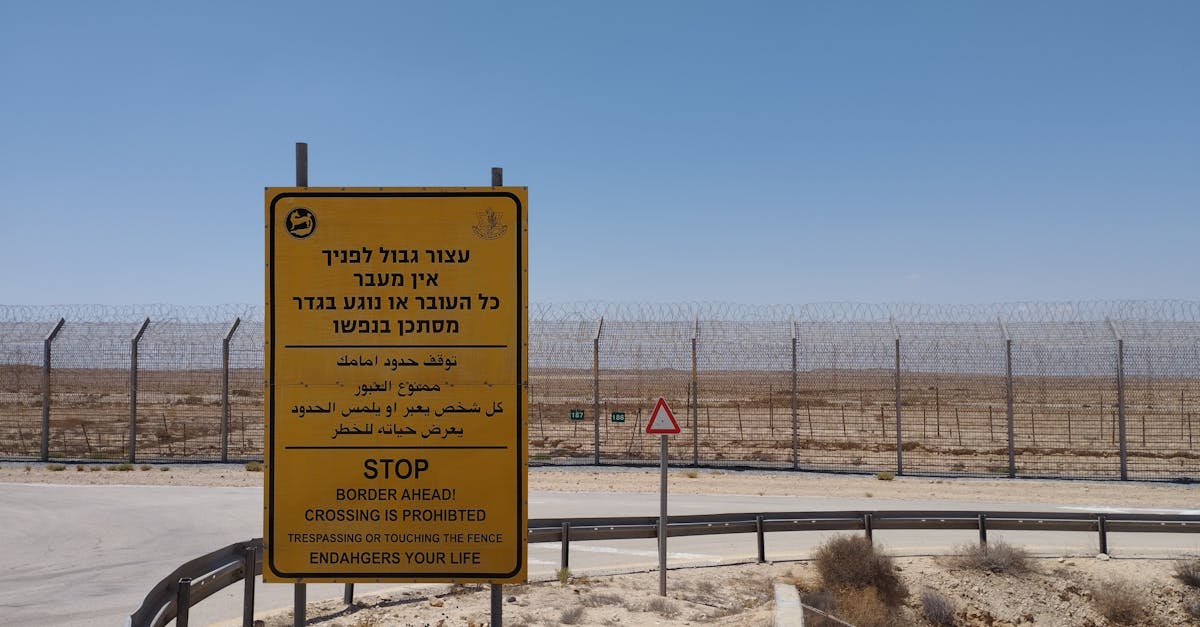
Chad spent three years trying to hold Sudan's war at arm's length. That ended on February 21, 2026. Clashes between RSF- and SAF-aligned forces in the twin border towns of Tiné spilled across the line, killing five Chadian soldiers and three civilians. N'Djamena responded by closing its eastern border indefinitely, citing "repeated incursions and violations by forces involved in Sudan's conflict," an admission, the Global Initiative writes, that informal deconfliction had failed.
The Tiné deaths did not arrive out of nowhere. RSF drone strikes and incursions had hit Chadian border forces in late 2025 and early 2026, and the strikes have reportedly continued since. The Global Initiative reads the sequence as a strategic shift: from incidental spillover to deliberate projection of force into Chadian territory.
Chad's internal politics make it flammable. The border economy runs through Zaghawa communities with ties to the anti-RSF coalitions of Darfur, so every convoy that crosses armed and every checkpoint that taxes it lands on top of a political fault line. The country also shelters one of the war's largest refugee populations, more than 600,000 Sudanese arrivals since April 2023 by the UN refugee agency's count, along the same roads that move the weapons. Chad is the only Sahelian state not already consumed by internal armed conflict. If that insulation fails, the Global Initiative warns, a continuous belt of instability would stretch from Mali to Sudan's Red Sea coast, merging the conflict dynamics of Sudan, Libya and the Sahel at a scale not yet seen.

There is an older pattern underneath it. Sudan's western deserts have served as the rear area for other people's wars for forty years; Libya's 1980s war in Chad ran through the same frontier, and Hemedti's own RSF grew out of the Janjaweed militias Khartoum mobilized for Darfur's war two decades ago, then formalized under Omar al-Bashir in 2013, then sent to fight in Yemen, where Hemedti built the Gulf relationships that now arm him. What has changed is not the geography. It is the altitude.
Satellites, Starlink and the targeting question
The war's least visible weapon has been disconnection. Within hours of the first shots in April 2023, the regulator asked MTN Sudan to cut service, and national traffic fell 60 percent, according to the Tahrir Institute for Middle East Policy. In February 2024, the RSF's seizure of ISP data centers in Khartoum produced a month-long nationwide blackout, broken in early March largely when Zain and Sudani rebuilt infrastructure in Port Sudan. Shutdowns hid atrocities, severed remittances through apps like Bankak, whose activations surged 85 percent as cash vanished, and left civilians unable to warn their own families.

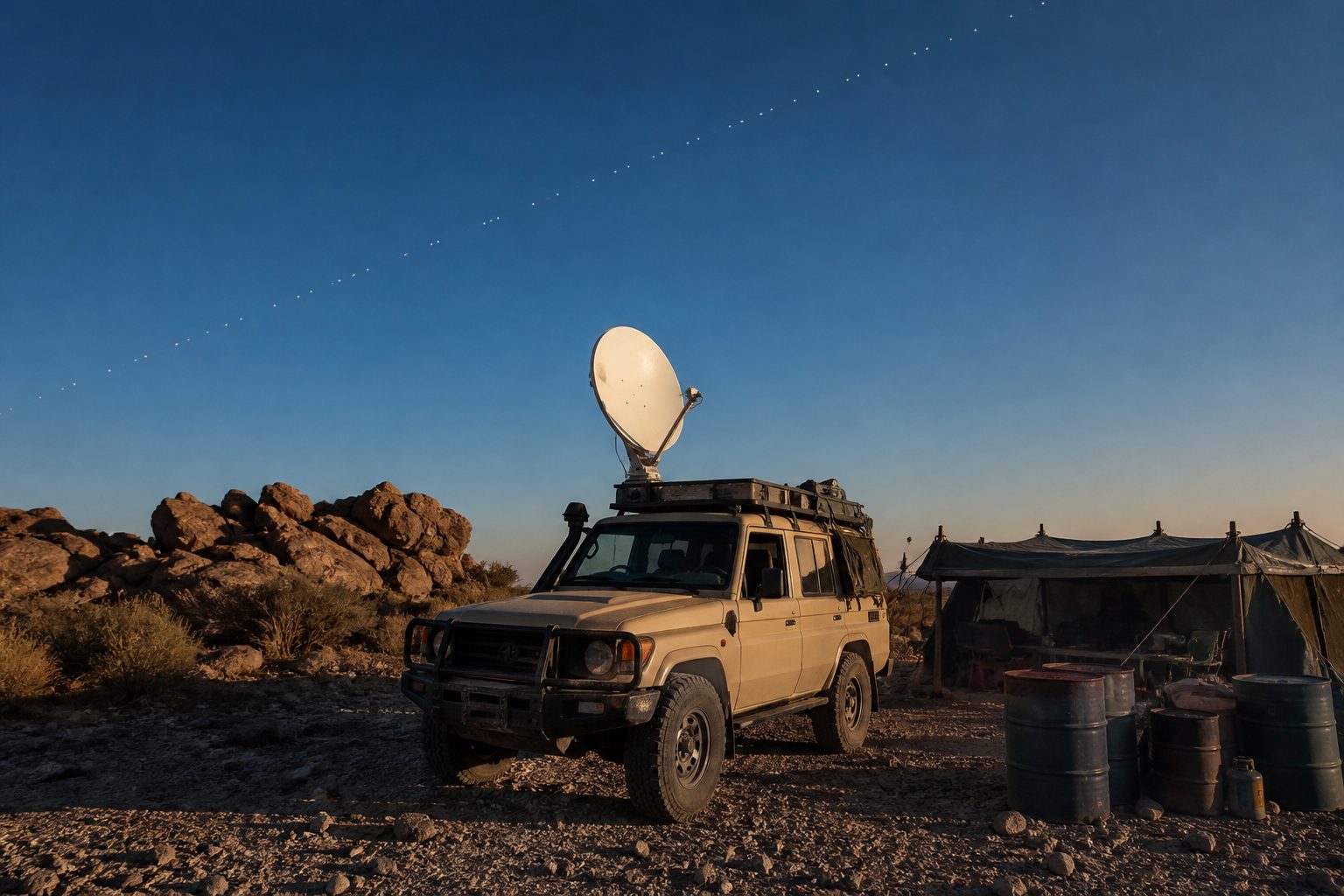
Into that darkness came satellite internet. Starlink terminals, never formally licensed in Sudan for most of the war, spread through the same porous border economy that carries fuel and weapons, activated on roaming plans registered abroad and sold at prices only the desperate pay. For doctors and families they have offered what the Tahrir Institute calls a "glimmer of hope" for civilians desperate to stay connected and informed. The corollary is obvious, and uncomfortable: the same dish that lets a hospital call for blood lets anyone on the ground share a grid reference. The terminals are dual-use by design.
Whether smuggled Starlink traffic has actually fed live targeting to remote drone operators remains an open question. No publicly available evidence reviewed for this story establishes that link, and it is worth saying so plainly. What investigators have documented is a targeting chain with no such ambiguity, and it is worse.
In El Fasher, the last contested city in Darfur before the RSF's final assault in October 2025, Nathaniel Raymond's team at the Yale School of Public Health's Humanitarian Research Lab reconstructed the mechanics from satellite imagery and open-source evidence. Fixed-wing drones, Chinese-made CH-95 or FH-95 models flying roughly 150 miles north from Nyala, loitered over the city gathering communications data, Raymond told Scripps News, locating where people hid, blocking calls for help and choking the flow of video. Then came the small quadcopters, launched from along the earthen berm the RSF had built to seal escape, aimed at bomb shelters, mosques, community kitchens and schools. "They were hunters," he said.
At the Al-Safiya Mosque in October, seventy-eight people died when a drone took the corrugated roof at an angle and turned it into shrapnel funneled down into the body of the building. "The arc was so precisely planned," Raymond said, "that if it wasn't horrific, it would be elegant." The same forensic apparatus that documents the killing now dissolves the alibis. On March 20, 2026, the first day of Eid al-Fitr, a drone hit the El Daein Teaching Hospital in East Darfur twice, killing 70 people, among them 13 children and three medical staff, and wounding 146 more, per the World Health Organization. The Sudanese rights group Emergency Lawyers reported the strike was carried out by an SAF drone; the army denied targeting the hospital; two military officials told the Associated Press the intended target was a nearby police station. Yale's researchers looked at the police station and found it untouched. "We can really get crime scene level data," Raymond said, "like we're dealing with a handgun in a homicide." That is what falls away first when states fight with drones: deniability. The aircraft goes where someone directs it, and the satellites over Sudan are watching.
The limits of the machine

None of this means drones are deciding the war, and the honest evidence cuts against any version of that claim. The SAF's strike tempo held at roughly 70 a month through spring 2026 even as the Pakistani pipeline reportedly closed, a story of substitution and adaptation, not of a wonder weapon. The RSF's strike rate has declined for three straight months, ACLED finds, and the cause the monitor signals is mundane: disrupted supply. When El Fasher finally fell, drones hunted the trapped population, but what broke the city was a siege, a starvation campaign and a ground assault, the oldest tools in the region's armory, backed by famine formally declared at the nearby Zamzam camp as early as August 2024 and documented ethnic cleansing of the Massalit in West Darfur that predates the heavy drones entirely.
ACLED's own forecast is sobering in both directions: air campaigns to soften Darfur before rainy-season ground offensives, RSF consolidation with rare but high-impact strikes, and, even in stalemate, "a state of perpetual but lower-intensity violence." The technology, in that reading, has not resolved anything. It has lowered the cost of never resolving anything.
Paper shields
The institutions built for the last Darfur war remain structurally mismatched to this one. The UN embargo still covers Darfur only, monitored by a panel of experts whose findings accumulate without enforcement. The United States determined in January 2025 that the RSF had committed genocide and sanctioned Hemedti, then sanctioned al-Burhan and army-linked entities days later; the corridors absorbed the penalties and kept moving. When the UK put an immediate ceasefire resolution before the Security Council in November 2024, Russia vetoed it. No UN or African body has a mandate, let alone the aircraft observation posts and flight-registry audits, to police the Chad and Libya corridors through which the RSF's heavy air power flows. The International Criminal Court says it is collecting fresh Darfur evidence; the same satellite forensics that attribute strikes now may be the strongest accountability mechanism on offer.
The triangle, August 2026

As of late August 2026, the war's center of gravity is sliding toward the triangle where Sudan, Libya and Egypt meet. Both armies are massing there, and ACLED assesses it will probably be the next decisive battleground, fought during the rainy season that peaks this month. Chad's border remains officially closed. The smuggling corridors adapt around each new interdiction. And over Obeid the drones still come around 3 a.m., piloted by someone who may be sitting hundreds of kilometers away, fed by supply lines crossing jurisdictions that officially prohibit them.
The story the evidence tells is not that one gadget changed the war. It is that a complete logistical ecosystem, drones built in China and Iran and Turkey, brokers in Chad, fuel from Haftar's Libya, cash from the Gulf, satellite dishes on contraband roaming plans, has been assembled across four borders precisely because no single state controls it, monitors it or answers for it. Sudan's border is being erased, but not by armies marching. It is being erased by supply chains and flight plans, one cleared customs form and one armed sortie at a time, and the people underneath, in Tiné and Obeid and the camps of Adré, are the ones paying the tariff.
Sources / References
- Nabih Bulos, "Drones turn Sudan's 'forgotten' war into a relentless civilian killing field," Los Angeles Times, May 24, 2026. https://www.latimes.com/world-nation/story/2026-05-24/drones-turn-sudans-forgotten-war-into-relentless-civilian-killing-field
- Nohad Eltayeb and Ali Mahmoud Ali, "How has Sudan's drone war adapted to shifting supply lines?" ACLED, 2026. https://acleddata.com/report/how-has-sudans-drone-war-adapted-shifting-supply-lines
- Alexandre Bish, "How border criminal economies are drawing Chad further into Sudan's conflict," Global Initiative Against Transnational Organized Crime, March 6, 2026. https://globalinitiative.net/analysis/how-border-criminal-economies-are-drawing-chad-further-into-sudans-conflict/
- "The drones being used in Sudan: 1,000 attacks since April 2023," Al Jazeera, February 3, 2026. https://www.aljazeera.com/news/longform/2026/2/3/drone-warfare-in-sudan-tracking-1000-aerial-attacks-since-april-2023
- Jason Bellini, "Sudan's drone war: How unmanned aircraft became the deadliest weapon against civilians," Scripps News Investigations, 2026. https://www.scrippsnews.com/investigations/sudan/sudans-drone-war-how-unmanned-aircraft-became-the-deadliest-weapon-against-civilians
- Yale School of Public Health, Humanitarian Research Lab, El Fasher conflict analyses (2025), as described in Scripps News.
- "Drones over Sudan: Foreign Powers in Sudan's Civil War," American Enterprise Institute. https://www.aei.org/articles/drones-over-sudan-foreign-powers-in-sudans-civil-war/
- "Internet in Conflict: Sudan's Battle for Connection," Tahrir Institute for Middle East Policy, September 19, 2024. https://timep.org/2024/09/19/internet-in-conflict-sudans-battle-for-connection/
- The New York Times, reporting on the UAE's role in Sudan's civil war, September 21, 2024. https://www.nytimes.com/2024/09/21/world/africa/uae-sudan-civil-war.html
- The Washington Post, reporting on new UAE- and Iran-linked weapons in Sudan, October 15, 2024. https://www.washingtonpost.com/world/2024/10/15/sudan-war-weapons-uae-iran/
- Amnesty International, report on new weapons fuelling the Sudan conflict, 2024.
- UN Security Council, final report of the Panel of Experts on the Sudan established pursuant to resolution 1591 (2005), January 2024.
- UNHCR Sudan emergency refugee registration data, 2024 to 2026.
- IPC Famine Review Committee, famine declaration for Zamzam displacement camp, August 2024.
- Human Rights Watch, "The Massalit Will Not Come Home": ethnic cleansing and crimes against humanity in El Geneina, West Darfur, May 2024.
- US Department of State and Treasury, Sudan genocide determination and related sanctions, January 2025.
- UN Security Council proceedings: Russian veto of the draft ceasefire resolution on Sudan, November 2024.
- Associated Press reporting on the May 2025 drone strikes on Port Sudan and the March 2026 El Daein hospital strike.
Comments (6)
Continue exploring
Wagner's Sahel Drone War: What Three Years of Evidence Actually Show
Russian jets, Turkish drones and untested air defenses have reshaped the war in Mali, Burkina Faso and Niger since 2022, but the…
China's quiet rare-earth chokepoint on U.S. defense and chip supply chains
Chinese rare-earth exporters are reportedly refusing U.S. orders even where licenses exist. Inside the licensing, sanctions, and…
The Kidnappers Outsmart Nigeria’s Surveillance State
Nigeria has more tools to track kidnappers than ever, but fragmented data systems and slow institutional response leave criminal…
Expanding the 2004 Darfur embargo to cover all of Sudan, which the article strongly implies is overdue, would still run into the basic enforcement problem that the existing panel of experts has catalogued violations largely without consequence for twenty years.
Reading the description of Obeid, the antiaircraft fire at 3 a.m., the engineer standing among downed drones, the highways turned into life-or-death gambles, reminded me vividly of conversations I had with displaced people from North Kordofan in 2024 who described the same soundscape. The detail about DJI Mavics being fielded alongside longer-range systems matched what I heard repeatedly from local fighters who were almost proud of their improvised setups. The piece finally gave me a clearer framework for what those conversations were circling around. I keep going back to the Los Angeles Times photo caption because it captures something I struggled to put into words myself.
The article's conclusion that the technology chain sustaining the war has already dissolved Sudan's borders is a striking claim, but the evidence presented consists mostly of arms origins (Iran, China, the UAE, Turkey) rather than any explicit demonstration that Sudan's sovereignty has been meaningfully eroded. The supply chains described could be consistent with a government actively importing weapons through normal procurement channels, especially on the SAF side. What specific indicators does the article cite that go beyond foreign sourcing to show that border control itself has collapsed? I'd want to see customs data, intercept records of the covert flights through Chad and Libya, or testimony from Sudanese officials before accepting that framing.
I found the Where the air forces come from section probably the most useful, because it lays out specific airframes, including the Mohajer-6, the FH-95 and the Akinci, and ties each one to a documented supplier and route. That level of granularity made it possible to follow the rest of the argument about external enablers without getting lost. I was slightly less convinced by the inferences drawn from individual strikes, but the inventory section stood on its own. If anything, I would have liked an even longer breakdown of the RSF's procurement chain given how many disparate systems they appear to be running simultaneously.
The article frames drones as the defining story of the war, yet it also notes at least 150,000 deaths over four years, a toll that pre-dates the drone saturation by years and almost certainly reflects large-scale ground combat, artillery and ethnic massacres that the piece barely mentions.
The line a scene out of another century's fiction about the Akinci-versus-Akinci mid-air intercept genuinely stopped me scrolling for a second. Two Turkish drones fighting each other over Sudan, both sides flying the same airframe through different middlemen, is a wild image and it also seems to undercut the clean SAF-versus-RSF framing the piece started with. It suggests the war is increasingly being fought with whoever's logistics network delivered that month. Hard to read that paragraph and still think this is really about two generals and their original quarrel.