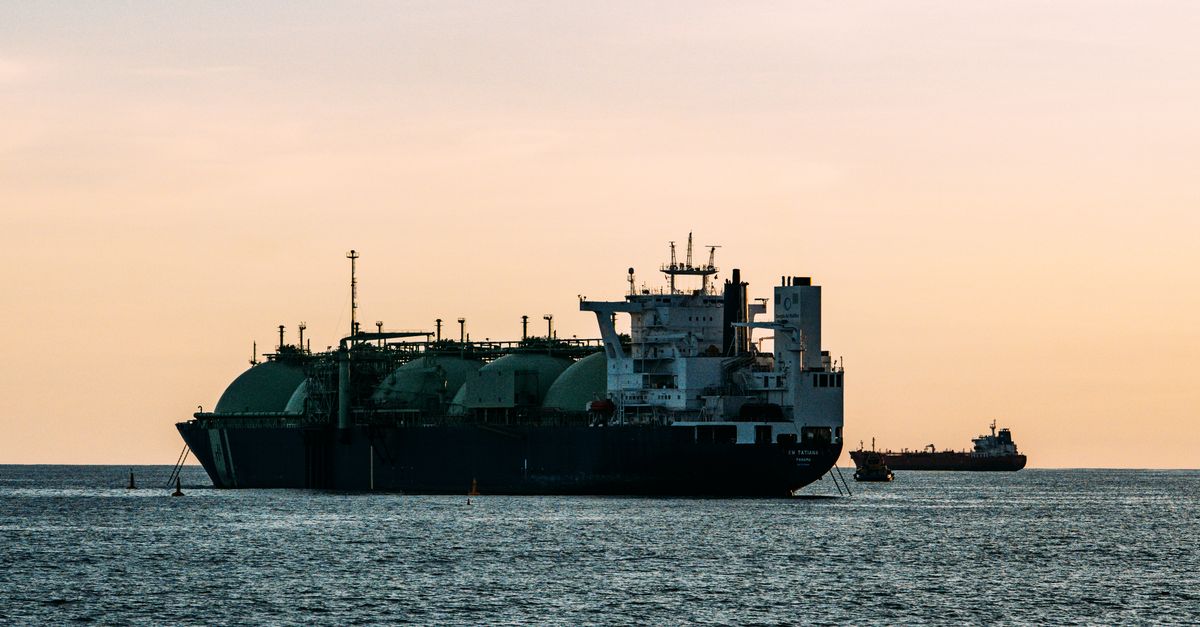
On March 2, 2026, days after the United States and Israel launched strikes on Iran, Iranian retaliation reached Ras Laffan Industrial City, the natural gas complex on Qatar's northern coast with capacity to produce 77 million metric tons of liquefied natural gas a year. Qatar suspended LNG exports after the attack. The halt reached beyond the gas trade. Ras Laffan is also the origin point of essentially all Qatari helium, stripped from natural gas as a trace byproduct, so when the LNG trains went quiet, roughly a third of the world's helium supply went with them.
By mid-March, spot helium prices had surged an estimated 70 to 100 percent, and the global market was short about 5.2 million cubic meters of helium per month, according to Aleksandr Romanenko, founder of the market research firm IndexBox. On March 26, industry executives told Reuters the tightening supply had begun to affect parts of the global technology supply chain.
Helium cools the superconducting magnets inside MRI scanners, carries gases into deposition chambers, and keeps the most advanced lithography tools from overheating. In those roles it has no practical substitute. The 2026 conflict turned an obscure corner of the industrial gas business into a live stress test, and it raised two questions that outlast any ceasefire: how deep does the exposure actually run, and which of the available mitigations, from recycling to storage to recontracting, can genuinely reduce it?
Why a third of the world's helium rides on Qatari LNG

Helium is not produced on its own schedule. It accumulates underground alongside natural gas, where it typically makes up just 0.3 to 0.5 percent of a reservoir's contents. Separating it requires cryogenic processing so capital-intensive that it pays only where enormous volumes of gas are already being liquefied, according to an IDTechEx analysis. That economic logic is what made Ras Laffan the anchor of the world helium market: the complex hosts what QatarEnergy LNG calls the world's largest helium plant, a University of Virginia assessment notes. Qatar's helium exists because the world wanted Qatar's gas.
The supply base that results from this byproduct economics can be counted on one's fingers.
| Country | Helium production, 2024 (million cubic meters) |
|---|---|
| United States | 81 |
| Qatar | 64 |
| Russia | 17 |
| Algeria | 11 |
| Canada | 6 |
| China | 3 |
| Poland | 3 |
Source: US Geological Survey, Mineral Commodity Summaries 2025. Figures are estimates; the US total combines helium extracted from natural gas with output from the Cliffside Field. USGS rounds the world total to about 180 million cubic meters.
Seven countries produced essentially all the world's commercial helium in 2024, and the top two, the United States and Qatar, account for roughly 80 percent of it. Qatar alone supplies about a third and holds what IDTechEx calls the largest known reserves, more than 10,000 million cubic meters. The US Geological Survey is more cautious: it lists Qatar's reserves only as "large" and puts measured US reserves at 8,500 million cubic meters, the largest figure in its table.
On the buying side, dependence is uneven but deep where it bites. Qatar supplied 40 percent of US helium imports over 2020 to 2023, with Canada at 36 percent, per USGS. South Korea reportedly sourced about 65 percent of its helium from Qatar in 2025, while Taiwan reportedly splits roughly two-thirds of its supply between Qatar and the United States, with the rest diversified. The Virginia analysis, which works from transaction-level trade data, finds that Germany, China, South Korea, Taiwan, Japan, and Singapore are all heavily reliant on Qatar for rare gas imports, and that most of the risk runs through a handful of corridors, especially flows from Qatar and the UAE to the United States, India, and Pakistan. Its firm-level mapping shows a division of labor: QatarEnergy LNG and Qatargas anchor upstream production, companies such as Air Products and Air Liquide act as regional storage and redistribution hubs, specialist carriers like HOYER and Gulf Agency Company move the product, and gas majors including Linde, Taiyo Nippon Sanso, and Matheson absorb it into customer portfolios. End users are scattered across the globe; the points of failure are not.
What helium does inside a chip fab
A leading-edge fab etches billions of transistors onto silicon wafers 12 inches across, and helium touches the process at nearly every stage. It is the carrier gas that delivers precursor chemicals in deposition, a dilutant in plasma etching, the coolant that keeps wafers from warping under thermal stress, and the refrigerant for the extreme ultraviolet lithography systems used to print sub-5nm chips, the node class behind current AI accelerators. Between production runs, its atoms, the smallest and most slippery of any element's, are used to leak-test pipelines and tools, and it provides the ultra-clean atmospheres some steps require. It performs all of this because it is chemically inert, exceptionally thermally conductive, and has the lowest boiling point of any element, 4.2 kelvin.

No other gas does those jobs at commercial scale. IDTechEx states flatly that helium has no direct substitutes in semiconductor manufacturing, and the Virginia analysis concludes the same for many cryogenic applications. The American Chemical Society has described helium as endangered and irreplaceable, noting that once released it rises until it escapes the atmosphere entirely, the only element that is truly gone.
Beyond fabs, the exposure spreads across precision manufacturing and medicine. USGS breaks down 2024 US consumption as: analytical, engineering, laboratory, and specialty gases at 22 percent; lifting gas at 18 percent; MRI at 17 percent; controlled atmospheres, fiber optics, and semiconductors at 15 percent; welding at 8 percent; aerospace pressurizing and purging at 7 percent; leak detection at 5 percent; and diving at 5 percent, with various other minor applications taking the remaining 3 percent. MRI scanners depend on liquid helium to hold their magnets near absolute zero, so a sustained supply shock threatens hospital imaging capacity as reliably as it threatens chip output.
And demand is climbing into the shortage. IDTechEx forecasts helium demand from semiconductor manufacturing growing more than fivefold by 2035, with total demand nearly doubling, driven by the same AI and high-performance-computing buildout that was already straining chip capacity when the missiles hit Ras Laffan. The shock arrived at the moment of peak dependence.
How exposed are semiconductor supply chains to the outage?
Helium's physics sets the market's clock. It is moved as a liquid, and it leaks from storage containers at roughly 1 percent a day by industry estimates cited by IDTechEx. It is expensive to hold, and as the Virginia report puts it, chokepoint delays do not just postpone deliveries, they destroy product. Not even the largest fabs can simply buy a year of helium and shelve it.
So the industry runs on thin buffers. Large fabs such as TSMC typically carry a few months of inventory and operate helium recycling systems, according to IDTechEx, and whether they can ride out a disruption depends on how long it lasts. A stoppage of several months, the firm warns, would have serious consequences for the industry.
The price signal arrived first. The 70 to 100 percent spot increase IndexBox estimated in mid-March came against a 2024 US base price of about $14 per cubic meter. Volume math was just as stark: Romanenko's estimated 5.2 million cubic meters of missing monthly supply is almost exactly Qatar's annual output divided by twelve.
There are qualified counterweights. Phil Kornbluth, president of Kornbluth Helium Consulting, argues the market entered the conflict well supplied, and he expects supply to return to previous levels once Qatari production normalizes. His warning attaches to the other timeline: he cautions that "as soon as pre-crisis inventories are consumed and as long as supply from Qatar is shut down, the helium market will experience a significant shortage." IDTechEx adds that even a partial restart leaves a backlog that will work through the value chain.
The defensible verdict is conditional. Weeks of disruption are a price problem. Months of disruption are a production problem. Exposure is graded by sourcing: a buyer drawing 65 percent of supply from Qatar sits in a different position from a diversified buyer, or from the United States, which is a net helium exporter overall (about 42 million cubic meters exported against 12 million imported in 2024, per USGS) yet still takes roughly 40 percent of its imports from Qatar and sits on one of the corridors the Virginia team flags as most concentrated. Its authors conclude that sustained Strait of Hormuz instability could produce meaningful supply stress in both the United States and the advanced Asian economies.
Where this story sits
5 related pieces

Hover a story · click to read
 No. 35 · Sep 5, 2026China's quiet rare-earth chokepoint on U.S. defense and chip supply chains
 No. 70 · Oct 16, 2026Day 30 Without Supply: Why America's Older Weapons May Outlast Its Newest Ones
 No. 18 · Aug 28, 2026How drones, Starlink and covert flights through Chad and Libya are redrawing Sudan's war
 No. 45 · Sep 12, 2026China's Supply Chain Chokepoints: What De-Risking Costs, and Whether It Works
 No. 51 · Sep 19, 2026The three-day shutdown: what actually breaks when Taiwan, helium, and rare earths fail together
Could other suppliers fill the gap?
Kornbluth's arithmetic shows how thin the bench is. Russia's Amur 2 plant, recently commissioned by Gazprom, could replace about 600 to 700 million cubic feet (roughly 17 to 20 million cubic meters). A storage plant in Germany could replace about 300 million cubic feet (roughly 8.5 million cubic meters). US storage caverns could add some volume. Total it up and, his conclusion is blunt: "only around half of the lost supply from Qatar can be replaced."

Politics shrinks the bench further. The European Union adopted a sanctions package on June 25, 2024 that banned helium imports from Russia, effective September 26, 2024, and Russian output is largely inaccessible to Western buyers in general. Amur's spare molecules mainly help customers outside the sanctions regimes; they are not a relief valve for Rotterdam or Busan.
Supply that does not yet exist is slower still. New helium capacity still arrives mostly as a passenger on giant gas projects; primary-helium exploration plays exist, but none yet at Gulf scale. In 2024, worldwide output grew about 4 percent, helped by three new Canadian facilities and four new US operations, the strongest kind of year the industry manages, and still a rounding error against the loss of 64 million cubic meters.
What the market can do in a squeeze is ration by price. Nearly a fifth of US helium goes to lifting gas, the balloons and airships of the demand table, and in a squeeze those are the uses priced out first, leaving spot molecules for the fabs and hospitals that have no alternative. That is allocation, not supply.
Why helium is so hard to stockpile
Every mitigation eventually collides with the same physics: helium does not want to be stored. Vented gas is gone permanently, liquid inventory boils off in transit, and a container parked on the wrong side of a closed strait is a depreciating asset. For most of a century the world had an answer to this problem, and two years before the war it sold the answer.
The Federal Helium System, built around the Cliffside Field reservoir and a government crude-helium pipeline in Texas, was the market's strategic buffer. The Helium Stewardship Act of 2013 mandated the system's privatization, and the government auctioned its conservation helium through a final sale in summer 2018. Management passed from the Bureau of Land Management to the General Services Administration in December 2022, and on January 25, 2024, the government sold the rest in two lots, about 50 million cubic meters of crude helium plus the system's physical assets, to a single private buyer. The transfer closed June 27, 2024. Within months, the lease on the purification unit at Cliffside lapsed without a replacement, and the District Court of Amarillo allowed the new owner to keep the equipment running to preserve domestic supply while negotiations continued. No agreement had been reached by year's end.
The United States therefore entered the 2026 crisis without a public helium reserve. The buffers that remain are the German storage plant Kornbluth cites, private cavern capacity, and the leaking inventories at fabs and gas distributors.
Washington was not asleep to mineral risk in general. The Pentagon sought fresh supplies of 13 critical minerals the day before the first strikes on Iran, Reuters reported on March 4. For helium, though, the stockpile lever no longer exists. It had been privatized into someone else's balance sheet.
How far can recycling stretch supply?
Recycling is the strongest near-term technical mitigation, and the least dramatic. The method is straightforward: capture gas that would otherwise vent, including boil-off from liquid systems, purify it, and re-liquefy it. Every molecule recovered is a molecule that does not need to cross the Strait of Hormuz.
Practice varies sharply by region and application. USGS notes that large-volume helium use in the United States is seldom recycled, with recovery confined mainly to low-volume and liquid boil-off systems, while recycling is more common in the rest of the world. Leading chip manufacturers already capture and reuse helium inside their fabs, which is part of why companies like TSMC can stretch months of inventory.
The honest limit is that recycling is a multiplier on inventory, not a source of supply. It thins a fab's intake requirement; it cannot produce helium during a total outage, and the systems that deliver it are capital equipment installed in calm years, not improvised in a crisis. The MRI side tells the same story: recovery and re-liquefaction at imaging centers cuts net consumption, but the magnet still drinks what the recycler cannot catch.
Which contracts and shipping lanes decide who keeps running?

The remaining levers are commercial and logistical, and the market is already pulling them. Samsung and SK Hynix, sitting behind South Korea's reported 65 percent dependence on Qatari helium, have reportedly moved to secure long-term supply agreements. Taiwan's split sourcing, reportedly about two-thirds from Qatar and the United States combined and the remainder diversified elsewhere, shows what deliberate diversification buys when a single corridor fails.
The Virginia assessment urges policymakers and firms to go further down the same path: corridor-level monitoring, tracking of the upstream facilities that actually matter, and contingency planning concentrated on the most exposed lanes and companies rather than diffuse global averages. Its central finding is that this crisis is not a diffuse market shock but a corridor-specific failure centered on a narrow set of exporters, routes, firms, and facilities, which means remedies can be targeted the same way.
Even perfect contracting, though, still has to cross water. Helium leaves the Gulf in liquid form through a logistics layer handled by a small set of specialist carriers, and the Strait of Hormuz, which normally carries about 20 million barrels of oil a day, is its only exit. UN Trade and Development warned that the fighting beginning in late February choked traffic through the strait and sent ripples through maritime supply chains. As of April 9, traffic remained well below normal even after a ceasefire, with carriers cautioning that restoring normal network operations would take time, and the effects of a US blockade that began April 13 had yet to register, according to reporting compiled in the April 15 Virginia assessment. Restored production and restored shipping are separate problems, and relief arrives only when both are solved.
What the shock settles, and what it doesn't
Read together, the evidence supports a clear and uncomfortable picture. The world's semiconductor and precision-manufacturing supply chains are highly exposed to Qatar-linked helium in structure, but conditionally exposed in practice. Roughly a third of supply flows from one coastal complex as a byproduct of someone else's energy trade. Inventories measured in months, plus recycling, keep fabs running through a short interruption at painful prices. Beyond that horizon, the math fails: only around half of Qatar's lost volume can be replaced from elsewhere, Europe's import ban walls off part of the available replacement supply, substitution does not exist for the uses that matter most, and the public reserve that once buffered exactly this scenario was sold two years before the war.
What the shock has settled is the direction of travel. Buyers are recontracting for longer terms and broader sourcing, recycling investment looks different when the alternative is an idle EUV tool, and helium has acquired a place in the same conversations that governments were already having about critical minerals on the eve of the war.
What it has not settled is duration, and duration decides everything else. If Ras Laffan returns quickly, Kornbluth's forecast holds and the episode becomes an expensive warning. If the outage or the shipping disruption stretches for months, inventories drain, recycling reaches its ceiling, and the shortage he describes arrives in fabs and imaging centers rather than just in spot prices.
Either way, the structural fact remains after the smoke clears. A gas that cannot be substituted, can barely be stored, and escapes the planet when spilled now sits inside the supply chain for the chips behind the AI buildout and the scanners behind modern medicine, and a third of it arrives as an afterthought of an energy business the technology industry does not control. The war did not create that arrangement. It merely made it impossible to keep ignoring.
Sources and references
- Fareed Rahman and Alvin R. Cabral, "Iran war puts 'endangered' helium supplies at risk as Qatar halts exports", The National, March 18, 2026.
- Shababa Selim, "Beyond Oil: Middle East Tensions Chokehold Global Helium Supply", IDTechEx, March 27, 2026.
- Robert C. Goodin, "Helium," Mineral Commodity Summaries 2025, US Geological Survey, January 2025.
- "Threats to the Persian Gulf Helium Supply Chain", National Security Data and Policy Institute, University of Virginia, April 15, 2026.
- "Helium shortage has started impacting tech supply chains, execs say", Reuters, March 26, 2026.
- "Pentagon sought fresh supply of 13 critical minerals day before Iran attack", Reuters, March 4, 2026.
- Emmanuel Ashemiriogwa, "How Iran Crippled World's Second-Largest Helium Producer", Data Explained, March 31, 2026.
Comments (7)
Continue exploring
How drones, Starlink and covert flights through Chad and Libya are redrawing Sudan's war
What began as a power struggle in Khartoum is now a drone war supplied through Chad and Libya, connected by smuggled satellite…
China's Supply Chain Chokepoints: What De-Risking Costs, and Whether It Works
Export controls on minerals, medicines, circuit boards, and legacy chips have turned supply chains into instruments of coercion…
The three-day shutdown: what actually breaks when Taiwan, helium, and rare earths fail together
U.S. planning treats Taiwan, helium, and rare earths as three separate chokepoints. The 2026 record says otherwise. A mapped…
Could you do a follow-up that tries to quantify what closed-loop recycling at advanced fabs is actually contributing today, and whether that capacity could realistically absorb a Ras Laffan-scale shock if it happened again in 2027?
One thing the piece doesn't quite wrestle with is the Cliffside Field caveat - the US figure of 81 million cubic meters bundles federal reserve output with private extraction, which makes the headline gap to Qatar look narrower than it really is operationally. Also, even though the article flags that helium is irreplaceable in deposition and leak-testing, fabs have been quietly expanding closed-loop recycling for years, and it's worth asking how much of that buffer actually showed up during the March squeeze. The piece gestures at recycling as a mitigation but never really quantifies it, which feels like the missing piece for anyone trying to model what happens next.
I sit on a procurement team at a memory fab in Taiwan, and when the March notices started coming through we did start getting allocation calls from our supplier, though I'm honestly not sure how much of that was genuine shortage versus them preemptively protecting their bigger customers.
Calling the supply base something 'that can be counted on one's fingers' is the kind of framing that makes an abstract dependency suddenly feel like an engineering problem with a known name.
The throughline is that helium's status as a trace byproduct of LNG means concentration is built into the physics of the market, and any procurement team that is not actively building redundancy through multi-region contracts and on-site recovery is essentially betting that the next Ras Laffan never happens.
The article's note that US reserves at Cliffside are the largest figure USGS will put a number on tracks with what the helium units tied to Permian producers have been signaling about expanded recovery, which would be the obvious counterweight if Qatar stays structurally unreliable.
The USGS production table was the most useful element because it makes the headline concentration auditable in a single glance - five countries produce roughly 95 percent of global helium, and the US-Qatar duopoly alone clears four-fifths of the total. Pairing that with the buyer-side figures for South Korea and Taiwan turns what could have been a vague dependency argument into something you can actually route through a risk register.