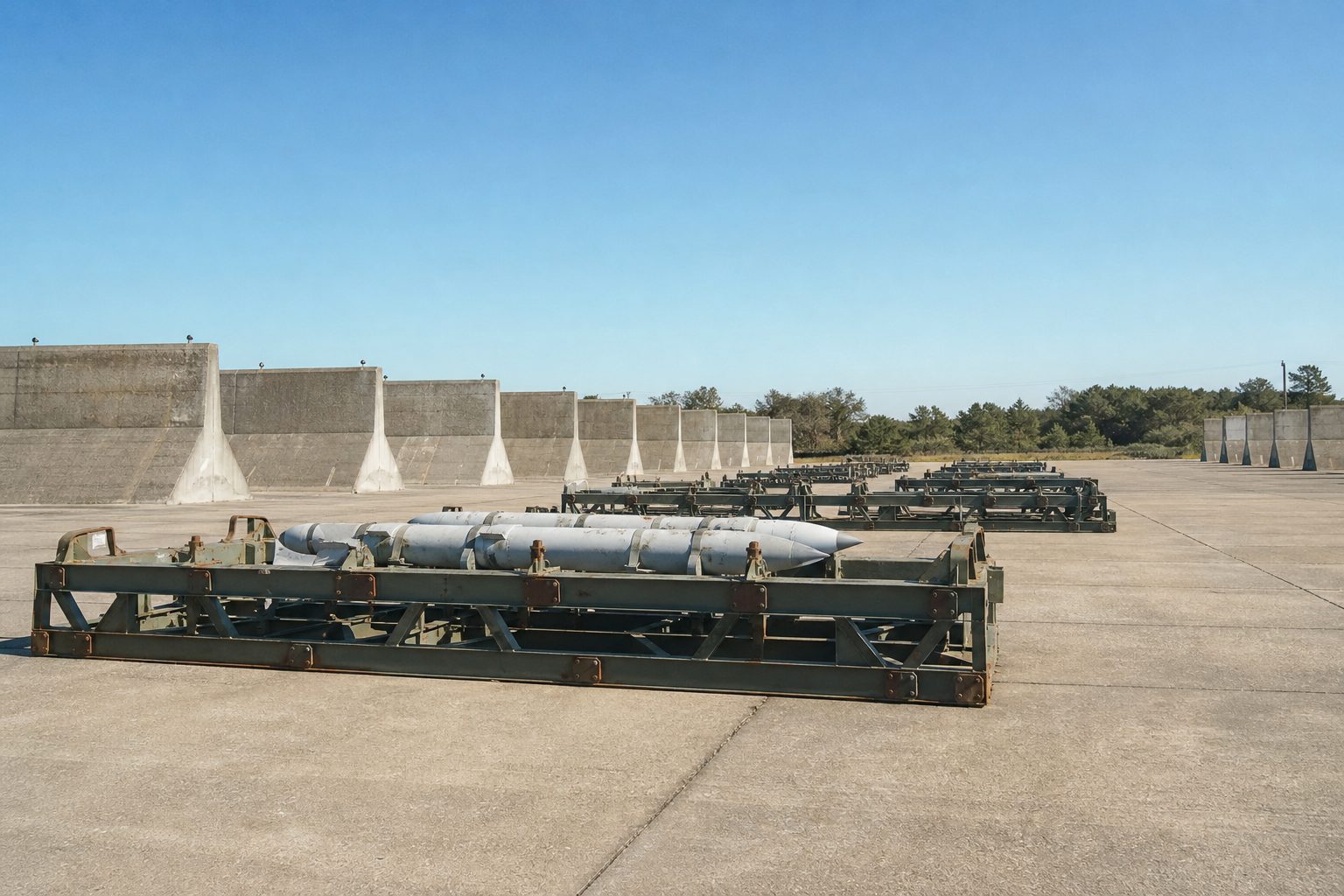
The Heritage Foundation's January 2026 assessment of the U.S. munitions system in the Indo-Pacific begins with a number: the United States fields fewer than 250 operational Long Range Anti-Ship Missiles, known as LRASM, against a requirement that exceeds 1,000 [1]. CSIS's 2023 wargame of a Chinese invasion of Taiwan projected that the American inventory of that missile would be exhausted in about a week of intense fighting [7]. Heritage's own simulation, called TIDALWAVE, then draws the timeline that gives this article its clock: forward stockpiles collapse in roughly the first 25 days, degradation continues through day 120, and U.S. forces would enter the main phase of combat around Day 30 in what its authors call a logistically degraded state. Heritage assigns that judgment moderate confidence, in part because exact U.S. stockpiles are classified [1].
Day 30 is therefore the point at which American combat power stops depending on what the force owns and starts depending on what the force can be handed: missiles reloaded, engines overhauled, circuit cards replaced. The question matters well beyond one wargame. It shapes whether deterrence in the Pacific and Europe survives contact with an actual blockade, what allies should conclude about U.S. staying power, and whether the next decade of procurement buys endurance or fragility.
Run the thought experiment. Cut five inputs at once for thirty days: rare earths, advanced semiconductors, energetics, titanium, and machine-critical components such as specialty bearings. Add high-intensity consumption. Which platforms are still meaningfully in the fight at day 30? The evidence points somewhere uncomfortable for admirers of the newest equipment. The survivors skew old. But they survive for reasons a birth year does not capture, and some of the worst sustainment performers in the inventory were designed in the 1990s.
What day 30 actually measures

Two clocks run underneath any supply cutoff, and confusing them produces bad analysis.
The first clock is consumption. Precision weapons leave magazines faster than any peacetime procurement system replaces them. CSIS's wargame found the United States would run through some of its most capable precision munitions, LRASM included, in about a week [7]. Heritage's modeling puts the initial depletion of forward stockpiles at roughly 25 days, driven by consumption and by strikes on the bases where those stocks sit; in its scenarios, concentrated hubs such as Guam and Kadena could suffer up to 90 percent attrition in the opening wave of PLA strikes [1].
The second clock is throughput, and it is the one that bites at day 30. Navy vertical launch system, or VLS, cells are loaded pier-side because underway reloads were abandoned decades ago over crane and sea-state risk. Heritage estimates those reloads take weeks, reducing ships to what it calls "single-sortie" platforms: vessels that fight with what they loaded, then leave the fight to rearm [1]. Its model caps replenishment throughput at roughly 500 units a day moved by sea, with airlift adding about 50, volumes that cannot cover wartime consumption [1]. Replacing what was expended is slower still, with replenishment cycles measured in years, partly because solid rocket motor production is itself a bottleneck [1].
Raw materials barely register on either clock in the first month. A jet does not stop flying on day 30 because a magnet shipment failed to leave China. It stops flying because the magazine is empty, the spares bin is empty, and the depot pipeline was thin to begin with. Rare earths, chips and titanium run the third clock, reconstitution, which decides whether anything destroyed in month one exists again in year two.
One structural problem interferes with even this basic accounting. The Government Accountability Office reported in July 2025 that the Department of Defense relies on a global network of more than 200,000 suppliers, yet the federal government's primary procurement database "provides little visibility into where these goods are manufactured or whether materials and parts suppliers are domestic or foreign" [4]. The Pentagon cannot fully compute its own day-30 exposure, because it cannot see the origin of what it buys. GAO recommended three fixes, including testing contract requirements that suppliers disclose country of origin; DoD concurred with all three [4].
The five chokepoints, and when each one bites
Rare earths set the concentration record. In 2024 China mined 60 percent of the world's magnet rare earths, refined 91 percent, and manufactured 94 percent of sintered permanent magnets, the components inside precision motors, actuators and the steering systems of guided weapons [2][3]. The exposure stopped being theoretical in April 2025, when China imposed export controls on seven heavy rare earths. Shipments collapsed within weeks, and automakers in the United States and Europe cut production or idled plants while licenses were negotiated; even after volumes recovered, European prices for the controlled elements ran as high as six times Chinese prices [2][3]. In October 2025 Beijing escalated, adding five elements and a license requirement covering any internationally made "parts, components and assemblies" containing Chinese-sourced rare earth materials or made with Chinese technology [2]. That clause is the closest thing yet to a rehearsed day-30 scenario: not a container stopped at a port, but a licensing regime capable of freezing the parts pipelines of companies anywhere. Those controls were suspended for a year in November 2025, and in January 2026 China tightened rules on dual-use exports bound for Japan [2]. The International Energy Agency estimates full implementation of the controls would put about $6.5 trillion a year of downstream production at risk [2].
Semiconductors behave differently than most people assume. U.S. weapons rarely depend on the most advanced logic chips; they depend on mature-node commercial parts, programmable logic, memory and power electronics, most of them fabricated in East Asia and much of them discontinued quickly. The vulnerability sits at board level, in circuit cards built around commercial parts whose own sub-tier origin is undisclosed. The IEA found China is the leading refiner for 19 of 20 strategic minerals, with an average 70 percent market share [3]. GAO's origin-blindness finding means no one can currently say how deep that dependence runs inside a given weapons system [4].
Energetics are the binding constraint on rebuilding. After decades of consolidation, large solid rocket motors in the United States come from two primes: Northrop Grumman, which absorbed the former Orbital ATK business, and L3Harris, which bought Aerojet Rocketdyne in 2023. Heritage's munitions chapter identifies insufficient rocket-motor production as one reason replenishment cycles are measured in years [1]. The pattern repeats downstream. The Stinger line sat dormant for roughly two decades before the Army could restart it, a restart that required redesigning components no longer made, and the Army's effort to expand 155mm shell output roughly sevenfold from its pre-2022 baseline of about 14,000 shells a month has slipped repeatedly, as service and industry leaders have acknowledged publicly.
Titanium shapes airframes, forgings and fasteners. The U.S. Geological Survey reports that the United States produces little titanium sponge and imports the large majority, historically led by Japan [12]. The Pentagon's own 2018 industrial base assessment flagged titanium dependence years before the 2022 invasion forced aerospace firms to scramble for substitutes [9].
Bearings and machine-critical parts are the least glamorous chokepoint. The same 2018 assessment identified nearly 300 vulnerabilities across the defense industrial base, many of them single- or sole-source suppliers of components nobody notices until the qualified producer quits [9]. The Defense Logistics Agency's strategic materials arm tracks dozens of such inputs and has repeatedly flagged materials whose inventories fall short of wartime requirements in its reports to Congress.
None of this decides whether an aircraft flies on day 30. It decides whether the force that fights through day 30 gets replaced before the war ends.
Which platforms start losing capability at day 30
The first casualties are functions rather than airframes.
Everything that fights from a vertical launch cell suffers together, regardless of age. Once those cells are empty, a destroyer that cost $2 billion becomes a single-sortie platform with a multi-week reload ahead of it, and the Navy has only recently begun rehearsing underway reloads again in response to exactly this critique [1]. The precision-magazine problem hits old ships and new ships equally; a 1990s Arleigh Burke hull faces the same empty cells as a brand-new one.
The F-35 then inherits a second, self-inflicted problem. GAO's sustainment reviews have found the fleet's mission capable rate sitting near half in recent years, well below targets, with parts shortages and depot shortfalls among the causes [8]. Every design choice compounds the baseline. The fleet has one engine design from one manufacturer, after the alternate engine program was cancelled. Airframes are assembled not only in Texas but at final assembly lines in Italy and Japan, and the expulsion of Turkey from the program in 2019 forced requalification of replacement suppliers for Turkish-built components. Threat libraries for the jet are compiled and loaded at dedicated reprogramming laboratories in the United States, so a force cut off from reachback loses its ability to update against new threats. Widely cited Pentagon estimates put the rare earth content of a single F-35 at roughly 920 pounds. None of this matters while parts flow. It all begins to matter when they do not. Tangredi uses cost per flight hour as a proxy for the same fragility: an F-35 is estimated at $33,000 per flight hour in 2012 dollars, against $10,507 for an F/A-18 [5].
The F-22 shows what a small fleet does under the same pressure. Only 195 were ever built, the production line closed in 2011, and a 1990s-era congressional ban barred exports, so there is no allied spares pool and no production to tap. Every combat loss is permanent, and the aircraft has been in an obsolescence spiral for years, with components whose manufacturers no longer exist.
The small fleets at the top of the bomber force face the same arithmetic. About twenty B-2s carry the stealth penetrating mission today, with coating and component logistics that keep availability low in the best of times. The B-21 is a different case: it first flew in November 2023, the test and early production fleet remains small, and no combat-coded squadrons exist yet, which is an honest limitation on any day-30 scorecard. Its long-term significance for this question runs the other way. The Air Force has promised a stealth bomber far cheaper to maintain than the B-2, but those claims are unproven, and the aircraft's supply chain embeds the same commercial electronics and concentrated inputs as every other system designed in this century.
The Virginia-class submarine sits near the back of the failure list only because boats at sea are hard to touch. The U.S. builds nuclear attack submarines at exactly two shipyards, General Dynamics Electric Boat and HII's Newport News, and the Congressional Research Service has documented slipping deliveries and a submarine industrial base that also has to build the new Columbia-class ballistic missile boats with the same workforce [11]. Overhauls routinely finish late. In a supply cutoff, a submarine that takes battle damage does not return to the fight in month two; the shipyard queue measures in years.
The Zumwalt class does not really make the list, which is the problem. Three hulls were built around a gun system whose specialized ammunition was cancelled in 2016, and the ships are being converted to carry hypersonic missiles. A class of three bespoke platforms has no depth: every casualty removes a third of the force.
Where this story sits
5 related pieces

Hover a story · click to read
 No. 29 · Sep 3, 2026The Helium Chokepoint: What Qatar's Shutdown Revealed About Semiconductor Supply Chains
 No. 35 · Sep 5, 2026China's quiet rare-earth chokepoint on U.S. defense and chip supply chains
 No. 45 · Sep 12, 2026China's Supply Chain Chokepoints: What De-Risking Costs, and Whether It Works
 No. 51 · Sep 19, 2026The three-day shutdown: what actually breaks when Taiwan, helium, and rare earths fail together
 No. 16 · Aug 27, 2026Lake America: The Hidden Technology Problems Behind Trump’s Lake Ontario Order
Why the old designs keep flying
The platforms that keep operating at day 30 share four traits, none of them a date.
First, multi-source, largely domestic suppliers for the parts that break. Second, technical data the government owns, so depots can manufacture what the market abandoned. Third, repair-forward design, meant to be fixed near the fight with local tools. Fourth, mechanical tolerance for degraded operations, because the designers assumed supply would be slow.
The B-52H is the standard example. Seventy-six airframes remain, a Rolls-Royce F130 re-engining program is underway, and the Air Force plans to fly the type into the 2050s. Sixty years of continuous supplier relationships mean that nearly everything that wears out has a known fix. The jet still cannot do much if its precision weapons are gone, but the airframe itself keeps generating sorties when logistics collapse.
The F-16 makes the same point from a different angle. Its production line has run since the late 1970s, more than 4,500 have been built, new jets still come off the line in South Carolina for foreign customers, and the global fleet means spares exist in quantities no other fighter enjoys. The engines for new-production aircraft are still being made for other programs in the same family.
The Arleigh Burke class supplies the surface example. Its LM2500 gas turbines are built domestically by General Electric, the class numbers more than seventy hulls with common parts, and its hulls, generators and drive train are repairable with industrial tools. The caveat is real: modern Aegis baselines run commercial computing hardware instead of the old military-spec mainframes, so the newest ships in an old class carry new supply-chain exposure in the one system that cannot be fixed with a wrench.

The tanker fleet adds a wrinkle. KC-135s designed in the 1950s still haul most of the fuel, while the KC-46 and P-8 are built on 767 and 737 airframes with global commercial fleets feeding their parts pipelines. Commercial-derivative platforms buy resilience of a different kind: scale. They also buy foreign dependence, since commercial supply chains are exactly the ones whose sub-tier origins DoD cannot trace [4].
Munitions follow the same pattern as platforms. Tomahawk has been upgraded block by block for four decades on a line that never fully closed, and AMRAAM has been in continuous production since the early 1990s. The lines are mature and continuously active; the quantities are not. Heritage's finding of replenishment cycles measured in years applies to old weapons as much as new ones [1].
Tangredi drew the operational conclusion from all this in Proceedings in 2023. The United States has not fought an opponent that could attack its networks since 1991, and it has not had to "fight to get to the fight" [5]. A Taiwan conflict places American supply lines roughly 6,000 nautical miles from home ports, against roughly 100 for the invader [5]. His prescription is a network-optional, low-bandwidth, locally commanded reserve force, what he calls an analog fleet, built from systems that keep working when the digital grid is down. The December 2021 Amazon Web Services outage, which silenced vacuums, took down a discount brokerage and left Disney World visitors unable to enter with no adversary involved, is his illustration of what networked fragility does without a war [5].
Where the 1990s rule breaks
The tempting conclusion, that 1990s design equals endurance, fails on its own evidence.
The F-22 first flew in 1997. The Zumwalt class was designed in the 1990s. The Seawolf class was a 1990s production program, truncated to three boats. The F/A-18E/F Super Hornet entered service in 2001 from a 1990s design, and its readiness has been consumed by two decades of deployment tempo and depot backlogs, a shortfall Navy officials have spent years acknowledging publicly. If design decade were the variable, these would be the healthiest aircraft and ships in the force. They are not.
The 1990s is better understood as the decade when the assumptions changed. The Pentagon's official acquisition history for 1989 to 2001 records the era in its own chapter titles: "Integrating the Defense and Civilian Industrial Bases," "Reinventing Government," and "Changing 'What We Buy': Military Specifications and Standards Reform" [6]. Defense Secretary William Perry's 1994 memorandum told the services to replace military specifications with performance specifications wherever possible. The reform produced real savings and real problems: cheaper commercial parts, faster acquisition, and the beginning of the migration toward commercial off-the-shelf components that now dominates sustainment. Just-in-time logistics followed the same commercial logic [6]. The Gulf War had already shown the limits of stockpile-based warfare: the historians titled one chapter on Desert Storm procurement "Progress Without Production," a war won from existing inventories while factories idled [6]. The peace dividend then closed lines that were never reopened: Seawolf cut, the F-22 cut, Tomahawk purchases paused, Stinger's line went dark.
Aging cuts against the old fleet as well. Diminishing manufacturing sources hit every platform whose components go end-of-life, and the survivors survive because production was massive, data rights were owned, and lines stayed open, not because their schematics carry a favorable date. The B-52 endures for the same reason the F-16 endures: scale, ownership and continuity. A 1990s platform with a closed line, a small fleet and commercial-derivative avionics can die as fast as anything newer.
The 1990s, in other words, is a proxy. The real variables are production continuity, supplier geography, repair philosophy, and dependence on reachback. Those variables correlate with age, which is why the day-30 survivors look old. The correlation is not the cause.
Can stockpiles and reserves bridge thirty days?
The United States built the National Defense Stockpile to survive the wars of the mid-twentieth century, then spent the 1990s selling much of it off under the logic that no major war was coming. What remains sits with the Defense Logistics Agency's strategic materials arm, whose own requirements reporting to Congress has repeatedly identified materials held below wartime needs. Service-level War Reserve Materiel exists as well, prepositioned munitions and parts sized for the scenarios of an earlier planning era. Reserves can bridge consumables such as fuel and common ammunition. They cannot bridge engines, radar line-replaceable units, or precision weapons whose production runs in years [1]. And the visibility problem compounds everything: a reserve system requires knowing what you actually depend on, which GAO has found the department does not know [4].
What the Pentagon is doing about it
Mitigation is now policy rather than debate. The first National Defense Industrial Strategy, published in January 2024, made its priorities explicit: resilient supply chains, workforce readiness, flexible acquisition, and economic deterrence [10]. The Office of Strategic Capital was created to steer private investment toward defense-critical technologies. In July 2025 the Pentagon announced a rare earths partnership with MP Materials that includes preferred equity, a ten-year price floor for neodymium-praseodymium, and a commitment to buy magnets from its Fort Worth plant, an attempt to rebuild a domestic magnet chain from mine to finished component [13]. The Microelectronics Commons network of regional hubs was established in 2023 to shorten the path from chip design to defense prototypes. Allied sourcing has expanded through AUKUS and European munitions co-production, and Congress has poured multibillion-dollar investments into the submarine industrial base [11].
The honest limit is time. A country that manufactures 94 percent of the world's permanent magnets does not lose that share in a year [2][3]. The November 2025 suspension of the October controls bought breathing space, not a solution; the January 2026 tightening aimed at Japan shows the underlying leverage remains [2]. Heritage's replenishment timelines, measured in years, apply to the surge capacity being built right now [1].
A day-30 scorecard

This table compresses the public evidence discussed above. It reflects open modeling and the public record, not a classified assessment.
| Platform or system | Day-30 exposure | The binding constraint |
|---|---|---|
| Surface warships with VLS cells (Arleigh Burke class) | High | Empty cells and multi-week pier-side reloads; hulls and turbines remain domestic and repairable |
| Precision munitions (LRASM, JASSM-class) | Highest | Inventories measured in days against wartime demand [1][7] |
| F-35 | High | Peacetime availability near half; one engine source; global parts web with untraceable origin [4][8] |
| F-22 | High | 195 built, line closed; every loss is permanent |
| B-2 | High | Fleet of about 20; bespoke coatings and parts |
| B-21 | Not yet applicable | Test and early production fleet; claims of easier sustainment unproven |
| Virginia-class submarines | Medium to high | Two shipyards; battle damage exits a boat for years [11] |
| Zumwalt class | High | Three bespoke hulls, no class depth |
| B-52H | Low to medium | Continuous supplier base; re-engining underway; still needs munitions |
| F-16 | Low to medium | Production never stopped; thousands of airframes share parts |
| KC-135 / KC-46 | Low to medium | Decades of parts scale; commercial derivatives inherit global fleets |
What day 30 reveals about American military power
Heritage's conclusion deserves the last word on the mechanism: "The problem is not merely running out of weapons; it is the convergence of attrition, supply-chain ceilings, and industrial lag that makes sustained U.S. combat power untenable under current conditions" [1].
Day 30 is survivable for the weapons that never assumed the supply chain would arrive on time. The B-52s and F-16s and Burke hulls keep flying and steaming not because their engineers were wiser, but because they designed for an industrial system that assumed slowness, stockpiled spares, kept lines running and owned the data. The F-22s, Zumwalts and Super Hornets show that a favorable birth decade guarantees nothing, and the F-35 shows that the newest design carries the newest concentration of dependencies. The chokepoints themselves mostly decide the rebuild rather than the first month; the first month is decided by magazines, reloads and depot pipelines that were thin before any container ship was turned away.
The uncomfortable finding is not that old beats new. It is that the United States cannot yet fully answer its own question, because it cannot see the origin of what it buys [4]. Heritage's clock, CSIS's empty bins, and GAO's blind spot are three views of one system. Until the Pentagon can trace a circuit card to the foundry that made its parts, day 30 will keep arriving as a surprise. The most useful day-30 weapon currently on the table is a parts ledger.
Sources
- The Heritage Foundation, "Chapter 6: Assessing the U.S. Indo-Pacific Munitions System" (TIDALWAVE), January 20, 2026. https://www.heritage.org/tidalwave/chapters/chapter-6-assessing-the-us-indo-pacific-munitions-system
- International Energy Agency, "Rare Earth Elements," executive summary (accessed October 2026). https://www.iea.org/reports/rare-earth-elements/executive-summary
- Tae-Yoon Kim, Shobhan Dhir, Amrita Dasgupta, and Alessio Scanziani, "With new export controls on critical minerals, supply concentration risks become reality," International Energy Agency, October 23, 2025. https://www.iea.org/commentaries/with-new-export-controls-on-critical-minerals-supply-concentration-risks-become-reality
- U.S. Government Accountability Office, "Defense Industrial Base: Actions Needed to Address Risks Posed by Dependence on Foreign Suppliers" (GAO-25-107283), July 24, 2025. https://files.gao.gov/reports/GAO-25-107283/index.html
- Sam J. Tangredi, "Fighting When the Network Dies," U.S. Naval Institute Proceedings 149/3 (March 2023); reprint posted at Indian Strategic Studies, March 24, 2023. https://www.strategicstudyindia.com/2023/03/fighting-when-network-dies.html
- Philip L. Shiman, Elliott V. Converse III, and Joseph A. Arena, "Reform and Experimentation After the Cold War, 1989–2001," History of Acquisition in the Department of Defense, Vol. V, Office of the Secretary of Defense Historical Office, 2022. https://history.defense.gov/Portals/70/Documents/acquisition_pub/OSDHO-Acquisition-Series-Vol.5.pdf
- Mark F. Cancian et al., "The First Battle of the Next War: Wargaming a Chinese Invasion of Taiwan," Center for Strategic and International Studies, January 2023. https://www.csis.org/analysis/first-battle-next-war-wargame-preliminary-report
- U.S. Government Accountability Office, "F-35 Aircraft Sustainment" (GAO-23-105235), 2023. https://www.gao.gov/products/GAO-23-105235
- U.S. Department of Defense, "Assessing and Strengthening the Manufacturing and Defense Industrial Base and Supply Chain Resiliency," report to the President, September 2018.
- U.S. Department of Defense, "National Defense Industrial Strategy," January 2024.
- Congressional Research Service, "Navy Virginia (SSN-774) Class Attack Submarine Procurement: Background and Issues for Congress" (RL32418, updated regularly). https://crsreports.congress.gov/product/RL32418
- U.S. Geological Survey, "Mineral Commodity Summaries 2025," titanium sponge entry. https://pubs.usgs.gov/periodicals/mcs2025/
- U.S. Department of Defense and MP Materials, announcement of strategic partnership on domestic rare earth and magnet production, July 2025.
Comments (9)
Continue exploring
China's Supply Chain Chokepoints: What De-Risking Costs, and Whether It Works
Export controls on minerals, medicines, circuit boards, and legacy chips have turned supply chains into instruments of coercion…
The three-day shutdown: what actually breaks when Taiwan, helium, and rare earths fail together
U.S. planning treats Taiwan, helium, and rare earths as three separate chokepoints. The 2026 record says otherwise. A mapped…
Lake America: The Hidden Technology Problems Behind Trump’s Lake Ontario Order
Renaming Lake Ontario “Lake America” changes more than a map label. It creates challenges for geographic databases, search…
The GAO recommendation to test contract requirements that suppliers disclose country of origin sounds reasonable on paper, but weaving that requirement into existing multi-year procurement vehicles with thousands of line items would need legal review at every contracting command and likely slow already-slow awards. Smaller tier-2 and tier-3 suppliers often do not know their own sub-tier origin data, so the compliance burden would fall hardest on the primes.
On the chokepoints section, the semiconductor paragraph appears to be cut off mid-sentence. Could the authors publish the full section, especially what node sizes U.S. weapons actually depend on and whether legacy fabs in the U.S. and allied countries can cover that demand? The implication that advanced-node shortages may matter less than mature-node bottlenecks is interesting and deserves more than a fragment. It would also help to know which specific weapons programs the article considers most exposed to that mature-node risk.
My read of the piece is that the U.S. munitions problem is less about running out of fancy weapons and more about the inability to reload, refurbish, or rebuild them quickly once wartime consumption outruns peacetime production. The practical implication I took away is that any serious procurement reform has to value throughput—reloadable VLS, depot capacity, solid rocket motor lines—over the next sleek platform, because sleekness without resupply is essentially a one-shot. Allies reading this should probably plan around the assumption that the first 30 days of any Pacific fight are what the U.S. brings to the pier.
I want to push back gently on the framing of Day 30 as primarily a logistics threshold. The piece treats the cutoff date almost mechanically, but consumption rates in a real conflict depend heavily on emission policy and rules of engagement that wargamers necessarily have to assume. I'm not sure the 25-day stockpile collapse holds up under a more restrained firing doctrine.
The "two clocks" framing was the most useful section for me. The distinction between consumption (a week for LRASM per CSIS), throughput (about 500 units a day by sea plus 50 by airlift), and reconstitution (replenishment cycles measured in years because of solid rocket motor bottlenecks) clarifies why "running out" is not one event but a cascade. It also explains why the raw-materials chokepoints only bite on the third clock rather than the first 30 days, which I had been conflating. Several other supply-chain arguments I've read collapse precisely because they ignore that timing difference.
I worked on VLS reload procedures in the early 2010s and pier-side reload was not as universal as the article suggests—several classes had tested underway replenishment in benign sea states, even if it was never adopted fleet-wide. The "abandoned decades ago" line overstates it a bit.
Can you do a follow-up on what the November 2025 suspension of the rare-earth controls actually changed on the ground? A one-year pause with licensing still in place is not the same as the controls being lifted, and the article left me unsure which downstream industries are still rationed versus back to normal flows.
The claim that the survivors skew toward older platforms despite 1990s-era systems being among the worst sustainment performers would benefit from the specific sustainment metrics behind that judgment.
The October 2025 license requirement covering internationally made parts containing Chinese-sourced rare earths reads like a dry run for the kind of extraterritorial controls the EU has been struggling with around its own CBAM and forced-labor rules. I wonder if export-control lawyers are now treating Chinese rare-earth policy as a template rather than a one-off dispute.