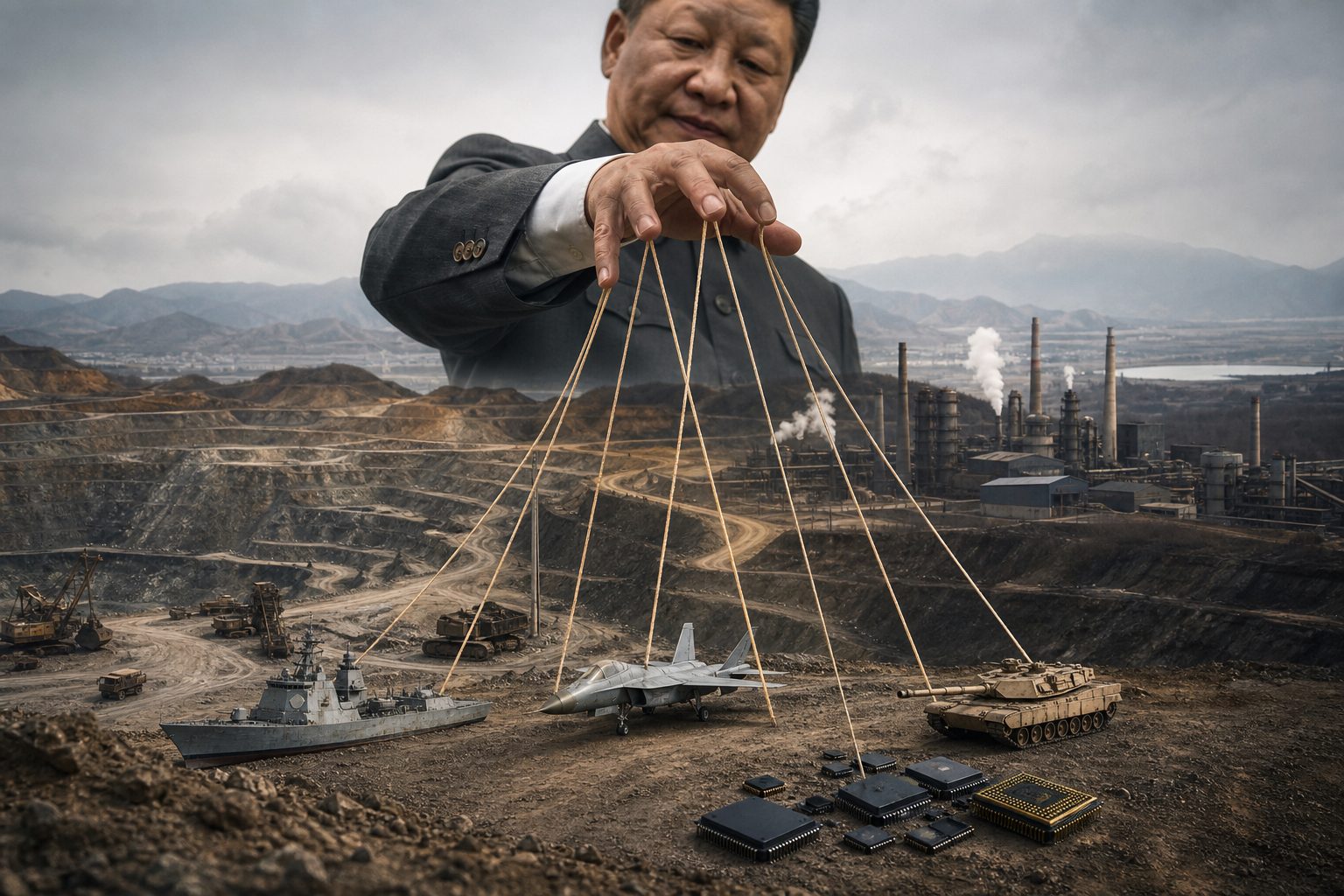
In early August 2026, Reuters reported that some Chinese rare-earth suppliers simply stopped shipping material to American customers, with no ban announced and no new regulation published. Some of those exporters, according to the account, held valid export licenses issued by Beijing's own commerce ministry and declined to ship anyway, telling U.S. buyers they feared repercussions from Chinese authorities. The report, carried by the Asahi Shimbun and summarized by OilPrice, said the freeze arrived weeks before a planned summit between Xi Jinping and Donald Trump. The materials involved were described as sitting inside aerospace engines, semiconductor tools, grid hardware, and medical devices.
Because this episode anchors what follows, its evidentiary limits belong on the record: the August account is a single thread of reporting, carried secondhand through the outlets above, and it could not be independently confirmed before publication. No exporter was publicly named, and neither Beijing nor Washington has verified the described conversations. If the account holds, though, this is what a mature chokepoint looks like. The headline version of this story was always dramatic: China bans exports, markets convulse. The reality that has emerged is quieter and harder to counter. Beijing has built an export-licensing system that turns trade into permission, trained its sanctions machinery on some of the firms that help Western buyers verify their supply chains, and cultivated a climate in which Chinese suppliers police themselves more strictly than any written rule requires. If the August reporting is accurate, it is proof the mechanism now works without Beijing having to say no out loud.
Understanding how the three layers fit together, and what can actually loosen them, matters for any U.S. or allied industry that touches a magnet, a radar, or a battery.
Why would licensed suppliers refuse to ship?

The risk math facing a Chinese exporter has become brutally asymmetric. Since 2023, Beijing has converted a growing list of minerals from ordinary traded commodities into licensed goods. Each shipment requires a government license; exporters and buyers must disclose end users and end uses, and licenses are issued case by case, as the export-control timeline compiled by ORF America documents. A shipment that sails through this process is not necessarily safe in retrospect. If a cargo later proves to have reached, say, a defense prime contractor or a semiconductor line Beijing dislikes, the exporter could face consequences ranging from losing its license to prosecution under national security or counter-espionage statutes.
The upside of a U.S. sale is margin. The downside is personal and commercial ruin. Faced with that distribution, rational firms over-comply. Call it supplier self-deterrence: the exporter declines business no regulation formally forbids, because the written rule is not the relevant risk.
Beijing has actively cultivated this. Reuters reported in 2025 that the government demanded detailed staffing information from rare-earth and magnet companies, including the identities and expertise of technical specialists, a move consistent with tightening control over process knowledge. The historical template also points the same direction. China's 2010 halt of rare-earth shipments to Japan, the episode the U.S.-China Economic and Security Review Commission cites at the opening of its supply-chain analysis, was itself largely informal: no published ban, just exporters who understood what was expected of them.
Beijing, for its part, insists civilian trade is unaffected. Chinese officials approved civilian-oriented general licenses after the October 2025 trade truce, and state messaging frames the system as routine dual-use administration. If the August account is accurate, the refusals suggest the suppliers do not fully believe the reassurance, or believe that what happens around a summit matters more than what the ministry says.
How did export licenses become the chokepoint?
The chronology is worth reading as the construction of an instrument rather than a series of tantrums.

July 2023: China imposed export licensing on gallium and germanium, critical to chips, optics, and radar, requiring buyers to disclose end uses. December 2023: similar licensing took effect for graphite, and Beijing separately banned exports of rare-earth extraction, separation, and magnet-making technology, a detail that matters later. September 2024: licensing on antimony, used in munitions primers, night-vision gear, and flame retardants. December 3, 2024: after a U.S. chip-control escalation, Beijing banned exports of gallium, germanium, and antimony to the United States outright, Reuters reported. February 4, 2025: controls expanded to tungsten and four more minerals, while China placed PVH Corp, punished for its Xinjiang-sourcing compliance, and gene-sequencing firm Illumina on its unreliable entity list. April 4, 2025: licensing extended to seven rare-earth elements and the magnets made from them, triggering shortage warnings across global auto and defense supply chains; Ford briefly idled its Chicago plant that spring for lack of magnets, CEO Jim Farley told Aspen attendees, as Reuters covered.
By then the pattern was visible. Shipments of the controlled metals sat at historically low levels through early 2025 even while world prices climbed, Reuters found in April 2025. The chokepoint was no longer the minerals. It was the signature on the license.
October 2025 industrialized the system. Beijing added five more rare-earth elements, bringing the licensed list to twelve, extended licensing to magnet manufacturing equipment and processing technology, and, in its most aggressive step, asserted jurisdiction over foreign-made products containing as little as 0.1 percent Chinese rare-earth content. Exports for military end use were to be refused, and shipments into advanced semiconductor and AI production placed under case-by-case review. Rhodium Group's analysis emphasizes what this meant structurally: the regime now reaches intermediate goods such as wafers, magnets, and battery materials, the manufacturing layer where China's dominance is deepest, and it reaches them outside China's borders.
The October 30, 2025 Trump-Xi meeting in Busan bought a reprieve. The measures were suspended for a year, China began issuing general licenses to some magnet exporters, and shipments partly recovered. Then the dial turned again. On February 24, 2026, Beijing's commerce ministry prohibited dual-use exports to 20 Japanese firms, including magnet maker TDK, and barred foreign entities from reselling to them, a move Rhodium describes as extending Beijing's controls to third-country processors and manufacturers. And then, if the August reporting holds, came the quiet refusals.
The EU Institute for Security Studies, in a May 2026 paper based on dozens of industry and policymaker interviews, adds the most unsettling documented detail about how the system functions beneath the licensing: the approval process demands production-site data, product detail, and end-user identities, letting Beijing map foreign defense-industrial networks even as it restricts the materials. Licenses became leverage in unrelated talks too, with the paper documenting Chinese efforts to trade mineral access for the removal of EU electric vehicle tariffs. Controls, the author writes, have "evolved into a geo-economic weapon," with supply restored after 2025's squeeze only at lower, strictly controlled volumes.
Where this story sits
5 related pieces
Read it →
Hover a story · click to read
 No. 29 · Sep 3, 2026The Helium Chokepoint: What Qatar's Shutdown Revealed About Semiconductor Supply Chains
 No. 45 · Sep 12, 2026China's Supply Chain Chokepoints: What De-Risking Costs, and Whether It Works
 No. 47 · Sep 14, 2026What breaks if China stops exporting rare-earth magnets tomorrow
 No. 70 · Oct 16, 2026Day 30 Without Supply: Why America's Older Weapons May Outlast Its Newest Ones
 No. 54 · Sep 23, 2026The Foreign Dependencies Inside China’s State AI Clouds
Why does Beijing go after the auditors?
The third layer is less discussed and arguably the most durable: pressure on the verification layer, the due-diligence firms, consultancies, and compliance organizations whose job is to know where things come from.

In March 2023, Chinese authorities raided the Beijing office of U.S. due-diligence firm Mintz Group and detained five Chinese staff. Weeks later, Bain and Company staff in Shanghai were questioned, and state media coverage cast expert-network firm Capvision as a conduit for foreign espionage. An expanded counter-espionage law took effect July 1, 2023, broadening what counts as espionage-adjacent data. The message to anyone mapping Chinese supply chains for foreign clients was unmistakable.
The pressure runs the other direction as well. China punished PVH in February 2025 not for exporting to China but for following U.S. sourcing rules, effectively sanctioning supply-chain compliance behavior. Beijing's March 2025 implementing rules for the Anti-Foreign Sanctions Law then spelled out liability for organizations that help apply foreign restrictive measures, a category broad enough to reach the consultants, lawyers, and auditors who verify export-control and forced-labor compliance. Sanctions have also hit Western manufacturers directly: Beijing's October 2024 measures against U.S. drone maker Skydio were followed within weeks by the company losing its Chinese battery supplier, illustrating how a designation converts instantly into a physical cut in the chain.
Assembled, these moves create asymmetric visibility. A U.S. buyer must open its supply network to Beijing to obtain licenses, while Beijing works to ensure Western firms cannot safely hire anyone in China to check what is actually in the cargo. You disclose your chain; you cannot audit theirs. That asymmetry is what makes "sanctions on supply-chain assurance organizations" more than a headline category. It is a deliberate blinding of the compliance machinery that diversification would depend on.
Where does the pressure land?
Weapons makers
A modern force is a magnet-intensive enterprise. Rare-earth permanent magnets drive actuators, guidance fins, motors, and radar cooling across precision weapons; samarium-cobalt magnets survive engine-adjacent heat where neodymium magnets fail; gallium nitride powers the AESA radars being fitted across air defense fleets; germanium sits in night-vision optics; antimony hardens lead in ammunition and serves in primers. The Congressional Research Service has tallied roughly 920 pounds of rare-earth material in each F-35, 5,200 pounds in a destroyer, and 9,200 pounds in a Virginia-class submarine.
The dependency surfaced publicly in September 2022, when the Pentagon paused F-35 deliveries after finding an alloy from China in a Honeywell turbomachine pump magnet; deliveries resumed under a waiver while a compliant source was qualified. The EUISS paper documents Beijing now systematically denying critical-material exports for defense end use, which the author describes as creating new obstacles to U.S. and European rearmament. The U.S.-China Commission puts it bluntly in its 2025 annual report: even "short-term, partial disruption" of these inputs could cripple critical industries and military readiness.
Chips and optics
China accounts for nearly all of the world's primary gallium and the dominant share of germanium, per the U.S. Geological Survey; USGS modeling put the cost of a full gallium-germanium embargo at about $3.4 billion in U.S. GDP, a figure ORF America recalls. Gallium is the substrate for RF chips in radars, jammers, and 5G hardware; gallium arsenide and germanium substrates sit in space solar cells and fiber optics. October 2025's measures then fused the two fronts by tying rare-earth licenses to advanced semiconductor end uses, a rules-for-resources symmetry aimed directly at U.S. chip controls.
Batteries and the grid
China refines the vast majority of battery-grade graphite, placed under licensing in December 2023, and dominates the permanent magnets inside EV traction motors and direct-drive wind turbines. Rhodium's flow analysis carries an important warning here: the volume of critical minerals embedded in imported manufactured goods, wafers, magnets, batteries, vehicles, panels, turbines, now generally exceeds the volume imported directly. An economy can diversify ore purchases and still run its grid expansion, auto fleet, and defense industrial base on Chinese content it cannot even tabulate. The August account listed energy alongside aerospace and chipmaking, and the mechanism explains why.
Which fixes actually reduce exposure?

Exposure is concentration multiplied by time and substitutability. Strategies that change one of those three variables quickly are the ones that matter; the rest buy headlines.
Guaranteed demand beats new mines
The last rare-earth price crisis produced Molycorp, which spent roughly $1.5 billion reopening the Mountain Pass mine after 2010 and entered bankruptcy in 2015 when prices collapsed. Mines die when Chinese supply floods back at trough pricing; processing plants die faster. The Pentagon's July 2025 deal with MP Materials addressed exactly that failure mode: $400 million in equity making the government the company's largest shareholder, a ten-year floor price of $110 per kilogram for neodymium-praseodymium, and guaranteed offtake from a planned 10,000-ton-per-year magnet facility targeted at 2028. Apple separately committed $500 million to MP for magnets sourced from recycled feedstock. It is telling that MP, the one significant U.S. mine, had spent years shipping concentrate to China for separation, and halted those shipments in 2025 amid Chinese retaliatory tariffs. Demand certainty, not geology, was the missing ingredient all along.
Rhodium's caution about price floors deserves weight: floors applied at the wrong point raise costs for the downstream sectors being cultivated. The MP template works because the floor applies at the chokepoint itself, the separation-to-magnet span, and the buyers are guaranteed rather than merely subsidized.
The fight is in the middle of the chain
Mining and refining draw the speeches, but the binding constraints sit in separation, metallization, and magnetics, and in the machinery and chemists behind them. That is why Beijing banned the export of extraction, separation, and magnet-making technology in December 2023 and has since extended restrictions to mineral processing equipment and battery manufacturing technology. Outside-China midstream capacity is arriving, slowly: Pentagon-funded Lynas heavy rare-earth separation in Texas, Saskatchewan's provincial processing facility, and the magnet plant Neo Performance Materials opened in Narva, Estonia in 2025, the first at scale in Europe. On the U.S. side, refiners like Phoenix Tailings in New Hampshire, which recovers rare earths from mine waste streams among other feedstocks, are scaling as the Pentagon pushes industry to break dependence, part of what the AP described in July 2026 as refiners racing to expand amid growing conflicts.

The honest assessment: none of this ends dependence inside this decade. It converts a stop-work fragility into a manageable cost premium and a shrinking gap.
Allies, stockpiles, and substitution, working together
Japan remains the template: after 2010 it spread sourcing through investment in Lynas and trade-finance diplomacy, cutting China's share of its rare-earth imports from roughly nine-tenths to under six-tenths within a decade, per Japanese trade figures, and it still ended up among the targets of Beijing's February 2026 dual-use export prohibitions. Diversification without allies is therefore necessary and insufficient. Substitution helps at the margins: Tesla has announced a next-generation motor design that drops rare-earth content entirely, and iron-nitride magnets promise rare-earth-free alternatives once scaled. Stockpiles buy months, not years, but months count when a truce lapses.
Policy is adding forcing pressure. Executive Order 14415, signed July 20, 2026, ends the Pentagon's routine waivers of the statutory bar on Chinese specialty metals and rare-earth magnets as of January 1, 2027, requires contractors seeking an exception to file formal mitigation plans with firm timelines, exposes contractor fraud in those plans to Justice Department referral, and orders raw-material-to-end-product supply-chain mapping across national security acquisitions. The statute had been waived into near meaninglessness; the order converts compliance from paperwork into schedule risk, which is the language defense primes actually hear.
How long will the truce hold?
The October 2025 measures were suspended for one year, which puts their scheduled return in late October 2026, barely seven weeks from now, unless renewed at the summit the August reporting said was planned. General licenses remain revocable. The 2023 counter-espionage expansion, the due-diligence detentions, and the 2025 anti-sanctions implementing rules remain on the books unchanged. Nothing in the truce touches the incentive that reportedly produced August's behavior, which is precisely why, if the reporting is accurate, the exporters kept quiet even where licenses said go.
Washington's waiver cliff arrives January 1, 2027, against capacity milestones in 2027 and 2028. That gap, where the law bites before the factories fire, is the period adversaries read most carefully, and the suppliers know it too.
The deeper lesson of the August account is that a chokepoint stops being a regulation and becomes an instinct. Mines can be financed, separation plants permitted, magnets resourced. What cannot be ordered into existence is a supply chain in which middlemen, from Chinese exporters to foreign auditors, do not calculate that silence is safer than shipment. Capacity answers the problem economists measure. The harder, less photographed task is rebuilding the plain boring predictability that trade actually runs on, and the clock on the truce is not the only one that matters.
Sources

- Asahi Shimbun (Reuters), "China rare earth firms halt some U.S. shipments, sources say" (Aug. 2026): https://www.asahi.com/ajw/articles/16864327 — reporting relied on for the August 2026 episode; account not independently confirmed by this publication
- OilPrice, "China Rare Earth Firms Freeze U.S. Exports Weeks Before Xi-Trump Summit": https://oilprice.com/Latest-Energy-News/World-News/China-Rare-Earth-Firms-Freeze-US-Exports-Weeks-Before-Xi-Trump-Summit.html — summary of the same reporting; not independently confirmed
- Reuters, "China bans export of critical minerals to US as trade tensions escalate" (Dec. 3, 2024): https://www.reuters.com/markets/commodities/china-bans-exports-gallium-germanium-antimony-us-2024-12-03/
- Reuters, "China's export controls are curbing critical mineral shipments to the world" (Apr. 20, 2025): https://www.reuters.com/world/china/chinas-export-controls-are-curbing-critical-mineral-shipments-world-2025-04-20/
- ORF America, "China's Critical Mineral Export Controls: Background & Chokepoints," Background Paper No. 32: https://orfamerica.org/newresearch/chinas-critical-mineral-export-controls
- U.S.-China Economic and Security Review Commission, "Chained to China: Beijing's Weaponization of Supply Chains," 2025 Annual Report, Chapter 9: https://www.uscc.gov/sites/default/files/2025-11/Chapter_9--Chained_to_China_Beijings_Weaponization_of_Supply_Chains.pdf
- Rhodium Group, "Critical Mineral Chokepoints Extend Far Beyond Mining and Refining" (May 14, 2026): https://rhg.com/research/critical-mineral-chokepoints-extend-far-beyond-mining-and-refining/
- Joris Teer, "Beijing's Critical Raw Material Weapon," EU Institute for Security Studies, Chaillot Paper 189 (May 2026): https://www.iss.europa.eu/sites/default/files/2026-05/CP_189_0.pdf
- Executive Order 14415, "Securing America's Defense Supply Chains and Ensuring Domestic Acquisition of Critical Materials" (July 20, 2026), 91 FR 46693: https://thefederalregister.org/documents/2026-15003/securing-america-s-defense-supply-chains-and-ensuring-domestic-acquisition-of-critical-materials
- Associated Press, "China's dominance on critical minerals runs into US weapons need" (July 2026): https://apnews.com/article/trump-critical-minerals-defense-iran-war-china-df2b6c0f5fdd8b26143ce332336f6489
- U.S. Geological Survey, Mineral Commodity Summaries 2025: https://pubs.usgs.gov/periodicals/mcs2025/
- Congressional Research Service, "Rare Earth Elements in National Defense: Background, Oversight Issues, and Options for Congress," R41747: https://crsreports.congress.gov/product/pdf/R/R41747
- MP Materials and U.S. Department of Defense joint announcements, "Public-Private Partnership" (July 10, 2025)
- Apple Newsroom, $500 million MP Materials partnership (July 15, 2025)
- Reuters reporting on the September 2022 F-35 delivery pause over a Chinese alloy, the March 2023 Mintz Group detentions, the 2023 questioning of Bain and state-media campaign against Capvision, the December 2023 rare-earth processing technology export ban, China's February 2025 unreliable entity listing of PVH and Illumina, the March 2025 Anti-Foreign Sanctions Law implementing rules, the 2025 staffing-data demands on rare-earth firms, Ford's May 2025 magnet-shortage production pause, the October 9, 2025 control expansion, the October 30, 2025 Trump-Xi agreement, and December 2025 general license issuances
Comments (4)
Continue exploring
What breaks if China stops exporting rare-earth magnets tomorrow
One component, sintered NdFeB magnets, sits inside missiles, fighter jets, EVs, and surgical robots, and China makes over 90% of…
Day 30 Without Supply: Why America's Older Weapons May Outlast Its Newest Ones
A 30-day cutoff of rare earths, chips, energetics and titanium would ground America's newest combat systems while older ones keep…
The Foreign Dependencies Inside China’s State AI Clouds
China can build domestic AI switches, but advanced silicon, optical components, and software integration still create a narrow…
Strip away the Reuters reporting and the chronology, and the article's core message is that the chokepoint has migrated from minerals themselves to the licensing regime that gates every shipment. The practical implication for procurement and policy teams is that disruption will more often arrive as quiet refusals from licensed exporters than as a publicly announced ban, which means monitoring supplier silence matters as much as tracking headlines. Sourcing diversification, dual-qualification of non-Chinese inputs, and pre-positioned inventory become essential when the warning signal is a missing shipment confirmation rather than a ministerial decree.
We placed a magnet-grade neodymium order with a Shanghai exporter in late 2025 and it cleared without delay, which suggests the self-deterrence effect is not evenly distributed across all buyers or product grades.
The piece argues convincingly that the licensing regime has become the real chokepoint, but the claim that Beijing can credibly police the 0.1 percent Chinese-content threshold on foreign-made products deserves more scrutiny than the article gives it. Tracing rare-earth content through multi-tier subcontractor chains, especially in magnets that are often further processed in third countries before final assembly, is technically and administratively difficult even for well-resourced regulators. If enforcement turns out to be selective, the deterrence effect may be weaker than presented, and Western firms could find that the licensing system's bite depends heavily on which specific shipments Beijing chooses to audit.
Of the various sections, the passage on supplier self-deterrence was the most clarifying because it reframes the August shipment refusals as a predictable response to asymmetric risk rather than a curious anomaly. Showing that exporters weigh routine margin against potential loss of license or prosecution under counter-espionage statutes makes the behavior rational on its own terms. The historical parallel to the 2010 halt to Japan, where no formal ban was published either, is what clinched it for me as evidence of a recurring pattern rather than a one-off.