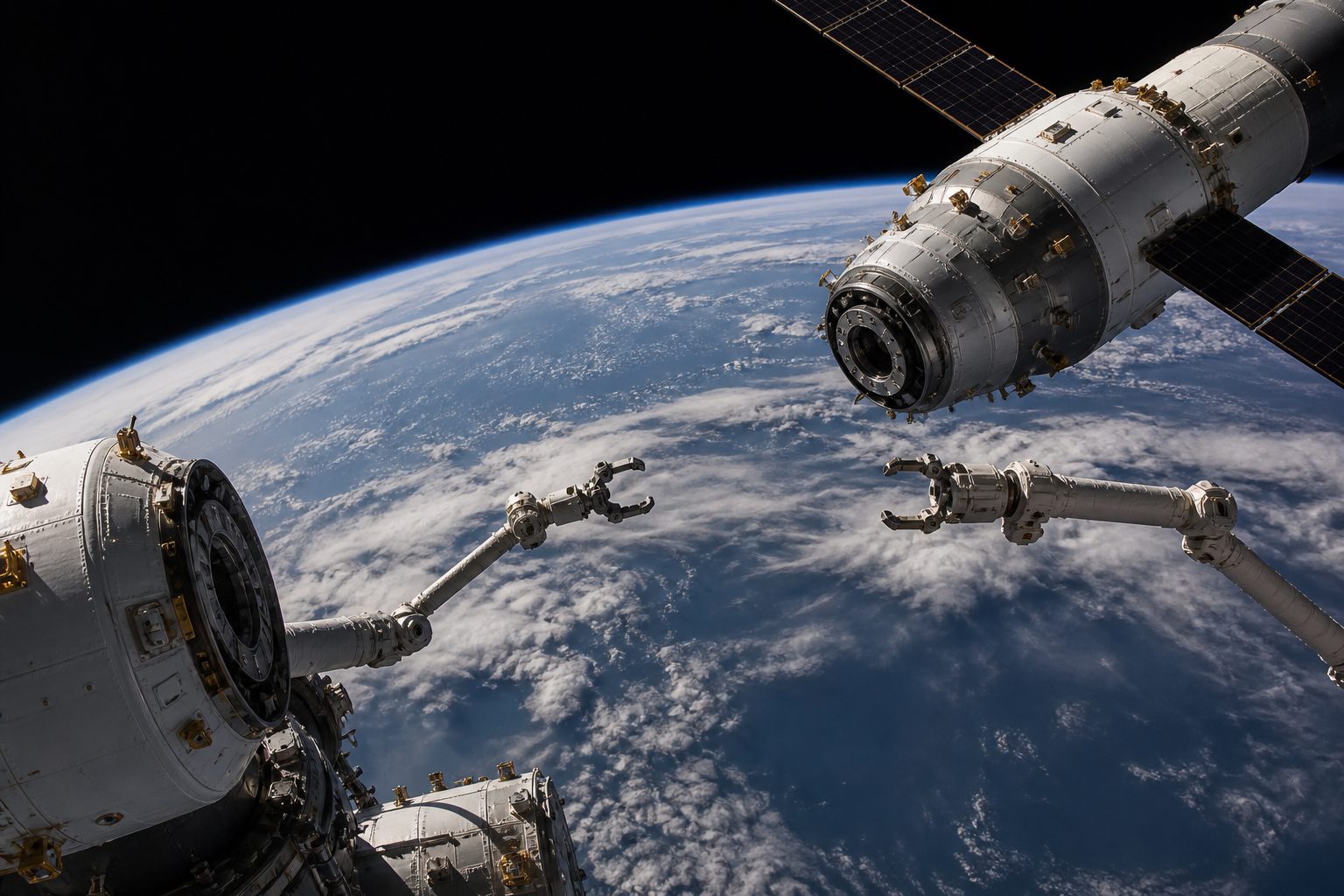
Sometime in the third week of January 2022, roughly 36,000 kilometers above the equator, a Chinese spacecraft called Shijian-21 drifted up to a dead satellite and took hold of it. The target was Beidou-2 G2, a navigation satellite that had died not long after its 2009 launch and had been drifting uncontrolled through the geostationary belt ever since. Over several days, a worldwide network of optical telescopes operated by the commercial tracking firm ExoAnalytic Solutions watched the two objects climb together, rising by roughly 3,000 kilometers above the belt. Then they separated. The dead Beidou was left in a disposal "graveyard" orbit. Shijian-21 slipped back down into the most valuable real estate in the sky (Breaking Defense, Jan. 26, 2022; SpaceNews, Jan. 27, 2022).
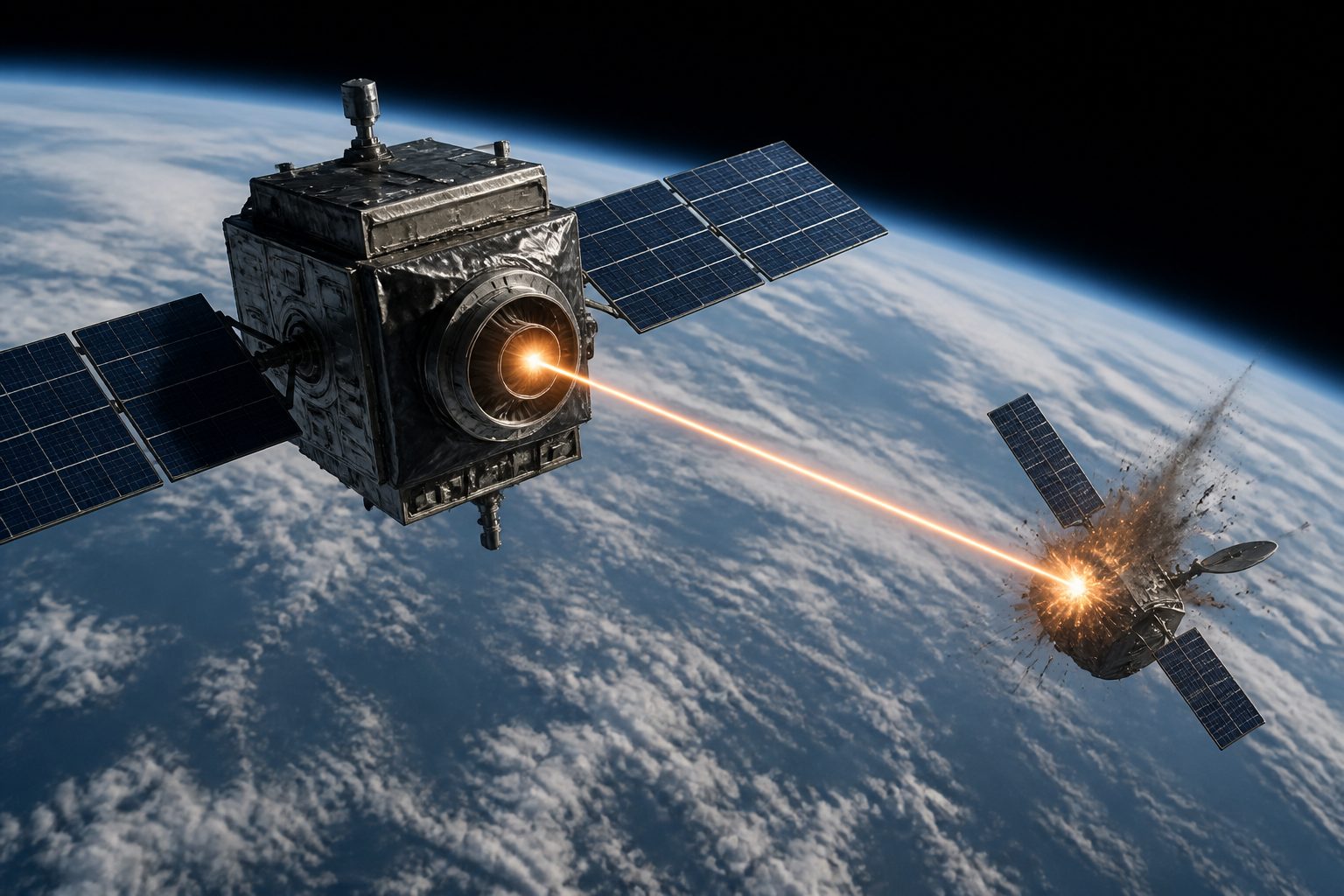
By any technical standard, it was an elegant piece of orbital work. China had registered Shijian-21 with the United Nations as a spacecraft for verifying "space debris mitigation technologies," and towing a derelict satellite out of the active belt is precisely what a cleanup vehicle is supposed to do. It is also precisely what a weapon would need to do. A vehicle that can sidle up to a satellite in geostationary orbit, physically attach to it, and drag it somewhere else can remove space junk, or it can remove someone's missile-warning satellite (CSIS, Space Threat Assessment 2025; Secure World Foundation, Global Counterspace Capabilities Report).
That ambiguity is now one of the central questions in space security. Satellites were historically passive infrastructure: launched, stationed, and left alone. Both Washington and Beijing are now building, flying, and institutionalizing spacecraft designed to do the opposite, to rendezvous with, inspect, follow, grasp, refuel, or reposition other objects in orbit. Nothing has been destroyed, and no nation has acknowledged deploying an offensive "grabbing" weapon. But the capability has been demonstrated in the same orbital belt that carries communications, weather, and early-warning satellites serving billions of people, and the line separating a tow truck from a co-orbital weapon has never been thinner. This report examines what is actually documented, what remains inference, and what the civilian world stands to lose if orbital maneuver becomes ordinary wartime behavior.
The tow truck at 36,000 kilometers
The geostationary belt matters because of a quirk of physics. At 35,786 kilometers up, a satellite's orbital period matches Earth's rotation, so it appears to hang fixed over one point on the equator. Park a satellite there and antennae on the ground never have to move. The belt accordingly hosts several hundred active satellites carrying satellite television, transoceanic internet, civil and military communications, weather observation, and missile early warning (Union of Concerned Scientists Satellite Database). Unlike low Earth orbit, there is no atmospheric drag at that altitude to clean things up. Objects abandoned there persist on timescales far longer than any human program; international practice is to boost dying satellites a few hundred kilometers higher into a graveyard orbit (ESA, Space Debris by the Numbers).
Shijian-21 had been launched on October 24, 2021, described in Chinese state media and in its United Nations registration filing as a test of debris-mitigation technology (UNOOSA, UN Register of Objects Launched into Outer Space; SpaceNews, Jan. 27, 2022). When ExoAnalytic analysts published their January 2022 observations, two things stood out to outside watchers. First, the mission worked: the dead Beidou ended up in a disposal orbit, which is arguably a public service. Second, the same sequence, approach, attach, tow, release, is exactly the operational profile of a co-orbital anti-satellite weapon that leaves no debris and gives no warning. Analysts at the Secure World Foundation and the U.S.-funded CSIS Aerospace Security Project have treated the event as a demonstrated grappling capability even while acknowledging its peaceful official purpose (Secure World Foundation, Global Counterspace Capabilities Report; CSIS, Space Threat Assessment 2025).
One honest caveat from the commercial trackers themselves: ground-based telescopes could confirm the approach, the joined movement, and the separation, but they could not resolve how Shijian-21 attached itself. Whether it used a robotic arm, a docking plate, or something else is not publicly known (Breaking Defense, Jan. 26, 2022).
Shijian-21 did not retire after its tow job. It continued maneuvering through the belt, and in mid-2025, commercial trackers reported that Shijian-25, launched in January 2025, officially to test on-orbit refueling and life-extension technologies, closed in on Shijian-21, with analysts assessing the pair had likely conducted a refueling demonstration in geostationary orbit (SpaceNews, 2025). Refueling a friendly satellite is a benign and genuinely useful trick, one Western companies are racing to sell. It also gives a grappler the ability to stay on station longer and maneuver more freely, which is why it draws the same scrutiny.
Why does no military smash satellites in orbit anymore?
To understand why the United States and China are investing in gentle, surgical orbital encounters, it helps to look at the alternative that history already tested.
The United States destroyed the Solwind satellite with an air-launched missile in 1985; the altitude was low enough that the debris field cleared relatively quickly. China changed the math in January 2007 when it destroyed its own Fengyun-1C weather satellite at about 850 kilometers. That single intercept produced more than 3,000 trackable fragments and tens of thousands of smaller ones, many of which are still aloft and still force avoidance maneuvers nearly two decades later. It remains the largest debris-generating event in space history (Secure World Foundation, Global Counterspace Capabilities Report; ESA, Space Debris by the Numbers). The United States destroyed its own failed spy satellite USA-193 with a missile in 2008, deliberately at far lower altitude so the field would disperse within the year. India's 2019 Shakti test added a few hundred more fragments. Then, in November 2021, Russia destroyed its defunct Cosmos 1408 satellite at an altitude brushing the International Space Station's orbit, generating more than 1,500 trackable pieces and forcing the station's crew, including Russian cosmonauts, to shelter in their escape capsules (U.S. Space Command, Nov. 15, 2021).
The lesson was absorbed everywhere. In April 2022, Vice President Kamala Harris announced that the United States would unilaterally commit not to conduct destructive direct-ascent anti-satellite missile tests, and a UN General Assembly resolution endorsing such a moratorium passed that December with 155 votes in favor; China and Russia were among the nine votes against (U.S. Department of State; UN General Assembly Resolution 77/41). Dozens of countries have since joined the pledge. Kinetic-kill attacks had become self-defeating: the debris endangers everyone, including the attacker's own satellites and stations.
But the moratorium covers only one very specific act, blowing up a satellite with a ground-launched missile. It says nothing about approaching one.
How could a servicing satellite double as a weapon?
A co-orbital counterspace weapon never fires anything. It is a satellite, launched like any other, that uses its own propulsion to maneuver near a target. In the geostationary belt, this is slow-motion chess: small engine burns translate into a drift of a few degrees per day, so a spacecraft can reposition itself across the belt over weeks and then make fine approaches measured in meters. Two objects closing within a kilometer of each other are conducting what the field calls rendezvous and proximity operations, or RPO (Secure World Foundation, Global Counterspace Capabilities Report).

From there, the menu of hostile options is broad and mostly quiet. A grappler can physically tow a satellite out of position, as Shijian-21 demonstrated. It can park in front of a camera or communications horn and blind or deafen it. It can jam uplinks at close range. It can nudge a satellite enough to ruin its mission, or force its operator to burn irreplaceable maneuvering fuel. None of this produces debris, flashes, or necessarily even attributable evidence. The same technologies, robotic arms, docking mechanisms, refueling plumbing, are the foundation of the legitimate on-orbit servicing industry: Northrop Grumman's Mission Extension Vehicles have docked with two aging Intelsat satellites and taken over their station-keeping (Northrop Grumman Space Logistics), Astroscale's ADRAS-J spacecraft has flown up to inspect a dead rocket body in low orbit (Astroscale, ADRAS-J), and DARPA's Robotic Servicing of Geosynchronous Satellites program aims to do similar work for the U.S. government (DARPA, RSGS).
That is the trap. There is no observable difference between a debris-removal tug and a co-orbital weapon until the moment it grabs someone else's satellite. U.S. intelligence assessments describe China as developing precisely this spectrum of tools, alongside ground-based jammers and lasers intended to dazzle or damage satellite sensors (Defense Intelligence Agency, Challenges to Security in Space, 2022).
Where this story sits
5 related pieces
Read it →
Hover a story · click to read
 No. 54 · Sep 23, 2026The Foreign Dependencies Inside China’s State AI Clouds
 No. 47 · Sep 14, 2026What breaks if China stops exporting rare-earth magnets tomorrow
 No. 25 · Sep 2, 2026China's Solar Capacity Crown Is Real. The Grid Beneath It Isn't.
 No. 33 · Sep 5, 2026U.S.-China AI talks could make autonomous cyberattacks a matter of strategic stability
 No. 55 · Sep 24, 202610 Gigawatts Overhead: The Orbital Data Centers the FCC Reviews One Filing at a Time
What has Beijing been practicing up there?
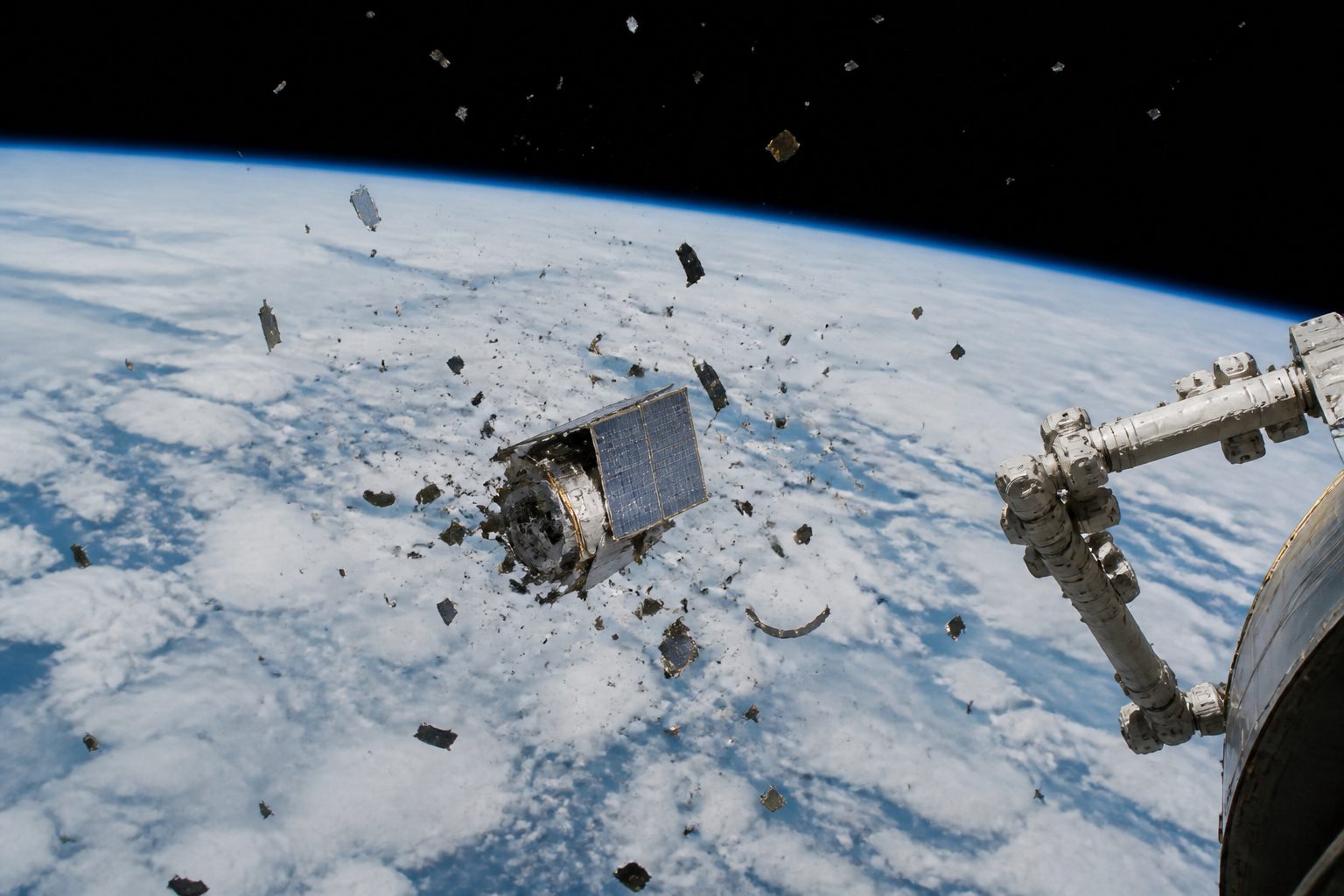
China's rendezvous pattern long predates the January 2022 tow. In 2010, the Shijian-12 satellite appeared to close to within contact distance of another Chinese satellite, a possible docking test. In 2013, a trio of satellites experimented with a robotic arm and close approaches. Shijian-17, launched in 2015 and described in open-source analyses as carrying a robotic arm, spent years drifting across the geostationary belt and conducting close approaches to other Chinese satellites, including an extended 2016 rendezvous with the aging ChinaSat-5A. The TJS-3 satellite, launched in late 2018 ostensibly to test communications technologies, entered the belt with a small companion object, and the two then maneuvered around each other in coordinated patterns that commercial analysts likened to cat-and-mouse exercises before TJS-3 drifted on to examine other satellites (Secure World Foundation, Global Counterspace Capabilities Report; CSIS, Space Threat Assessment 2025).
By 2024 this had migrated from geostationary orbit to low Earth orbit in more conspicuous form. In March 2025, Gen. Michael Guetlein, then the Space Force's vice chief of space operations, told a defense conference that U.S. tracking had observed five Chinese satellites, three Shiyan-24C spacecraft and a pair of Shijian-6 05-series satellites, conducting synchronized proximity maneuvers in low orbit, "tactics, techniques, and procedures" rehearsing satellite-on-satellite operations; his choice of phrase was "dogfighting in space" (SpaceNews, March 2025). China's reusable spaceplane, on its four orbital flights since 2020, has repeatedly released small objects and maneuvered near them, behavior followed by commercial radar trackers whose purpose Beijing has never explained (SpaceNews, December 2023).
The institutional shift matches the hardware. In April 2024, Xi Jinping dissolved the nine-year-old PLA Strategic Support Force and created a dedicated PLA Aerospace Force, elevating space warfighting to a service-level command under the Central Military Commission; the Pentagon's annual China military power report describes a force that treats space as a warfighting domain and that fields operational direct-ascent missiles, radio-frequency jammers, ground-based lasers, and experimental co-orbital satellites (U.S. Department of Defense, Military and Security Developments Involving the People's Republic of China, 2024; see also U.S.–China Economic and Security Review Commission, 2024 Annual Report and IISS, The Military Balance).
The counter-evidence deserves equal weight. Every one of these missions carries an official benign explanation, debris mitigation, scientific experiment, refueling technology verification, and several genuinely produce those benefits. Towing the Beidou corpse out of the belt removed a hazard. Beijing, for its part, routinely accuses the United States of being the power militarizing space, and it is not wrong that Washington runs similar machines. That is the next part of the story.
Is Washington doing the same thing?
In most respects, yes, and it started earlier. The United States flew inspection micro-satellites in the 2000s, and a 2006 program called MiTEx quietly placed small satellites in geostationary orbit to examine an ailing U.S. missile-warning satellite up close. Today the workhorse is GSSAP, the Geosynchronous Space Situational Awareness Program: six Space Force satellites that operate as what U.S. officials themselves have called a "neighborhood watch," sidling up to resident space objects, including ones belonging to other countries. Secure World Foundation's tracking of the program documents dozens of such close approaches over the years (Secure World Foundation, Global Counterspace Capabilities Report). The U.S. military's X-37B spaceplane adds another long-duration maneuverable platform; its seventh mission spent 434 days in orbit, executed a fuel-saving aerobraking maneuver the Space Force publicly announced, and landed in March 2025 (SpaceNews, March 7, 2025). Nothing in the public record supports describing any of these as weapons; they are surveillance and inspection craft. But an inspector and a stalker are built from the same parts, which is exactly what Chinese analysts say about American programs.
American doctrine is becoming explicit about the warfighting frame. In January 2024, Chief of Space Operations Gen. Chance Saltzman issued "Competitive Endurance," a theory of success built around avoiding operational surprise, denying an adversary the advantage of a first move in orbit, and responsible counterspace campaigning (Defense News, Jan. 26, 2024). In 2025 the Space Force published "Space Warfighting: A Framework for Planners," formally organizing combat concepts such as orbital warfare alongside electronic and cyber operations in the space domain (SpaceNews, 2025). The Pentagon's first commercial space integration strategy acknowledges something planners long avoided saying aloud: in a war, commercial satellites performing military-adjacent work may be treated as targets (U.S. Department of Defense, 2024 Commercial Space Integration Strategy). And the architecture itself is changing: the National Reconnaissance Office has abandoned a handful of exquisite spy satellites for proliferated constellations of cheap, numerous spacecraft built with SpaceX's Starshield bus, precisely so that grabbing or killing a few no longer blinds the fleet (SpaceNews, May 2024). A January 2025 executive order directing work on a homeland missile-defense shield contemplates space-based interceptors, blurring the line between orbital infrastructure and orbital weapons from the American side as well (Executive Order, The Iron Dome for America, Jan. 27, 2025).
Each capital points at the other's tug as proof of its own restraint. Both are describing the same technology.
What did the treaties forget to ban?
The legal situation is striking for what is missing. The 1967 Outer Space Treaty prohibits placing nuclear weapons or other weapons of mass destruction in orbit and declares the Moon and celestial bodies off-limits to military use. It requires states to act with "due regard" for others and to consult if their activities might cause harmful interference. It does not prohibit conventional weapons in orbit. It does not mention anti-satellite weapons, grappling, or proximity operations at all (Outer Space Treaty, 1967). The Registration Convention requires states to tell the UN what a satellite's function is, but the filing can be, and routinely is, one vague sentence; "verification of space-debris mitigation technologies" is entirely compliant (UNOOSA, UN Register of Objects Launched into Outer Space).
Efforts to close the gap have failed in instructive ways. Russia and China have promoted a draft treaty on preventing the placement of weapons in space since 2008; the United States rejects it because it defines neither weapon nor verification, and it would not touch ground-based missiles, the very systems both sponsors fly. The American-pivoted alternative, voluntary norms, produced the missile-test moratorium and nonbinding UN guidelines on long-term sustainability adopted in 2019, but a UN working group on space-threat norms ended its first session in 2022 without consensus recommendations, and a merged open-ended working group now tasked with these questions through 2028 has made slow progress (UN Office for Disarmament Affairs, Outer Space). Industry has tried to fill the vacuum with its own rendezvous-and-servicing code of conduct (CONFERS).
Meanwhile, the rhetorical floor is dropping. In October 2022, a Russian diplomat warned the UN that Western "quasi-civilian" satellites used in the Ukraine war could become legitimate targets (Reuters, Oct. 27, 2022), a warning with a decade of commercial imaging and satellite-internet use on the battlefield behind it. In 2024, U.S. officials publicly accused Russia of developing a space-based nuclear anti-satellite weapon, a capability that would violate the one orbital weapons ban that exists and would destroy satellites indiscriminately; a Pentagon official stressed it was not yet deployed and would be unusable without catastrophic self-harm (SpaceNews, May 2024). Against that backdrop, silent grapples in geostationary orbit look almost polite, which is precisely the problem.
What would a fight over this infrastructure cost the rest of us?
More than ten thousand working satellites now orbit Earth, the densest population in history. Several hundred occupy the geostationary belt; the majority are in low Earth orbit, where SpaceX's Starlink alone accounts for well over half of all active spacecraft, alongside Eutelsat OneWeb's more than 600 satellites and Amazon's Kuiper constellation, whose deployment began in April 2025 (ESA, Space Debris by the Numbers; Union of Concerned Scientists Satellite Database; SpaceNews, April 2025). The economic exposure is no longer theoretical. A 2019 study prepared for the National Institute of Standards and Technology estimated that GPS had generated roughly $1.4 trillion in U.S. economic benefits since it became available and that a 30-day outage would cost on the order of $1 billion a day, from timing synchronization in financial networks to agriculture and logistics (RTI International, Economic Benefits of the Global Positioning System, 2019). Space Foundation measured the global space economy at $613 billion in 2024 (Space Foundation, The Space Report).
Low Earth orbit is already operating at the edge of manageability without any shots fired. SpaceX has reported to the FCC that its Starlink satellites executed more than 25,000 collision-avoidance maneuvers in a single six-month period (SpaceNews, February 2023). China filed a formal UN complaint after two close approaches by Starlink satellites toward its Tiangong space station in 2021 (SpaceNews, December 2021). The ISS crew sheltered from Russia's 2021 test debris (U.S. Space Command), and again in June 2024 when a dead Russian Earth-observation satellite spontaneously broke apart near the station's orbit (SpaceNews, June 2024). At roughly seven kilometers per second, any collision manufactures a shotgun pattern of fragments; the 2009 Iridium–Cosmos crash alone seeded low orbit with some two thousand trackable pieces (ESA, Space Debris by the Numbers). The cascade hazard has a name, Kessler syndrome, from a 1978 paper by NASA scientists showing that past a density threshold, collisions create debris that causes more collisions even if humanity launches nothing new (Kessler and Cour-Palais, 1978); ESA's models indicate that in some crowded altitude bands, that collision-only growth process is already operating.
Geostationary orbit carries the same logic in slower motion and worse permanence. Debris there never comes down. And the belt's defensive targets are not generic satellites: they are the missile-warning constellations that underpin nuclear deterrence and the weather satellites that anchor hurricane forecasting. Blinding one in a crisis could be read as preparing a first strike, an escalation trap no grappler manual can defuse.
Even a debris-free co-orbital conflict would tax civilians hard. Reversible attacks, jamming, dazzling, forced approaches, trigger emergency maneuvers that exhaust the fuel budget on which GEO satellite lifetimes are priced. Conjunction alerts multiply. Insurance and replacement costs land on commercial operators. And every actor loses visibility, because the public catalog from the U.S. military's 18th Space Defense Squadron and commercial networks can show where satellites are, but never what they intend (Space-Track.org).
So are these satellites weapons?
The honest answer comes in layers. Demonstrated fact: a Chinese spacecraft grappled, towed, and released another object in geostationary orbit in January 2022, and Chinese and American military satellites now conduct rendezvous and proximity operations as a routine practice, including synchronized multi-satellite "dogfighting" rehearsals and mutual shadowing. Established by primary documents: both governments have built military institutions, the PLA Aerospace Force, the U.S. Space Force, whose official doctrine treats satellites as assets to defend and as targets. Reasonable inference, shared by most independent analysts: the same vehicles could disable adversary satellites on command. Not established by public evidence: that either nation has deployed a satellite designated as a grappling weapon, threatened another's satellite with one, or intends to use these benignly-flagged missions offensively. Genuinely unknown: the mechanisms inside these spacecraft and the rules of engagement governing them.
What has changed, definitively, is the posture. Maneuver is no longer exceptional; it is rehearsed, budgeted, and doctrinally normalized on both sides. The ambiguity is not an accident; it is strategically useful to everyone, providing cover, deterrence, and deniability at once. That is a quieter transformation than "satellites become weapons," but it may be the more consequential one, because it lowers the threshold for action while making action harder to prove. The first co-orbital use against a foreign satellite will likely be debated for weeks before it is confirmed.
Could anything stop the belt from becoming a battlefield?
The practical menu is known, even if the will is scarce: notification and registration rules for proximity operations, so an approach is announced rather than discovered by a telescope operator; licensing and transparency for debris-removal missions, so cleanup tugs carry credentials; military-to-military channels and an orbital incident hotline; shared tracking data that let all operators, commercial included, see anomalies quickly; and resilient architectures that reduce the payoff of grabbing any single satellite, a course the NRO is already pursuing. Each measure exists in draft form somewhere, in voluntary industry codes, in UN working-group papers, in academic proposals, and each has stalled on verification, because verifying intent in orbit is the one thing no sensor can do (UN Office for Disarmament Affairs, Outer Space; CONFERS).
Somewhere above the equator tonight, the corpse of Beidou-2 G2 circles in its graveyard orbit, where any modest telescope can find it. A spacecraft built for "practice" put it there, gently, lawfully, arguably helpfully, and without any treaty provision ever having contemplated the act. Nothing currently prevents the next tow from involving a satellite that is alive, foreign, and load-bearing for the society below. Between the physics that make such an act easy, the law that does not forbid it, the institutions now trained for it, and the billion-dollar-a-day dependence of modern life on the targets, the open question is no longer whether orbit can become a battlespace. It is whether anyone will be able, or willing, to say when it did.
Sources/References
- Hitchens, Theresa. "China's SJ-21 Towed Dead Satellite Into 'Graveyard Orbit': Watchdog." Breaking Defense, January 26, 2022. https://breakingdefense.com/2022/01/chinas-sj-21-towed-dead-satellite-into-graveyard-orbit-watchdog/
- Foust, Jeff. "China's Shijian-21 Towed Dead Satellite to a High Graveyard Orbit." SpaceNews, January 27, 2022. https://spacenews.com/chinas-shijian-21-towed-dead-satellite-to-a-high-graveyard-orbit/
- Secure World Foundation. "Global Counterspace Capabilities Report" (Brian Weeden and Victoria Samson, eds.). https://swfound.org/counterspace/
- CSIS Aerospace Security Project. "Space Threat Assessment 2025." https://www.csis.org/analysis/space-threat-assessment-2025
- Erwin, Sandra. "Space Force General Raises Concerns Over China's 'Dogfighting' Satellites." SpaceNews, March 2025. https://spacenews.com/space-force-general-raises-concerns-over-chinas-dogfighting-satellites/
- SpaceNews. "China's Secretive Spaceplane Releases Object into Orbit." December 2023. https://spacenews.com/chinas-secretive-spaceplane-releases-object-into-orbit/
- SpaceNews. "Shijian-21 and Shijian-25 Dock in Geosynchronous Orbit." 2025. https://spacenews.com/shijian-21-and-shijian-25-dock-in-geosynchronous-orbit/
- U.S. Department of Defense. "Military and Security Developments Involving the People's Republic of China, 2024." https://media.defense.gov/2024/Dec/18/2003615520/-1/-1/0/MILITARY-AND-SECURITY-DEVELOPMENTS-INVOLVING-THE-PEOPLES-REPUBLIC-OF-CHINA-2024.PDF
- Defense Intelligence Agency. "Challenges to Security in Space: Space Reliance in an Era of Competition and Expansion," 2022. https://www.dia.mil/Portals/110/Documents/News/Military_Powers_Publications/Challenges_Security_Space_2022.pdf
- U.S.–China Economic and Security Review Commission. "2024 Annual Report to Congress." https://www.uscc.gov/annual-report/2024-annual-report-congress
- IISS. "The Military Balance." https://www.iiss.org/publications/the-military-balance/
- United Nations Office for Outer Space Affairs. UN Register of Objects Launched into Outer Space. https://www.unoosa.org/oosa/en/spaceobjectregister/index.html
- Treaty on Principles Governing the Activities of States in the Exploration and Use of Outer Space (Outer Space Treaty), 1967. https://treaties.unoda.org/t/outer_space
- U.S. Department of State. "The United States Commits Not to Conduct Destructive, Direct-Ascent Anti-Satellite Missile Testing," April 2022. https://www.state.gov/the-united-states-commits-not-to-conduct-destructive-direct-ascent-anti-satellite-missile-testing/
- UN General Assembly Resolution 77/41, "Destructive Direct-Ascent Anti-Satellite Missile Testing," December 2022. https://undocs.org/A/RES/77/41
- UN Office for Disarmament Affairs. "Outer Space" (PAROS, working groups, and treaty processes). https://disarmament.unoda.org/topics/outerspace/
- U.S. Space Command. "Russia Tests Direct-Ascent Anti-Satellite Missile," November 15, 2021. https://www.spacecom.mil/Newsroom/News/Article-Display/Article/2845701/russia-tests-direct-ascent-anti-satellite-missile/
- Northrop Grumman. Space Logistics (Mission Extension Vehicle program). https://www.northropgrumman.com/space/space-logistics-services
- Astroscale. ADRAS-J mission. https://astroscale.com/missions/adras-j/
- DARPA. Robotic Servicing of Geosynchronous Satellites. https://www.darpa.mil/program/robotic-servicing-of-geosynchronous-satellites
- Albon, Courtney. "Space Force Outlines 'Competitive Endurance' Plan to Avoid Orbital Conflict." Defense News, January 26, 2024. https://www.defensenews.com/space/2024/01/26/space-force-outlines-competitive-endurance-plan-to-avoid-orbital-conflict/
- SpaceNews. "Space Force Releases New Space Warfighting Framework." 2025. https://spacenews.com/space-force-releases-new-space-warfighting-framework/
- U.S. Department of Defense. "2024 DoD Commercial Space Integration Strategy." https://media.defense.gov/2024/Apr/02/2003457610/-1/-1/1/2024-DOD-COMMERCIAL-SPACE-INTEGRATION-STRATEGY.PDF
- SpaceNews. "NRO Launches First Proliferated Architecture Satellites." May 2024. https://spacenews.com/nro-launches-first-proliferated-architecture-satellites/
- Executive Order. "The Iron Dome for America." The White House, January 27, 2025. https://www.whitehouse.gov/presidential-actions/2025/01/the-iron-dome-for-america/
- SpaceNews. "X-37B Returns to Earth After 434 Days in Orbit." March 7, 2025. https://spacenews.com/x-37b-returns-to-earth-after-434-days-in-orbit/
- Reuters. "Russia Says It May Target Western Commercial Satellites," October 27, 2022. https://www.reuters.com/world/russia-says-may-target-western-commercial-satellites-2022-10-27/
- SpaceNews. "Pentagon Official: Russia's Space-Based Nuclear Weapon Would Be Indiscriminate." May 2024. https://spacenews.com/pentagon-official-russias-space-based-nuclear-weapon-would-be-indiscriminate/
- European Space Agency. "Space Debris by the Numbers." https://www.esa.int/Space_Safety/Space_Debris/Space_debris_by_the_numbers
- Union of Concerned Scientists. UCS Satellite Database. https://www.ucs.org/resources/satellite-database
- SpaceNews. "ULA Launches First Batch of Amazon's Kuiper Satellites." April 2025. https://spacenews.com/ula-launches-first-batch-of-amazons-kuiper-satellites/
- RTI International. "Economic Benefits of the Global Positioning System (GPS)," report for the National Institute of Standards and Technology, 2019. https://www.rti.org/publication/economic-benefits-global-positioning-system-gps
- Space Foundation. "The Space Report." https://www.spacefoundation.org/the-space-report/
- SpaceNews. "SpaceX Says Starlink Satellites Performed More Than 25,000 Collision Avoidance Maneuvers." February 2023. https://spacenews.com/spacex-says-starlink-satellites-performed-more-than-25000-collision-avoidance-maneuvers/
- SpaceNews. "China Complains to UN After Space Station Encounters with Starlink Satellites." December 2021. https://spacenews.com/china-complains-to-un-after-space-station-encounters-with-starlink-satellites/
- SpaceNews. "ISS Crew Takes Shelter After Satellite Breakup." June 2024. https://spacenews.com/iss-crew-takes-shelter-after-satellite-breakup/
- Kessler, Donald J., and Burton G. Cour-Palais. "Collision Frequency of Artificial Satellites: The Creation of a Debris Belt." Journal of Geophysical Research 83 (1978): 2637–2646. https://doi.org/10.1029/JA083iA06p02637
- Space-Track.org (18th Space Defense Squadron public satellite catalog). https://www.space-track.org/
- CONFERS. Guiding principles for rendezvous and proximity operations and on-orbit servicing. https://www.satelliteconfers.org/
Comments (2)
Continue exploring
China's Solar Capacity Crown Is Real. The Grid Beneath It Isn't.
China's installed solar capacity has passed coal, but the grid cannot store, transmit or dispatch sunlight on demand, so coal…
U.S.-China AI talks could make autonomous cyberattacks a matter of strategic stability
Reuters reports the U.S. and China are preparing a mid-September AI safety dialogue. What it can realistically deliver: an…
10 Gigawatts Overhead: The Orbital Data Centers the FCC Reviews One Filing at a Time
SpaceX and Orbital Compute want to put AI data centers in orbit, filings that test whether the FCC can review a strategic system…
The article notes that international practice calls for boosting dying GEO satellites "a few hundred kilometers higher" into a disposal orbit, yet Shijian-21 raised Beidou-2 G2 by roughly 3,000 kilometers above the belt, about ten times the typical margin. Was that simply a conservative disposal to eliminate any chance of orbital recontact, or does the extra delta-v suggest the spacecraft was deliberately testing the upper limits of its propulsion and grappling endurance? If the latter, the maneuver may have revealed more about the grappler's performance envelope than a routine debris-mitigation task would require. Have the CSIS or Secure World Foundation analysts offered any assessment of why such an unusually high graveyard orbit was chosen?
The framing implies this is principally a Chinese capability advance, but DARPA's Robotic Servicing of Geosynchronous Satellites program and the operational MEV-1 and MEV-2 spacecraft are already performing rendezvous, docking, and repositioning of GEO satellites. The dual-use ambiguity the article attributes to Shijian-21 applies equally to those U.S. efforts, and the "race" framing is undercut when both sides are running nearly identical dual-use programs.