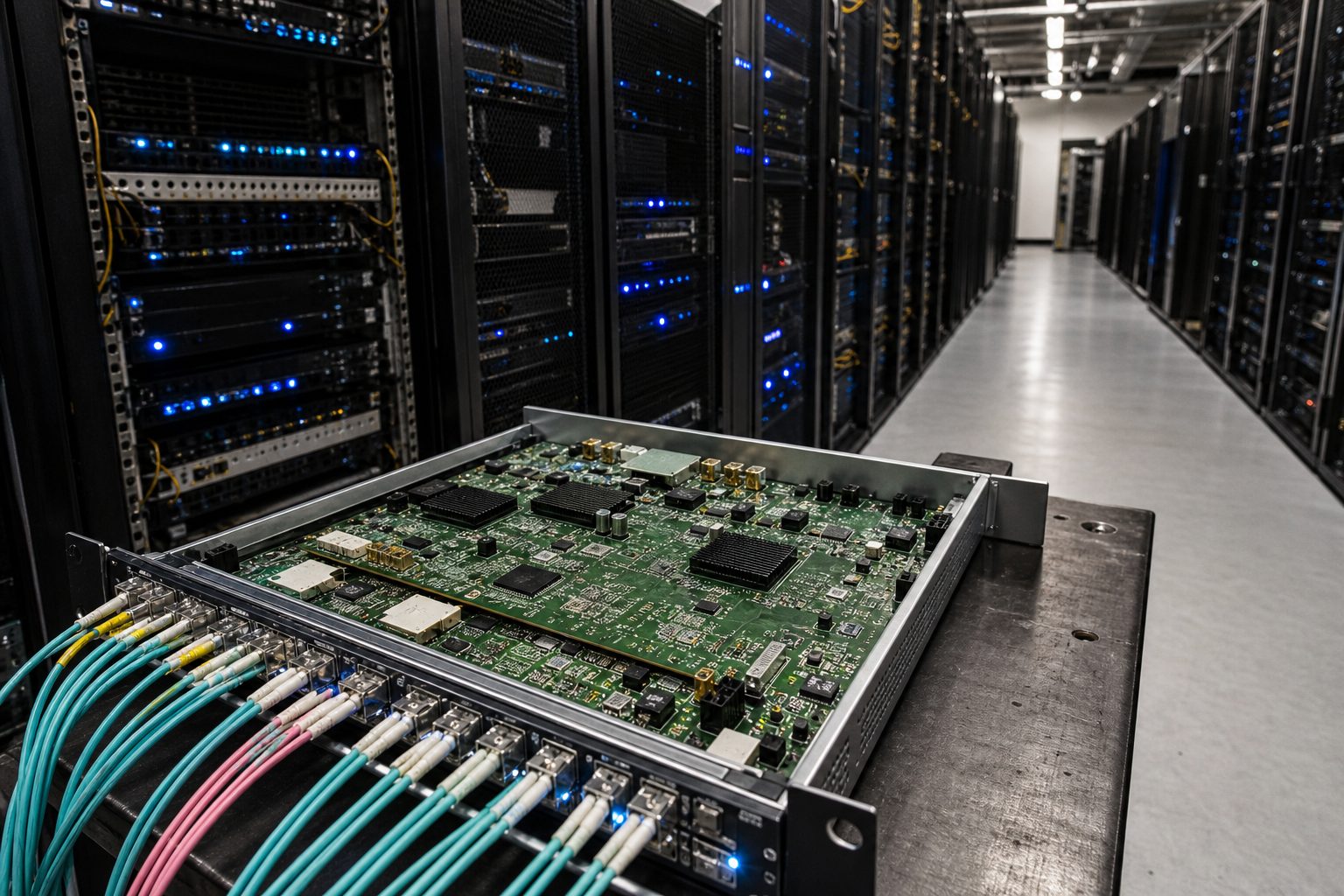
China can build a branded data-center switch and assemble an AI server while still depending on foreign technology at difficult layers of the network.
That distinction matters. A domestically branded switch is not necessarily a domestically designed or fabricated switch. Its enclosure, operating system, board design, and software may come from Huawei, H3C, or Ruijie while the underlying switching silicon, serializer-deserializer circuits, optical components, or manufacturing tools originate elsewhere.
Public evidence does not support a precise claim that all of China’s state-backed AI clusters depend on foreign networking hardware. Nor does it establish a reliable market-share figure for Cisco, Arista, Juniper, or NVIDIA/Mellanox inside those facilities. China’s procurement data is fragmented, and much of the relevant infrastructure is not disclosed at the component level.
The evidence supports a narrower conclusion: China has built a substantial domestic market for AI networking equipment, but its effort to create a fully self-sufficient AI infrastructure remains vulnerable at specialized components. Export controls can make those components harder to obtain and more expensive to replace. They cannot, by themselves, eliminate every foreign dependency.
The result is a trade-off. Replacing foreign components with domestic alternatives may improve supply security and political control, but it can also reduce performance, raise engineering costs, increase power consumption, and slow the deployment of large training systems.
The real dependency is inside the box
A data-center network has several layers. The visible layer is the branded switch, the device that operators buy, install, and manage. Beneath it sits the switch ASIC, the processor that examines packet headers and moves traffic between ports. Around the ASIC sit high-speed electrical interfaces, optical modules, digital signal processors, memory, power systems, and software.
For ordinary enterprise traffic, these components do not all need to operate at the limits of current technology. AI training is different. Thousands of accelerators may exchange data repeatedly during a single training step. If the network delays or drops that traffic, expensive GPUs sit idle.
That makes bandwidth and latency central design constraints. The more accelerators a cluster contains, the more the network behaves like part of the computer rather than a separate utility.
The 650 Group describes this split between conventional enterprise switching and cloud or AI-oriented switching. Its market analysis identifies different requirements for cloud and enterprise networks, including specialized semiconductors and high-speed Ethernet designs for AI and machine-learning clusters. It also distinguishes the Chinese market, where H3C, Huawei, and Ruijie are among the vendors covered in its analysis, from the non-Chinese market, where Cisco, Arista, Dell, and Juniper are discussed. The report does not establish the share of each vendor in China’s state-backed AI training clusters. (650 Group)

The distinction between equipment vendor and component supplier is central. A Chinese operator can buy a locally branded switch while remaining dependent on a foreign merchant-silicon supplier. Domestic assembly therefore does not prove domestic technological independence.
China’s domestic vendors are already significant
Huawei, H3C, and Ruijie sell networking and data-center equipment in China. Huawei also develops semiconductor products and has become one of the most important Chinese companies involved in the country’s effort to reduce reliance on foreign technology.
Available evidence suggests that China’s position is strongest at the equipment and integration layers. Local vendors understand Chinese procurement requirements, operate within the country’s software ecosystem, and can adapt products for state-owned enterprises and government-backed computing centers.
China also benefits from the size of its protected home market. That market gives local vendors opportunities to test products, refine software, build support networks, and sell equipment even when it is not yet competitive globally.
A 2025 analysis by the Mercator Institute for China Studies found that China was pursuing self-reliance across the AI technology stack, from chips and software frameworks to models and applications. It concluded that Chinese companies had developed domestic AI chips, but that their performance still did not match leading US designs. The report also described Huawei as a leading participant in the domestic chip effort and identified limited access to advanced semiconductors as a continuing weakness. (MERICS)
The same pattern may apply to networking. China can produce more of the visible infrastructure than it could several years ago. That does not mean every high-speed component inside those systems is domestically designed, fabricated, or equivalent in performance.
Switch ASICs are the pressure point

The switch ASIC is one of the hardest parts of the network to replace. It must process enormous volumes of traffic while maintaining predictable latency and managing congestion across many ports.
At the high end, bandwidth depends partly on the speed and number of SerDes channels. SerDes circuits convert parallel electrical data into serial signals and back again. They are difficult to scale because they combine high-speed analog behavior with demanding signal-integrity requirements.
A technical review of AI data-center switches by Patrick Zhou describes 51.2-terabit-per-second switch silicon as a high-end benchmark and identifies Broadcom, NVIDIA, and Marvell as major suppliers in high-speed Ethernet switching. The review also argues that advanced switch chips require leading-edge manufacturing processes and that restrictions on China’s access to advanced manufacturing constrain its ability to match the highest-end designs. (Deep Fundamental Research)
That analysis is not an official market census, and its market-share estimates should be treated as an informed industry interpretation rather than a definitive measurement. Its technical point is nevertheless important: China may be able to design a switch platform or integrate a domestic box while remaining constrained by access to advanced switch silicon.
The problem is not limited to raw bandwidth. AI fabrics also depend on congestion control, telemetry, collective-communication behavior, buffering, packet scheduling, and software integration. A switch that reaches a nominal throughput target may still perform poorly when thousands of accelerators exchange synchronized workloads.
This is why replacing a foreign ASIC is not equivalent to substituting one processor for another. It may require changes to the switch operating system, network-control software, cables, optics, accelerator drivers, and workload scheduler.
Optical transceivers add another foreign layer
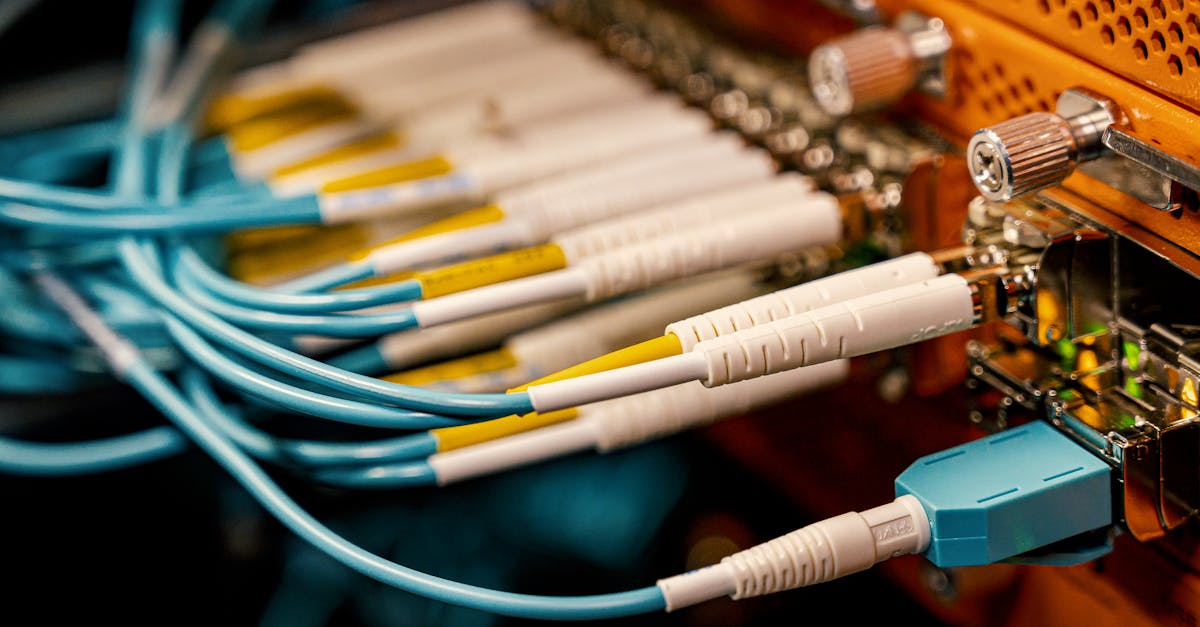
The switch ASIC is only one part of the physical network. Large AI clusters also require optical transceivers, lasers, photonic components, retimers, and digital signal processors.
Optical transceivers convert electrical signals from the switch into light for transmission through fiber, then convert incoming light back into electrical data. At increasingly high data rates, the module must manage signal loss, thermal conditions, error correction, calibration, and interoperability.
A domestically branded switch can therefore contain a foreign optical module even when the switch itself is Chinese. The same may be true of a domestic server using foreign network interface controllers or a locally assembled rack using foreign cabling and signal-conditioning components.
The public record does not establish the share of US, Japanese, or other foreign suppliers in China’s state AI optical-transceiver market. Nor does it provide procurement-level evidence showing that a named state-backed training cluster uses a specific foreign optical module.

That limitation matters. Claims that foreign optics account for a particular percentage of China’s AI infrastructure require procurement records, teardown evidence, supplier disclosures, or other direct documentation. The available evidence does not justify a precise number.
The broader dependency is technically plausible because high-speed optical components are specialized and difficult to validate at scale. But plausibility is not proof of universal dependence.
Export controls target the stack unevenly
US export controls have focused primarily on advanced computing chips, semiconductor manufacturing equipment, supercomputer uses, and related support. The Bureau of Industry and Security’s 2023 rules expanded controls on advanced computing integrated circuits and semiconductor manufacturing items, added performance-density thresholds, addressed circumvention risks, and imposed additional requirements affecting certain companies connected to China and other destinations subject to US arms embargoes. (BIS; Federal Register)
Those rules do not amount to a general ban on every Ethernet switch, optical module, or networking component entering China. This creates an important distinction.
A networking device may be politically important to an AI cluster without falling within the same control category as an advanced AI accelerator. A switch ASIC may also be treated differently from the GPU or accelerator attached to the network. Components below a particular performance threshold may remain available, while the highest-end parts face restrictions or licensing barriers.
The controls can still have indirect effects. If Chinese operators cannot obtain the newest accelerators, they may also lose access to tightly integrated networking platforms designed for those accelerators. If advanced chip-manufacturing equipment is restricted, domestic suppliers may struggle to produce competitive switch ASICs even when they possess the necessary architecture.
But export controls do not automatically force a complete technological separation. They create pressure at specific points. Companies can respond by using older components, designing around restricted products, buying through third countries, relying on domestic inventory, or accepting lower performance.
The available evidence does not establish how widespread relabeled foreign hardware or third-country routing is inside China’s state AI infrastructure. Such workarounds are widely discussed in technology-control debates, but discussion is not evidence that a particular state cloud used them.
The performance gap depends on the workload
The usual comparison is between InfiniBand, high-performance RoCE Ethernet, and domestic Ethernet fabrics.
InfiniBand has long been used for high-performance computing because it provides tightly integrated hardware and software for low-latency communication, remote direct memory access, congestion management, and collective operations. NVIDIA’s acquisition of Mellanox strengthened its position in this area by combining accelerators, network adapters, switches, and software into a more unified platform.

RoCE, or RDMA over Converged Ethernet, attempts to provide similar low-overhead communication over Ethernet. It can be attractive because Ethernet is widely deployed, supported by multiple vendors, and easier to integrate into general-purpose data centers. But achieving reliable performance at AI scale requires careful configuration of lossless behavior, congestion control, routing, queue management, and monitoring.
Domestic Ethernet alternatives may perform adequately for inference, smaller training jobs, or workloads that do not require constant synchronization across thousands of accelerators. They may also offer advantages in price, local support, and supply availability.
The risk appears when operators replace a mature, integrated fabric with a system that has similar headline bandwidth but weaker behavior under synchronized training traffic. Training throughput can fall even if the network remains technically functional.
The exact penalty is workload-specific. It depends on model architecture, batch size, parallelism strategy, accelerator type, topology, oversubscription, software stack, and the ratio of computation to communication. No credible general figure can be applied to every Chinese AI cluster.
The economic consequence is also indirect. A slower fabric does not simply make one training run more expensive. It can reduce the number of experiments a research team completes, delay model releases, increase the number of accelerators needed to meet a target, and make power and cooling costs more difficult to control.
All-domestic builds trade supply security for efficiency
A domestic network can offer strategic benefits even when it is technically inferior.
Chinese operators gain greater control over procurement, software updates, maintenance, data governance, and long-term product availability. They are less exposed to foreign licensing decisions and less vulnerable to a sudden cutoff of a critical supplier.
The costs are harder to measure but substantial.
First, a domestic alternative may carry a development premium. Operators and vendors must fund validation, interoperability testing, software adaptation, and performance tuning. A foreign platform with a mature ecosystem may require fewer engineering hours even when its purchase price is higher.
Second, lower performance can raise capital expenditure. If each switch handles less useful AI traffic, the cluster may need more switches, more optical modules, more fiber, and more rack space.
Third, power consumption can rise. Network power is influenced by port count, signal-conditioning requirements, cooling, optical modules, and the efficiency of the silicon. A slower system that requires additional equipment can impose a larger energy burden than a smaller high-performance fabric.
Fourth, reliability may suffer during the transition. A local product with limited deployment history may be adequate in a controlled environment but less proven under sustained, large-scale training loads. Reliability is not only a property of the hardware. It also depends on firmware, monitoring, spares, support teams, and the operator’s ability to diagnose failures quickly.
These penalties are not inevitable. China’s large domestic market may help finance rapid improvement, and local operators can optimize systems for workloads that differ from those used by US hyperscalers. But a mandate to purchase domestic equipment does not remove the engineering problem. It shifts more of the burden onto Chinese vendors and state-backed users.
The “90 percent Broadcom” claim needs caution
A September 23, 2026 report by Electronics For You said China’s State-owned Assets Supervision and Administration Commission had surveyed Broadcom switch deployments in state-controlled data centers. It reported preliminary findings that Broadcom switches accounted for as much as 90 percent of equipment in those facilities and said authorities were considering informal directives to reduce that reliance. (Electronics For You)
The report is recent and directly relevant, but it does not provide the underlying survey, a list of facilities, a definition of “Broadcom switches,” or independent confirmation from SASAC or the affected operators. It should therefore be treated as a reported allegation, not an established national statistic.
The figure may also confuse several categories: branded switches containing Broadcom silicon, switches sold under Broadcom-related product lines, or equipment whose network chips come from Broadcom. Those are materially different claims.
Even if the reported figure applies to a defined group of state facilities, it would not establish that 90 percent of China’s AI networking infrastructure depends on Broadcom, nor that 90 percent of switch ASICs in Chinese training clusters are foreign. The scope must be known before the number can support a broader conclusion.
Public procurement can reveal equipment, but not always silicon
China Telecom, China Mobile, China Unicom, Inspur, and provincial computing centers publish or circulate procurement notices for servers, switches, network services, and data-center construction. These documents can identify equipment vendors and sometimes product families.

They often do not identify every component inside the equipment. A tender may specify a Huawei, H3C, or Ruijie switch without stating whether its ASIC, optics, DSP, or manufacturing process is Chinese.
That creates a persistent evidence gap. Vendor-level procurement data can show that domestic companies are winning contracts. It cannot by itself prove that the resulting infrastructure is fully domestic.
To establish the central claim at cluster level, researchers would need to combine procurement notices with product specifications, vendor disclosures, import records, technical teardowns, and interviews or other evidence from operators. The current public record is not sufficiently granular to produce a reliable market-share table for Cisco, Arista, Juniper, NVIDIA/Mellanox, Huawei, H3C, and Ruijie across China’s state AI fabrics.
The strongest counterexample is also the warning
China’s domestic companies have developed AI chips, models, and supporting infrastructure, according to the MERICS assessment. Chinese operators can therefore integrate local servers, accelerators, switches, and software into working systems.
This is the strongest counter-evidence to any claim that China is incapable of running AI infrastructure without foreign suppliers.
But “can run” is not the same as “can run at the same scale, cost, reliability, and speed.” A cluster optimized for inference or smaller training jobs may not reveal the limitations that appear when tens of thousands of accelerators synchronize across a large fabric.
The right question is therefore not whether domestic networking works. It does.
The question is where it works, at what scale, with what software, and at what cost.
China’s foreign layer is thin, but strategically important
The evidence supports a qualified version of the central revelation.
China’s state-backed AI infrastructure is not simply a collection of imported foreign systems. Domestic companies are significant equipment suppliers, and China can design, assemble, deploy, and increasingly produce many parts of the AI stack.
At the same time, the public record does not prove that every major state AI cluster still depends on foreign switch ASICs and optical transceivers. Exact dependence varies by vendor, generation, workload, and procurement channel.
What the evidence does show is that the most difficult layer to indigenize is not the visible switch chassis. It is the specialized silicon, high-speed signaling, optical technology, manufacturing capacity, and integrated software required to make a large AI fabric perform predictably.
That creates a narrow but consequential vulnerability. Export controls can raise costs, delay access to leading components, and force Chinese operators toward older or less efficient designs. Domestic substitution can reduce that exposure, but it may also reduce training efficiency and increase the amount of capital and engineering required to reach the same result.
China can therefore make its AI infrastructure more politically controllable without making it completely independent. The likely outcome is not a clean break from foreign technology, but a layered ecosystem in which domestic equipment surrounds a smaller, harder-to-replace set of components whose supply or performance remains difficult to match.
That layer may be thin in physical volume. It is not thin in strategic importance.
Sources / References

- Bureau of Industry and Security. “BIS updated public information page on export controls imposed on advanced computing and semiconductor manufacturing items to the People’s Republic of China.” October 28, 2022, with links and summaries covering the October 2022 and October 2023 controls. https://www.bis.gov/press-release/bis-updated-public-information-page-export-controls-imposed-advanced-computing-semiconductor
- Bureau of Industry and Security. “Implementation of Additional Export Controls: Certain Advanced Computing Items; Supercomputer and Semiconductor End Use; Updates and Corrections.” Federal Register, vol. 88, no. 205, October 25, 2023, pp. 73458–73517. https://downloads.regulations.gov/BIS-2022-0025-0052/content.htm
- Mercator Institute for China Studies. “China’s drive toward self-reliance in artificial intelligence: from chips to large language models.” July 22, 2025. https://merics.org/en/report/chinas-drive-toward-self-reliance-artificial-intelligence-chips-large-language-models
- 650 Group. “Data Center Ethernet Switch Market for the Cloud Reaches New All-Time High in 2023.” March 1, 2024. https://650group.com/press-releases/data-center-ethernet-switch-market-for-the-cloud-reaches-new-all-time-high-in-2023-according-to-650-group/
- Zhou, Patrick. “Deep Dive: Switches.” Deep Fundamental Research, December 17, 2024. https://deepfundamental.substack.com/p/deep-dive-switches-in-ai-data-centers
- Gadhavi, Jaydeep. “Beijing Examines Broadcom Data Centre Footprint in Push for Silicon Autonomy.” Electronics For You, September 23, 2026. https://www.electronicsforyou.biz/industry-buzz/beijing-examines-broadcom-data-centre-footprint-in-push-for-silicon-autonomy/
Comments (2)
Continue exploring
China's Supply Chain Chokepoints: What De-Risking Costs, and Whether It Works
Export controls on minerals, medicines, circuit boards, and legacy chips have turned supply chains into instruments of coercion…
What breaks if China stops exporting rare-earth magnets tomorrow
One component, sintered NdFeB magnets, sits inside missiles, fighter jets, EVs, and surgical robots, and China makes over 90% of…
China's Solar Capacity Crown Is Real. The Grid Beneath It Isn't.
China's installed solar capacity has passed coal, but the grid cannot store, transmit or dispatch sunlight on demand, so coal…
The 'real dependency is inside the box' section was the most useful because it lays out the concrete component stack — enclosure, operating system, board, switching processor, high-speed electrical interfaces, and optical modules — giving readers a structural framework for evaluating every later claim.
Even if Chinese vendors closed the gap on switch silicon and SerDes, domestic ASIC production still depends on foreign EDA tools, IP blocks, and leading-edge foundry equipment — dependencies the article stops short of tracing through the supply chain.