On September 7, 2022, the Pentagon stopped accepting new F-35 fighters from Lockheed Martin after discovering that a magnet in each jet's turbomachine lubrication pump contained a samarium-cobalt alloy made in China. Deliveries stayed frozen for weeks, until the Defense Department issued a national security waiver because no compliant alternative supplier existed. That was over one component, inside one program, containing a fraction of one percent of the rare earth material in an F-35, which the Congressional Research Service puts at about 920 pounds per aircraft.

Four years later, the question is far bigger than one pump. On April 4, 2025, China's Ministry of Commerce put export licenses on seven rare earth elements and, significantly, on magnets made from them. In October 2025, Beijing escalated again with an extraterritorial rule covering foreign-made products containing trace Chinese rare earth content, then agreed to suspend those measures for one year when President Trump and President Xi Jinping met in South Korea at the end of that month, with Trump asserting, "All of the rare earth has been settled." As of mid-September 2026, that suspension is due to expire in roughly six to eight weeks. If China stopped exporting rare earth magnets tomorrow, here is what the evidence says would actually break, and when.
The short answer: nothing deployed stops working. Existing F-35s keep flying and existing wind farms keep turning. What breaks is new production. Automotive assembly lines feel it within weeks, because they carry almost no magnet inventory. Defense production lines feel it within months, as stockpiles draw down. Substitution and non-Chinese supply exist, but the credible timeline for them runs in years, while the shortage runs in weeks.
Why China's grip on sintered NdFeB magnets is the real chokepoint
Most coverage of rare earths fixates on mines, and mines are genuinely concentrated: the U.S. Geological Survey estimates China produced about 270,000 tonnes of rare earth oxide equivalent in 2024, roughly two-thirds of global mine output. But mining is the least concentrated stage of the supply chain. The binding constraint is downstream metallurgy.

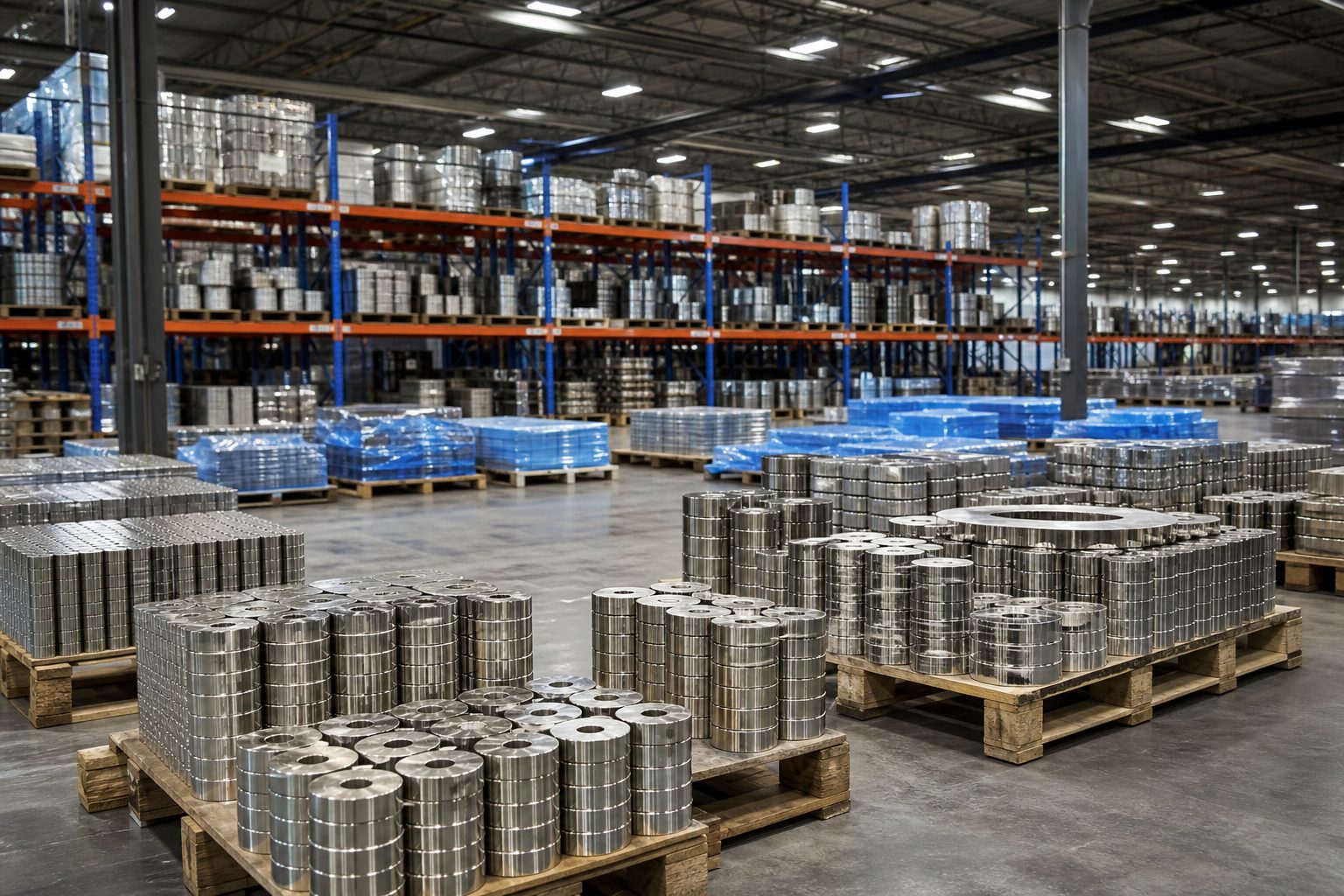
A sintered neodymium-iron-boron magnet, the world's strongest commercial permanent magnet, is made by separating neodymium and praseodymium oxides, reducing them to metal, casting a precisely blended alloy, milling it to powder microns thick in an inert atmosphere, aligning the grains in a magnetic field under a press, and sintering the compact in vacuum furnaces. High-temperature grades, the kind needed for aircraft actuators, missile fin servos, and hot-running electric vehicle motors, get a further doping of dysprosium or terbium so the magnet resists demagnetizing under heat. Tolerances are unforgiving and the process knowledge took decades to accumulate. China built much of that knowledge base inside companies that benefited from early patent licenses and state support, and much of the specialized equipment behind the process, the strip casters, jet mills, and sintering furnaces, is made there as well.
The concentration numbers steepen at every step. The International Energy Agency and European Central Bank economists put China's share of rare earth refining near 90 percent and its share of permanent magnet manufacturing above 90 percent. Independent tracking compiled by the defense research project ForcedAlpha puts China's share of sintered NdFeB production closer to 94 percent, and its share of heavy rare earth separation, the dysprosium and terbium step, at roughly 99 percent. The United States has no heavy rare earth separation running at commercial scale. Even Myanmar, which industry analysts estimate supplies half or more of the world's heavy rare earth feedstock, sends essentially all of it to China for processing. There is no Myanmar alternative sitting in reserve; that corridor feeds the same chokepoint.
This asymmetry explains why the U.S. can mine roughly 11 to 12 percent of global rare earths at MP Materials' Mountain Pass operation in California, which produced a record 45,000 tonnes of contained rare earth oxide in 2024, and still face a magnet embargo as an existential supply problem. Ore without metallurgy is geology.
What a Chinese "stop" would actually look like

A complete, formally announced embargo is the least likely scenario, and past practice suggests why. In 2010 China choked rare earth exports to Japan during a diplomatic dispute; prices spiked, some firms scrambled, and the macroeconomic effect stayed limited. The World Trade Organization later ruled China's raw rare earth export quotas inconsistent with its trade commitments, and China scrapped the quotas in 2015. Restrictions on gallium and germanium in 2023 likewise produced friction without material collapse in U.S. consumption. ECB economists reviewing these episodes identified three mitigating factors: China has an incentive not to push so hard that customers permanently substitute away, trade gets re-routed through third countries, and buyers stretch inventories, recycle, and redesign.
The regime that exists since April 2025 is more surgical than those earlier episodes, and that is what makes it precedent-setting. Announcement No. 18 of 2025 requires a MOFCOM export license for samarium, gadolinium, terbium, dysprosium, lutetium, scandium, and yttrium in metal, alloy, oxide, or compound form, and it names the magnet products directly: samarium-cobalt permanent magnets, and NdFeB magnets containing terbium or dysprosium. Applications demand full end-user identification and end-use descriptions, processing runs up to 45 working days, and shipments without the paperwork are detained at Chinese customs. Beijing floated a "green channel" for European Union shipments, whose practical operation remains murky, according to the law firm Taylor Wessing's April 2026 briefing for European clients.

In October 2025, Beijing added the legal chassis for something closer to a total stop: a foreign direct product rule, summarized by CSIS, under which foreign-made products containing even trace amounts of Chinese-origin rare earths require Chinese government approval. ForcedAlpha, the defense research project cited above, places the compliance threshold at 0.1 percent of product value, low enough to capture nearly any defense component containing a magnet, motor, or sensor. That October package also embargoed the outflow of skilled Chinese nationals and proprietary processing technology to foreign projects. Those October measures are the ones suspended for a year under the Trump-Xi understanding; the April licensing regime has continued operating beneath the suspension, and flows have restarted only partially. CSIS reports that even after Chinese magnet exports surged 13 percent when restrictions eased in November 2025, shipments to Europe rose 60 percent year over year while U.S. imports fell 11 percent. Yttrium, used in the thermal barrier coatings that keep jet engine parts from melting, has been harder hit: Chinese customs data show 17 tonnes went to the United States in the eight months after the April 2025 controls, versus 333 tonnes in the eight months before them, and aerospace manufacturers have told CSIS they are rationing material.
So "stopping exports" is not a hypothetical switch. It is the same licensing gate slammed shut: applications denied, customs detention, and the 0.1 percent rule reactivated, potentially with a month of notice.
Which weapons programs are most exposed

Defense demand is small by volume and enormous by consequence. The Congressional Research Service estimates each F-35 contains about 920 pounds of rare earth materials spread across actuators, sensors, avionics, and engine systems; a Virginia-class submarine carries roughly 9,200 pounds; an Arleigh Burke destroyer around 5,200 pounds. Not all of that weight is magnets, but the magnet fraction sits in components with no fast swap: flight-control actuators, pump motors, fin servos on air-launched weapons, and the small high-temperature motors inside guided munitions.
The 2022 F-35 episode demonstrated the trap. The samarium-cobalt alloy in that turbomachine magnet was not strategic in quantity; it was strategic in provenance. U.S. defense acquisition rules treat certain specialty alloys as items that must be melted in the United States or an approved country, and the Chinese alloy violated that. The Pentagon's only remedy was a waiver, because swapping in a compliant supplier mid-production would have forced a requalification too long and too costly for the program to absorb without further delay.
Heavy rare earths are where the defense exposure bites hardest, and they are also where the April 2025 controls still sit. Dysprosium and terbium keep motors and actuators functioning at the temperatures military hardware actually sees, and China controls nearly all separation. Samarium is on the April list too, which means the standard fallback for hot environments, samarium-cobalt magnets, does not exit the gate. Yttrium's squeeze on engine coatings adds a second, quieter dependency to the same aircraft programs.
The timeline: what breaks, and when

No authoritative public estimate exists for a single "halt date" on any weapons program; stockpile levels are classified and supplier-specific. What exists instead are three anchor points: the observed 2025 shock, ECB modeling, and publicly stated inventory horizons. Assembled honestly, they produce a consistent picture.
Weeks one to six: licenses become the blockade
The first effect is administrative rather than physical. Pending magnet shipments require licenses, processing takes up to 45 working days even in normal operation, and consignments without approvals stop at the border. The 2025 precedent is instructive: within weeks of the April announcement, automakers in the United States, Europe, and Japan were reporting supply disruptions serious enough, in their own assessments, to threaten production halts. Prices for affected products spiked then and would again. A few kilograms of magnet per traction motor, near zero inventory on the factory side, and just-in-time logistics mean the pinch arrives at automotive first, exactly as it did in 2025.
Months two to four: assembly lines feel it first
Car plants, drone manufacturers, and consumer electronics assemblers throttle output or pay whatever the spot market demands for the small stock of licensed, ex-China magnets that exists. European buyers may continue receiving preferential treatment if Beijing wants to divide its targets, which the post-truce trade data, Europe up 60 percent, America down, suggests is already happening. Wind turbine makers with permanent-magnet direct-drive designs face slipped delivery schedules; geared designs carry partial insulation but longer lead times of their own. Medical device lines using small precision motors, from surgical robots to pumps and imaging accessories, start rationing.
Months four to twelve: sustainment and second-tier suppliers
ECB economists note that importing-economy inventories may cover only a few months of demand. By this stage the drawdowns bite at defense primes, and the pain concentrates among second and third tier suppliers who make actuators, motors, and pumps and who typically carry thinner buffers than Boeing or Lockheed. One industry risk assessment puts the defense stockpile window at roughly six to eleven months; that figure is an estimate rather than an official statement, but it is consistent with the inventory horizon logic and with how 2025 actually unfolded at civilian firms. Sustainment and spare parts, already strained by wartime consumption of precision munitions elsewhere, compete with new production for the same dwindling magnet stock.
Years one to three: the rebuild runs slower than the shortage
Under an 18-month scenario of partial but persistent Chinese restrictions, ECB modeling estimates U.S. output losses between 0.3 and 0.6 percent, with automotive and electronics among the most affected sectors; a fuller embargo with thinner substitution options would be worse, and the authors are explicit that the numbers grow if substitution is harder. The supply response simply cannot move that fast. In CSIS's phrase, building integrated mine-to-magnet capacity takes years, not months, and the equipment embargo means even the factory machinery must be sourced or built elsewhere first.
Can alternatives replace NdFeB magnets in time?
Substitution is real engineering, but each path pays a price, and none field at wartime speed for defense applications.
| Substitution path | What it trades away | Where it genuinely works |
|---|---|---|
| Ferrite magnets | Far lower magnetic strength, so motors grow larger and heavier | Small motors, appliances, and some cost-driven EV designs |
| Induction motors | No magnets at all, but a few points of efficiency and torque density | Tesla's non-PM motor applications, industrial drives |
| Electrically excited synchronous motors | Copper weight and control electronics | BMW and Renault EV designs |
| Switched-reluctance motors | Acoustic noise and control complexity | Industrial niches, appliances |
| Heavy-REE-reduced NdFeB via grain boundary diffusion | Cuts dysprosium and terbium use, by half or more in leading processes, but does not eliminate dependence | High-performance grades from Japanese producers |
| Samarium-cobalt magnets | Still rare-earth based, and samarium is on the April 2025 control list | High-temperature defense and aerospace niches |
Tesla said in 2023 that its next-generation drive unit would use no rare earths, and the induction-and-permanent-magnet blend it already ships shows the direction. For radar actuators and missile fins, though, a bigger, heavier or less efficient motor is often a non-starter, which is why military qualification cycles sit at the far end of every timeline. A civilian carmaker can redesign in two or three years; a flight-critical actuator typically must requalify through testing that runs one to two years on its own, after a qualified magnet source exists to test.
How much non-Chinese capacity can arrive by 2030?
The response since mid-2025 has been the most aggressive U.S. industrial mobilization in this sector in generations. The Departments of Defense, Commerce, and Energy, plus the development and export credit agencies, have deployed financing across the chain; the Pentagon's July 2025 deal with MP Materials made the government the company's largest shareholder, set a ten-year NdPr oxide price floor of $110 per kilogram, roughly double the prevailing market price at the time, and guaranteed offtake, and Washington signed new bilateral minerals frameworks with Australia, Japan, Malaysia, and Saudi Arabia. Five days after the Pentagon announcement, Apple committed $500 million to buy American-made magnets from MP.

The physical project list is nonetheless thin against the scale of the problem. MP's Independence facility in Fort Worth began trial production of sintered NdFeB magnets in 2025 and targets about 1,000 tonnes per year, with first deliveries to General Motors, while its announced second plant, ten times that size, targets commissioning around 2028. Canada's Neo Performance Materials has been targeting 2026 startup of a roughly 2,000 tonne per year magnet plant in Estonia. USA Rare Earth has begun early production at a Stillwater, Oklahoma line, with first-phase capacity the company has put at roughly 1,200 tonnes per year. Germany's Vacuumschmelze is standing up a South Carolina plant announced with GM backing. Lynas is building a U.S. heavy rare earth separation facility in Texas under a Defense Department contract first awarded in 2022; if it runs on schedule, it would give the United States its first domestic separation capacity for dysprosium and terbium, adding to the initial heavy rare earth separation Lynas began at its Malaysian plant in 2025. Japan's Shin-Etsu and Proterial remain the largest producers outside China, with smaller lines in Vietnam and South Korea.

Add the announced targets generously and new sintered magnet capacity outside China reaches perhaps 15,000 to 20,000 tonnes a year by 2028 to 2030, against a global market that trackers such as Adamas Intelligence size near 200,000 tonnes today. ForcedAlpha's projection that non-Chinese capacity stays under 7 percent of world output through 2028 is an estimate, but it matches that arithmetic. Every project also runs the gauntlet CSIS identifies as the central issue: execution, because financing and price floors do not themselves commission furnaces, qualify parts, or transfer two decades of process learning.
The eight-week test
The scenario this article answers is hypothetical on its face and nearly literal in timing. The one-year suspension agreed in South Korea at the end of October 2025 lapses around late October or November 2026. Watch four things between now and then: China's monthly magnet export volumes and license approval rates, which showed Europe recovering and U.S. imports still below pre-restriction levels even under the suspension; yttrium tonnage in Chinese customs data, which aerospace suppliers say must return to something like pre-2025 levels to keep engine coatings flowing; any move to reactivate the 0.1 percent foreign direct product rule, which converts a bilateral squeeze into a planetary one; and whether MP's Independence ramp and Lynas's Texas separation plant hit their stated dates, because those two facilities represent the first physical steps out of the cage.
The deeper point is structural. A stockpile answers a short interruption; only capacity answers a long one, and the capacity in question is not ore but metallurgy. China spent thirty years building the factories, the furnace makers, the powder lines, and the patent position, and in the spring of last year it demonstrated it can throttle the output with a licensing form and a 45-day clock. The 2022 waiver that resumed F-35 deliveries was an admission that no alternative supplier existed for one small magnet. The honest measure of whether that stops being true by 2030 is not the billion-dollar announcements of 2025. It is whether magnets, separated heavy rare earths included, actually roll out of Fort Worth, Stillwater, Sumter, Narva, and Texas in tonnage, on time.
If they do not, the answer to what breaks first remains the same one Detroit already gave in the spring of 2025: the assembly line, within weeks.
Sources

- Ministry of Commerce of the People's Republic of China and General Administration of Customs, "Announcement No. 18 of 2025: Export control on medium and heavy rare earth related items," April 4, 2025. https://english.mofcom.gov.cn/Policies/AnnouncementsOrders/art/2025/art_0dd87cbee7b045bf93fabe6ab2faceee.html/
- Gracelin Baskaran and Meredith Schwartz, "Rare Earth Export Restrictions One Year Later," Center for Strategic and International Studies, April 27, 2026. https://www.csis.org/analysis/rare-earth-export-restrictions-one-year-later
- Pablo Aguilar, Matthieu Darracq Pariés, Valentin Jouvanceau, Baptiste Meunier, and Tajda Spital, "Rare earths, hard choices: How China export controls could ripple through the global economy," SUERF Policy Brief, based on ECB Occasional Paper No. 384. https://www.suerf.org/publications/suerf-policy-notes-and-briefs/rare-earths-hard-choices-how-china-export-controls-could-ripple-through-the-global-economy/
- Reuters, "China restricts exports of rare earths and other minerals. How does the system work?" April 24, 2025. https://www.reuters.com/world/china/china-is-restricting-mineral-exports-how-does-its-export-control-system-work-2025-04-24/
- Christoph Hezel and Pengcheng Zhou, "Key Changes in China's Export Control Landscape for Rare Earths," Taylor Wessing, 2026. https://www.taylorwessing.com/en/insights-and-events/insights/2026/04/key-changes-in-china-s-export-control-landscape-for-rare-earths
- MP Materials, "MP Materials Restores U.S. Rare Earth Magnet Production," January 22, 2025. https://investors.mpmaterials.com/investor-news/news-details/2025/MP-Materials-Restores-U.S.-Rare-Earth-Magnet-Production/default.aspx
- MP Materials, "MP Materials Announces Transformational Public-Private Partnership with the Department of Defense to Accelerate U.S. Rare Earth Magnet Independence," July 10, 2025. https://investors.mpmaterials.com/investor-news/news-details/2025/MP-Materials-Announces-Transformational-Public-Private-Partnership-with-the-Department-of-Defense-to-Accelerate-U.S.-Rare-Earth-Magnet-Independence/default.aspx
- Valerie Bailey Grasso, "Rare Earth Elements in National Defense: Background, Oversight Issues, and Options for Congress," Congressional Research Service, R46618. https://crsreports.congress.gov/product/pdf/R/R46618
- U.S. Geological Survey, Mineral Commodity Summaries 2025, "Rare Earths." https://pubs.usgs.gov/periodicals/mcs2025/mcs2025-rare-earths.pdf
- International Energy Agency, "Global Critical Minerals Outlook 2025." https://www.iea.org/reports/global-critical-minerals-outlook-2025
- World Trade Organization, Dispute DS431, "China: Measures Related to the Exportation of Rare Earths, Tungsten and Molybdenum." https://www.wto.org/english/tratop_e/dispu_e/cases_e/ds431_e.htm
- ForcedAlpha Research, "China Rare Earth Dependency: Defense Supply Chain Risk Map," February 2026. https://forcedalpha.com/research/china-rare-earth/
- Neo Performance Materials, Narva magnet facility project information. https://www.neomaterials.com/
- Vacuumschmelze / e-VAC Magnetics, U.S. magnet plant announcements. https://www.vacuumschmelze.com/
- Lynas Rare Earths, U.S. heavy rare earth separation facility updates. https://www.lynasrareearths.com/
- USA Rare Earth, Stillwater magnet facility updates. https://usare.com/
- Adamas Intelligence, rare earth magnet market analyses. https://www.adamasintel.com/
Comments (4)
Continue exploring
China's Solar Capacity Crown Is Real. The Grid Beneath It Isn't.
China's installed solar capacity has passed coal, but the grid cannot store, transmit or dispatch sunlight on demand, so coal…
U.S.-China AI talks could make autonomous cyberattacks a matter of strategic stability
Reuters reports the U.S. and China are preparing a mid-September AI safety dialogue. What it can realistically deliver: an…

Orbital Grappling: Inside the Quiet U.S.–China Race to Build Maneuverable Spacecraft
A Chinese tug towed a dead satellite out of geostationary orbit in 2022. Both Washington and Beijing are now building spacecraft…
The article assumes the October 2025 one-year suspension simply lapses in six to eight weeks, but says nothing about the more likely outcome, which is Beijing renewing it on its own terms. Treating expiration as the operative scenario quietly stacks the deck toward a 'what breaks tomorrow' framing.
Telling automakers to carry more magnet inventory ignores the 45 working days MOFCOM needs just to process a license, plus the green channel that Taylor Wessing calls murky. Stockpiling only works if you can refill the stockpile, and the article never addresses that.
The 'real chokepoint' section was the most useful. Putting the 94 percent sintered NdFeB figure and the roughly 99 percent heavy rare earth separation number next to MP Materials' 45,000 tonnes makes the gap between mining output and usable supply impossible to ignore. Most coverage I have read skips that step entirely.
In 2010 I was buying NdFeB for a small servo line and we did exactly what the article describes, stretched inventory and redesigned around available grades, and the resulting motors were noticeably worse for about eighteen months.