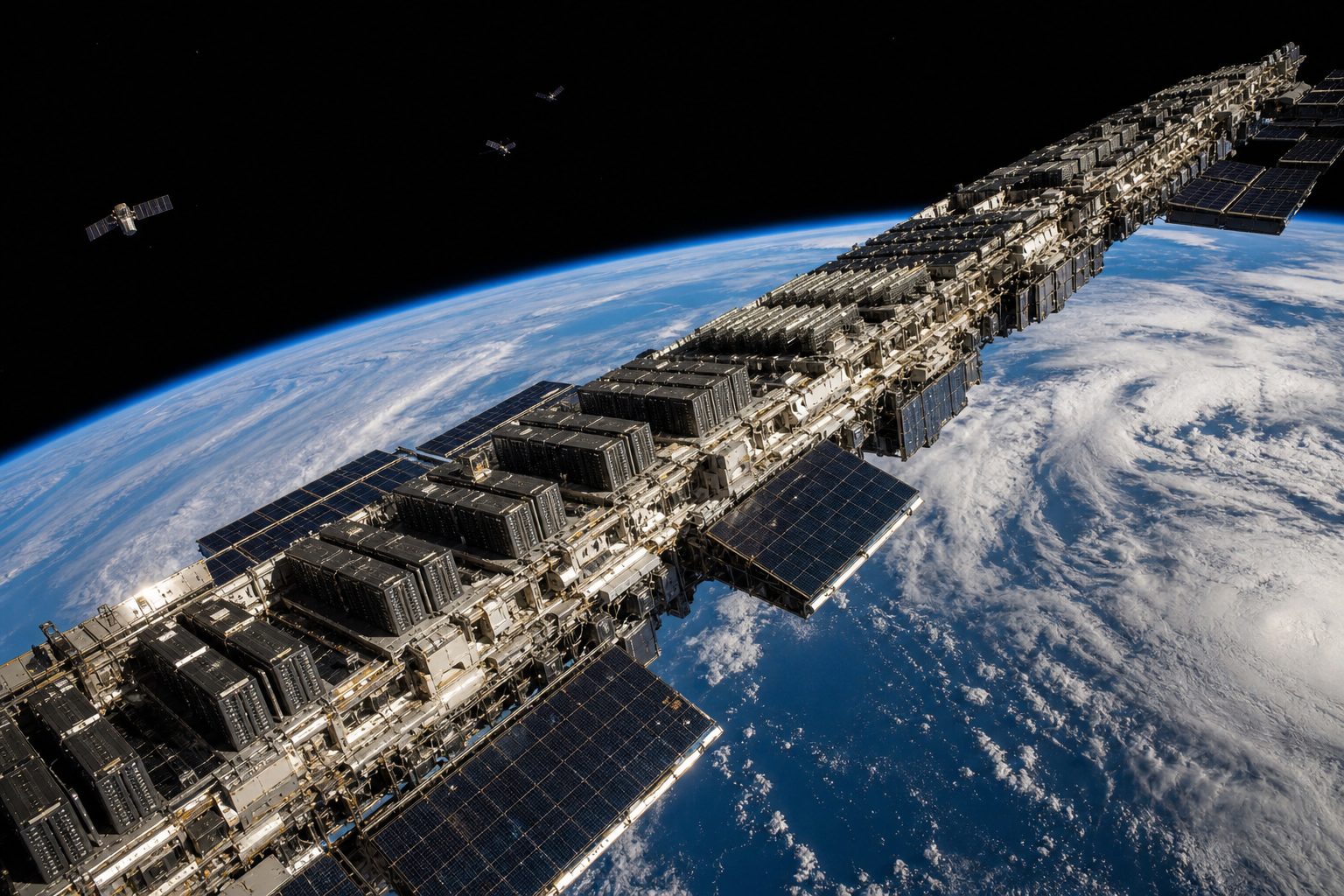
On February 4, 2026, the Federal Communications Commission's Space Bureau opened a licensing docket that pauses, mid-notice, to explain the Kardashev scale. The scale, drafted by Soviet astronomer Nikolai Kardashev in 1964, ranks civilizations by how much energy they command; its second rung, in the bureau's own gloss, belongs to a civilization that can harness "all the energy output of its host star." The explainer was there because the application cited it. SpaceX, the filing said, views its proposed Orbital Data Center system as "the first step towards becoming a Kardashev II-level civilization." The system on file is an application for up to one million satellites. [1][8]
The system under review is not broadband. It is a data center: satellites between 500 and 2,000 kilometers, in orbital shells up to 50 kilometers wide, cross-linked by what the application calls a "high capacity (petabit) and high reliability laser mesh" that hands traffic down through the Starlink constellation to the ground. [1] And it is not the only one. Orbital Compute, a Los Angeles startup founded in 2026, has asked the FCC for 100,000 AI-compute satellites totaling roughly ten gigawatts; Cowboy Space has filed for 20,000 larger nodes built into rocket upper stages. [2][3]
Together, the filings propose moving a meaningful slice of the world's frontier computing capacity off the grid and into orbits nobody owns. They force two questions. Does a hundred-thousand-satellite compute architecture spread risk out, or pile it up? And can a regulator that reviews one radio system at a time judge an infrastructure whose importance has almost nothing to do with radio?
The record supports an awkward answer. Operationally, these systems genuinely distribute failure. Systemically, they concentrate new loads on three commons that no single license governs: the orbital environment, the upper atmosphere, and the strategic position of whoever ends up owning the fabric. The consequences land on satellite operators sharing the shells, on the countries beneath them, and on anyone whose AI supply comes to depend on the result.
What the filings actually request
SpaceX's application, filed January 30, 2026 and accepted for filing five days later under ICFS file number SAT-LOA-20260108-00016, describes satellites operating from 500 to 2,000 km in 30-degree and sun-synchronous inclinations, with different hardware versions across shells. The radio ask is narrow: two Ka-band slivers, 18.3–19.3 GHz down and 28.6–29.1 GHz up, on a non-interference, unprotected basis, meaning the system must tolerate interference and yield to other users. Acceptance for filing opened a comment cycle that ran through late March 2026. It is a procedural step, not an approval. [1]
The application also requests a package of waivers: exemption from the processing-round procedures that let the FCC compare competing applicants for the same spectrum, exemption from the milestone schedules and surety bonds that pressure licensees to actually build, and relief from parts of the Schedule S technical form that disclose beam plans to the public. [1]
Orbital Compute's application, call sign S00867, announced in a June 30 press release describing a recent FCC filing, requests up to 100,000 satellites at 500 to 850 km in discrete shells up to 50 km wide. [4] Each spacecraft "functions as a single high-density rack," carrying "about eight of today's servers" and generating roughly 100 kilowatts from its own solar arrays, which works out to about twelve and a half kilowatts a server, the draw of a top-end accelerator machine. The press materials describe satellites spanning about 100 meters and weighing roughly two tons. At full scale the fleet would deliver about ten gigawatts, which the company compares to the roughly 8.5 gigawatts of new capacity the U.S. grid added in the past year. "Sunlight is constant, cooling is free, and there's no neighborhood to disrupt," founder and CEO Euwyn Poon said. [2]
The technical record is harder to pin down than the brochure. The Center for Space Environmentalism, an advocacy group that filed comments formally opposing the application on August 18, 2026, reads the same filing as specifying 100 kW-class spacecraft of 1,500 to 2,500 kilograms, stowed at 3 by 3 by 4 meters, with a deployed span of 50 to 70 meters, a hundred square meters of thermal radiator, and a projected cross-section of 80 to 120 square meters. Depending on which document you read, a hundred-meter satellite may be a fifty- to seventy-meter one. The gap is worth noticing, because it says something about how opaque this class of system already is, before a single unit has flown. [4]
Cowboy Space, formerly Aetherflux, filed in May 2026 for a 20,000-satellite system called Stampede, its nodes megawatt-class data centers integrated into rocket upper stages. Trade coverage of both programs carries the necessary caveat: these are applications, not approvals, and both remain speculative. [3]
How much machine is ten gigawatts?
For scale: the most electrically powerful object humanity keeps in orbit, the International Space Station, runs on the order of a hundred kilowatts and masses about 420 tonnes. One Orbital satellite would roughly match the station's power draw. The full constellation would draw a hundred thousand times that, roughly equal, by the company's own comparison, to a year of new U.S. grid additions. Completing the fleet at two tons per satellite means lofting roughly 200,000 tonnes of hardware before the first replacement cycle, nearly 500 times the station's mass. [2][3][17]
Then there is the replacement cycle. A seven-year design life, as the Center for Space Environmentalism reads the filing, means maintaining the constellation requires replacing about 14,300 satellites a year: roughly 39 spacecraft a day reaching end of life, and roughly as many lifting off to replace them. The entire world's launch industry currently flies on the order of a few hundred rockets a year; even loading dozens of satellites per flight, steady state demands about a launch a day, indefinitely. [4]
And Orbital's is the smaller of the two applications. SpaceX's ceiling is ten times more satellites, and the public notice, which counts satellites rather than gigawatts, states no total for that system's electrical power. [1]
Does the design spread risk or concentrate it?

The strongest version of the company's case is real. A failed satellite removes one hundred-thousandth of capacity instead of disabling a platform. Capacity grows one rack at a time, and a seven-year refresh means the fleet never carries yesterday's chips, a serious point in a business where AI accelerators go commercially stale within a few years while satellites are normally expected to fly much longer. [3][4] Drag helps: hardware lost near the bottom of the 500-to-850-km band falls back within a few years, so mistakes do not persist forever. Component failure risk really is spread across many independent units.
But component risk and system risk are different currencies. The correlated failures run the other way. Everything depends on a commons the deployment itself degrades: shells fill, debris multiplies debris, and reentry chemistry accumulates in air nobody owns. Strategic dependency tightens rather than spreads. SpaceX's filing ties its compute mesh into the first- and second-generation Starlink systems, so one company would own the transport, the compute, and the laser fabric between them. [1] Orbital plans commercial AI inference sold from orbit. [3] Either way, frontier compute, hardware the United States already treats as strategically controlled, moves onto infrastructure with a single gatekeeper whose availability depends on the orbital environment its own success worsens.
The physical packing is the sharpest concern: a hundred thousand objects with fifty- to seventy-meter deployed spans, pressed into bands tens of kilometers wide across a 350-kilometer altitude range, while a second system, SpaceX's, is proposed above the same 500-km floor, reaching to 2,000 km in shells of the same width. The Center for Space Environmentalism warns that a single dead or unmaneuverable satellite could, in shells that dense, trigger "a catastrophic runaway debris cascade," the collision-feedback scenario named for NASA's Donald Kessler, who described the mechanism in 1978. [4][12]
The self-cleaning counterargument deserves its due. At these altitudes, failures do eventually leave, which genuinely separates them from the derelict belts of the 800-to-1,000-km regime. What the counterargument lacks, at these densities, is a model that can actually price the tail risk. That gap is where the newest science lands.
Why narrow shells break the collision math
Long-term safety cases for low Earth orbit rest on source-sink models: divide the region into orbital shells, track average populations, and propagate ordinary differential equations. The approach assumes shells are wide enough that individual collisions average out, and established models accordingly use shells 10 to 50 kilometers wide. [5]
Operational reality has moved underneath them. The paper notes that the radial extent assigned to constellations is contracting toward kilometer scale, that the FCC has authorized Starlink shells separated by only five kilometers, and that Iridium-related analyses considered centerline spacings of 1.8 to 6.5 kilometers. [5]
In an August 2026 preprint, Jaewon Choi of Myongji University, Souvik Dhara of Georgia Tech, and Harsha Honnappa of Purdue rebuilt the LEO population as a Markov jump process, recovered the standard differential equations as the large-volume limit, and derived the stochastic correction: noise scales inversely with the square root of shell volume. Sweeping shell volume at fixed density across the 450-to-800-km band, the stochastic and deterministic pictures agree at conventional widths and diverge at fine ones. At the finest volumes tested, mean debris populations ran roughly 4.5 times the deterministic prediction, and several simulated histories ran away entirely, with no counterpart in the smooth curve. The mechanism is the nonlinearity: collision terms feed on variance and covariance, so noise in a small box raises expected collision rates, which generate more debris, which generate more collisions. The authors borrow their mathematics from epidemic compartment models, and the analogy is close: in a small population, chance clustering, not the average, decides whether an outbreak dies out or explodes. [5]
The caveat matters. This is a working paper and a methods demonstration, not an assessment of Orbital or SpaceX. But it bears on the geometry these filings propose: enormous object counts packed into discrete bands tens of kilometers wide, at the outer edge of the shell sizes the established models assume, in an environment where the paper shows constellation traffic contracting toward kilometer scale. And as shells narrow, the averaging assumption beneath the safety case can understate expected debris several-fold while hiding runaway outcomes altogether. It also points to a procedural fact: debris does not respect the boundary of an application. Two constellations stacked through the same region are physically coupled even if they are legally separate.
What burns up does not disappear
Steady-state arithmetic is blunt. One hundred thousand satellites on seven-year lives means about 39 spacecraft reentering every day. The Center for Space Environmentalism puts the annual mass at 21,000 to 35,000 tonnes of hardware vaporizing in the upper atmosphere. Satellites are largely aluminum structures carrying lithium-ion batteries and power electronics. The group argues that continuous launch and reentry cycles would inject black carbon, water vapor, and reactive alumina into the mesosphere and stratosphere, where such particles absorb solar radiation, warm the stratosphere, and contribute to ozone loss, and it calls the constellation's environmental pitch a false trade: the impact does not disappear, it changes address. "Outer space is a shared human environment, not an off-grid dump for energy-intensive industrial processing," the comment reads. [4]
That is the opposition's case, built from Orbital's own design parameters. The underlying reentry-pollution science is young, and the tonnage is derived, not measured. But the governance fact stands on its own: no license currently turns on the question. The FCC's review has no atmospheric docket, and the FAA licenses launches and reentries mission by mission, a frame ill-suited to the steady-state chemistry of a permanent constellation. [4][11]
Orbital's environmental argument deserves equal space, because it is not nothing: ten gigawatts of compute with no terrestrial electricity, no cooling water, no land, none of the grid-interconnection queues and permitting fights that now slow data-center construction on the ground. [2][3] The counterweight is in the filing's own numbers. Rejecting a hundred kilowatts of heat in vacuum takes radiator surface, which is why the opposition's reading of the application gives each satellite a hundred square meters of it. Cooling is free only in the sense that no neighborhood is there to complain. [4]
The license covers the radio, not the machine

The FCC licenses satellites because they transmit. Strip away the laser mesh, the racks, the solar arrays, and the strategic questions, and what remains of SpaceX's application is two Ka-band slivers on an unprotected footing, plus a request to be excused from the procedures, milestones, bonds, and disclosures that normally discipline large satellite systems. The docket, in other words, is a form built for radio systems, being asked to carry a description of something else. [1]
The waivers have an internal logic. If you accept unprotected status, you are not competing for interference protection, so there is less for a comparative processing round to compare; milestones and surety bonds exist chiefly to stop companies warehousing scarce spectrum, and an optically linked fleet arguably warehouses little. [1][4] But the same package also removes the FCC's tools for forcing seriousness, its mechanism for sequencing rival megaconstellations through shared shells, and the Schedule S detail that lets third parties check an applicant's interference claims. The Center for Space Environmentalism, which flags the matching waiver requests in Orbital's application, calls them misuse. Whatever the bureau decides, it will be deciding on a record the applicant asked to keep thin. [4]
Then there is the public-interest question, which is genuinely new. Broadband constellations could point to unserved homes. Orbital, per the opposition's summary of its filing, points to demand from cloud providers, and the comment's answer is flat: commercial demand for compute "does not constitute a statutory 'public interest' justification for commandeering low-Earth orbit." The Communications Act predates AI by almost a century, and nothing in it speaks directly to whether renting frontier compute from orbit is a service the statute exists to promote. [4]
The FCC has shown it can cut a request down. It licensed the original Starlink system in 2018, Amazon's Kuiper constellation in 2020, and in 2022 granted 7,500 of the roughly 30,000 satellites SpaceX proposed for Gen2, deferring the rest. [1][6][7] A few weeks before accepting the data-center filing, it authorized an upgraded Gen2 fleet. [1] But the pattern in all of it is one applicant at a time. Nothing in the process asks what happens when several compute constellations stack overlapping shells together, which is the actual proposal on the table, and rival megaconstellations filed by other governments claim the same territory at the International Telecommunication Union, which makes the aggregate question international rather than merely inter-agency.
Where the rest of the system goes unreviewed
The FCC holds the only license that covers the operating system end to end, and it covers the radio. Everything else is slices, held by different offices under different statutes. The FAA licenses each launch and reentry and caps expected public casualties at one in ten thousand per mission. [11] NASA's Orbital Debris Program Office studies collision risk and disposal reliability but licenses nothing. The Defense Department watches and warns, and civil operators now receive their conjunction warnings through the Commerce Department's young Traffic Coordination System for Space. [16] None of those reviews asks whether the system should exist, or what its aggregate strategic weight is. Each asks whether one slice complies with one rule.
Export controls show how strange the arrangement is. Most space technologies are export-controlled; commercial satellites moved from the State Department's munitions list to the Commerce Department's control list in the 2010s reform, with "space-qualified" definitions and hosted-payload rules doing the sorting, and launch services carrying their own rules. [9] Since 2022, the Commerce Department has also controlled exports of the most advanced AI accelerators, the exact class of hardware at issue. [10] An orbital data center is thus a controlled computer, operated continuously, internationally, outside any customs boundary, serving customers the FCC never sees and Commerce cannot inspect. Whether the Outer Space Treaty's Article VI obligation on the United States to authorize and continuously supervise its nationals' activities is satisfied by a spectrum license plus launch permits is a question no agency owns. [13]

Space situational awareness completes the loop. A fleet of 100,000 maneuvering, laser-linked nodes would be the heaviest user the traffic-coordination system has ever carried, and would bring, in effect, its own continuously updated catalog of member positions. The applications, as filed, contain no commitment to integrate with the traffic system their fleets would come to dominate, and nothing in the record so far establishes that the traffic system is ready for a hundred thousand hundred-meter-class objects. [4][16]
Who pays if it goes wrong
The treaty architecture is state-to-state. Under the Outer Space Treaty and the 1972 Liability Convention, the United States, as the launching state for spacecraft its licensees fly, is internationally liable for the damage they cause: absolute liability for damage on the ground or to aircraft, fault-based liability for damage to another spacecraft in orbit. An operator's exposure is a matter of domestic law and contract; the international claim goes to Washington. At 100,000 satellites, small per-object probabilities accumulate into state-level exposure: a disposal regime that fails one percent of the time strands about a thousand derelicts into the shells every replacement cycle. [13]
Infrastructure history suggests how this can go. Submarine cable, the last planet-scale digital system, began as bare private enterprise and accumulated governance as its strategic weight registered, from an 1884 high-seas protection treaty [14] through landing licenses to today's national-security review of cable landings. Nearly all intercontinental data now rides that fiber, concentrated among a handful of operators. Internet exchange points took the opposite path and stayed largely self-governing member associations. Microsoft even tested the ocean as a machine room, sinking a working pod off Scotland's Orkney Islands in 2018 and recovering it in 2020 with the hardware performing well. [15] The sea, whatever its problems, offers no collision cascade and no shared spectrum. The lesson from the cable era is not that governance eventually arrives, so relax. It is that governance arrived after the dependence was established, and orbit is being licensed in the same order, with physical feedbacks that copper and fiber never had.
What to watch in the dockets
As of this writing, both applications are pending, and the near-term hardware is modest. Orbital's $5 million pre-seed round, led by a16z speedrun, funds Pathfinder, a single-GPU demonstration payload targeted for a Falcon 9 in 2027, and starts development of Orbital-1, the first purpose-built satellite, targeted for 2028. [2][3] Filings are ceilings, not commitments: the Gen2 decision granted a quarter of what SpaceX asked for, and there is no reason yet to treat the million-satellite number as a deployment plan. [6]
The markers to watch are specific. Whether the bureau grants the waiver package whole, or conditions any grant on milestones and disclosure, will say how much of its own toolkit it intends to keep. Whether it answers the Center for Space Environmentalism's public-interest argument, which asks outright that Orbital's application be denied, or treats compute demand as self-evidently in the public interest, will say whether the statute can stretch to cover machine time as a service. [4] And whether any other agency or Congress asserts jurisdiction over the strategic layer, rather than the slices, will say who, if anyone, is responsible for the whole.
The question underneath the docket
The public notice defines a Type II civilization as one able to harness its star's full output. What is actually on file is smaller and stranger: on paper, two hundred thousand tonnes of servers riding lasers between shells selected for sunlight, selling intelligence by the hour, with the first unit targeted for a rival's rocket. The distance between those two pictures is the distance the FCC's process is being asked to span, one filing at a time.
The architecture genuinely distributes failures. It also concentrates consequences: a debris cascade with no applicant's name on it, a stratosphere exposed to the steady burning of the fleet that maintains it, a strategic capability folded into the ownership structure of one or two firms, and a review process that can see each application perfectly and the system not at all. The FCC will decide whether these systems may transmit. Whether the country wants its frontier-compute industrial base overhead, and under whose supervision, is a question that fits in no filing. As things stand, no office is chartered to answer it.
Sources / References
- Federal Communications Commission, Space Bureau, Public Notice DA-26-113, "Space Bureau Accepts for Filing SpaceX's Application for Orbital Data Centers," ICFS File No. SAT-LOA-20260108-00016, released February 4, 2026. https://docs.fcc.gov/public/attachments/DA-26-113A1.txt
- Orbital Compute, Inc., press release, "Orbital Unveils Plans for a 100,000-Satellite Constellation to Move AI Compute Into Space," June 30, 2026. https://orbital.inc/press/orbital-100000-constellation.html
- David Chernicoff, "Comparing Space-Driven Data Center Strategies: Modular Satellites vs. Integrated Rocket Nodes," Data Center Frontier, July 15, 2026. https://www.datacenterfrontier.com/machine-learning/article/55388486/comparing-space-driven-data-center-strategies-modular-satellites-vs-integrated-rocket-nodes
- Center for Space Environmentalism, "Comments of the Center for Space Environmentalism" on the application of Orbital Compute, Inc. (Call Sign S00867) before the Federal Communications Commission, filed August 18, 2026. https://www.spaceenvironmentalism.org/actions/public-statements-and-comments/orbital-compute-odcs-comment
- Jaewon Choi, Souvik Dhara, and Harsha Honnappa, "Narrow-Shell Stochasticity in Source–Sink Models of the Low Earth Orbit Environment," arXiv preprint, August 2026. https://arxiv.org/html/2608.27133
- Federal Communications Commission, "Space Exploration Holdings, LLC, Request for Orbital Deployment and Operating Authority for the SpaceX Gen2 NGSO Satellite System," Order and Authorization, 37 FCC Rcd 14882 (2022).
- Federal Communications Commission, Kuiper Systems, LLC (Amazon), Order and Authorization, July 2020.
- N. S. Kardashev, "Transmission of Information by Extraterrestrial Civilizations," Soviet Astronomy, vol. 8, pp. 217–221 (1964).
- U.S. Department of Commerce, Office of Space Commerce, and Federal Aviation Administration, Office of Commercial Space Transportation, "Introduction to U.S. Export Controls for the Commercial Space Industry," 2nd ed., November 2017. https://www.faa.gov/about/office_org/headquarters_offices/ast/media/export_controls_guidebook_for_commercial_space_industry_doc_faa_nov_508.pdf
- U.S. Department of Commerce, Bureau of Industry and Security, advanced computing export controls, adopted 2022 and expanded in subsequent rules.
- 14 C.F.R. Part 450 (FAA launch and reentry safety standards, including public casualty risk criteria).
- D. J. Kessler and B. G. Cour-Palais, "Collision Frequency of Artificial Satellites: The Creation of a Debris Belt," Journal of Geophysical Research, vol. 83, no. A6, pp. 2637–2646 (1978).
- Treaty on Principles Governing the Activities of States in the Exploration and Use of Outer Space, Including the Moon and Other Celestial Bodies (1967), arts. VI–VII; Convention on International Liability for Damage Caused by Space Objects (1972).
- Convention for the Protection of Submarine Telegraph Cables (1884).
- Microsoft Research, Project Natick underwater data center experiment, Orkney Islands, 2018–2020.
- U.S. Department of Commerce, Office of Space Commerce, Traffic Coordination System for Space (TraCSS) program.
- NASA, International Space Station reference data (mass and electrical power figures).
Comments (3)
Continue exploring
Global Compute Token Ledger: Architecture for Enforcing Prepaid Compute Everywhere
A compute budget is not enforceable if some work reaches the budget ledger and other work reaches a provider directly. That is…

The Portsmouth experiment: can 10 gigawatts of AI compute avoid shifting grid costs onto its neighbors?
SoftBank, OpenAI, and NVIDIA are assembling 10 gigawatts of privately powered AI compute at a former uranium plant in Ohio…
Orbital Grappling: Inside the Quiet U.S.–China Race to Build Maneuverable Spacecraft
A Chinese tug towed a dead satellite out of geostationary orbit in 2022. Both Washington and Beijing are now building spacecraft…
The piece nails it: orbital data centers might decentralize hardware failures but pile systemic stress on orbital, atmospheric, and strategic commons — meaning licensing frameworks built for radio, not infrastructure, are already obsolete and need serious rework before any of these fleets actually fly.
I'm curious whether the FCC's one-radio-system-at-a-time review model could realistically handle a startup filing for, say, 5,000 compute satellites, or whether smaller applicants will simply get steamrolled by the processing-round waivers SpaceX has requested. The article frames these as flagship filings, but the gating question seems to apply just as much to anyone who isn't already running a constellation.
The 'How much machine is ten gigawatts?' section was probably the most useful for me, since the ISS comparison finally made the scale legible — matching a single satellite's draw to the station's full output put the 200,000-tonne figure into a frame I could actually feel. Though I do wonder if that comparison still holds once you account for continuous sunlight versus the station's eclipse cycle.