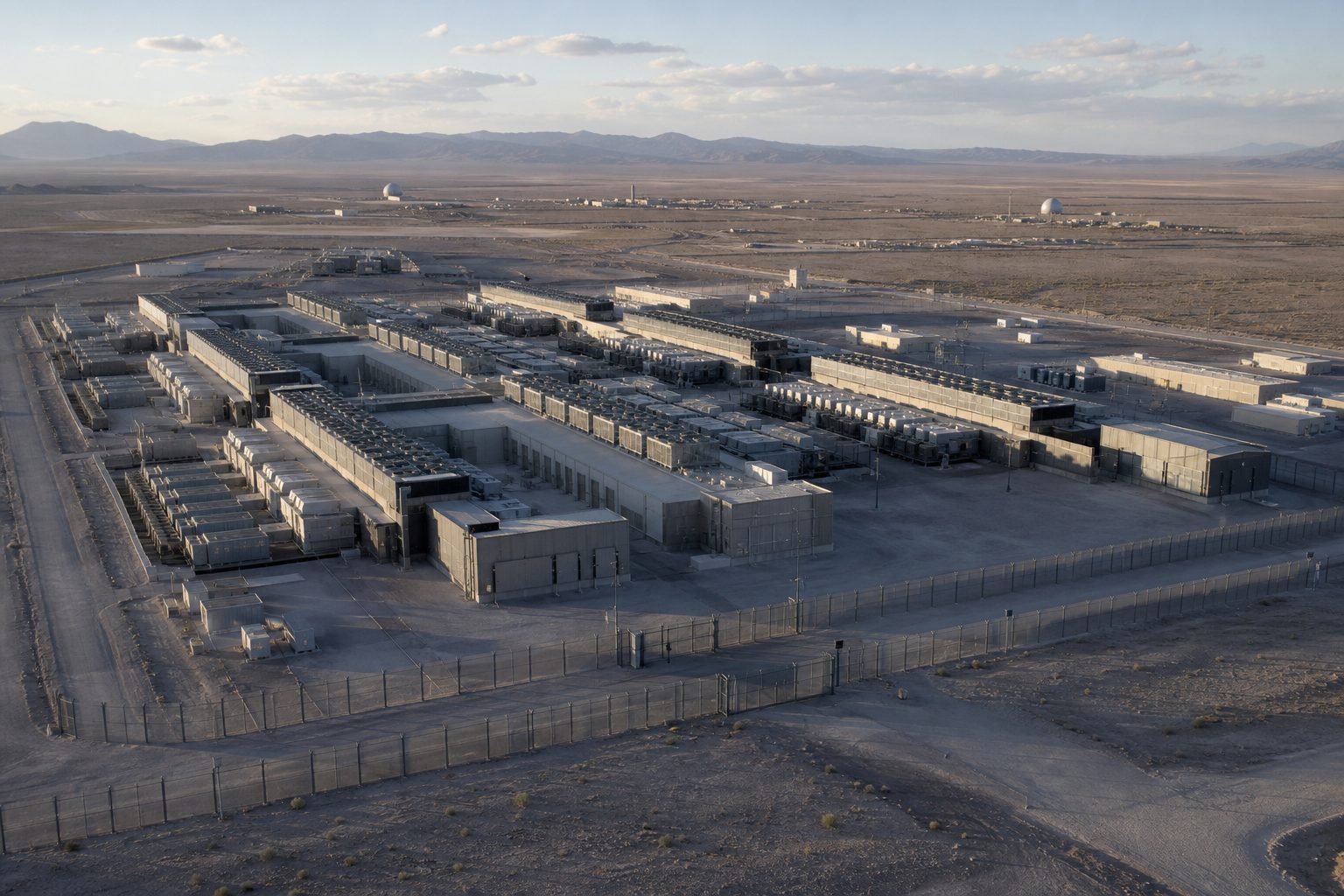
On March 26, 2026, the U.S. Army announced that it had conditionally selected two companies to build and operate commercial hyperscale data centers inside its installations. Carlyle, a publicly traded investment firm, received the first project: about 1,384 acres at Fort Bliss in El Paso, Texas, home of the 1st Armored Division. CyrusOne, a data center developer jointly held by funds managed by KKR and BlackRock, received the second: roughly 1,201 acres at Dugway Proving Ground, a Utah test range an hour's drive from the nearest community. No lease has been signed. The selections open a period of exclusive negotiations, the Army Corps of Engineers still must complete environmental reviews, and the Army projects initial operating capability at Fort Bliss in fiscal 2027 and at Dugway in fiscal 2029.
The word "hyperscale" deserves a second look. It describes data centers built at cloud scale, campuses whose appetite for electricity is measured in the hundreds of megawatts and, increasingly, in gigawatts. Reporting by El Paso Matters and the Associated Press describes the Fort Bliss concept as a complex of up to 3 gigawatts that within a few years would draw more electricity than all of El Paso Electric's 460,000 customers combined. Whether or not the project reaches that scale, the mechanism underneath it, a 50-year commercial ground lease behind military gates, carries consequences that reach far past two construction sites. It would change how compute physically sits on Army posts, who generates the power for it, who governs the land beneath it, and what an adversary sees when it maps the country's AI capacity.
What the Army actually agreed to, and what it has not
The legal instrument is the enhanced use lease, a real-estate tool authorized by 10 U.S.C. § 2667 that lets a military department lease land it owns but does not currently need, in exchange for cash, in-kind services, or both, at no less than fair market value set by an Army appraisal. The land stays federal. The solicitation covering Fort Bliss, Fort Hood, Fort Bragg, and Dugway Proving Ground was, an Army spokesperson told DefenseScoop, the first time the service had sought to use that tool for data centers; the resulting leases, if awarded and executed, would be the first of their kind on Army installations.
The structure is blunt, and worth reading closely. Under the solicitation posted on SAM.gov, the lessee designs, finances, permits, builds, owns, operates, maintains, and eventually decommissions the facility, then restores the acreage to its prior condition when the 50-year term ends. The project must be "viable without any commitment or contribution, monetary or otherwise" from the government. Substantive lease terms were declared non-negotiable up front, and the Army reserved "sole and absolute discretion" to modify, suspend, or cancel the process at nearly any point. The Army release calls the arrangement "no upfront cost to taxpayers."
The funnel behind the announcement was wider than two winning bids. An unclassified Army screening deck dated November 17, 2025 compared at least six properties, including Red River Army Depot and Tooele Army Depot, on transmission voltage, natural gas access, water stress, fiber routes, tax incentives, and land availability before the field narrowed. The government record for the data center lease solicitation opened in mid-December 2025, the formal request for proposals published in late January 2026, offers closed February 23, and the conditional selections followed on March 26. Fort Hood, Texas, and Fort Bragg, North Carolina, were part of that solicitation but not of the selections; officials say data center proposals for those posts remain under study, along with ideas drawn from a separate, open-ended call the Army issued in March under its Strategic Capital Initiative. That call pulled in more than 200 industry proposals across fields from mineral processing to manufacturing; Secretary of the Army Dan Driscoll told reporters on May 28 that roughly 120 proved executable and about 20 were already in various stages of execution. More than 95 percent came from companies the Army had never worked with, said Col. John Oliver, executive officer to Deputy Undersecretary Dave Fitzgerald, naming the logistics giant FedEx and the private capital firm Apollo among them, Defense One reported.
There is a tension worth noting between the strategy and the instrument. Driscoll framed the program in warfighting terms: "AI is a strategic asset for the Army. It is a force multiplier, supports future transformation and requirements, keeps the Army ahead of our adversaries, and generates resiliency across the force. These data centers are a critical resource to support that strategic imperative." The release adds that the initiative "will enhance computational capability for the warfighter." Yet the solicitation itself describes purely commercial facilities, and no anchor cloud tenant for either site has been named publicly. Exactly how Army computing needs would connect to a tenant's commercial capacity, through in-kind lease consideration or separate arrangements, is not spelled out in any public document so far.
Two kinds of compute behind the same fence line
What the Army is really offering is a bundle that private developers struggle to assemble on the open market: cleared land, adjacent transmission, gas lines, long-haul fiber, and a perimeter. Waldemar Szlezak, global head of digital infrastructure at KKR, put the competitive logic plainly in the announcement: "U.S. leadership in the global AI race will be decided in large part by who can build the infrastructure fastest."
Architecturally, the proposal breaks with how the military has usually treated data centers, as government-owned server rooms to be consolidated or closed. Here the Army would not own the computers. It would be the landlord of a compute platform, and its own screening materials suggest it understands the platform's value. The November 2025 deck catalogs fiber providers the way a hyperscaler would: Cogent, Lumen, TransTelco, and Windstream along Interstate 10 at Fort Bliss, and Lumen and Cogent along Interstate 80 near Dugway.
Oliver offered the fullest picture of the intended end state. The Army, he told Defense One, is planning something like a data-center ecosystem, with a commercial side, a classified military data side, and its own power generation. "Our data centers are not going to be just big buildings that are out in the middle of nowhere that are run by 10 people," he said. "It becomes kind of a campus that we can work on."
That single sentence sketches a genuinely new architecture for a military installation, and it also raises the questions the public record cannot yet answer. Nothing released so far commits the Army to placing classified workloads inside a tenant's commercial facility; the more cautious reading is a shared site with hard separation between the commercial and classified builds. Where the network boundary sits, which authority would accredit a classified edge built inside a commercial campus, and whether the Army itself becomes a customer of the companies leasing its land are engineering and accreditation decisions that will be made, if at all, inside lease exhibits and follow-on agreements most people will never read.
Where would the power come from?
The national context makes the question unavoidable. Researchers at Lawrence Berkeley National Laboratory estimated in December 2024 that U.S. data centers consumed about 176 terawatt-hours of electricity in 2023, roughly 4.4 percent of the national total, and projected between 325 and 580 terawatt-hours by 2028, or 6.7 to 12 percent of the country's power. A single new campus at the reported Bliss scale would be a load event of city size.
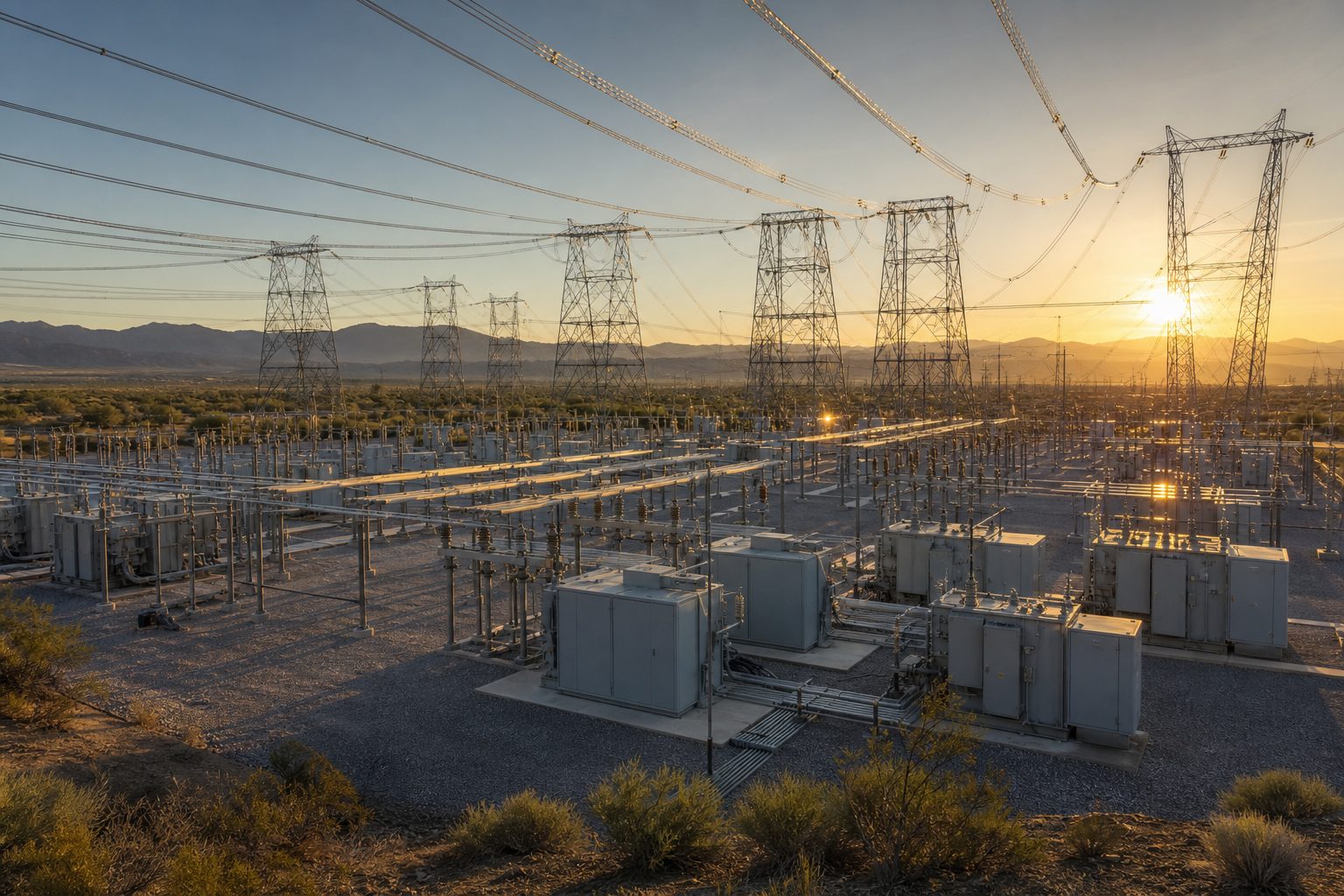
The Army's own screening data shows what that means site by site. At Fort Bliss, El Paso Electric's 115-kilovolt lines run on-site with 345-kilovolt transmission adjacent, Kinder Morgan and ONEOK gas transmission lines run nearby, and utility-scale solar and battery storage were anticipated on the installation by 2028; baseline water stress in the region is rated medium to high. Dugway, by contrast, sits on a 69-kilovolt PacifiCorp line with no local gas supply and the nearest transmission pipeline 30 miles away, per the candidates deck.
The Army's answer is to push the problem onto the tenant. Officials wrote in the announcement materials that developers "will build and operate comprehensive behind-the-meter power and water solutions, thereby guaranteeing operational continuity without burdening public systems," according to DefenseScoop. Behind the meter means the generation sits on the customer's side of the utility connection: the campus makes its own power rather than drawing it from the public grid. Oliver told Defense One the proposals must show net-zero water usage and a power plan that does not draw on the local energy grid.
That design has a dual effect that is easy to conflate. It insulates the surrounding community from the data center, and it insulates the data center from grid failures. What it does not automatically do is make the Army's own missions more resilient. The tenant's electrons belong to the tenant. The Army does have an energy-resilience program of its own, with microgrids built or planned for dozens of installations, and its screening deck footnotes the service's Project Janus nuclear microreactor effort, noting that Janus sites have not been publicly released, that Janus reactors would support Army electric load only, and that "the Army will entertain developer driven NRC licensed commercial nuclear power." Any resilience dividend flowing from a commercial campus to Army operations would have to be negotiated deliberately. The solicitation does allow rent in kind rather than in cash, which creates a lawful channel for such arrangements, but nothing public commits tenant generation to Army missions.
Two more open questions sit in the energy file. The first is fuel. The public documents impose performance conditions, self-generation and water neutrality, without prescribing the source, and the Army's own deck notes the gas transmission lines adjacent to Fort Bliss; whether the campus runs on turbines, solar and storage, or eventually nuclear remains a tenant decision pending in negotiations. The AP report notes that questions about water usage and air pollution remain unanswered. The second is water chemistry. One idea under discussion would have Carlyle fund a new well on Fort Bliss to feed the local desalination plant, offsetting cooling water and possibly making the project "net-positive" for the city's supply. "We don't know if that's an engineering solution that we can actually get to yet," Oliver cautioned, "but we're actively working toward that as a part of the process."
The regional stakes are already visible. If built as reported, the Fort Bliss campus would be the third major data center project in the Borderland, alongside Meta's $10 billion facility in Northeast El Paso and the $165 billion Project Jupiter campus that Oracle and OpenAI are building in Santa Teresa, New Mexico, a concentration that could remake the region into a hub of power generation and AI infrastructure, per the AP report.
Where this story sits
5 related pieces
Read it →
Hover a story · click to read
 No. 55 · Sep 24, 202610 Gigawatts Overhead: The Orbital Data Centers the FCC Reviews One Filing at a Time
 No. 24 · Sep 2, 2026Whole Servers, Hidden Compute: Taiwan and the New AI Export Problem
 No. 40 · Sep 7, 2026The Army's launched-effects bet: a faster upgrade cycle for autonomous strike systems
 No. 5 · Aug 25, 2026Global Compute Token Ledger: Architecture for Enforcing Prepaid Compute Everywhere
 No. 21 · Aug 30, 2026The air base decides: Niger's 24-hour mutiny and the technology of regime survival in the Sahel
Who governs a 50-year tenant on an Army post?

A half-century ground lease is not a procurement. It is closer to a constitution for a piece of territory, and the terms already visible show where the friction will live.
The financial guardrail is the appraisal: rent, in cash, in kind, or combined, cannot fall below fair market value as the Army determines it. Jason Walter, an associate professor of economics at the University of Tulsa, told DefenseScoop that the 50-year frame is significant and that the government appears to control most elements of the arrangement, but he flagged the in-kind option as the soft spot. Federal land could exempt or complicate local taxation even while requiring new infrastructure, he noted, and "any 'in-kind' payment could potentially make this worse." Appraising a 50-year industrial tenancy on a military reservation is not like appraising office space, and in-kind consideration, compute, power, services, is harder to value and audit than a check.
The control terms run the other way. The solicitation, handled by the Army Corps of Engineers' Louisville District, fixes the substantive lease language as non-negotiable, obliges the tenant to restore the land at term's end, and reserves sweeping discretion to the Army. The tenant takes the construction and market risk; the Army keeps the landowner's leverage. One structural mismatch is built in and worth naming plainly: data center hardware turns over in years, while this tenancy is built to outlast several generations of chips, cooling technology, and threat models. How the lease handles expansion, renegotiation, and obsolescence will matter as much as the headline acreage.
The program also sits on a deliberate policy pivot. The Army ties the initiative to "Accelerating Federal Permitting of Data Center Infrastructure," the executive order President Donald Trump signed on July 23, 2025, the same day the White House released its AI Action Plan. That order revoked a Biden administration order, Executive Order 14141 of January 2025, that had directed the Defense and Energy departments to lease federal land for frontier AI data centers paired with renewable power. The replacement keeps the federal-land buildout but drops the clean-energy pairing, substituting speed and self-sufficiency conditions for source requirements. The environmental guardrails that remain are process-based: the Army trimmed the Bliss parcel before posting because of cultural and environmental considerations, according to solicitation attachments reported by DefenseScoop, and the Corps of Engineers' environmental reviews are still ahead.
Who answers to the neighbors?
Community resistance has become one of the defining hazards of data center development, and the Army's approach suggests it has studied the pattern. Darrell West, a senior fellow at the Brookings Institution who researches data centers, told Defense One that communities tend to accept projects when developers disclose the terms up front. "People want to know up-front, you know, where the energy is coming from, how much water is being used, how much the overall cost is going to be, and what the noise levels are," he said. As a counter-example of what success can look like, West pointed to Microsoft's arrangement to restart a reactor at Three Mile Island to power its data centers, calling it a genuine success story but an idiosyncratic one, since most communities do not have an unused nuclear plant next door.

The solicitation itself institutionalized the point, requiring offerors to describe "planned local outreach and engagement for its potential deployment of the data center on the Properties to assess local sentiment and any risks or opposition." In the spring of 2026, Deputy Undersecretary Fitzgerald went to Fort Bliss for a listening session with the 1st Armored Division's commander, community members, El Paso Water, El Paso Electric, and Carlyle. "We're part of the communities that are there, and we are going to engage with them on a routine and regular basis to look for solutions that work for everyone," Oliver said. The Army also holds some structural advantages in the noise and siting fights: installations are vast, and Dugway is an hour from its nearest neighbor.
The jobs case is real but bounded. The Army release projects a significant number of American jobs, and West agrees construction is the strongest argument data centers have, demanding electricians, plumbers, welders, and pipefitters. His caution is that nearly all of those trades are already in short supply. Promised employment, like promised water neutrality, will eventually be judged against payrolls and aquifer readings rather than press releases.
How does the attack surface change?
Start with what the base contributes. A controlled, fenced perimeter, restricted airspace, setback distances measured in miles, and a location chosen for isolation are security properties most commercial developers cannot buy at any price. The same remoteness that quiets noise complaints at Dugway also keeps the facility distant from casual observation.
What tenancy adds is harder, and the request for proposals acknowledges it directly by requiring every offeror to submit "a proposed security plan to mitigate potential cyber, physical, supply chain, and other security risks." The questions those plans must answer are visible even from the public record. Construction would put a large skilled workforce on post, and operations would keep a standing commercial staff inside the perimeter, turning access control, vetting, and escort policy into lease questions rather than purely military ones. Servers, accelerators, and cooling gear would cross the same gates that serve military logistics, which is presumably why the solicitation mentions supply chain risk by name. And the adjacency Oliver described, commercial and classified compute on one campus, makes the network boundary between them the single most consequential engineering decision in the program.
There is also a co-location effect that cuts in both directions, and it should be labeled as analysis rather than documented fact. The base lends the data center its perimeter; the data center lends the base its profile. A gigawatt-scale AI campus is strategic infrastructure by any planner's definition, and siting one inside Fort Bliss folds commercial compute into the same targeting logic as the installation itself, just as the installation's prominence draws fresh attention to what sits behind its gates. None of this demonstrates a vulnerability; the RFP's security-plan requirement exists precisely because the Army knows the questions. But the answers will live in the negotiated leases and their security annexes, and the public record does not yet show them. Sample business terms and lease agreements were attached to the solicitation; the final, negotiated versions are what will count.
What the program has not decided yet
For all the ceremony of a selection announcement, the decisive work is still pending. The exclusive negotiations must produce signed leases with real rents, real in-kind terms, and real security annexes. The environmental reviews must survive scrutiny, in a desert, on a parcel already shrunk once for cultural and environmental reasons. The power mix for two gigawatt-class campuses must be chosen and financed. The desalination offset, in Oliver's words, may not prove to be "an engineering solution that we can actually get to." Fort Hood and Fort Bragg remain in the study pile rather than the build queue. The classified edge of the envisioned campus must be designed, accredited, and funded, or quietly dropped. And beyond the Army, the statute that makes all of this possible, Title 10's leasing authority, is available to every military department, so the Fort Bliss and Dugway leases, whatever they finally say, will read less like a one-off and more like a template.
That is the deeper shift hiding in the acreage figures. For a century, military reservations stored armies: troops, vehicles, ranges, ammunition. The Army is now testing whether the same land can store computation, and whether the country's AI capacity should partly live behind gates, on ground that is neither fully public nor meaningfully private, governed by appraisal clauses and restoration riders instead of zoning boards. The 1,384 acres outside El Paso will not answer that question at groundbreaking. They will answer it in the lease exhibits, in the generator fuel, in the water accounting, and in whether, fifty years on, the arrangement is remembered as the moment the Army became a platform for national compute or the moment it handed a piece of itself to tenants it could no longer direct.
Sources and references
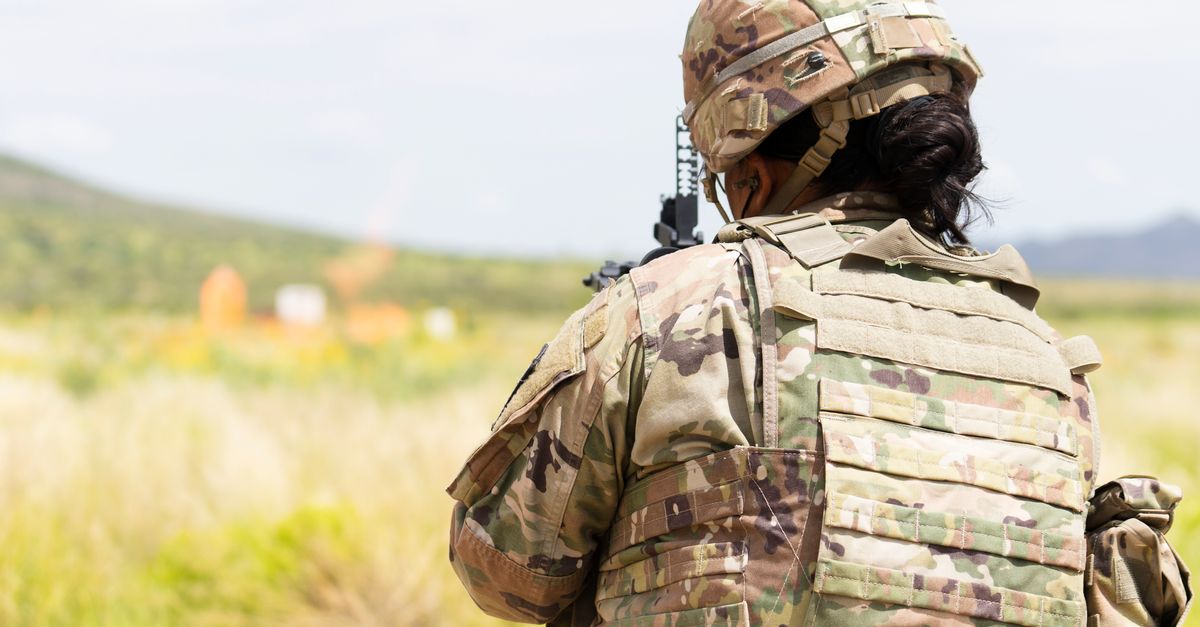
- U.S. Army Communications and Outreach Office. "Army reaches conditional agreement with private industry for hyperscaled data centers." Army.mil, March 26, 2026.
- Brandi Vincent. "Army looks to lease out land on 4 military installations for new commercial data centers." DefenseScoop, Feb. 6, 2026.
- Jon Harper. "Army picks companies to build commercial data centers at Fort Bliss, Dugway Proving Ground." DefenseScoop, March 26, 2026.
- Meghann Myers. "The Army wants to build a better data center. Can they do it?" Defense One, June 11, 2026.
- Diego Mendoza-Moyers, El Paso Matters. "Proposed Fort Bliss data center could use more power than all of El Paso." Associated Press, 2026.
- U.S. Army Corps of Engineers, Louisville District. "Enhanced use lease for commercial data centers," Notice ID W912-QR-DACA27-1-26-102, SAM.gov; record history from Dec. 15, 2025; published Jan. 29, 2026; offers due Feb. 23, 2026.
- U.S. Army. "Army Data Center Targets of Opportunity," request for information, Version 10, Nov. 17, 2025.
- The White House. "Accelerating Federal Permitting of Data Center Infrastructure," executive order, July 23, 2025; and "Winning the Race: America's AI Action Plan," July 2025.
- Executive Order 14141, "Advancing United States Leadership in Artificial Intelligence Infrastructure," signed Jan. 14, 2025 (revoked July 2025).
- Arman Shehabi et al. "2024 United States Data Center Energy Usage Report." Lawrence Berkeley National Laboratory, Dec. 2024.
Comments (4)
Continue exploring
The Army's launched-effects bet: a faster upgrade cycle for autonomous strike systems
The Army's 2026 plan to field long-range launched effects from AEVEX, Griffon and Dragoon is a test of whether modular, competing…
Global Compute Token Ledger: Architecture for Enforcing Prepaid Compute Everywhere
A compute budget is not enforceable if some work reaches the budget ledger and other work reaches a provider directly. That is…
The air base decides: Niger's 24-hour mutiny and the technology of regime survival in the Sahel
When mutinous soldiers attacked Niamey's Air Base 101 in August 2026, Russia's Africa Corps, not Niger's own army, settled the…
'No upfront cost to taxpayers' — sure, right up until the grid upgrades, water rights, and transmission lines get socialized onto someone else's bill.
The breakdown of the enhanced use lease terms in the 'what the Army actually agreed to' section finally made the 50-year structure click for me.
So the Army is framing this as a warfighting asset but the piece admits no anchor cloud tenant has been named publicly for either site — what evidence actually supports the claim that soldiers will get first crack at the compute instead of whoever signs the commercial lease?
Following the CyrusOne deal since the KKR and BlackRock acquisition made headlines, and this Dugway gigawatt-scale angle really feels like the next chapter of that same consolidation story.