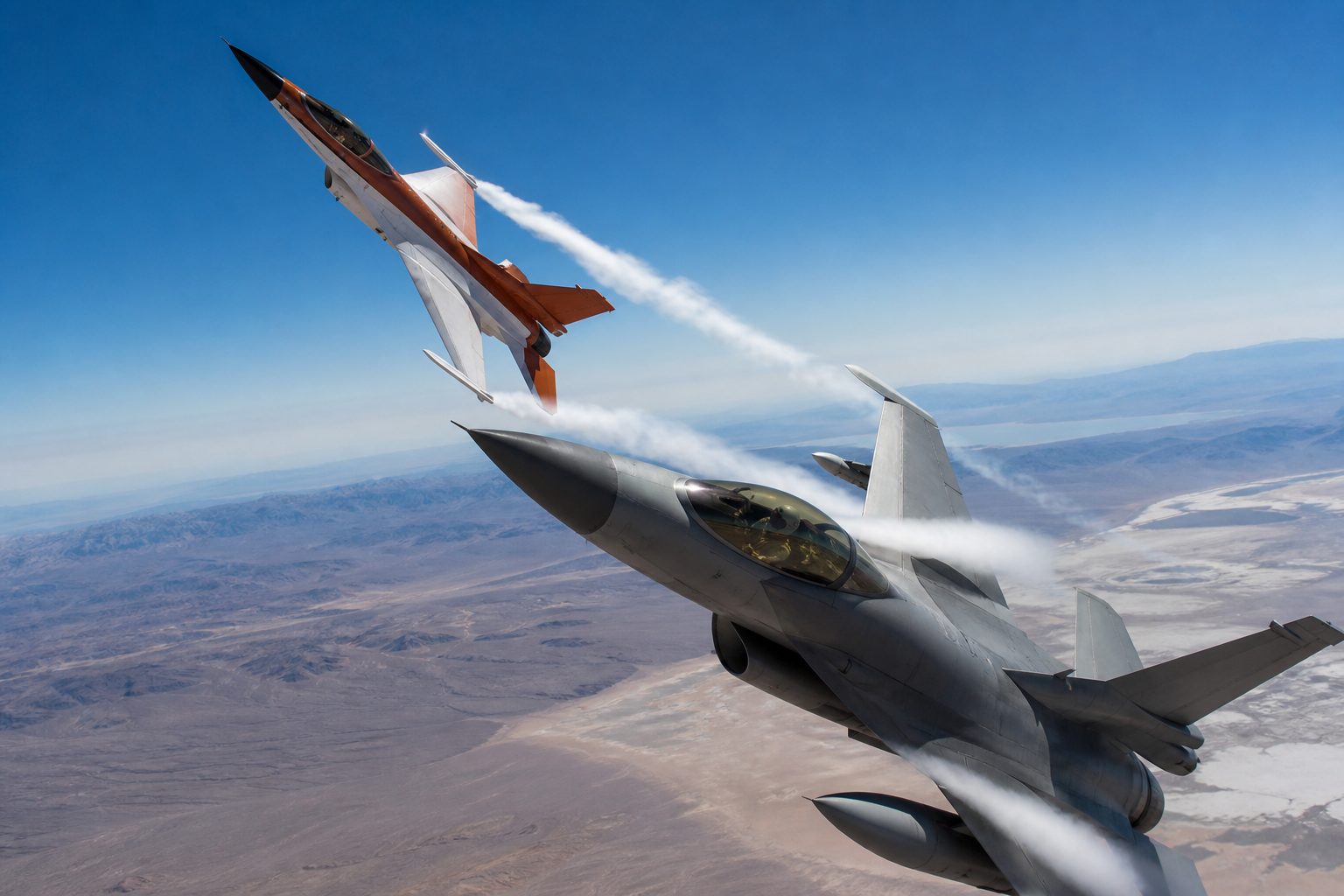
On the morning of May 2, 2024, Frank Kendall climbed into the front seat of an orange-and-white F-16 test jet at Edwards Air Force Base and did what no sitting secretary of the Air Force had done before: he handed the airplane to software. The jet, the X-62A VISTA operated by the Air Force Test Pilot School with DARPA researchers, ran close-range combat maneuvers against a human-piloted F-16 while a safety pilot sat behind the secretary and, through the engagement sequences, left the controls alone [1]. Afterward, Kendall told reporters the technology was "a security risk not to have" and that, at this point, the Air Force has to have it [1]. Months earlier, DARPA had disclosed that the same aircraft had flown a fully artificial intelligence-piloted dogfight against a crewed F-16 over Edwards in September 2023, and characterized the algorithm's performance as holding its own [2].
That flight was the public overture to the largest bet the Air Force has placed in a generation. The service is building what it calls Collaborative Combat Aircraft, or CCAs: jet-powered autonomous drones designed to operate in contested airspace alongside crewed fighters such as the F-35 and the coming F-47. Both prototypes in the program's first tranche, General Atomics' YFQ-42A and Anduril's YFQ-44A, completed first flights in 2025 [7][8], and the Air Force has said it intends to select its first production aircraft in fiscal 2026 [19]. The Navy and Marine Corps are running parallel efforts, and Australia, Turkey, China, and Russia are building their own versions [11][14][48][49][46][28].

The public argument about these machines tends to stall on dogfights: could an algorithm out-fly a seasoned pilot? Inside the program offices, that question is settled enough to move past. The questions that will define airpower are harder. What does a commander do with aircraft that can be risked like missiles and recovered like planes? What happens to a fighter budget built around $80 million aircraft when an adversary's interceptor can cost more than the drone it kills? What does autonomous combat do to deterrence? And running through all of it: the deciding software will be written, trained, and periodically retrained by companies, under intellectual-property terms that may leave the government unable to fully inspect it, and unable to rebuild it at wartime speed without the vendor's cooperation. The most consequential component of a future wingman formation may not be the drone or its weapons. It may be a contractor's model weights, and the contract clauses that govern them.
What are Collaborative Combat Aircraft, in plain terms?
A Collaborative Combat Aircraft is an uncrewed aircraft smaller and cheaper than a crewed fighter, designed to fly with a piloted lead and perform jobs the lead cannot do alone: scouting ahead, jamming enemy radars, drawing fire, or carrying extra missiles. Air Force officials and congressional researchers describe the first tranche as oriented toward counter-air missions, essentially flying as armed escorts, with electronic warfare, sensing, and strike roles planned for later increments [19].
The idea is older than the branding. In 2017, the Air Force Research Laboratory flew its Have Raider II demonstration at Edwards, pairing a crewed F-16 with an F-16 flying autonomously as a "loyal wingman" executing attack tasks [9]. The follow-on Skyborg program built an "autonomy core system" meant to be portable across drone types before it was folded into the CCA effort in 2023 [10]. The Air Force Research Laboratory's XQ-58A Valkyrie, built with Kratos under a program explicitly pursuing low-cost attritable aircraft, first flew in March 2019 with a publicized goal of roughly $2 million to $3 million per aircraft in rate production, and it launches by rocket rather than runway [11]. General Atomics flew the XQ-67A in February 2024 to test a modular "genus and species" approach in which different drone variants share a common core [12]. The Australian-built Boeing MQ-28 Ghost Bat, the most mature operational loyal wingman outside the United States, has been flying since February 2021 [48].
In April 2024, the Air Force narrowed five companies with design contracts to two, selecting General Atomics and Anduril to build and test production-representative aircraft, while stating that Boeing, Lockheed Martin, and Northrop Grumman remained eligible to compete for future work [4]. Anduril's entry, designated the YFQ-44A Fury, descends from a design by Blue Force Technologies, a small firm Anduril acquired in September 2023 [5][6]. On March 3, 2025, the service gave the pair official fighter-series designations, YFQ-42A and YFQ-44A, the first time the Air Force has ever used the "FQ," for unmanned fighter [6]. General Atomics flew the YFQ-42A on August 27, 2025 [7]; Anduril's YFQ-44A followed in the fall of 2025 [8].
The planning math is deliberately stark. Then-Secretary Kendall framed a notional fleet of roughly 1,000 CCAs: two for each of 200 planned crewed Next Generation Air Dominance fighters and two for each of 300 F-35s, a figure he described as a planning yardstick rather than a requirement [3]. Officials have publicly discussed first-tranche costs in the low-to-mid tens of millions of dollars per aircraft, roughly a quarter to a third of an F-35's price, with later increments intended to get cheaper still [19]. The Navy, meanwhile, has commissioned carrier-suited CCA concepts of its own, layered over years of work on the MQ-25 Stingray tanker drone, whose initial operating capability, once scheduled for 2024, has slipped to 2026 [13][14]. The Marine Corps has already flown XQ-58s teamed with F-35s, including in an electronic-warfare role [11].
How does the autonomy actually work?
The foundation was laid in a simulator. In August 2020, during DARPA's AlphaDogfight Trials, an agent built by Heron Systems defeated an experienced Air Force fighter pilot five to zero in simulated within-visual-range combat (the pilot was described as a graduate of the Air Force Weapons School); Heron was acquired by Shield AI the following year [15][17]. DARPA's Air Combat Evolution program then pushed the same class of algorithms, developed by multiple performers, onto a real aircraft: the X-62A VISTA, a heavily instrumented F-16 that can fly like other jets. The September 2023 dogfight against a crewed F-16 was the program's proof that the jump from simulation to air, the hardest gap in combat autonomy, could be crossed [2].
The Air Force is now industrializing that proof at Eglin Air Force Base under VENOM-AFT, the Viper Experimentation and Next-gen Operations Model Autonomy Flying Testbed, which has modified a reported fleet of up to six F-16s to fly autonomy software at high tempo, several sorties a day, so that algorithms accrue flight hours far faster than any single prototype program could manage [16].
Three terms from the policy and scholarly literature organize how humans relate to all this. "In the loop" means the human approves each action. "On the loop" means the system acts on its own unless the human intervenes. "Out of the loop" means no human can intervene in time [18][31]. U.S. policy formally situates combat aircraft in the first two categories. DoD Directive 3000.09, first issued in 2012 and updated in January 2023, requires that autonomous weapons be designed to allow "appropriate levels of human judgment over the use of force," and it routes certain novel autonomous systems through senior-level review before formal development [18]. Air Force leaders have repeatedly said the first CCAs will operate with human authorization for weapons release [19]. The doctrinal picture that follows: the pilot of an F-35 or F-47 acts less like a wingman-leader calling turns and more like a quarterback, assigning missions to drones that then execute the details themselves, including, critically, when jamming severs the link. Officials have stressed that CCAs must keep functioning with communications degraded, which is a requirement written in physics: in heavy electronic-warfare conditions, autonomy is not a feature but a precondition [19][20].
Underneath the aircraft sits the plumbing that matters most to this story. The Air Force says CCAs are being built to open-standards interfaces, Open Mission Systems and the Universal Command and Control Interface, and program officials describe an Autonomy Government Reference Architecture intended to make autonomy software portable between airframes and vendors [20]. That ambition, taking a software brain off one drone and bolting it onto another, is the hinge on which much of the force's future negotiating leverage turns, and the section below examines how real it is.
Why does the Air Force want attritable mass now?

The service's own leaders have described today's fighter inventory as the oldest and smallest in its history [21]. The deeper problem is what happens to that inventory in a serious war. When the Center for Strategic and International Studies wargamed a Chinese invasion of Taiwan in repeated iterations, reported U.S. losses in most scenarios included two aircraft carriers, 10 to 20 large surface combatants, and hundreds of aircraft, the bulk of them destroyed on the ground at vulnerable forward bases [22]. A force that is expensive and few in number, parked in predictable places, is a force designed to lose mass quickly.
The acquisition economics point the same direction. An F-35A costs about $80 million per aircraft, and the Government Accountability Office reported in April 2024 that estimated life-cycle sustainment costs for the F-35 program had risen to roughly $1.58 trillion, even as the services re-planned to fly the jets less to save money [23]. Against those figures, officials describe CCAs costing a fraction of a crewed fighter, attritable by design: built to be risked and, if necessary, lost, in ways the service would never accept for a crewed aircraft [19]. AFRL's earlier cost goals for the XQ-58, low millions per copy, show the ambition extends well below even those official figures [11].
The force-structure logic compounds:
- Mass without matching pilot production. Fighter pilots cost years of pipeline time to replace; drone attrition does not consume the same human capital [19].
- Sortie generation without daily flying. Officials have floated storing CCAs for long periods and surging them in crisis, since they do not need pilot-currency sorties to stay useful [19].
- Runway independence as survivability. Rocket-launched designs like the XQ-58 can be dispersed to sites that missiles cannot easily target, addressing the ground-kill problem the CSIS game exposed [11][22].
- Cost-exchange pressure. An air defender facing cheap, plentiful attackers needs weapons and shooters whose unit cost does not dwarf the incoming threats [33][35].
Think-tank wargaming has reinforced the capacity case: Mitchell Institute analyses argue that CCA mass meaningfully expands combat power per dollar in a Pacific fight [24]. The Pentagon's Replicator initiative, announced in August 2023 with a goal of fielding thousands of attritable autonomous systems in 18 to 24 months, institutionalized the same logic department-wide [25], and a July 2025 Defense Secretary memorandum extended it by directing that small drones be treated as consumable munitions with delegated buying authority [53].
Honest caveats belong here. Unit-cost figures for CCAs are targets, not contractual facts; congressional researchers have noted appropriators' questions about concurrency, cost realism, and whether attritable aircraft can be made cheap enough to treat as expendable in practice [19]. Analysts at CNAS have made a version of the same argument: a $25 million drone is still expensive munition, and the economics of expending it are unproven [33]. The bet is a bet, and it is being placed at roughly $1 trillion in total national defense resources for fiscal 2026 once reconciliation funds are counted [52].
What changes in a dogfight when the wingman is software?
Doctrine shifts first at the level of the formation. A crewed flight lead with two to five autonomous escorts gains mass without pilots: drones that peek over the threat ring, carry extra air-to-air missiles, jam, decoy, or simply present more tracks than an enemy's engagement capacity can cheaply service [19][24]. Every missile the enemy fires at a CCA instead of a crewed fighter is, in the Air Force's framing, a favorable trade in both lives and dollars [19].
Then tempo shifts. Human dogfighting is bounded by physiology and decision time; agents trained on millions of simulated engagements act in machine time, and their behavior can be retrained between conflicts rather than between generations of pilots [2][31]. That is why the ACE disclosure and Kendall's flight mattered less as stunts than as signaling: the service demonstrated in public that the within-visual-range portion of the problem, the portion pilots call "the merge," the moment opposing fighters meet close enough to see each other, was tractable [1][2].
The harder doctrinal work is human. Pilot training syllabi built over seventy years teach wingmen to fly formation; future fighter leads will instead manage formations of semi-independent agents, allocating tasks and attention, and absorbing machine-generated recommendations while retaining release authority [19][20]. That creates new failure modes a human wingman never posed: fratricide risk if identification-friend-or-foe fails, behavior that is correct-by-algorithm but wrong in context, and rules of engagement that must be encoded before the mission because there is no pilot aloft to ask [18][31]. Russia provided the cautionary image in October 2024, when an S-70 Okhotnik combat drone, flying with a Su-57, lost control and was apparently shot down by its own side over eastern Ukraine [28]. Teaming a fighter with a drone turns out to require trusting the drone.
What stops the enemy from hacking or jamming the wingmen?
The honest answer is that electronic warfare has been the most effective counter-drone weapon ever fielded. RUSI's field research on the Ukraine war estimated that in 2023 Ukraine was losing on the order of 10,000 drones a month, the large majority to Russian electronic warfare rather than kinetic fire [26]. Both sides in that war have since migrated toward terminal guidance by machine vision and fiber-optic control links precisely to escape jammers, an adaptation cycle measured in weeks, not acquisition years [26][33]. U.S. CCAs are being built for that environment: the comms-degraded requirement exists because planners assume the link is the first thing an enemy attacks [20].
Beyond jamming sits a subtler threat class: adversarial attacks on the learned components themselves, from sensor spoofing and deceptive visual inputs to poisoning of training data. MITRE's ATLAS framework catalogs these techniques for military AI systems, and no consensus test standard yet exists for certifying a learning system against them [27]. The counter-autonomy race, in short, does not eliminate autonomy's value; it raises the assurance burden, and it places the software supply chain, every vendor's training pipeline and update mechanism, squarely inside the threat surface. That is the seam the next two sections press on.
What does autonomy do to deterrence and escalation?
The scholarly case has been built for years. Michael Horowitz has argued that lethal autonomous systems compress decision time and create incentives to automate, with first movers gaining speed advantages that are inherently destabilizing [29]. RAND's Edward Geist and Andrew Lohn warned in 2018 that machine learning applied to nuclear-age strategic warning and targeting could erode the stability that deterrence depends on [30]. Paul Scharre's formulation is that autonomous mass lowers the political price of using force, since attritable aircraft hold no pilot to rescue and produce no flag-draped arrivals, which can simultaneously strengthen denial and lower the threshold for employing force [31].
Two facts from the last two years give that theory edges. On June 1, 2025, Ukraine smuggled 117 short-range drones in trucks to within range of multiple Russian bomber bases and struck them, in what became known as Operation Spider's Web. Kyiv claimed 41 aircraft hit; commercial satellite imagery confirmed destroyed and damaged Tu-95 and Tu-22M3 strategic bombers, with independent open-source tallies settling around a dozen aircraft affected [32]. The drones were flown by humans over local links, not by AI, and the lesson is about cost, reach, and sanctuary rather than autonomy per se, but analysts immediately connected it to what swarming autonomy would eventually multiply: aircraft designed to be survivable because of their bases' distance turned out to be killable in their sanctuary for tens of thousands of dollars per effect [32][33]. A fleet of autonomous CCAs is, among other things, a way to put that arithmetic on the U.S. side of the ledger.
The second fact is cost exchange as strategic attrition. When Iran fired more than 300 projectiles at Israel in April 2024, Israeli tallies said roughly 99 percent were intercepted, at a defense cost Israeli officials estimated at around $1 billion to $1.35 billion, several times the attack's cost [34]. In the Red Sea, a single U.S. carrier group fired on the order of 150 Standard-family interceptors, each costing a few million dollars, largely against Houthi drones priced in the tens of thousands [35]. Magazine depth and interceptor economics are now deterrence variables, and CCAs are pitched partly as a way to carry cheaper shots against cheap threats [19][33].
Against this stands a thin normative architecture. Directive 3000.09 governs U.S. systems [18]. The U.S. Political Declaration on Responsible Military Use of AI and Autonomy, issued in November 2023, has gathered endorsements from dozens of states [36]. The Hague's REAIM summit produced a call to action the same year [37], while more than a decade of Geneva talks under the Convention on Certain Conventional Weapons has produced guiding principles but no binding rules [38]. Which leaves a blunt observation: with international law unsettled and self-imposed policy doing most of the work, the practical meaning of "responsible autonomous weapons" is currently defined in software, whoever writes, owns, and maintains it.
Who owns the software at the controls?
The Air Force chose not to pick a single autonomy. It seeded a market. Anduril flies its own autonomy stack, an outgrowth of its Lattice software, on the YFQ-44A [5][8]. General Atomics draws on its in-house ecosystem and partners [7]. The VENOM F-16s at Eglin have flown agents from multiple vendors, including EpiSci [16]. The X-62A's ACE-era agents came from several performers [2]. Shield AI's Hivemind, built on the lineage of AlphaDogfight winner Heron Systems, has flown on V-BAT teams and an XQ-58 [17]. And Northrop Grumman opened its Model 437 Vanguard test aircraft to outside autonomy firms under "Project Beacon," with reported partners including Applied Intuition and Shield AI among others [43]. The market is already consolidating inside itself: Applied Intuition, a commercial vehicle-autonomy company, acquired EpiSci, one of the tactical-AI vendors flying on Air Force test F-16s, in February 2025 [42]. A government that deliberately wanted several autonomy suppliers is watching the count of distinct software bloodlines shrink toward two or three platforms.
On paper, the government has leverage. Since the 2017 defense authorization act, statute has required modular open system approaches in major defense acquisition programs, codified today at 10 U.S.C. §4401 [39]. The Air Force's Autonomy Government Reference Architecture is meant to make autonomy swappable across airframes [20]. DFARS clauses give the government data rights in software it funds to develop, often government-purpose rights after negotiated periods [40].
But two technical realities cut against the paperwork. First, what the government owns under those clauses is typically rights in delivered software and documentation. The consequential artifacts of learned autonomy are different objects: trained model weights, training-data provenance, the reward structures that shaped behavior, and the vendor's simulation pipeline. Under standard DFARS software rights, artifacts developed at private expense, or under SBIR protections, can remain restricted for years even when the government paid for much of the surrounding work; what is protected in any given program depends on contract terms that are not public [40]. Second, assurance of a learning system cannot be done by reading code the way reviewers certify conventional flight software. It is demonstrated by behavior, in simulation and flight, which is why the government is renting flight hours on VISTA and VENOM jets [2][16] and why the FAA's civil roadmap for AI safety assurance, the closest regulatory analogue, treats non-deterministic systems as an open problem [45]. The Pentagon's own software leadership has spent years pushing "continuous authorization" policies and admitting, via the Defense Innovation Board's influential 2019 study, that software is never done and that the workforce to sustain it is the binding constraint [41][44].
The program has a working precedent for what goes wrong, and it is the F-35. GAO has documented for years how limited access to technical data constrained the department's sustainment options on that fleet, contributing to rising costs and deepening dependence on the prime contractor [23]. Now apply the lesson to a hotter oven: in Ukraine, electronic-warfare adaptation cycles run in weeks [26]. If retraining autonomy against a new adversary technique requires a vendor's pipeline, weights, and personnel, then the force adapts at the vendor's release tempo. Whether the government could, in a crisis, retrain and re-field the autonomy on its own CCAs without the originating vendors is an open question whose answer today varies by program and contract, and the public record does not support a confident yes. The strongest available evidence suggests the Air Force is aware of the risk and is using its reference architecture to buy optionality against it [20]; whether that architecture has yet been proven by swapping one vendor's autonomy into another vendor's airframe through full test and safety certification is not publicly established [20][42].
There is a real defense of the multi-vendor model, and it deserves weight. Competition disciplines cost and pace; Anduril's self-funded development, GA's decades of uncrewed-aircraft sustainment, and Shield AI's rapid flight-test cadence each delivered speed the traditional process rarely does [5][7][17]. Intellectual-property protection is part of what draws venture-backed engineering talent into defense at all [5][42]. A deliberate pluralism of autonomy suppliers also denies an adversary a single point of failure to target. The cost of that pluralism is an accountability seam: when one company's autonomy rides another company's airframe under a third party's rules of engagement, every layer's assurance case must compose with the others, and the question of who certifies the whole, let alone who answers for its failure, does not yet have a public answer [18][27][44].
Who else is building loyal wingmen?
China is the mirror that concentrates minds. The Pentagon's 2024 China Military Power Report describes the PLA's "intelligentization" push and its expanding uncrewed aviation programs [45]. Beijing publicly unveiled the GJ-11 flying-wing combat drone in 2019 and has displayed loyal-wingman concepts such as the FH-97A at its Zhuhai air shows; when a twin-seat variant of the J-20 stealth fighter appeared publicly in 2024, Western analysts including IISS and Janes assessed the back seat as intended for a human controller managing drones [46]. CNAS wargaming of a Taiwan fight found drone density on both sides would be extraordinary, and that China's commercial drone industrial base gives it a production-depth advantage the United States cannot currently match [33]. Russia's S-70 Okhotnik flew with the Su-57 for years before the October 2024 loss of control and apparent fratricidal destruction over Ukraine, whose wreckage became a windfall for Western analysts; the program's status since has been opaque [28].

Among U.S. partners, Australia's MQ-28 is the furthest along, with Canberra funding additional aircraft beyond the prototypes and the type drawing sustained American interest [48]. Turkey fields the most unconventional fleet: the Kızılelma carrier-capable jet drone flew in December 2022, the Anka-3 flying wing in December 2023, and the TCG Anadolu is being developed as a drone carrier [49]. Britain cancelled its Project Mosquito demonstrator in 2022 and folded the effort into a broader autonomous-platform strategy [50]. Airbus showed a Wingman concept in Berlin in 2024, and South Korea, Japan, and India have all unveiled combat-drone or loyal-wingman demonstrators [51][46]. No one with an air force worth the name plans to fight the next war without wingmen that don't get tired, don't defect, and don't appear on casualty lists. The unresolved difference is who, in each country, owns the code.
What to watch
The fiscal 2026 decision season compresses most of this story into a few concrete tells:
- The Increment 1 production award and its data-rights annex. Winner and price will make news; the clauses governing model weights, training data, and retraining rights will matter more [4][40][52].
- Increment 2's shape. Cheaper airframes, more vendors, allied participation: each choice is a vote on which lesson the service took from Increment 1 [19].
- A demonstrated autonomy swap. The reference architecture means little until one vendor's brain demonstrably flies another vendor's body through certification [20].
- Assurance policy for learning systems. How the Pentagon applies continuous-authorization ideas to software that changes behavior between versions will set the ceiling on adaptation speed [44][45].
- Counter-drone economics. If CCAs become cheap interceptor carriers, they answer the Red Sea arithmetic directly [35][53].
- Adversary counter-autonomy. Ukraine's adaptation tempo suggests the winning side is whichever one's vendors, or organic labs, can retrain fastest [26][33].
Kendall strapped himself into the VISTA to prove a service could trust software with a life for an hour. The service is now trusting software with its doctrine, its budgets, a chunk of its deterrent, and, if the contracts are written narrowly, the keys to its own adaptation in wartime. The dogfight footage was never the point. The point is whose software climbs the ladder next, and whether, five years from now, the Air Force can service what it bought.
Sources / References
- U.S. Air Force, coverage of Secretary Frank Kendall's X-62A VISTA autonomy flight, af.mil, May 2024.
- Defense Advanced Research Projects Agency, Air Combat Evolution program materials and spring 2024 disclosure of the September 2023 X-62A dogfight against a crewed F-16, https://www.darpa.mil/program/air-combat-evolution.
- Frank Kendall, keynote remarks, Air & Space Forces Association Warfare Symposium, March 2023 (the roughly 1,000-CCA planning figure), with contemporaneous Defense News and Breaking Defense coverage.
- U.S. Air Force, "Department of the Air Force selects companies to build, test Collaborative Combat Aircraft," af.mil, April 24, 2024.
- Anduril Industries, announcement of the acquisition of Blue Force Technologies, September 2023.
- U.S. Air Force, official Mission Design Series designations for the YFQ-42A and YFQ-44A, af.mil, March 3, 2025.
- General Atomics Aeronautical Systems, YFQ-42A first flight announcement, August 27, 2025.
- Anduril Industries, YFQ-44A first flight announcement, and Air & Space Forces Magazine coverage, fall 2025.
- Air Force Research Laboratory, "Have Raider II" manned-unmanned teaming flight demonstration, Edwards AFB, 2017.
- Air Force Research Laboratory program materials and official statements on the Skyborg autonomy effort and its 2023 transition into the CCA program.
- Air Force Research Laboratory and Kratos, XQ-58A Valkyrie first flight (March 5, 2019) and Low Cost Attritable Aircraft Technology cost goals, af.mil; USNI News, Marine Corps XQ-58 teaming tests with F-35s, 2023.
- Air Force Research Laboratory and General Atomics, XQ-67A Off-Board Sensing Station first flight, February 2024.
- Boeing, MQ-25 Stingray first flight release, September 2019; USNI News reporting on MQ-25 schedule revisions, 2023-2024.
- USNI News reporting on U.S. Navy carrier-based Collaborative Combat Aircraft concept work, 2024-2025.
- DARPA and Johns Hopkins Applied Physics Laboratory, AlphaDogfight Trials, August 2020.
- Eglin Air Force Base materials and trade coverage (Breaking Defense; Air & Space Forces Magazine) of the VENOM-AFT F-16 autonomy flying testbed, 2023-2025.
- Shield AI announcements: acquisition of Heron Systems (2021); Hivemind autonomous teaming flights on V-BAT aircraft (2023); Hivemind flights on an XQ-58 (2024).
- Department of Defense Directive 3000.09, "Autonomy in Weapon Systems," January 25, 2023 (originally November 21, 2012), https://www.esd.whs.mil/Portals/54/Documents/DD/issuances/dodd/300009p.pdf.
- Congressional Research Service, In Focus report on the U.S. Air Force Collaborative Combat Aircraft program, updated 2025, crsreports.congress.gov.
- U.S. Air Force program-office descriptions of the Autonomy Government Reference Architecture and use of Open Mission Systems / Universal Command and Control Interface standards for CCAs, as reported in trade press, 2024-2025.
- Air & Space Forces Magazine reporting of Air Force leadership statements describing the oldest and smallest fleet in service history, 2024.
- Mark F. Cancian, Matthew Cancian, and Eric Heginbotham, "The First Battle of the Next War: Wargaming a Chinese Invasion of Taiwan," Center for Strategic and International Studies, January 2023, https://www.csis.org/analysis/first-battle-next-war-wargaming-chinese-invasion-taiwan.
- U.S. Government Accountability Office, F-35 sustainment assessments, including April 2024 findings that estimated life-cycle sustainment costs rose to about $1.58 trillion and earlier findings on technical-data access constraints, gao.gov.
- Heather Penney and colleagues, Mitchell Institute for Aerospace Studies analyses and wargaming on Collaborative Combat Aircraft, 2023-2024.
- Deputy Secretary of Defense Kathleen Hicks, "The Urgency to Innovate" (Replicator announcement), NDIA Emerging Technologies Conference, August 28, 2023, defense.gov; Defense Innovation Unit program materials.
- Jack Watling and Nick Reynolds, "Meatgrinder: Russian Tactics in the Second Year of Its Invasion of Ukraine," Royal United Services Institute, May 2023, and subsequent RUSI field research on drone adaptation.
- MITRE ATLAS (Adversarial Threat Landscape for Artificial-Intelligence Systems), https://atlas.mitre.org.
- Reuters reporting and UK Ministry of Defence assessments of the October 5, 2024 loss of a Russian S-70 Okhotnik combat drone over eastern Ukraine.
- Michael C. Horowitz, "When speed kills: Lethal autonomous weapon systems, deterrence and stability," Journal of Strategic Studies, 2019.
- Edward Geist and Andrew J. Lohn, "How Might Artificial Intelligence Affect the Risk of Nuclear War?" RAND Corporation, Perspective PE-296, 2018, https://www.rand.org/pubs/perspectives/PE296.html.
- Paul Scharre, Army of None: Autonomous Weapons and the Future of War (W.W. Norton, 2018).
- Reuters and Associated Press coverage, June 1-4, 2025, of Ukraine's drone attacks on Russian bomber bases (Operation Spider's Web), Ukrainian government claims, and commercial satellite imagery of damage.
- Stacie Pettyjohn, Hannah Dennis, and Molly Campbell, "Swarms over the Strait: Drone Warfare in a Future Fight to Defend Taiwan," Center for a New American Security, June 2024.
- Israeli military tallies and U.S. Central Command statements on the April 13-14, 2024 Iranian attack; Israeli official cost estimates of the interception campaign as reported by Ynet, Calcalist, and international press, April 2024.
- USNI News reporting on U.S. Navy interceptor expenditures in Red Sea operations, 2024; U.S. Navy budget documents for Standard Missile unit costs.
- U.S. Department of State, Political Declaration on Responsible Military Use of Artificial Intelligence and Autonomy, November 2023, https://www.state.gov/political-declaration-on-responsible-military-use-of-artificial-intelligence-and-autonomy/.
- REAIM 2023 Summit, "Call to Action on Responsible Artificial Intelligence in the Military Domain," The Hague, February 2023.
- United Nations Office for Disarmament Affairs, materials on the CCW Group of Governmental Experts on Lethal Autonomous Weapons Systems.
- 10 U.S.C. §4401 (modular open system approach requirement), enacted as Section 805 of the FY2017 NDAA (originally 10 U.S.C. §2446a) and renumbered by the FY2022 NDAA, https://www.law.cornell.edu/uscode/text/10/4401.
- Defense Federal Acquisition Regulation Supplement 252.227-7014 and 252.227-7018 (rights in noncommercial computer software; SBIR/STTR data rights), acquisition.gov.
- Defense Innovation Board, Software Acquisition and Practices (SWAP) Study, May 2019.
- Applied Intuition, announcement of the acquisition of EpiSci, February 2025; contemporaneous trade coverage.
- Northrop Grumman announcements and trade coverage of the Model 437 Vanguard test aircraft and the Beacon autonomy-partner ecosystem, 2024-2025.
- DoD Chief Information Officer, Software Modernization Strategy (February 2022) and associated continuous Authorization to Operate policy work, dodcio.defense.gov.
- Federal Aviation Administration, Roadmap for Artificial Intelligence Safety Assurance, 2024.
- U.S. Department of Defense, Military and Security Developments Involving the People's Republic of China 2024, December 2024; IISS and Janes analysis of Chinese loyal-wingman displays (GJ-11, FH-97A, twin-seat J-20S), 2022 and 2024.
- (Number reserved; see 11 for Marine Corps XQ-58 teaming tests.)
- Department of Defence (Australia) and Boeing Defence Australia, MQ-28 Ghost Bat program milestones, including first flight in February 2021 and follow-on funding.
- Baykar, Kızılelma first flight (December 14, 2022); Turkish Aerospace Industries, Anka-3 first flight (December 28, 2023); Reuters on TCG Anadolu's drone-carrier role, April 2023.
- FlightGlobal reporting on the cancellation of the RAF's Project Mosquito demonstrator, June 2022; UK Ministry of Defence Autonomous Collaborative Platforms strategy documents.
- Airbus "Wingman" loyal-wingman concept unveiling, ILA Berlin, June 2024; trade coverage.
- Office of the Under Secretary of Defense (Comptroller), FY2026 defense budget rollout materials, June 2025, comptroller.defense.gov.
- Secretary of Defense Pete Hegseth, "Unleashing U.S. Military Drone Dominance" memorandum, July 10, 2025; White House Executive Order, "Unleashing American Drone Dominance," June 6, 2025.
- Reuters, reporting on Anduril's Arsenal-1 factory announcement in Pickaway County, Ohio, January 2025.
Comments (8)
Continue exploring
The Sahel Juntas' Post-Wagner Arsenal: Drones, Air Defenses and What They Changed
Mali, Burkina Faso and Niger expelled Western forces and built their own arsenal. The documented inventory shows what arrived…

The Army's launched-effects bet: a faster upgrade cycle for autonomous strike systems
The Army's 2026 plan to field long-range launched effects from AEVEX, Griffon and Dragoon is a test of whether modular, competing…
How drones, Starlink and covert flights through Chad and Libya are redrawing Sudan's war
What began as a power struggle in Khartoum is now a drone war supplied through Chad and Libya, connected by smuggled satellite…
For a smaller allied air force thinking about jumping into this, would the article's recommendation still hold if you only have a handful of F-35s to pair drones with? I keep wondering whether the cost calculus collapses without that 200-fighter backbone to spread the CCA fleet across.
The autonomy section was the most useful for me, especially the part about the AlphaDogfight Trials and how simulator-derived policies are being moved onto tactical aircraft like the X-62A VISTA.
I'm not sold on the framing that contractor-held model weights are the scariest part of this program - if anything, the bigger unknown is how these aircraft will be maintained in a degraded communications environment, which the article barely touches.
I was at Edwards when the X-62A first flew autonomous maneuvers against a crewed F-16, and the safety pilot never touched the stick during the engagement runs. The article's description of that flight lines up with what the DARPA team briefed us afterward.
On the planning figure of roughly 1,000 CCAs paired two-per-platform with 200 NGAD fighters and 300 F-35s, how firm is that ratio if crewed fighter procurement ends up slipping past the FY26 production selection?
The $2-3 million per XQ-58A figure has not held up in production - unit costs have run noticeably higher in my experience on similar attritable programs.
Kendall's line about CCAs being a security risk not to have matches what I've seen at the squadron level - when we lose a drone in a contested scenario we treat it operationally like a spent munition rather than a downed crewed aircraft, and that genuinely changes the calculus on every sortie.
The piece glosses over what happens when a contractor that owns the underlying model weights goes bankrupt or gets acquired mid-program, which is a real procurement risk I've watched play out on smaller autonomy contracts.