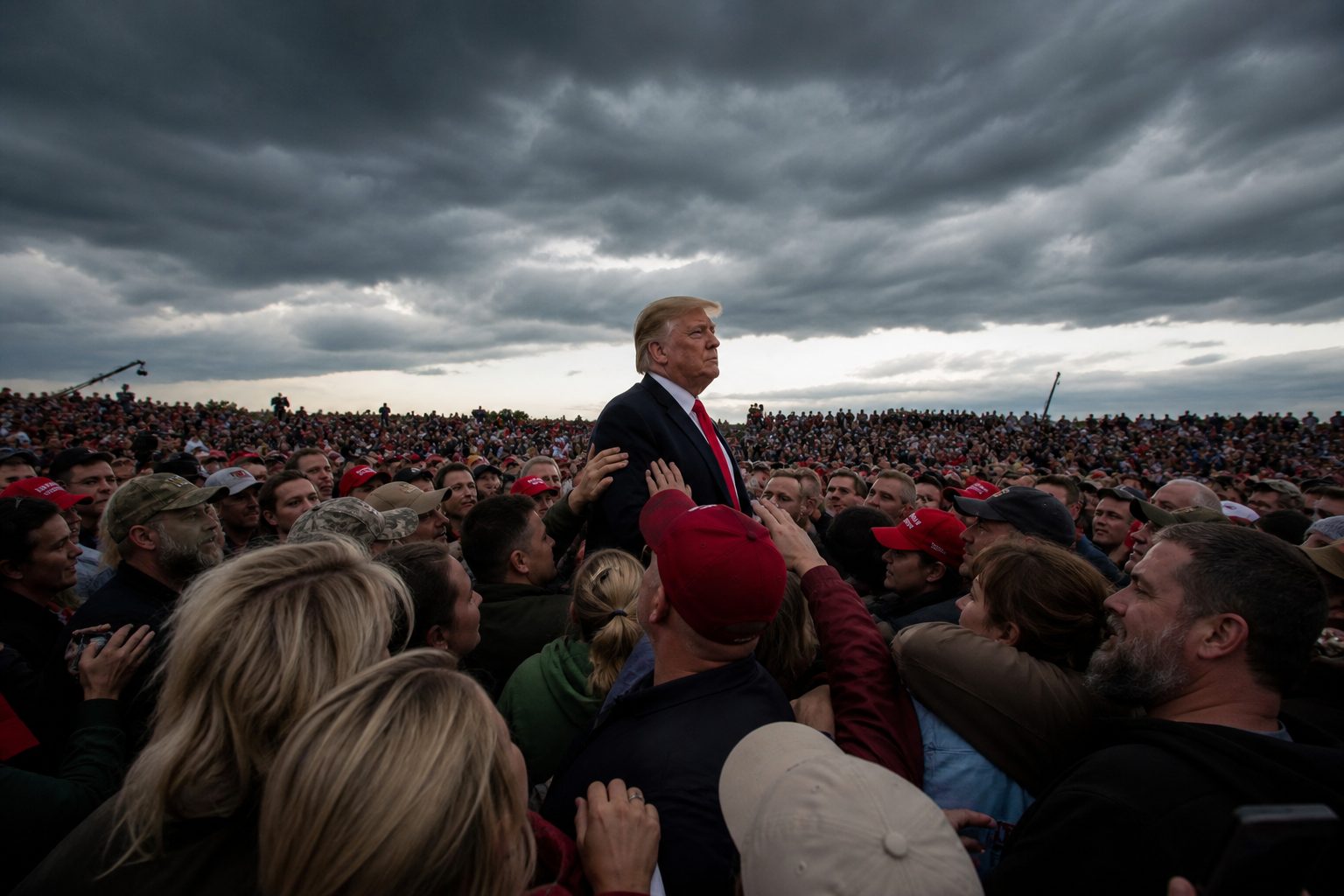
On the evening of May 30, 2024, twelve jurors in a Manhattan courtroom found a former president of the United States guilty of 34 felony counts, the first such verdict in the 235 years since the presidency began. Within 24 hours, Donald Trump's campaign reported raising $53 million in online donations, a surge that briefly crashed the Republican donation platform WinRed. The campaign said nearly a third of the money came from first-time donors, according to the Associated Press. Six weeks later, a sniper's bullet tore through the top of Trump's right ear at a fairground in Butler, Pennsylvania, killing Corey Comperatore, a 50-year-old former fire chief seated in the bleachers behind him. Five days after that, Trump walked onstage at the Republican National Convention in Milwaukee, a white patch covering his ear, and told the delegates what many of them had already concluded: "I'm not supposed to be here tonight."
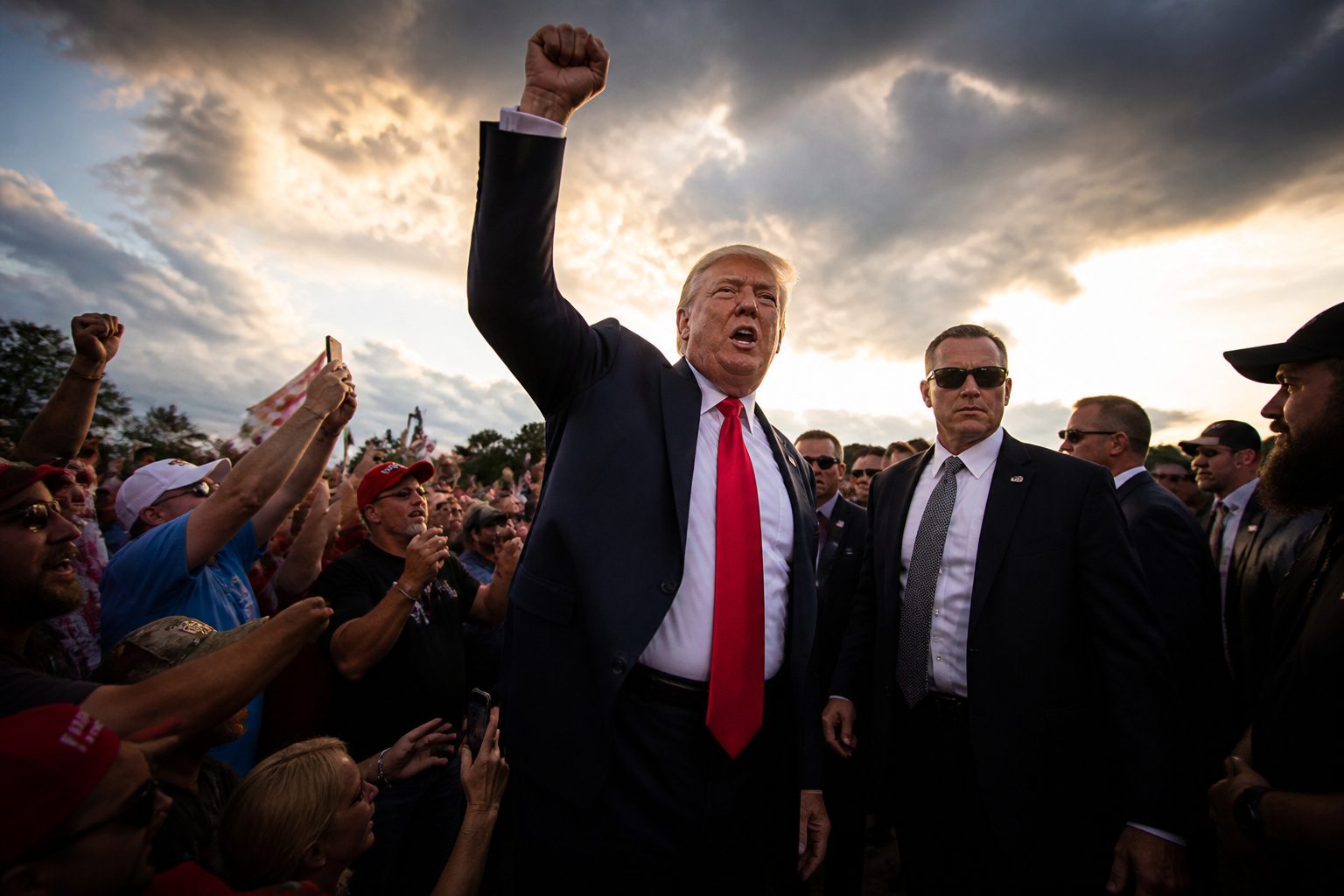
Any one of these events should have ended the career of a normal politician. Each one instead paid measurable dividends in money, solidarity, and eventually votes. In November 2024, Trump won the popular vote, something no Republican had done in twenty years, with about 49.8 percent of ballots cast. That inversion is the subject of this article. The durability of Trump's support is usually told as a story about a gifted performer and a besotted crowd. The evidence assembled by political scientists, psychologists, election lawyers, and the congressional record describes something else: a system. Trump's power has survived four indictments carrying, at their fullest extent, 91 felony counts, two impeachments, and a lost reelection by roughly seven million votes, because it rests on interlocking mechanisms that convert the ordinary antibodies of democratic politics into nutrients. Identity attaches voters to him personally. An insulated information environment pre-interprets every shock before it arrives. The mechanics of party primaries make defection fatal for Republican officeholders, whose capitulation then signals back to voters that the leader was right all along. Churches, rural institutions, and the social geography of the coalition make dissent expensive in daily life. And a personalist theory of leadership, cultivated deliberately during and after his first term, has turned loyalty itself into an operating system for government, as the public-administration scholar Donald Moynihan has documented in detail.
The question matters now, in the autumn of his second term, because the interesting question has changed. It is no longer whether Trump can survive a shock. He has metabolized more of them than any figure in American political history. The question is what happens to the machine he built: whether it is hardening into the permanent structure of one of the world's two governing parties, or quietly developing cracks that will accomplish what the prosecutors could not. With midterm elections eight weeks away and the Twenty-second Amendment barring a third term in 2028, the architecture is approaching its two hardest tests, one of performance and one of succession. What follows is a tour of the machine, part by part, and then an honest audit of its weakest points.
Why do attacks on Trump so often make him stronger?
Start with the pattern, because the pattern is what has to be explained. When the FBI searched Mar-a-Lago on August 8, 2022, Republican primary polling moved in Trump's favor rather than against it. After the first indictment landed on March 30, 2023, his campaign reported more than $4 million in donations within 24 hours, and his national polling average among Republican primary voters climbed several points over the following weeks, ground he never surrendered. Federal Election Commission filings later showed his political committees paying out tens of millions of donor dollars in legal fees, a transfer from supporters to defense lawyers that produced no revolt. Federal judges threw out his attempts to overturn the 2020 election roughly 60 times, many of those rulings written by judges his own party appointed; the Supreme Court granted him broad criminal immunity for official acts in July 2024; and none of it, in either direction, visibly moved his standing with the people who decide Republican nominations. A panel study of Trump supporters published in PS: Political Science & Politics found the mechanism in the data rather than in anecdote: the more deeply a voter's identity was fused with Trump before the 2020 election, the more strongly that voter came to believe the 2020 election was stolen, and that belief in turn predicted downplaying his criminal charges and supporting his agenda (Moniz and Swann, 2025).

Four mechanisms, working together, produce this effect. The first is identity fusion itself, a condition in which the boundary between a person's self and a leader or group becomes, in the researchers' phrase, porous. A fused supporter does not experience an attack on Trump as news about Trump; it is processed as an attack on the self and the community, and it triggers defense rather than deliberation. The second is prophecy. Trump has been pre-announcing his own persecution since before he won anything, warning through the summer and fall of 2016 that the election would be rigged, and the story's structure is self-sealing: every indictment arrives as the confirmation of a prediction, and every rebuttal arrives as part of the plot. A prediction that keeps coming true, for a certain kind of believer, accumulates credibility rather than losing it. The third is the cast of antagonists. The people bringing the cases had already been defined for years, by him and by sympathetic media, as the corrupt establishment. Attacks from an already-defined enemy carry no new information; they are what enemies do. The fourth is elite ratification. When the party's own leaders defended him after each shock, voters who might have wavered heard an authoritative voice on their side confirm that the leader's frame was the safe one. "I am your retribution," Trump told the CPAC audience in March 2023, a month after his third appearance before that crowd, and at rallies through that year he refined the bargain into a single transactional sentence: they are not after me, they are after you, and I am just standing in the way. It is the most efficient persecution narrative in modern politics, because it promises the supporter that the leader's legal bills and the supporter's grievances are the same bill.
The corrective honesty required here is that the backfire effect has a boundary. The loop operates inside the coalition, and the coalition is not the country. In 2020, amid all the same dynamics, 81 million people voted against him. The Manhattan verdict did not make him beloved in November 2024; it made him available and reinforced, in an election that swung on prices and memory. What the machine reliably produces is intra-party invulnerability and mobilized margins, not national affection. Confusing those two things is the most common analytical error in coverage of this era, and getting it straight is necessary before asking what, if anything, could ever break the system.
Why is the bond identity, not opinion?
The psychological architecture underneath the loyalty is well documented, and it does not require the coalition to be stupid, ignorant, or hypnotized. The foundation was laid decades before Trump descended the escalator. Lilliana Mason's work on social sorting showed how American party affiliation gradually stacked itself on top of race, religion, geography, and cultural style, so that being a Democrat or a Republican stopped being a policy preference and became a summary of who a person is. On that terrain, political disagreement registers as status threat, not as an argument to be answered. Diana Mutz's analysis of the 2016 electorate, published in the Proceedings of the National Academy of Sciences, found that the movement toward Trump was better explained by perceived threats to dominant-group status than by voters' economic situations (Mutz, 2018). And the baseline of democratic commitment had already softened: Roberto Foa and Yascha Mounk documented that three quarters of Americans born in the 1930s considered living in a democracy essential, against roughly 30 percent of those born in the 1980s, a generational collapse in the value assigned to the system itself.
Identity fusion adds the personal load-bearing wall. In the research of William Swann and his collaborators, fused individuals treat the group's fortunes as their own and prove the bond through costly action; the more porous the boundary between self and leader, the more an attack on one becomes an attack on both. The January 6 attack offered a grim natural experiment. A three-wave panel run around the insurrection found that fusion with Trump predicted the perception that Democrats posed an existential threat to the American way of life, and that perceived threat in turn predicted endorsement of authoritarian actions against them; Biden supporters showed no analogous pattern around their own leader, and fusion with the United States itself ran in the opposite, protective direction (Martel, Moniz, Ashokkumar and Swann, 2024). That paper opens with the fact that the sitting president had retweeted a video declaring that the only good Democrat is a dead Democrat. The asymmetry the researchers measured is the whole point: this is ordinary human identity-protective cognition aimed at an extraordinary target, a man, rather than the usual target, a party or a country.
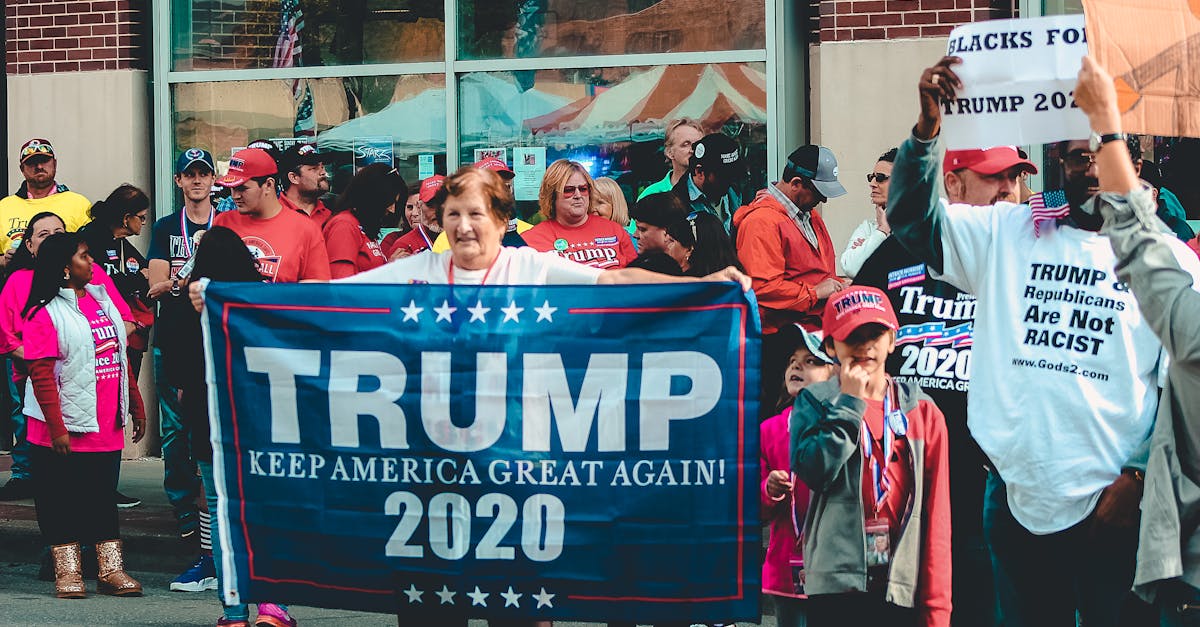
Geography finishes the job. In 2020, Joe Biden won 477 of America's roughly 3,100 counties; Trump won 2,497, and post-election surveys have consistently credited him with about three fifths of the rural vote or more. Most Trump supporters live inside physical communities where their politics is the ambient default: the county Republican committee, the church, the feed on the phone, the talk at the diner. In that environment, defection is not a private change of mind. It is a public act with visible social consequences, and staying has no cost at all. Surveys can measure what people endorse; the structure of daily life measures what they will defend.
How was the sealed information system built?

The third layer is communicative, and its scale was measured years before most of politics understood what it was seeing. The Berkman Klein Center at Harvard analyzed more than two million election-related stories from roughly 70,000 online sources across the 2016 cycle and found something distinctly asymmetric: not two comparable information bubbles, but a discrete and relatively insular right-wing media ecosystem, centered on Breitbart and Fox News, whose internal attention patterns differed sharply from the rest of American media. An attention backbone ran from openly conspiratorial fringe sites through bridging outlets like Breitbart and the Daily Caller into the mainstream right, laundering the paranoid style into respectability, while the ecosystem partly insulated its audience from nonconforming news reported elsewhere and moderated the impact of bad news for Trump's candidacy (Benkler, Faris and Roberts, 2017). Insulation, note, does not mean that contrary facts never enter. It means they enter pre-interpreted, arriving with the frame already attached: here is what they are saying about us now.
The ecosystem also polices its own deviation, and the economics of that policing became public record in the Dominion Voting Systems litigation. Fox News called Arizona for Biden on election night 2020, a correct call, and spent the following weeks hemorrhaging viewers to Newsmax and One America News, networks that told the departing audience what it wanted to hear. Internal messages unsealed in Dominion's suit showed Fox's own hosts privately describing the stolen-election claims the network was amplifying as insane and their purveyors as liars. In April 2023, the company settled for $787.5 million. Read that sequence as the industry's price list: acknowledging reality cost ratings immediately, while broadcasting fraud claims cost money years later, and only because a voting-machine company happened to have standing to sue. Gallup's long-running survey of media trust shows the audience side of the ledger: by 2023 and 2024, roughly one in ten Republicans expressed a great deal or fair amount of trust in the mass media, a collapse without parallel among Democrats. A voter who trusts no referee experiences every whistle as bias. Meanwhile, the raw material of virality favors the incendiary: a landmark study of 126,000 contested news cascades on Twitter, published in Science by MIT researchers, found that false stories were about 70 percent more likely to be retweeted than true ones, that political falsehood traveled faster and deeper than any other category, and that the accelerant was human beings, not bots (Vosoughi, Roy and Aral, 2018).
The final two components complete the seal. Local news has collapsed; the Medill Local News Initiative counts more than 200 American counties with no local news source at all, which pushes information diets toward nationalized, partisan narratives. And the leader owns a direct channel. Trump had more than 88 million Twitter followers when he was suspended in January 2021, built his own platform in Truth Social, returned to X in August 2023 with a booking photo as his first post back, and in 2024 ran a deliberate podcast strategy, sitting for a three-hour conversation with Joe Rogan and for hours of programming aimed at younger men. His statements move through the ecosystem within minutes, carrying his frame ahead of any fact-check.
Where this story sits
5 related pieces
Hover a story · click to read
 No. 16 · Aug 27, 2026Lake America: The Hidden Technology Problems Behind Trump’s Lake Ontario Order
 No. 2 · Aug 25, 2026NGINX and the Architecture of the Modern Web
 No. 5 · Aug 25, 2026Global Compute Token Ledger: Architecture for Enforcing Prepaid Compute Everywhere
 No. 17 · Aug 27, 2026The Kidnappers Outsmart Nigeria’s Surveillance State
 No. 34 · Sep 5, 2026Can a Satellite Network Be Sovereign if SpaceX Owns It? Hungary's 4iG Deal Will Test the Answer
What happens to Republicans who cross him?

On January 13, 2021, one week after a mob of his supporters beat roughly 140 police officers at the Capitol, ten House Republicans voted to impeach Donald Trump for inciting the attack. By the time the next Congress seated, four of them had lost their primaries, four more had retired rather than face theirs, and only two remained. Liz Cheney, the third-ranking Republican in the House, was stripped of her leadership post, censured by the Republican National Committee in February 2022 in a resolution that described the January 6 investigation as persecution of citizens engaged in "legitimate political discourse," and then lost her Wyoming primary in August 2022 by about 37 points. In the Senate, seven Republicans voted to convict. Nebraska's Ben Sasse and North Carolina's Richard Burr were censured by their state parties; Louisiana's Bill Cassidy was censured by his; Mitt Romney announced in 2023 that he would not run again. Only Lisa Murkowski has since been reelected, and the reason she survived is the subject of the next section.
The reversal gallery tells the same story from the other direction, and it should be read not as hypocrisy but as a published price list. Lindsey Graham warned in 2016 that "if we nominate Trump, we will get destroyed, and we will deserve it"; he became the president's golf partner and Senate confidant. Ted Cruz called Trump a pathological liar in May 2016 and became a floor ally. J.D. Vance privately wondered in 2016 whether Trump was "America's Hitler," a message Vance later acknowledged and said he no longer believed, according to Reuters' reporting; he is now vice president. Marco Rubio mocked him as a con man and is now secretary of state. Kevin McCarthy completed the education of every ambitious Republican in under three weeks: on January 13 he told the House that Trump "bears responsibility" for the attack, and audio later published by the New York Times' Jonathan Martin and Alexander Burns captured him telling colleagues he would urge Trump to resign; on January 28 he flew to Palm Beach and posed for a photograph at Mar-a-Lago, because Trump's help was needed for the midterms. Everyone in the party absorbed the lesson at once: defection is fatal, recantation is cheap, and loyalty, however recently manufactured, is rewarded.
Perhaps the machine's most elegant property is what it does with high-level repudiation. Trump's former defense secretary Jim Mattis wrote in June 2020 that he was the first president in Mattis's lifetime who "does not even pretend to try" to unite the country. John Kelly, his longest-serving chief of staff, told the New York Times in October 2024 that Trump fell within "the general definition of fascist," and warned he would rule like a dictator if allowed. Mark Milley, the chairman of the Joint Chiefs he appointed, was quoted in Bob Woodward's War calling him "a fascist to the core." These are the most senior military men of his own administration, and the collective electoral effect of their testimony was approximately zero, because inside the persecution frame, establishment generals denouncing him is not evidence against him. It is evidence he was telling the truth about the swamp. Meanwhile, as Moniz and Swann note, Republican voters rewarded legislators who declined to punish him. Officeholders are not behaving irrationally. They are responding precisely to the electorate that can end their careers, which is the next mechanism.
Why do a few thousand primary voters decide so many careers?
The binding constraint on a Republican politician's future is usually not the general election. Most House districts are not competitive; the advocacy group Unite America, which campaigns against partisan primaries and therefore has its own agenda, has estimated that in 2022 only about one voter in ten effectively determined 83 percent of House seats, because the decisive contest was the primary. Turnout in those primaries routinely runs at a fraction of the eligible electorate, and the fraction that shows up is self-selected for intensity: the fused vote every time. In closed and semi-closed states, only registered partisans vote, and Trump's strength lives among the most committed partisans. Wyoming made the arithmetic vivid. Cheney's campaign openly urged Democrats and independents to re-register as Republicans to save her, in a state where registered Republicans outnumber Democrats more than four to one. The effort produced nowhere near the numbers required. The wall held by 37 points.
Now consider the natural experiment hiding in the list of survivors. The two House Republicans who voted to impeach and retained their seats, Dan Newhouse of Washington and David Valadao of California, both hail from states that use nonpartisan top-two primaries, in which every voter gets the same ballot. Murkowski survived in Alaska in 2022 under a top-four primary and ranked-choice general election that Alaska voters themselves had adopted in 2020; she won the final ranked count 53.7 percent against a Trump-backed challenger. Every congressional Republican who voted to punish Trump and kept a seat did so in a system where Republicans do not control who votes. Georgia adds a counterpoint from the other side: in May 2022, Governor Brian Kemp, whom Trump had made a personal target, crushed a Trump-endorsed primary challenger by more than three to one, and Secretary of State Brad Raffensperger, the man Trump had begged on tape to "find 11,780 votes" in the audio published by the Washington Post, won renomination outright. Open primaries, independent statewide brands, and demonstrated institutional credibility can defeat the machine. Closed, low-turnout, low-information contests are where it is strongest.

The machine also has a documented cost, which the party has been willing to pay. In 2022, Trump's endorsed Senate candidates lost winnable races in Pennsylvania, Georgia, Arizona, and New Hampshire, and Kari Lake lost both the Arizona governorship and, later, a Senate race. But 2024 delivered the White House, the Senate, and the House, and on March 8, 2024 the formal capture of the party machinery was made literal: Trump-installed leadership took over the Republican National Committee, with his daughter-in-law Lara Trump as co-chair after she publicly promised that "every single penny" of the committee's money would go to electing her father-in-law, according to Associated Press reporting. The primary is the wall that keeps the coalition herded. In Washington and California, that wall is a door, and the only survivors walked through doors.
What do churches and small towns add to the structure?
The religious layer of the architecture is routinely misread as hypocrisy, by critics who expect a twice-divorced casino owner to repel churchgoers and are then baffled when he doesn't. The more accurate reading, argued at length by sociologists Andrew Whitehead and Samuel Perry, is that the bond was never a judgment about his piety. It was a protection contract over cultural authority: a constituency that believes the country's Christian identity is under siege aligned with a strongman who promised to defend it. The deliverables were concrete. Trump published lists of prospective Supreme Court nominees in May and September 2016, an unprecedented act of pre-commitment aimed at exactly this constituency, then appointed three justices and 234 judges to lifetime federal posts overall, according to Ballotpedia's tally, and in June 2022 his justices provided the votes that overturned Roe v. Wade. Surveys credit him with between three quarters and 85 percent of white evangelical votes across three elections, depending on the instrument, and PRRI's 50-state research on Christian nationalism found about three in ten Americans, and a majority of Republicans, qualifying as adherents or sympathizers of the view that America is and should remain a Christian nation.
The charismatic strand of that world supplied the theology that converts politics into providence. Since 2016, prophetic networks around figures like Lance Wallnau have cast Trump as a modern Cyrus, the imperfect pagan king of Isaiah 45 whom God uses for holy purposes, a frame that renders personal scandal theologically irrelevant. After Butler, the frame upgraded from utility to anointing: religious allies described the near miss as divine intervention, and Trump himself told the convention he felt he had God on his side. In February 2025, the administration institutionalized the relationship with an executive order creating a White House Faith Office led by his longtime adviser Paula White, alongside a task force on anti-Christian bias. What churches and small towns contribute, beyond votes, is reinforcement density: recurring, face-to-face, trusted social settings where the political identity is re-performed weekly. This is why fact-checking strategies fail against the base. You cannot rebut a community.
Has anything like this survived before?

History supplies both comfort and warning, because personalist machines fail predictably and it is almost never scandal that kills them. Senator Joseph McCarthy's power was elite-mediated: senators tolerated him, newspapers amplified him, and when the elites withdrew, after the televised Army-McCarthy hearings in 1954 and a Senate censure that December by 67 to 22, his power evaporated within months. McCarthy had no fused electorate that could end a senator's career in a primary. Trump's innovation was to build one. George Wallace ran outside the party system in 1968, took 13.5 percent of the vote and five states, and could not capture a major party; American primaries, as Steven Levitsky and Daniel Ziblatt have argued, were supposed to be the gatekeeping device that kept demagogues out, and the Republican establishment's 2016 decision to accommodate rather than confront its insurgent was the abdication that made everything after possible. The American anomaly had been that parties could control their own nominations. Once that stopped being true, the capture route existed.
Juan Perón shows what makes a movement outlive its founder. Peronism was embedded in labor unions, a party, and a class identity; it survived his overthrow in 1955, eighteen years of exile and official proscription, and when finally allowed to run he won the 1973 election with about 62 percent of the vote. Durable institutions, not charisma, carried the loyalty. Silvio Berlusconi is the closest Western analog and the more instructive one for a media-age America: entering politics in 1994 on a television empire he owned, he faced dozens of proceedings over two decades, converted prosecution into campaign fuel by framing magistrates as Communist persecutors, and survived politically long after comparable leaders would have been finished, as Reuters' obituary recounted. But his ending is the caution. Forza Italia was a vehicle, not an institution; by 2022 it took 8 percent of the vote while Giorgia Meloni's Brothers of Italy took 26 percent and the leadership of the right. When the person waned, the machine's energy migrated to the next strong claimant rather than staying with any structure he had built. Hugo Chávez solved the succession problem a different way, by fusing the movement to the state itself so that a successor could inherit it, and that is the disanalogy that matters: in 2020, American courts threw out roughly 60 post-election challenges, and state officials of Trump's own party certified the result he demanded they overturn. The machine worked everywhere except the certification chain. What the second-term project is, in large part, is an effort to re-staff that chain.
The historical lesson, stated plainly: personalist coalitions die at succession or are dismantled by redesign. Scandal has never done it. Persecution is their nutrition.
Is the machine holding or fraying in the second term?
As of this writing, both things are true at once, in different layers of the structure. The holding evidence is institutional, and it arrived fast. On January 10, 2025, the Manhattan case ended with an unconditional discharge, no punishment of any kind. Jack Smith's federal prosecutions were closed after the election, and his final report's verdict on the election-interference case, that the evidence was "sufficient to obtain and sustain a conviction," was a conclusion that will never be tested before a jury because voters settled the question differently. On his first day back in office, Trump pardoned roughly 1,500 January 6 defendants and commuted the sentences of 14 more, including people convicted of seditious conspiracy and of assaulting police officers, closing the loop with the coalition's most violent fringe. The same day, he signed Executive Order 14171 reviving and expanding Schedule F under the name Schedule Policy/Career, a mechanism to strip civil-service protections from tens of thousands of career officials, the administrative expression of the personalism Moynihan's research describes. Roughly two dozen prosecutors who had worked January 6 cases were dismissed in early 2025, and FBI employees were ordered to answer surveys about their role in those investigations. The Office of Personnel Management's 2025 merit-hiring plan asked applicants to describe how they would advance the president's agenda. ABC settled a defamation suit for $15 million in December 2024; Paramount paid $16 million in July 2025; law firms pledged pro bono commitments reported in the aggregate as approaching $1 billion; Columbia University settled for $200 million. Elite institutions far beyond politics updated their incentives the same way congressional Republicans had. Courts have pushed back intermittently, hundreds of lawsuits track the presidency, and Bright Line Watch's expert surveys recorded their lowest ratings of American democratic performance since the project began, but the wall itself has not cracked: Republican approval of the president held around 90 percent through 2025.
The fraying is visible in the roof rather than the walls. Overall approval slid from the high 40s at the start of the term to the mid and high 30s in many major polls by late 2025. In April 2025, Wisconsin voters elected a liberal state supreme court justice by ten points despite more than $20 million in spending from groups tied to Elon Musk, and in Florida special elections the same day, Republicans won in districts halved from Trump's 2024 margins. The June 2025 rupture with Musk over the president's signature tax-and-spending law functioned as a stress test the machine passed effortlessly: post-feud polling found Republican voters siding with Trump overwhelmingly, by roughly ten to one in YouGov's survey. November 4, 2025, delivered the clearest warning: Democrats won the Virginia and New Jersey governorships by double digits, Zohran Mamdani won the New York mayoralty, and California's redistricting counterstroke, Proposition 50, passed nearly two to one, according to Associated Press results. Hiring had stalled over the summer of 2025 and unemployment had drifted to 4.3 percent, its highest since 2021; inflation was edging back toward 3 percent as tariffs passed through; polling through 2025 showed his support among Hispanic voters and young men, the least fused and most price-sensitive layers of the 2024 expansion, falling from its peak. The gap between those two paragraphs is the entire architecture in miniature: a floor that barely moves, and a swing layer that moves constantly.
What could finally break the architecture?
Five conditions, in rough order of structural weight. The first is succession, the machine's appointment with the one shock it cannot metabolize. The Twenty-second Amendment bars another term in 2028, whatever the president's occasional teasing suggests, and as of this autumn he is 80, the oldest person ever inaugurated to the office. Fused identity attaches to a person; apparatuses transfer but fusion does not automatically follow, and Berlusconi's Forza Italia is the documented fate of a vehicle at that moment. Peronism points the other way: if the movement's borrowed institutions mature into ones it owns, the party, the civil service, the churches, transfer becomes more plausible. No honest empirical answer exists yet, because every test so far has been run with the man at the center.

The second is arithmetic, arriving November 3, 2026. Republicans hold the House by a handful of seats; the president's party has lost House seats in nearly every midterm since 1946, on average in the mid-20s; and November 2025 showed an energized opposition and a movable swing layer. The caveat from the record is that the machine has already survived electoral judgment once, in 2022, without decoupling its elites, so the threshold is high. But the incentive loop runs on prices, and a rout moves prices. The third condition is economic rupture of the kind that reaches the fused rather than the fringe, since the 2024 additions joined over inflation and the coalition's outer ring is calibrated to prices. The 2020 record counsels humility here: a pandemic and a crash moved the national vote without cracking the base. The fourth is quietest and most structural: redesign. Ranked-choice and top-two systems are the standing natural experiment, and every Republican who punished Trump and kept a seat walked through one of those doors. Where the primary wall becomes a door, loyalty's price falls. The fifth is the failure mode in which nothing appears to break at all. The January 6 committee's final report framed the 2020 certification chain, election administrators, secretaries of state, courts, as the thin line that held (Final Report, 2022), and the second term's personnel project is targeted at exactly that chain. The deepest risk to the system is not that it collapses. It is that it matures until the antibodies it was built to absorb no longer form.
On May 30, 2024, the jury did what juries do, and the machine did what it was built to do: the conviction arrived as proof, the donations arrived as tribute, and the prosecutors, as the movement's theology had it, converted themselves into his witnesses. The architecture runs on a single accounting identity, that loyalty is cheaper than defection, at the kitchen table, in the pew, in the primary, and at Mar-a-Lago. Two forces can change that price: arithmetic the fused cannot see, and time they cannot prevent. Newhouse and Valadao, the two of ten who are still in office, are the standing reminder of how this kind of system actually fails. It does not fail like McCarthy, in a censure blaze, and does not fail like the prosecutors hoped, in a courtroom. It fails where Washington state meets California and Alaska: quietly, by redesign, in the small print of who gets to vote.
Sources and references
- Moniz, Philip, and William B. Swann Jr. "The Power of Trump's Big Lie: Identity Fusion, Internalizing Misinformation, and Support for Trump." PS: Political Science & Politics 58(3), 2025, pp. 363-368. cambridge.org
- Martel, Francois Alexi, Philip Moniz, Ashwini Ashokkumar, and William B. Swann Jr. "Identity fusion and support for political authoritarianism: Lessons from the U.S. insurrection of 2021." Political Psychology, 2024. doi.org/10.1111/pops.12979
- Moynihan, Donald P. "Trump, Personalism, and US Administrative Capacity." Politics & Policy, 2025. doi.org/10.1111/polp.70059
- Benkler, Yochai, Robert Faris, and Hal Roberts. "Partisanship, Propaganda, and Disinformation: Online Media and the 2016 U.S. Presidential Election." Berkman Klein Center for Internet & Society, Harvard University, 2017. cyber.harvard.edu
- Vosoughi, Soroush, Deb Roy, and Sinan Aral. "The spread of true and false news online." Science 359:1146-1151, 2018. science.org
- Mutz, Diana C. "Status threat, not economic hardship, explains the 2016 presidential vote." Proceedings of the National Academy of Sciences 115(19), 2018. doi.org/10.1073/pnas.1718155115
- Foa, Roberto Stefan, and Yascha Mounk. "The Danger of Deconsolidation: The Democratic Disconnect." Journal of Democracy 27(3), July 2016. journalofdemocracy.org
- Mason, Lilliana. Uncivil Agreement: How Politics Became Our Identity. University of Chicago Press, 2018.
- Levitsky, Steven, and Daniel Ziblatt. How Democracies Die. Crown, 2018; and Tyranny of the Minority. Crown, 2023.
- Whitehead, Andrew L., and Samuel L. Perry. Taking America Back for God: Christian Nationalism in the United States. Oxford University Press, 2020.
- PRRI. "Support for Christian Nationalism in All 50 States." February 2024. prri.org
- Pew Research Center. "Behind Biden's 2020 Victory" (validated voter study), June 2021. pewresearch.org
- Edison Research. National exit poll results, 2016 and 2024. edisonresearch.net
- Gallup. Megan Brenan, media trust findings, 2023 and 2024; presidential job approval readings, 2025. gallup.com
- U.S. Bureau of Labor Statistics. Employment Situation and Consumer Price Index news releases, 2025 (hiring slowdown, 4.3 percent unemployment, CPI readings). bls.gov
- Muro, Mark, et al. "Biden-voting counties equal 70% of America's economy." Brookings Institution, November 2020. brookings.edu
- Medill Local News Initiative. "The State of Local News" reports. localnewsinitiative.northwestern.edu
- Unite America. "The Primary Problem" research reports. uniteamerica.org
- Ballotpedia. "Federal judges nominated by Donald Trump." ballotpedia.org
- Select Committee to Investigate the January 6th Attack on the United States Capitol. Final Report, December 2022. govinfo.gov
- Executive Order 14171, "Restoring Accountability to Policy-Influencing Positions Within the Federal Workforce" (Schedule Policy/Career), January 20, 2025. Federal Register.
- Presidential proclamation granting pardons and commutations for January 6, 2021 offenses, January 20, 2025. The White House / Federal Register.
- Executive order establishing the White House Faith Office, February 2025. The White House.
- Trump v. United States, 603 U.S. 593 (2024). supremecourt.gov
- Office of Special Counsel Jack Smith. Final report on the 2020 election-interference investigation, released January 2025. justice.gov
- U.S. Department of Justice. Capitol breach case statistics, 2021-2025. justice.gov
- U.S. Office of Personnel Management. "Merit Hiring Plan," May 2025. opm.gov
- Federal Election Commission filings of Trump-affiliated political committees (legal-fee disbursements), 2023-2024. fec.gov
- People v. Trump (N.Y. Sup. Ct.), verdict of May 30, 2024 and sentencing to unconditional discharge, January 10, 2025; Associated Press coverage. apnews.com
- Associated Press. "Trump's campaign says it raised $53 million in 24 hours after guilty verdicts," May 2024; Butler rally shooting coverage, July 2024. apnews.com
- Associated Press and Reuters. Coverage of the November 4, 2025 elections (Virginia, New Jersey, New York City, California Proposition 50); the April 2025 Wisconsin Supreme Court and Florida special elections; and 2024-2025 settlement reporting (ABC, Paramount, law firms, Columbia University). apnews.com, reuters.com
- Dominion Voting Systems v. Fox News Network, unsealed court filings (Del. Super. Ct., 2023) and $787.5 million settlement announced April 18, 2023; Associated Press coverage. apnews.com
- New York Times. "G.O.P. Declares Jan. 6 Attack 'Legitimate Political Discourse'," February 4, 2022; reporting on post-2020 ratings shifts among right-wing networks, December 2020; coverage of Trump's 2016 "rigged election" warnings, August 2016. nytimes.com
- Martin, Jonathan, and Alexander Burns. New York Times reporting on the McCarthy recordings, April 2022; This Will Not Pass. Simon & Schuster, 2022.
- Schmidt, Michael S. "As Election Nears, Kelly Warns Trump Would Rule Like a Dictator." New York Times, October 22, 2024.
- Woodward, Bob. War. Simon & Schuster, 2024.
- Mattis, James. Statement on the president, June 3, 2020, published in The Atlantic. theatlantic.com
- Reuters. Reporting on J.D. Vance's 2016 private messages about Trump, July 2024; obituary of Silvio Berlusconi, June 12, 2023; 2024 campaign and RNC reporting. reuters.com
- Washington Post. Audio and transcript of Trump's January 2, 2021 call with Georgia Secretary of State Brad Raffensperger, published January 3, 2021. washingtonpost.com
- Associated Press. Coverage of the 2022 Republican primaries (Wyoming, Georgia, Cheney crossover appeal) and the February 2024 Lara Trump "every single penny" remarks. apnews.com
- State of Alaska Division of Elections. Certified 2022 general election results; Ballot Measure 2 (2020). elections.alaska.gov
- U.S. Senate Historical Office. "The Censure Case of Joseph McCarthy of Wisconsin (1954)." senate.gov
- Encyclopaedia Britannica. "United States presidential election of 1968"; "Juan Perón." britannica.com
- YouGov. Post-Musk-feud polling of Republican voters, June 2025. today.yougov.com
- Bright Line Watch. Expert surveys of U.S. democratic performance, 2021-2025. brightlinewatch.org
- Trump remarks at CPAC ("I am your retribution"), March 4, 2023, and Republican National Convention acceptance speech, July 18, 2024; public transcripts.
Comments (3)
Continue exploring
Global Compute Token Ledger: Architecture for Enforcing Prepaid Compute Everywhere
A compute budget is not enforceable if some work reaches the budget ledger and other work reaches a provider directly. That is…
The Kidnappers Outsmart Nigeria’s Surveillance State
Nigeria has more tools to track kidnappers than ever, but fragmented data systems and slow institutional response leave criminal…
Can a Satellite Network Be Sovereign if SpaceX Owns It? Hungary's 4iG Deal Will Test the Answer
Hungary's 4iG and SpaceX are building Starlink Mobile and "Sovereign Solutions" services, so the real question is what…
The 'Why do attacks on Trump so often make him stronger?' section is the most useful part — identity fusion backed by the Moniz and Swann panel study is finally a data-grounded explanation instead of vibes, and pairing it with the $4 million in 24 hours after the March 2023 indictment shows the financial reflex is already wired in before the propaganda kicks in. The first half of the article, before the mechanisms are actually named, reads like throat-clearing.
'Convert the ordinary antibodies of democratic politics into nutrients' is the line of the whole piece for me. Such a strange biological metaphor but it actually clicks once you see the indictment-money cycle and the primary lock-step laid out together. It also makes the midterms sound less like a normal election and more like an immune response test, which is a pretty grim frame. Not sure I love it but I can't unsee it now.
If party primaries are the mechanism that makes defection fatal for Republican officeholders, what does the evidence suggest happens to that lock once Trump is barred by the Twenty-second Amendment from running in 2028? Does the personalist structure you describe transfer cleanly to a designated successor, or does the absence of an incumbent to defend begin to dissolve the capitulation signal back to primary voters?