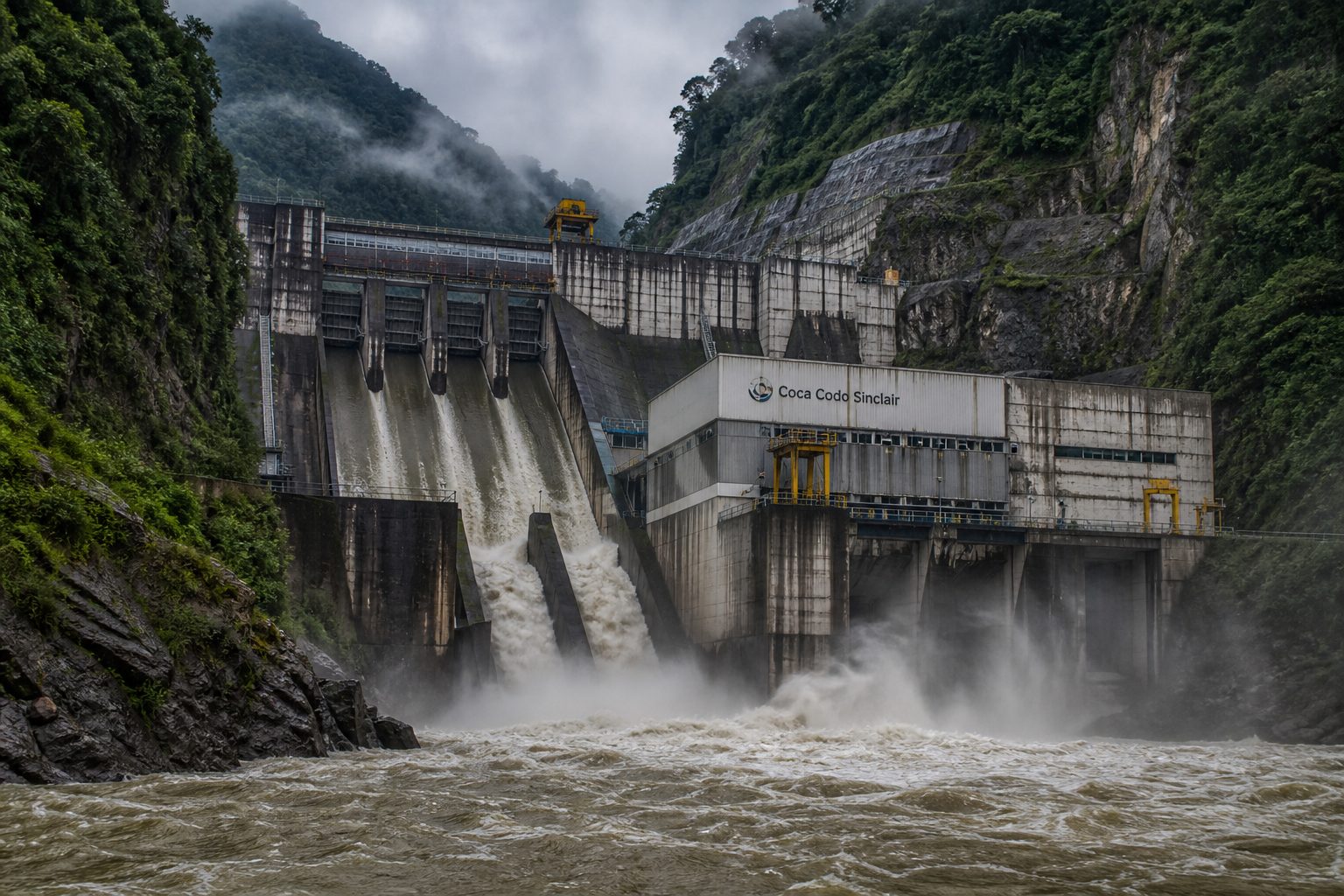
On Friday, August 28, 2026, in a courtroom at Ecuador's National Court of Justice in Quito, a three-judge tribunal ruled that former president Lenín Moreno, 73, was guilty of cohecho: bribery as a public official. His sentence is five years in prison and a permanent ban on holding public office, and he can appeal in a higher court. The case, known in Ecuador as Caso Sinohydro, ties Moreno and his family circle to a corruption network through which roughly $76.1 million in kickbacks flowed from the Chinese state-owned builder of the Coca Codo Sinclair hydroelectric plant, the largest power station ever built in Ecuador, according to the public prosecutor's account as reported by Reuters.
Two failures haunt this project, and the verdict resolves only one of them. The first is financial: a decade-long graft network that prosecutors say ran from 2009 to 2018. The second is physical: thousands of fissures in the steel distributors of a plant that supplies between 20 and 30 percent of Ecuador's electricity, and a river that is eroding its own bed upstream toward the dam. The temptation is to fuse these two stories into one, to say the bribes bought bad steel and the cracks convicted a president. The evidence does not support that. What actually happened is more instructive.
What Coca Codo Sinclair is
Coca Codo Sinclair is a 1,500-megawatt hydroelectric plant on the Coca River, in the Andean foothills northeast of Quito, built by Sinohydro Corporation with financing from the Export-Import Bank of China. It was, according to Latinoamérica Sustentable, the first and largest hydroelectric facility built by China in Latin America, and it began operating in 2016. It sits on the slopes of the active El Reventador volcano, in a basin prone to earthquakes, heavy sediment, and unstable soils.
The plant matters to every factory, hospital, and home on the Ecuadorian grid, which is why its defects became a national security problem rather than an engineering footnote. And the defects were documented early. Welding flaws in the distributors, the curved steel housings that channel pressurized water into the turbines, were identified as early as 2014, before the plant was even inaugurated.
How the bribes moved
The prosecution's case, launched in March 2023, reconstructed a payment architecture rather than a single transaction. According to the attorney general's office, Sinohydro paid approximately $76.1 million in bribes between 2009 and 2018 through fraudulent consulting contracts, a sum equal to about 4 percent of the contracted price of the works, per the Fiscalía's investigation as summarized by Ecuador Chequea.
The money moved through a corporate layer cake. Sinohydro allegedly disbursed funds through Recorsa S.A., incorporated in Panama, and Comercial Recorsa C.A., in Ecuador, and from there through what investigators described as a complex web of domestic and international financial operations, overseas accounts, and shell companies in tax havens. The largest identified destination was a network tied to Ecuadorian businessman Conto Patiño, whose family members, companies, and lawyers allegedly received $58.8 million. More than $1 million allegedly reached the circle around Moreno while he served as vice president from 2007 to 2013.
Moreno's personal take, as described by the court, was almost insultingly modest compared with the headline figure. He did not receive cash, the prosecution argued. He received furniture: $19,342 worth of it, paid by the offshore company INA Investment Corp to the Swiss firm Moinat SA and delivered to an apartment Moreno had registered in Geneva. A second alleged benefit ran through Quito real estate: apartment 12 in the Las Cumbres building, formally bought by Moreno and his wife in 2014 for $225,000. His relatives received bank transfers of various amounts, according to Ecuador Chequea's account of the tribunal's findings.
The judges found that Moreno, trading on his position as vice president, intervened to secure the financing of the Coca Codo Sinclair project. That finding matters for understanding his role. He was not accused of signing the construction contract, which was signed under President Rafael Correa, nor of supervising construction, which Moreno's defense attributed to then-vice president Jorge Glas. The court convicted him as the direct author of bribery for what he did at the financing stage.
What actually convicted Lenín Moreno
The tribunal, composed of judges Manuel Cabrera (the rapporteur), Daniella Camacho, and Julio Inga, convicted Moreno's wife Rocío González, his daughter Irina Moreno González, his sister-in-law Martha González, and his brothers Edwin and Guillermo Moreno as accomplices, sentencing each to two and a half years. Cai Runguo, China's former ambassador to Quito, received five years, Reuters and AFP both reported. Prosecutors had asked for more than six years for Moreno and nineteen other defendants.
"Lenin Moreno's conduct is consistent with the charges brought by the prosecution: the crime of bribery attributed to a public official," Judge Cabrera said in delivering the ruling.
It is worth being precise about the evidentiary mechanism, because the case has acquired a reputation it does not deserve. No encrypted communications were broken. No algorithmic magic untangled the shell companies. The conviction rested on the oldest tools in financial investigation: bank transfer records, corporate registry documents in Panama and Ecuador, invoices, and property deeds. The offshore entity INA Investment Corp had already been dragged into daylight years earlier by Ecuadorian investigative reporters in the leak-based series known as the INA Papers, which exposed the same furniture purchase through Moinat SA that later appeared in the prosecution's file. Forensic accountants followed the layering, one company and one transfer at a time, until the beneficial owners emerged. The paper trail was boring, patient, and sufficient.
Moreno, who returned to Ecuador from Paraguay to face the trial, denied everything. "You're looking in the wrong place. Look at those who signed the contracts, at those who had the habit of demanding kickbacks," he told the court. He argued the case was built by his correísta enemies, that Correa had once promised revenge, and that Correa signed the contract while Glas ran the construction. The tribunal was unconvinced. With the verdict, Ecuador deepened its tally of former presidents convicted of crimes: Rafael Correa, convicted of bribery in 2020, was already on it. The broader roster of convicted former senior officials also includes Jorge Glas, who succeeded Moreno as vice president and was later found guilty in graft cases of his own.
Where this story sits
5 related pieces
Read it →
Hover a story · click to read
 No. 63 · Oct 7, 2026After the Indictment: Three Years of Named Cyber Attributions, Measured
 No. 14 · Aug 26, 2026The Quiet Relay: How China-Linked Hackers Turned IoT Devices Into Espionage Highways
 No. 31 · Sep 3, 2026The Case for Roe v. Wade: What Fifty Years of Evidence Says About Women's Lives
 No. 32 · Sep 5, 2026The East Micronesia Cable Turns Digital Resilience Into Regional Strategy
 No. 65 · Oct 11, 2026Wagner's Sahel Drone War: What Three Years of Evidence Actually Show
The cracks in the powerhouse
The second failure is metallurgical, and it is separately and thoroughly documented, just not in the criminal file.
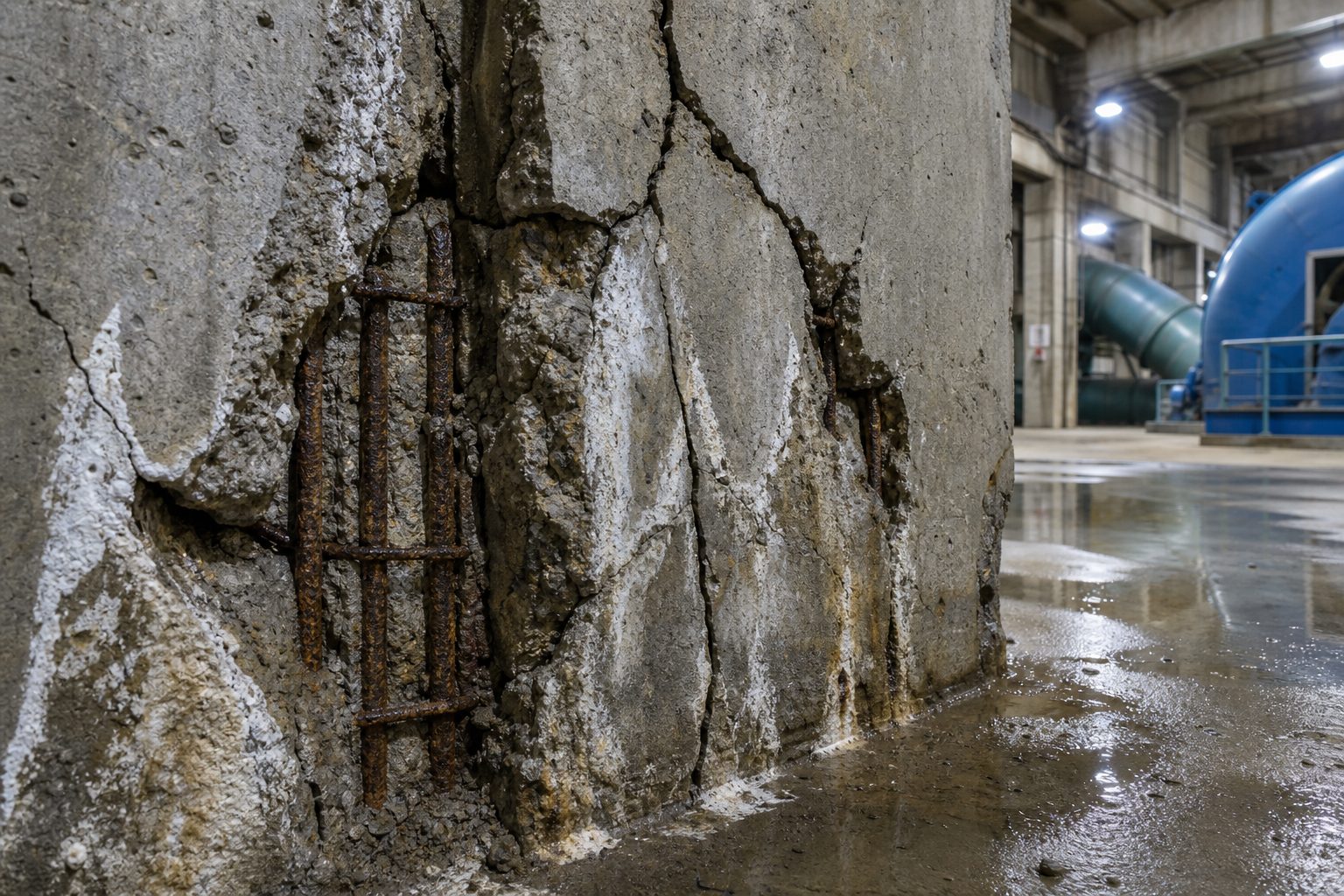
In findings made public in early 2019, Ecuador's Comptroller General (Contraloría) confirmed 7,648 fissures in the plant's eight distributors. The comptroller's report attributed the cracking to two causes: Sinohydro used materials that had not been homologated under the contract, and the company failed to apply proper technical procedures to weld flaws detected in 2014. That forced repair campaigns in 2015 and 2018, without, in the comptroller's judgment, anyone ever determining the cumulative effect of those repeated interventions on the powerhouse, a structure in which the state had invested $1,010.8 million.
Sinohydro argued that its steel, designated Q500D, met an ASTM standard similar to the ASME standard specified in the contract. The comptroller rejected that claim for lack of supporting evidence. Sinohydro and the state utility CELEC then agreed to hire the German inspection firm TÜV to evaluate the distributors, at Sinohydro's expense, a process expected to take about a year.
The physics here is not exotic, and the reader should understand it. Welded steel pressure components in a hydroelectric powerhouse live under constant cyclic loading: water arrives under high pressure, turbines spin up and down, and every weld is a potential weak point. Standard practice calls for qualified weld procedures and post-weld heat treatment to relieve the residual stresses that welding locks into the metal. Skip those steps, or weld steel that deviates from the approved specification, and you create brittle zones where small fissures initiate and then grow under years of pressure cycles. The comptroller's findings on materials and weld procedures, and later reporting on the LAS findings describing omitted heat treatment and non-approved materials, describe exactly that failure pathway.
The count grew over time. A 2022 oversight report cited by the LAS researchers tallied 17,661 fissure detections in the distributors from 2015 through 2022, a cumulative figure that includes cracks that reappeared during repairs. Many were sealed. Others could not be reached, because CELEC had ordered reinforcing concrete poured around generating units 1 through 4, a step the comptroller noted makes the distributors difficult to inspect, repair, or replace. How many fissures remain today is unknown; as the China-Global South Project notes, no technical information about the defects has been made public since the 2021-2022 repair documentation.
Sinohydro representatives maintain the fissures are not consequential for energy production. The comptroller, and numerous independent commentators, raised the possibility that they could trigger flooding or even the collapse of the powerhouse. Ecuador took the dispute to international arbitration in 2021, demanding $580 million.
Did the bribes buy bad steel?
This is the question the case invites, and intellectual honesty requires answering it directly: there is no public evidence establishing that the $76.1 million in kickbacks caused the metallurgical failures, and the cracks played no role in Moreno's conviction.
What the evidence does establish is a project where both the financial controls and the engineering controls failed at the same time, which is its own finding. Earlier feasibility work had pointed to a plant of about 859 megawatts. The design was pushed to 1,500 megawatts in a compressed period, and Sinohydro was selected before the updated studies were finished and before the higher capacity received formal approval, according to reporting on the LAS review. The environmental assessment leaned on decades-old studies and data gathered for an oil pipeline. In a telling design change, Sinohydro removed bottom outlet gates that earlier plans had included to flush coarse sediment through the intake, weakening the plant's ability to manage the Coca River's heavy sediment load.
The China Ex-Im Bank, for its part, approved a high-risk credit in 2010 without updated environmental impact assessments, without evidence of required public consultations, and without environmental or social clauses conditioning disbursements, the LAS report found. The bank's own guidelines called for monitoring; the researchers found no evidence of on-site inspections, required sustainability reporting, or suspended payments even as construction slipped and warnings accumulated. Both the bank and the builder, in the report's formulation, prioritized speed of execution over technical and environmental rigor.
The honest synthesis is that corruption of the procurement process and degradation of the hardware are siblings, not parent and child. A procurement system that can be bought is a procurement system that does not demand rigorous studies, qualified materials, or slow, expensive weld inspections. Prosecutors proved the first failure, transaction by transaction. Auditors documented the second, fissure by fissure. A court has now put a price on one of them.
A river eating its own riverbed
The plant's gravest threat is not in its steel. It is in the water.
In February 2020, the San Rafael waterfall, 19.2 kilometers downstream of the dam, collapsed, and the Coca River began transforming: its bed widening and deepening as regressive erosion chewed upstream toward the plant. The erosion front advanced 2.5 kilometers in 2025 alone and now sits roughly 3.6 kilometers from the dam. If it arrives, it will carve out the riverbed beneath the intake works, leaving the plant unable to generate and vulnerable to collapse. Along the way, the shifting canyon has damaged roads and oil pipelines, contributed to major spills, and driven some residents from their homes.
Whether the plant itself caused or accelerated the erosion is genuinely disputed. The LAS researchers note the possibility that sediment retention by the dam contributed, since a reservoir that traps sediment releases hungry water that scours the downstream bed. Ecuador has worked with the U.S. Army Corps of Engineers to slow the advance. Sinohydro's Ecuador unit has not directly participated in those efforts. And Energy Minister Inés Manzano has been explicit about who will bear this risk under the new arrangement with China: no one, or rather, Ecuador by default. "No one is responsible for the regressive erosion," she said, because the concession terms will not assign it to the Chinese operator.
The handover and the debt that never leaves
On April 17, 2026, nearly a decade after commissioning, Sinohydro formally handed Coca Codo Sinclair over to the Ecuadorian state, closing the arbitration claim in exchange for $200 million in compensation from PowerChina, Sinohydro's parent company, plus another $200 million earmarked for renewable energy investment. The deal, announced by presidents Xi Jinping and Daniel Noboa the previous June, came with a condition: Ecuador accepted the defective asset only because operation and maintenance will be concessioned back to PowerChina under a planned 25-year arrangement at an expected cost of $46 million per year.
CELEC stresses that no final concession has been signed; the government's latest clarification describes an associative management model whose scope and risk allocation remain to be defined. Sinohydro, for its part, stated that the distributor warranties remain in force: "Ecuador retains stewardship, oversight, and the defense of its interests." Minister Manzano insists Sinohydro remains responsible for repairing the fissures and for the risk if they ever cause operational failure. Earlier reports that the company offered to replace the distributors outright have never been officially confirmed.
Read the documented facts a certain way, and an asset like this starts to look like something else: sovereign technical debt. The phrase is an interpretive frame, not a court finding or a rating agency's category, but it fits the documented facts with uncomfortable precision. Ecuador owns a machine whose critical components are embedded in concrete and partially uninspectable. The cumulative crack count includes an unknown number of residual defects. The party best positioned to maintain the equipment is the corporate group that built it and is accused of breaking it, now returning as a paid operator. The single largest environmental risk has been assigned to no one. And the state paying $46 million a year for maintenance is the same state that spent years in arbitration over the defects it is now paying to manage.
The LAS authors point to the Santa Cruz dams in Argentina, Ivirizu in Bolivia, and Rucalhue in Chile as projects where similar questions about studies, structural performance, and oversight deserve attention before the Coca Codo pattern repeats.
What the verdict does and does not settle
The Quito tribunal answered a narrow question with strong tools: it traced furniture to Geneva, an apartment in Quito, and more than a million dollars through Panama and tax-haven shells, and it held a former vice president and president responsible for selling access to a financing process. That is what won the five-year sentence. Not decryption, not crack forensics, not metallurgy. Bank records and deeds.
The dam itself remains an open question wearing concrete. Moreno's sentence can be appealed. The concession terms will decide whether the fissure warranties mean anything in practice, whether PowerChina inherits liabilities alongside revenue, and who stands in front of a collapse scenario the comptroller first raised years ago. Meanwhile, 3.6 kilometers of riverbed separate the Coca River's erosion front from the foundation of a plant that cannot be moved, defended only by engineering works whose success is not guaranteed and whose risks, by the government's own account, remain Ecuador's alone.
Ecuador has now convicted the man who took the money. It has not yet found anyone accountable for the machine.
Sources / References
- Reuters, via The Straits Times, "Ecuador finds ex-President Moreno guilty in hydro plant bribery case," August 29, 2026. https://www.straitstimes.com/world/ecuador-finds-ex-president-moreno-guilty-in-hydro-plant-bribery-case
- AFP, via Yahoo News Canada, "Ecuador sentences ex-president Moreno to five years in jail in bribery case," August 29, 2026. https://ca.news.yahoo.com/ecuador-sentences-ex-president-moreno-034825839.html
- Ecuador Chequea, "Caso Sinohydro: Lenin Moreno y su entorno familiar son culpables de cohecho, según Tribunal," August 28, 2026. https://ecuadorchequea.com/caso-sinohydro-lenin-moreno-y-su-entorno-familiar-son-culpables-de-cohecho-segun-tribunal/
- India Today, "Ex-Ecuador President Lenín Moreno gets five years in Sinohydro bribery case," August 29, 2026. https://www.indiatoday.in/world/story/lenin-moreno-bribery-case-ex-ecuador-president-five-year-sentence-sinohydro-contract-ptag-2982238-2026-08-29
- Latinoamérica Sustentable, "Coca Codo Sinclair: Urgent Lessons from a Project Returning to Chinese Hands — Executive Summary," June 2026. https://latsustentable.org/wp-content/uploads/2026/06/Executive-Summary-CCS-EN.pdf
- Julie Radomski, "China Ecuador Coca Codo Dam Handover Explained," The China-Global South Project / BU Global Development Policy Center, 2026. https://chinaglobalsouth.com/analysis/china-ecuador-coca-codo-dam-risks/
- Techy44, "Ecuador's failing Coca Codo Sinclair hydro plant finally has names attached: a report points at China," OKDiario, August 6, 2026. https://okdiario.com/techy/en/ecuadors-failing-coca-codo-sinclair-hydro-plant-finally-has-names-attached-a-report-points-at-china/7169/
- Contraloría General del Estado (Ecuador), media dossier citing El Comercio, "Contraloría confirma 7.648 fisuras en Coca Codo Sinclair," March 28, 2019. https://www.contraloria.gob.ec/CentralMedios/PrensaDia/21525
Comments (2)
Continue exploring
The Case for Roe v. Wade: What Fifty Years of Evidence Says About Women's Lives
An evidence-first argument that Roe v. Wade delivered measurable health gains, told honestly: what the national data after Dobbs…
The East Micronesia Cable Turns Digital Resilience Into Regional Strategy
Six nations have completed the 2,250-kilometre East Micronesia Cable, wiring Nauru, Kiribati and Kosrae into the global internet…
Wagner's Sahel Drone War: What Three Years of Evidence Actually Show
Russian jets, Turkish drones and untested air defenses have reshaped the war in Mali, Burkina Faso and Niger since 2022, but the…
The ruling seems to settle who profited from the financing without addressing what the plant has become, a structure on an eroding riverbed that still feeds up to 30 percent of Ecuador's grid. I find it hard to call this a resolution when the operational question remains entirely in the hands of engineers rather than judges.
Having audited procurement on three Latin American dams, I can confirm that bribery at the financing stage rarely correlates with welding defects like the ones flagged at Coca Codo Sinclair as early as 2014.