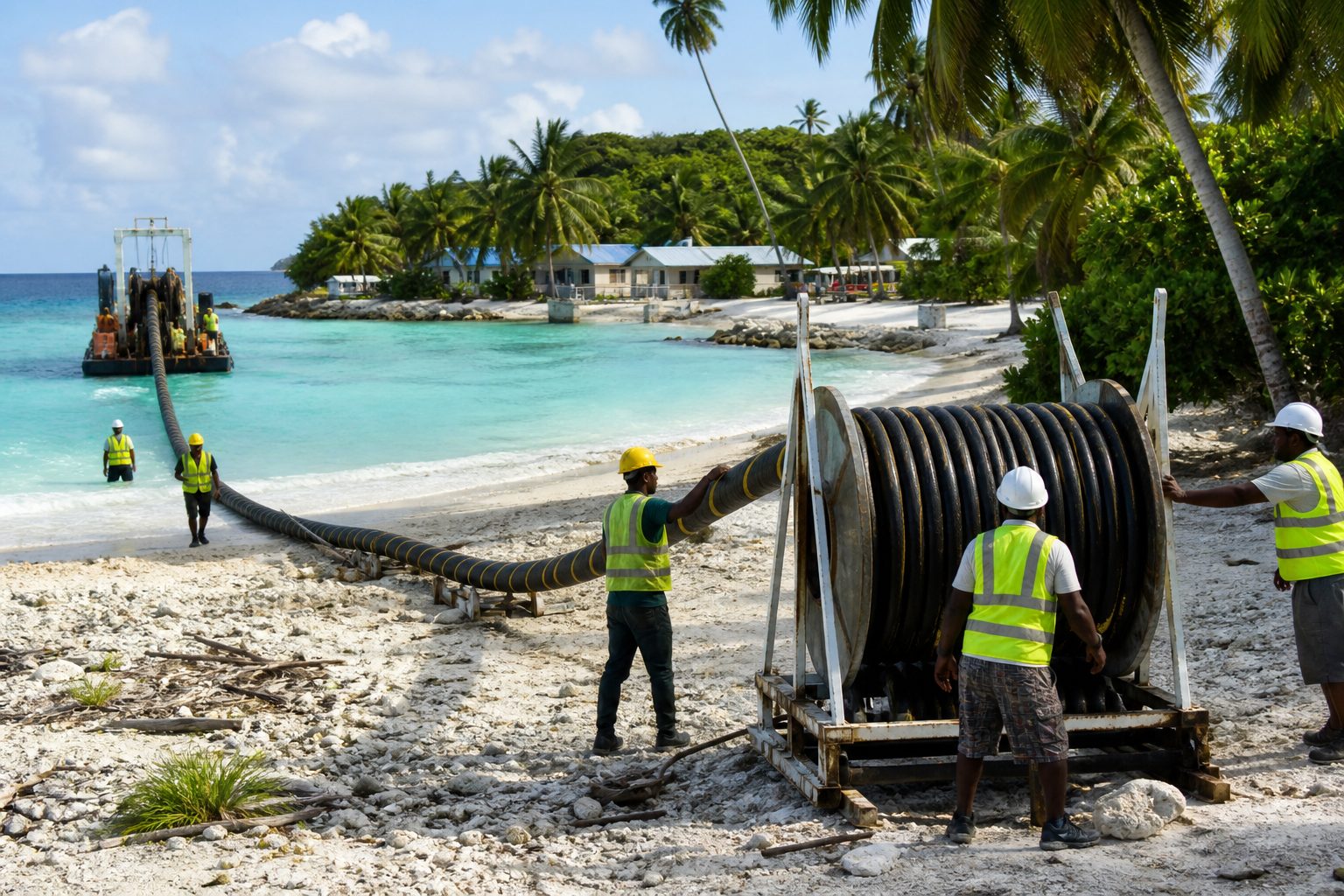
On 1 September 2026, the Australian government announced that a six-nation partnership had delivered the East Micronesia Cable, a 2,250-kilometre submarine fibre-optic system linking Naoero in Nauru, Tarawa in Kiribati and Kosrae in the Federated States of Micronesia to the rest of the world through Pohnpei and Guam. The three communities, home to more than 100,000 people, had relied on satellite links until now. With the system complete, every Pacific Islands Forum member is connected to undersea telecommunications infrastructure for the first time (Australian Government media release).
The milestone is also a strategic instrument, and it was always meant to be. Roughly 99 per cent of the world's digital communications move through submarine cables (European Journal of International Security), and control of those networks has become an arena of state competition. This particular cable exists because an earlier, cheaper bid by a Chinese supplier collapsed after a quiet American diplomatic intervention in late 2020 (Reuters, Submarine Networks), after which Australia, Japan and the United States rebuilt the project themselves with about A$135 million in grant funding, no loans attached (AIFFP). The question now is what the cable actually protects its users from, and which old dependencies it has swapped for new ones.
What six nations just finished building
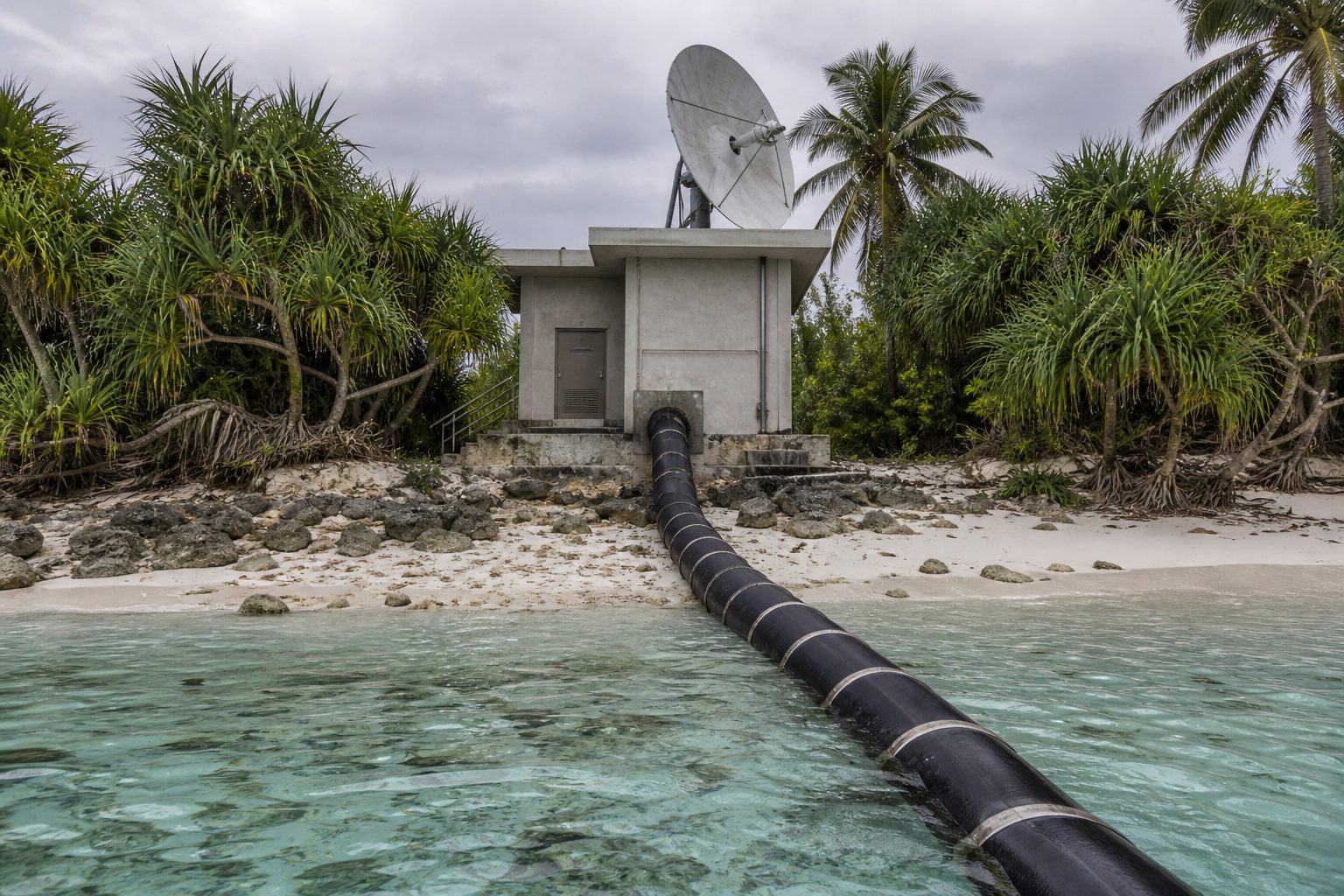
The completed system runs from Tarawa to Pohnpei, with branches to Nauru and Kosrae, and lands at the existing HANTRU-1 facility in Pohnpei for onward connectivity to Guam and the wider internet. It also interconnects with the Chuuk to Pohnpei cable, which spares it a second Pohnpei landing site and adds redundancy to that older system (East Micronesia Cable project site). NEC supplied the cable, and it is jointly owned and operated by three state-linked entities: the FSM Telecommunications Cable Corporation, Kiribati's BwebwerikiNet Limited and the Nauru Fibre Cable Corporation (Submarine Networks).
The engineering is deliberately spare. The network operates on a single fibre pair, with the three countries dividing it through spectrum sharing; each is provisioned at 100 gigabits per second initially, on a system designed to scale to 10 terabits (project site). Cable landing stations, beach manholes and backhaul were built at each landing point. Governance ran through a management committee of the three state operators, an executive board of senior officials from all six governments, and a coordination unit contracted by Australia's infrastructure financing agency.
The money tells the strategic story. Australia contributed approximately A$65 million of the A$135 million (US$95 million equivalent) project cost through the Australian Infrastructure Financing Facility for the Pacific, and the build was funded entirely by grants (AIFFP, media release). The United States committed US$20 million, later adding a further US$2.5 million in September 2023 (Submarine Networks). Implementation began in 2022, and the cable came ashore in stages: Tarawa in July, Nauru on 9 August, and finally Kosrae. NEC declared construction complete in May 2026 (AIFFP, Submarine Networks).
"Improved connectivity enhances the Pacific region's resilience and capacity to respond to economic and security challenges," Foreign Minister Penny Wong said in the announcement. Pacific Island Affairs Minister Pat Conroy framed it as proof that "Pacific nations work together for the benefit of the region" (media release). Both statements are accurate. Neither mentions who was deliberately left out.
The cable that geopolitics sank, then revived
The first attempt to build this cable was a World Bank and Asian Development Bank project worth about $72.6 million. HMN Technologies, the former Huawei Marine, bid more than 20 per cent below rivals including Alcatel Submarine Networks and NEC, and was in a strong position to win (Submarine Networks). Then, in December 2020, the United States sent the Federated States of Micronesia a diplomatic note and warned Pacific governments that a Chinese-built cable posed a security threat. The planned connection to a cable running toward Guam, an American territory hosting substantial military assets, sharpened the alarm; FSM, for its part, has military defence arrangements with Washington under a decades-old agreement (Reuters, Submarine Networks). The island governments hesitated, the tender deadlocked, and the World Bank-led project collapsed without a contract being awarded.
Australia had already established the template for what followed. In 2016, Solomon Islands signed with Huawei to lay a cable to Sydney; Canberra responded by paying for most of the Coral Sea Cable to Papua New Guinea and Solomon Islands itself, a deal that cost Australia about $137 million. The Huawei arrangement would have meant Chinese hardware connected to the backbone of Australia's domestic internet infrastructure, and as Jonathan Pryke of the Lowy Institute put it, "that was seen as a red line that Australia would not cross," so Australia jumped in with a grant-funded alternative delivered by a procurement partner of its own choosing (ABC News).
The Micronesia rerun moved on the same rails. On 12 December 2021, Australia, Japan and the United States announced they would jointly fund the cable, promising faster internet for roughly 100,000 people across the three island states (ABC News). A six-country memorandum followed in July 2022; the three allies signed a final US$95 million funding agreement in June 2023 with NEC as supplier; and by September 2023 the United States had topped up its contribution (AP, Submarine Networks). Associated Press reported the 2023 agreement plainly as a move to counter China's expanding regional influence (AP).
What it means to friendshore the seabed
A paper published in February 2026 in the European Journal of International Security gives the practice a name and a warning. "Friendshoring," a term that emerged during the Biden administration, describes how states encourage firms to shift trade and supply chains toward countries seen as sharing their political values. Applied to cable systems like the East Micronesia Cable, the Coral Sea Cable and the Palau Spur, the authors argue, like-minded states are building collective control of information flows, what the paper calls "network centrality," by excluding "unfriendly" states from seabed network development (EJIS). The same paper dates the intensification of cable anxiety to roughly 2015, as Chinese suppliers expanded under Beijing's Digital Silk Road.
There is a genuine sovereignty gain inside this arrangement. The cable is owned locally through FSM, Kiribati and Nauru corporations rather than by a distant carrier, and the grant structure means no debt overhang. But the system's life cycle still runs through allied capitals: a Japanese supplier, Australian-led financing, and onward egress through an American territory. Data integrity and signals intelligence are part of why control of these networks matters at all (EJIS), and the architecture answers that concern by concentrating access in friendly hands rather than eliminating the leverage that landing points and management systems confer. The lever did not disappear. It changed hands.
The EJIS authors also state the cost of this strategy openly: friendshoring the seabed "contributes to reifying strategic competition and global economy bifurcation." The East Micronesia Cable is, by design, a brick in one bloc's wall.
Where this story sits
5 related pieces
Hover a story · click to read
 No. 41 · Sep 7, 2026Stress-Testing the American Empire: Real Decline or Cyclical Strain?
 No. 37 · Sep 5, 2026U.S. Grid Cyber Rules Are Finally Catching Up With Virtualized Operations
 No. 28 · Sep 3, 2026Norway and Iceland Join GOVSATCOM and IRIS²: Europe Extends Its Secure Satellite Architecture Into the Arctic and North Atlantic
 No. 64 · Oct 11, 2026The ARTEX AI bank hack claim: what South Korea's record actually shows
 No. 33 · Sep 5, 2026U.S.-China AI talks could make autonomous cyberattacks a matter of strategic stability
How much resilience does 2,250 kilometres actually buy?
The resilience gains are substantial and specific. Before this system, Nauru, Tarawa and Kosrae relied on satellite links whose "capacity, speed, cost and reliability fall short of countries' needs," in the AIFFP's own assessment (AIFFP). The cable cuts the risk of telecommunications outages (media release) and gives each country 100 gigabits per second of provisioned capacity on a system that can scale to 10 terabits per second (project site). Its tie-in to the Chuuk to Pohnpei system strengthens that network in return (project site).

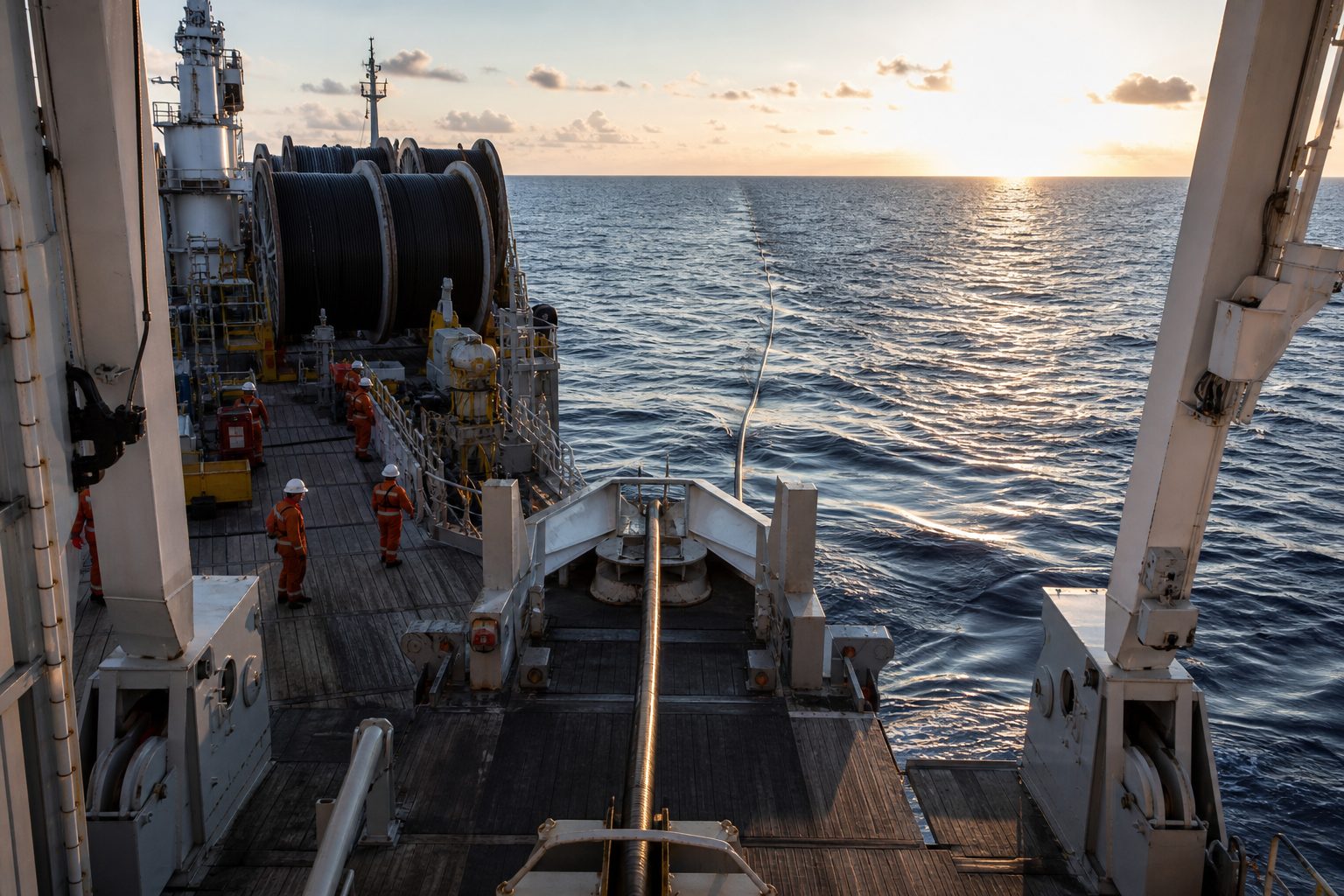
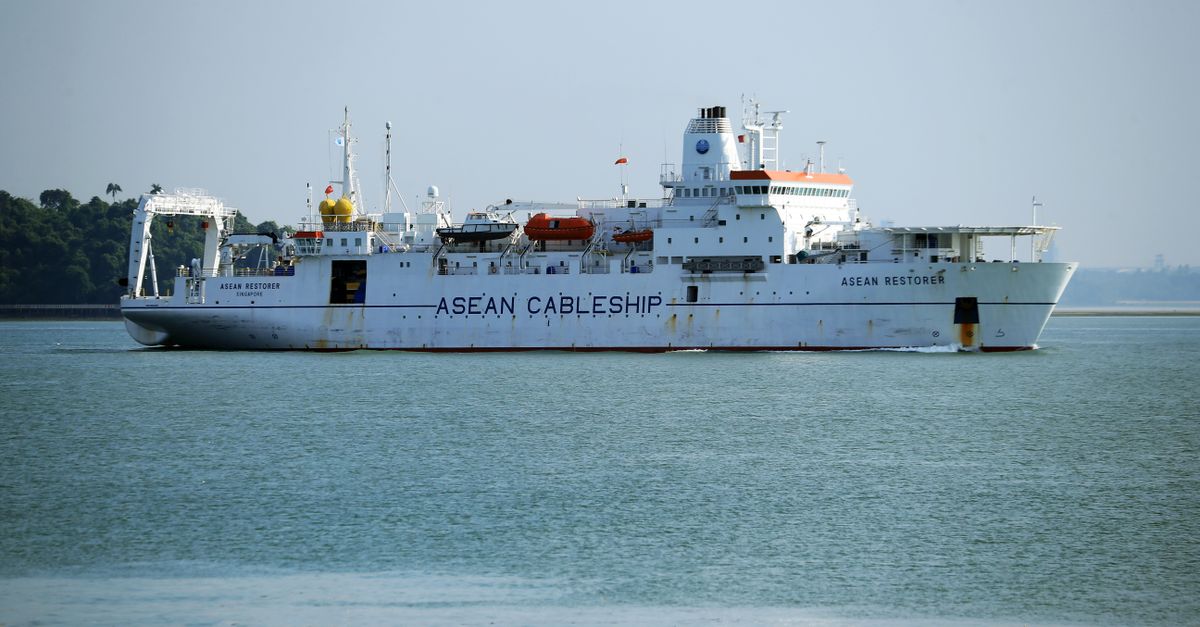
The same specification defines the limits. A single fibre pair and a trunk-and-branch layout mean there is no ring to reroute around: a cut on the wrong segment can isolate every island downstream of the break, and a fault in the shared Pohnpei landing or the HANTRU-1 path toward Guam touches all three countries at once. When that happens, the fallback is the same satellite baseline the project documents describe as inadequate. Restoration then depends on one of a small global pool of specialised repair vessels transiting to a fault, locating it on the seabed, grappling the cable and splicing glass fibres; Pacific operators know from repeated experience, as Tonga's weeks-long outage after the January 2022 volcanic eruption severed its cable demonstrated, that this is measured in weeks, not hours. Each landing station also has to be powered, cooled and physically secured in some of the world's smallest public administrations, where grids and budgets are thin.
There is a market caveat too. When the trilateral funding was announced in 2021, Australian National University researcher Amanda Watson cautioned that a new cable does not by itself guarantee cheaper or faster retail internet, because prices and speeds also depend on local competition, operating costs and commercial operators connecting to the system. Those factors remain in the hands of the three small domestic markets (ABC News).
Who pays to keep the link alive?

The public record is generous on construction and quiet on the decades that follow. The A$135 million covers the build. The published project materials do not detail how ongoing operations, insurance, spare equipment, technical support or future capacity upgrades will be financed for the lifetime of the system (AIFFP, Submarine Networks). Submarine systems routinely carry long-term maintenance agreements with their suppliers, which in this case means NEC, while the owning corporations together serve a combined market of roughly 100,000 people by the project's own count. If maintenance funding ever becomes a negotiation, the three island states will face it from a position of need, and their patrons will hold the pen. That is an inference, but it is the financial structure the announcements describe.
Sabotage, anchors, and the road to Guam
The routine threat has not changed. Cables are damaged constantly by fishing gear, ship anchors, underwater landslides and volcanic activity (EJIS), and the shallow approaches to the new landing points sit in exactly the busy coastal water where that damage concentrates.
The deliberate threat has sharpened, though mostly elsewhere. Two widely reported alleged acts of cable sabotage hit the Baltic Sea in late 2024, and in June 2025 a Taiwanese court convicted the Chinese captain of the Togolese-registered vessel Hong Tai 58 of damaging Taiwan's submarine cables with an anchor, sentencing him to prison (EJIS). Attribution of that kind is rare precisely because anchor-dragging is easy to disguise as negligence. A cable designed in part to be harder for an adversary to touch now draws a bright line, on charts available to anyone, toward a US military hub at Guam (Submarine Networks). The delivery announcement says nothing about surveillance, cable protection zones or patrol responsibilities along the route (media release). For microstates with limited maritime enforcement capacity, deterrence along 2,250 kilometres of open Pacific remains, at best, a work in progress.
The dependency the Pacific chose
Two realities sit side by side. The first is what the ministers said: three island communities now have the fast, reliable connectivity that satellite could not provide, and the Pacific Islands Forum's membership is, for the first time, fully wired into the world's telecommunications backbone (media release). The second is the architecture: locally owned on paper, but financed, engineered and routed through an allied system from whose construction "unfriendly" bidders were deliberately excluded, in a contest the academic literature itself warns is hardening into blocs (EJIS).

The island states understand hedging better than their patrons sometimes assume. Kiribati transferred diplomatic recognition from Taipei to Beijing in 2019; Nauru did the same in January 2024. Both still took the allied cable, because fibre is fibre and grants are grants. Infrastructure alignment, it turns out, can be built to outlast diplomatic posture. Days after the completion announcement, the Australian Financial Review reported that Canberra is investing in a wider web of subsea cables amid what it described as fears of Chinese tracking activity (Australian Financial Review), a sign that the web will keep growing and the dependencies with it.
The East Micronesia Cable is exactly what its architects claim: a genuine resilience asset built where none existed. It is also what it had to be to exist at all: a tether. Whether it stays resilient will be decided not in the launch communiqués but in maintenance budgets that have not been published, repair arrangements that have not been detailed, patrols that have not been announced, and second paths that have not yet been laid.
Sources
- Australian Government, Office of the Minister for Foreign Affairs/Pacific Island Affairs, "Landmark six-nation partnership delivers East Micronesia Cable", 1 September 2026 (also via ministers.dfat.gov.au).
- East Micronesia Cable System, "The Project", official project site.
- Submarine Networks, "EMCS: East Micronesia Cable System", technical and project history.
- Australian Infrastructure Financing Facility for the Pacific, "Improving digital connectivity in the Federated States of Micronesia, Kiribati and Nauru via submarine cable", investment listing.
- Samuel Bashfield et al., "'Friendshoring' the seabed: Securing submarine cables through network centrality", European Journal of International Security, published online 16 February 2026.
- Jonathan Barrett, "U.S. warns Pacific islands about Chinese bid for undersea cable project", Reuters, 17 December 2020.
- "New undersea internet cable for Nauru, Kiribati and the Federated States of Micronesia will be funded by Australia, the US and Japan", ABC News, 12 December 2021.
- Mari Yamaguchi, "Japan, Australia, US to fund undersea cable connection in Micronesia to counter China's influence", Associated Press, 6 June 2023.
- "Australia invests in web of subsea cables amid Chinese tracking fears", Australian Financial Review, 4 September 2026.
Comments (8)
Continue exploring
Norway and Iceland Join GOVSATCOM and IRIS²: Europe Extends Its Secure Satellite Architecture Into the Arctic and North Atlantic
Norway and Iceland are joining GOVSATCOM and IRIS², moving Europe's sovereign secure-satellite architecture into the North…
The ARTEX AI bank hack claim: what South Korea's record actually shows
No South Korean regulator, bank, or security vendor has produced a record of an ARTEX AI intrusion, yet the country's documented…
U.S.-China AI talks could make autonomous cyberattacks a matter of strategic stability
Reuters reports the U.S. and China are preparing a mid-September AI safety dialogue. What it can realistically deliver: an…
The article says the system is designed to scale to 10 Tbps, which sounds reassuring on paper. But having worked on Pacific island telecom rollouts, the bottleneck is almost never the wet plant - it's the landing station power, the backhaul, and the local exchange. If those aren't upgraded in lockstep, the 10 Tbps number is meaningless and the 100 Gbps initial allocation will feel generous within five years.
Here's what worries me about the "no loans attached" framing - grants are great until the cable needs a repair ship. A fault in the middle of that 2,250 km span could cost tens of millions to fix, and there's no way Nauru or Kiribati can absorb that hit. So who's on the hook for maintenance once the initial build budget is spent, and is there actually a funded spares depot somewhere along the route?
One thing the article barely touches: the handover from satellite to fibre is going to create a massive spike in demand that nobody has really planned for. People who never streamed video on satellite because it was impossible will suddenly start, and the local mobile networks in Tarawa and Kosrae are nowhere near ready for that traffic. The cable may technically deliver 10 Tbps but the last-mile experience could actually degrade before it improves if backhaul upgrades aren't sequenced properly.
The article ends mid-sentence about FSM's defence arrangements with Washington, which feels like the most interesting thread it opened. Could there be a follow-up examining how the Compact of Free Association effectively shapes which suppliers are even eligible to bid on projects like this?
The engineering section was the most useful to me, especially the bit about the three countries dividing a single fibre pair through spectrum sharing at 100 Gbps each. I wasn't sure how they'd divvy up capacity without laying a second cable, so that detail clarified a lot.
I lived in Tarawa for two years and the satellite link was exactly as bad as the article suggests - by evening it was unusable for anything but email. This cable is going to be transformative there.
The line about the cable being "a strategic instrument, and it was always meant to be" does a lot of heavy lifting in framing the entire project.
Calling this a "regional strategy" stretches things - a 100 Gbps link shared by 100,000 people isn't going to deter anyone. What actual evidence shows this cable shifts the strategic balance rather than just adding redundancy?