
On 26 March 2026 in Brussels, the European Union signed secure-connectivity agreements with Norway and Iceland, giving both countries entry into GOVSATCOM, the EU's pooled secure satellite communications service, and the IRIS² Secure Connectivity Programme, the multi-orbit constellation Europe is building for the rest of the decade. The European Commission's DG for Defence Industry and Space announced that the EU's GOVSATCOM service has been operational since January 2026, and Euractiv reported that the two Nordic states are the first non-EU countries to join IRIS².
The weight of the deal is geographic as much as institutional. It pushes Europe's sovereign satellite-communications architecture into the Arctic and the North Atlantic, a region where subsea cables, satellite ground stations and early-warning radars now function as frontline security infrastructure. The people affected are the users of governmental satellite services: defence forces, coast guards, emergency responders, climate and environmental agencies, and public authorities responsible for remote northern communities, shipping and aviation.
Four questions determine whether the agreement matters in practice: what it does to communications resilience, how it distributes governance power, how Norwegian and Icelandic equipment and users interoperate with the EU system, and how much strategic autonomy the effort actually buys Europe. The evidence supports real gains on the first count, and far more constrained answers on the other three.
What are GOVSATCOM and IRIS²?
GOVSATCOM: pooling secure capacity that already exists
GOVSATCOM is not a new constellation. It is a component of the Union Space Programme, established by Regulation (EU) 2021/696, that pools and shares secure satellite communications capacity drawn from existing national and commercial systems and makes it available to authorized government users with security guarantees. The Commission describes it as securing Europe "from ground to space", and states it has been operational since January 2026. In practice it serves government and crisis-management users: secure government operations, disaster response, climate monitoring and environmental protection, with the Commission adding that improved connectivity should also benefit remote communities, including access to healthcare, and support safe air and maritime navigation.
IRIS²: a new constellation with 2030 targets
IRIS², short for Infrastructure for Resilience, Interconnectivity and Security by Satellite, is far more ambitious. Established by Regulation (EU) 2023/588 for the 2023–2027 period, the system is built on more than 290 satellites in low- and medium-Earth orbit, set to enter service in 2030, funded through a public-private partnership blending the EU budget, member-state contributions, European Space Agency programmes and private capital. Its official factsheet lists Arctic region coverage explicitly, alongside governmental use cases ranging from crisis management and maritime emergencies to institutional communications and telemedicine. It also designates the system as a reinforcement of terrestrial networks, "an alternative in cases of disruptive events," and describes integration of the European Quantum Communication Infrastructure (EuroQCI) for secure transmission of cryptographic keys. Euractiv frames the programme as a European alternative to Starlink.
The distinction between the two programmes drives everything else about this agreement. GOVSATCOM is a service running today. IRIS² is a bet on 2030.
Why can't ordinary satellites cover the High North?
The answer is geometry. Most long-standing satellite communications rely on geostationary orbit, where satellites parked 35,786 km above the equator appear fixed in the sky. The NATO-aligned Joint Air Power Competence Centre documents that such architectures suffer line-of-sight limitations above roughly 65 degrees north latitude: the satellite sits low on the horizon, and the enormous distance adds latency. Above the Arctic Circle, the backbone of global satellite communications simply thins out.
The workaround is inclined and elliptical orbits. Norway helped prove the concept before IRIS² existed. The Arctic Satellite Broadband Mission, launched on 11 August 2024, flies two satellites in highly elliptical orbits, each of which loiters high over the northern hemisphere near the far end of its path, so that two phased spacecraft can keep the High North covered around the clock. Built by Northrop Grumman for Space Norway in partnership with the US Space Force, the mission carries an X-band payload for the Norwegian Armed Forces, a commercial Ka-band payload for Viasat, and, in a first, a protected US government military communications payload integrated onto an internationally operated commercial satellite.
The vulnerability picture is not only orbital. Iceland depends on three submarine internet cables for its connectivity, and its ambassador to the EU described IRIS² as of "enormous importance" because it provides a backup for those cables, he told Euractiv. An April 2026 expert survey published by the Institute for Security and Development Policy found that Arctic specialists across industry, policy, academia and defense view satellite-enabled systems as essential for northern operations, particularly hybrid multi-orbit architectures, while rating undersea cables and other fixed infrastructure as the most exposed link in the chain. The same survey urges governments to treat cables, landing points and ground stations as critical infrastructure.

This is the doctrinal core of the agreement. Resilience in the High North is no longer defined by any single cable, orbit or provider. It is defined by redundancy across all three.
What kind of membership did Norway and Iceland just buy into?
The answer matters, because it is narrower than membership in almost any other European club. The EU–Norway agreement text, published by the Council of the European Union in February 2026, makes the terms explicit. Norway becomes a GOVSATCOM participant and a Secure Connectivity participant "in so far as it authorises GOVSATCOM users and Union Secure Connectivity users of governmental capacities, or provides satellite communication capacities, ground segment sites or part of the ground segment facilities."
Then comes the clause that defines the politics: "This Agreement shall not confer on Norway any decision-making power" in either programme, and it does not affect the programmes' legal framework or institutional structure, which remain established by EU law. The ultimate security lever stays in Brussels as well: under Council Decision (CFSP) 2021/698, acting through Article 35 of the Space Regulation and Article 31 of the Secure Connectivity Regulation, the Council and the High Representative retain responsibility for responding when the system's operation threatens the security of the Union or its member states.
Norway's financial contribution flows through a separate EEA Joint Committee decision amending Protocols 31 and 37 of the European Economic Area agreement, and the document recognizes that Norway already participates in the Union Space Programme. The security plumbing for classified information is older still, anchored in a Norway–EU security of information agreement signed on 22 November 2004 and security arrangements agreed a month earlier.
According to Euractiv, Norway and Iceland are expected to contribute about €40 million and €3 million respectively to IRIS² for 2026–2027, with future amounts to be negotiated after the EU's 2028–2034 budget is settled. Iceland closed its negotiations in July 2025 but waited for Norway to finish its own talks before both signed.
Read plainly, this is a rule-taker arrangement in the established EEA pattern: pay in, plug in, follow the common rules, and leave the formal decisions to member states. For Oslo and Reykjavik the trade is access to a sovereign European capability they could not build alone. For the EU it brings Nordic geography, infrastructure and money inside the programme's perimeter without diluting institutional control.
Where this story sits
5 related pieces
Read it →
Hover a story · click to read
 No. 68 · Oct 14, 2026Where Will North Asia Find Enough Electricity to Power Its AI Boom, and Who Will Pay the Price?
 No. 34 · Sep 5, 2026Can a Satellite Network Be Sovereign if SpaceX Owns It? Hungary's 4iG Deal Will Test the Answer
 No. 39 · Sep 6, 2026Isar's Spectrum Reached Orbit. The Test of European Space Sovereignty Starts Now.
 No. 2 · Aug 25, 2026NGINX and the Architecture of the Modern Web
 No. 36 · Sep 5, 2026The Army Is Turning Military Land Into an AI Compute Platform
How do users, satellites, and ground stations actually plug in?

The agreement's own categories show the machinery. A participating country can do three concrete things: authorize its governmental users, provide satellite communication capacities, and provide ground segment sites.
The first is administrative and rides on the 2004 classified-information framework. The second is where Norway's existing assets become interesting: the agreement expressly permits a participant to provide capacity, and Norway operates exactly the kind of High North capability, the elliptical-orbit ASBM system, built to close the coverage gap that geostationary satellites leave above 65 degrees north. Whether Norway will contribute national capacity to GOVSATCOM has not been announced; the agreement creates the channel, and nothing more can be said with confidence.
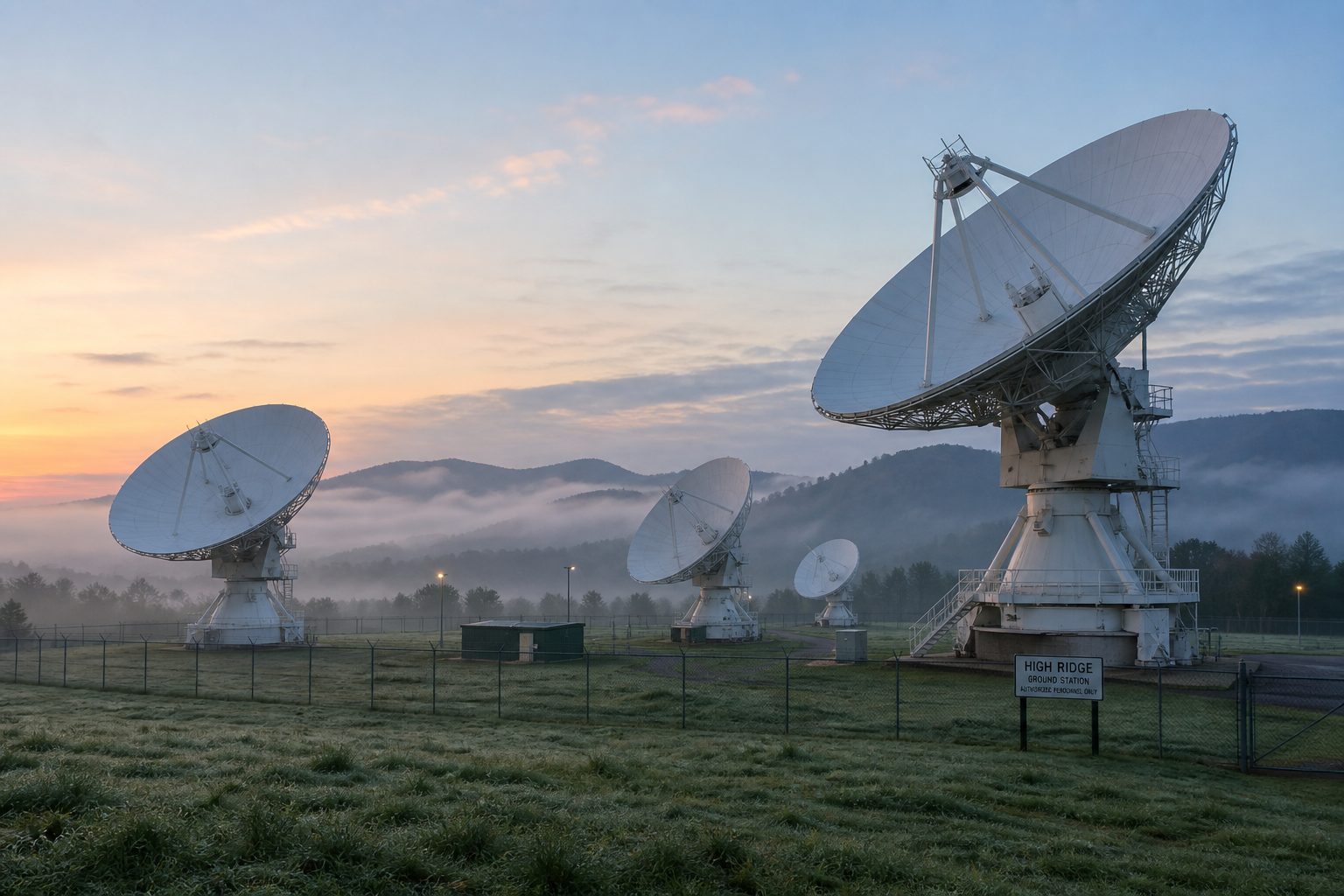
The third category is where Norwegian geography is decisive. Kongsberg Satellite Services operates what JAPCC describes as the world's largest satellite ground station on Svalbard, an archipelago halfway between mainland Norway and the North Pole whose latitude maximizes line of sight to satellites passing overhead in highly inclined orbits. A multi-orbit European constellation needs exactly this kind of northern ground segment, and the agreement creates a common framework through which it could be provided.
Interoperability also runs through encryption and design philosophy. IRIS²'s official factsheet commits to EuroQCI integration for quantum-secured key transmission, capacity to host additional non-communication payloads, and relay functions for Galileo and Copernicus data. The ASBM mission demonstrated the complementary pattern from the defense side: as Northrop Grumman's Blake Bullock put it, that flight marked the first time a secure US government military communications payload had been integrated onto a commercial satellite, "let alone with an international partner", using a secure payload interface that effectively isolates military capability from everything else aboard.
The expert consensus points the same direction. The ISDP survey found that specialists expect the Arctic communications environment to be neither fully integrated nor fragmented, but selectively shared among like-minded states, with mission-specific data sharing for functions such as search and rescue, vessel monitoring, environmental response and civil contingency coordination rather than wholesale system integration. The Norway–Iceland arrangement matches that forecast almost feature by feature: governmental services shared, commercial functions separate, military payloads compartmented.
Does this make Europe more strategically autonomous?
It improves Europe's options. It does not create autarky, and one unresolved tension sits at the heart of the programme.

The autonomy case is direct. Bringing two NATO allies that are not EU members into a sovereign European constellation reduces the need to lean on non-European providers for governmental communications, and it does so in the region where the need is sharpest. Norwegian minister Cecilie Myrseth called the signing "a significant step towards bringing Norway closer to EU's work on security, resilience and technological independence in space," adding that the need for European autonomy is continuously growing. Commissioner Kubilius said access to both programmes "will reinforce the response by Iceland and Norway to security and economic challenges while strengthening Europe's global position." The accession also sets a template: Kubilius told Euractiv last year that he favours Ukraine joining IRIS² as well.
The complication is that Europe's member states are quietly hedging against the very programme the Nordic countries just joined. Euractiv reports that IRIS², targeting full operations by 2030, faces delays and uncertainty after the German military announced it will build a national €10 billion constellation of its own. Kubilius acknowledged the strain at the signing: "Of course we need to look how we integrate new developments of sovereign constellations." If Europe's largest member builds a sovereign national system in parallel, the scale economics and coherence of the shared programme weaken, and "European autonomy" starts to mean two different things in Berlin and Brussels. That tension was live in March 2026 and remains unresolved as of September 2026.
There is a second, quieter layer. Norway's own Arctic satellite system was built with the US Space Force and carries a protected American military payload. The United States operates missile-warning radars at Pituffik in Greenland, a location chosen during the Cold War because it sits roughly halfway between Moscow and New York. The architecture taking shape across the North Atlantic is therefore less a wall than a set of interlocking, partially overlapping networks among like-minded states. Measured against ISDP's finding that activity along the Northern Sea Route is rising, including growing Chinese commercial shipping linked to Russian energy exports, that layering looks less like indecision than deliberate strategy: no partner needs to depend on any single cable, orbit or ally, and each adds a layer to the whole.
What changes now, and what has to wait until 2030?
The near-term gains flow through GOVSATCOM, which has been operational since January 2026. Norway and Iceland now have a legal basis to grant their governmental users access to pooled European secure communications, and the Commission's stated benefits, crisis management, disaster response, climate monitoring, secure government operations and protected navigation, are available services rather than targets. The expected 2026–2027 contributions are about €40 million from Norway and €3 million from Iceland.
The structural gains wait on IRIS². The constellation is set to enter service in 2030, and its Arctic coverage, EuroQCI encryption and commercial broadband do not exist until then. Future Nordic contributions depend on the EU's next long-term budget. The German national constellation question must be answered by member states, not negotiators. And the governance asymmetry is permanent by design: the agreement that grants Norway and Iceland their seats at the table also states, in writing, that participation confers no decision-making power in how the system is run.
What does this add up to across the North Atlantic?

The March signing is best understood as one act in a wider redundancy build-out. Europe's position in the Arctic has shifted from "High North, low tension" assumptions toward the premise JAPCC cites from a high-ranking NATO official: that the mantra no longer holds, with Russia re-opening Soviet-era Arctic bases, deploying nuclear submarines beneath the polar icecap during the 2024 Ocean 24 exercise, and conducting joint patrols with China. In that setting, subsea cables fail, geostationary links fade north of 65 degrees, and single providers become single points of failure. The EU's answer is a layered network of pooled capacity today and a sovereign multi-orbit constellation by 2030. Norway and Iceland's answer is to be inside that layer, even without a vote over it.
Whether the arrangement delivers will be decided by execution: whether IRIS² launches on anything close to its 2030 schedule, whether the next EU budget sustains its funding, whether Berlin's national constellation complements or cannibalizes the shared system, and whether two Nordic democracies remain comfortable as paying participants rather than governing members. The wiring diagram for resilience in the North Atlantic now includes Svalbard, Reykjavik and Brussels on the same page. Drawing the diagram was the easy part. Energizing it is the test.
Sources/References
- European Commission, DG for Defence Industry and Space — "EU boosts space cooperation with Norway and Iceland with Secure Connectivity Agreement" (26 March 2026)
- Council of the European Union — ST 5371/26: Agreement between the European Union and the Kingdom of Norway on participation in GOVSATCOM and the Union Secure Connectivity Programme (6 February 2026)
- Euractiv — "Iceland and Norway join EU's Starlink competitor, IRIS2" (March 2026)
- European Commission, DG for Defence Industry and Space — "EU GOVSATCOM: Securing Europe, from ground to space" (26 February 2026)
- European Commission — "IRIS²: Infrastructure for Resilience, Interconnectivity and Security by Satellite" factsheet (September 2025)
- Joint Air Power Competence Centre — "High Above the High North: Resilient Satellite Communications for the Arctic" (Journal Edition 39, May 2025)
- Breaking Defense — "Closing the Arctic High North communications gap" (28 January 2025)
- Institute for Security and Development Policy — "Expert Perspectives on Arctic Communications: Resilience, Infrastructure Vulnerability, and Selective Interoperability" (April 2026)
Comments (9)
Continue exploring
Isar's Spectrum Reached Orbit. The Test of European Space Sovereignty Starts Now.
Isar Aerospace's Spectrum finally delivered satellites to orbit from Norway, proving a private European rocket can fly. The…
NGINX and the Architecture of the Modern Web
The problem hiding behind a successful page load A browser requests a page. Before the application can answer, something must…
The Army Is Turning Military Land Into an AI Compute Platform
Carlyle and CyrusOne won exclusive negotiations to build commercial hyperscale data centers on roughly 2,600 acres of Army land…
The recommendation to treat IRIS² as a credible resilience layer for Iceland's three-cable dependency assumes a ground-station footprint the article does not discuss, and if the ground segment clusters in a few sites the satellite backup inherits a different single point of failure.
One thing the article kind of glosses over is what happens if Norway or Iceland pulls out of the arrangement, or if domestic politics shift on EU-adjacent defence procurement. Both are NATO members with their own sovereign satellite ambitions, and Space Norway is literally the operator of ASBM, so the agreement sits on top of pre-existing bilateral arrangements with the US rather than in a clean EU-only lane. That layering is not really unpacked in the piece, and it matters a lot for who actually owns the operational picture day-to-day.
Europe's northern satellite push is real on paper but mostly a 2030 promise, so anyone planning High North comms resilience today should still treat cable and inclined-orbit capacity as the operational baseline.
The argument that Iceland's three submarine cables make IRIS² strategically decisive deserves more pushback, since a satellite backup does not resolve the routing diversity problem those cables exist to address.
I'm skeptical of the implied confidence in the 2030 IRIS² service date. The article itself acknowledges this is a "bet on 2030," but does not cite any programmatic evidence to support the timeline. Schedule slippage on multi-orbit constellations is well documented in the commercial sector, and a public-private partnership blending EU budget, ESA programmes, member-state contributions, and private capital adds coordination overhead that historically slows delivery. What specific milestones or gateway reviews has the Commission committed to between now and first launch? Without those, treating 2030 as a planning baseline rather than a hope seems wiser.
A follow-up on how the EuroQCI integration is supposed to work inside IRIS² would be welcome, since the factsheet lists cryptographic key transmission as a use case but offers no detail on whether it piggy-backs on existing terrestrial EuroQCI links or requires new satellite-specific key distribution.
I agree with the article's point about subsea cable vulnerability being a structural driver here, and from our work on North Atlantic infrastructure we have seen Icelandic operators treat any single-cable failure as a realistic scenario rather than a tail risk.
The phrase "from ground to space" lands as marketing, but the operational reality described in the rest of the article is far narrower than that implies.
The "Why can't ordinary satellites cover the High North?" section was the most useful for me, because the breakdown of why geostationary satellites at 35,786 km fail above roughly 65 degrees north finally made the connectivity gap concrete rather than abstract. The Arctic Satellite Broadband Mission example also lands well as proof that inclined and elliptical orbits work, and the X-band, Ka-band, and US military payload split illustrates how layered the actual architecture has to be.