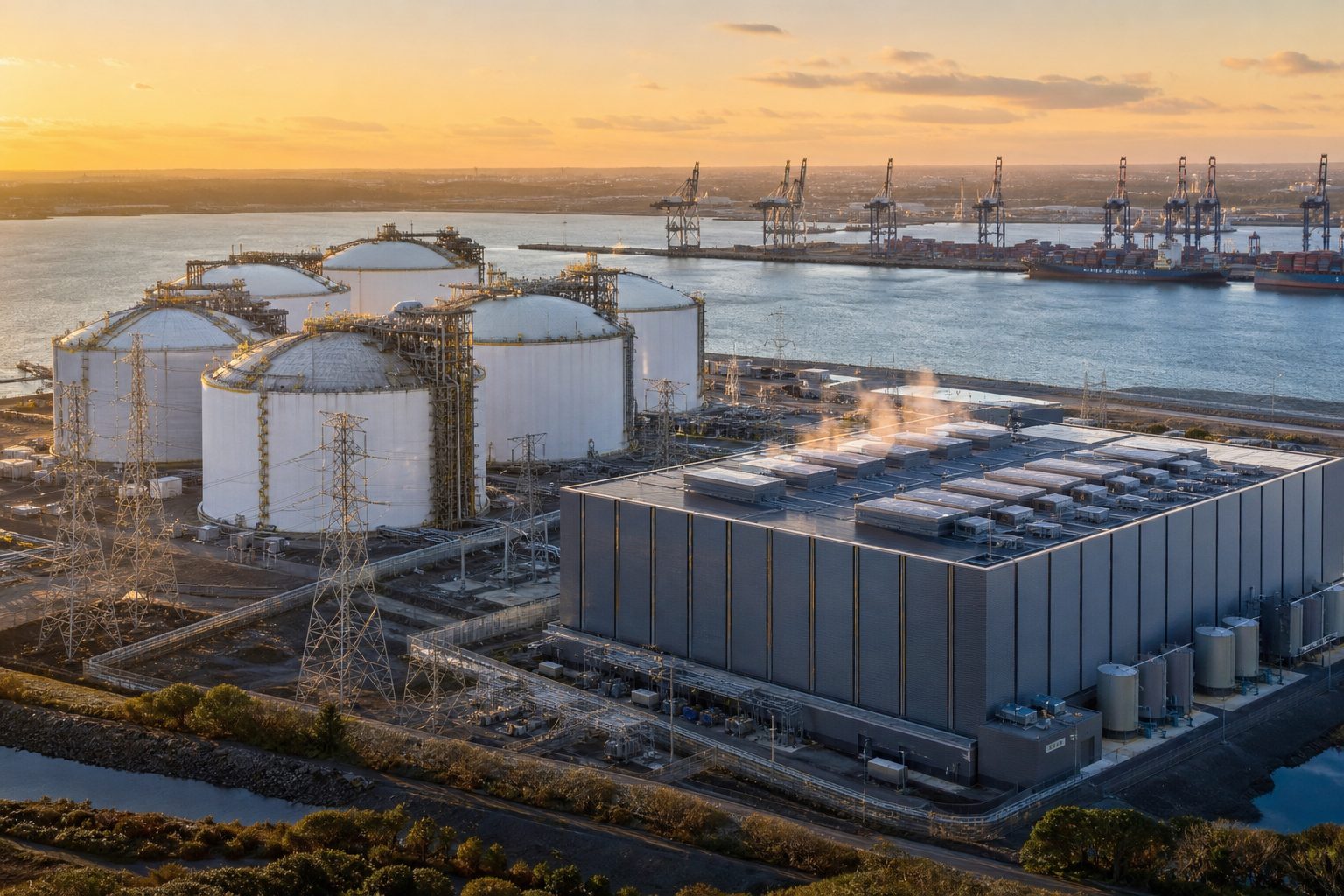
In June 2025, Amazon Web Services announced a roughly five-billion-dollar AI data-center campus in Ulsan, the heavy-industry port on South Korea's southeast coast [1]. The site came with an unusual landlord: SK Gas, a fuel and power company whose liquefied natural gas infrastructure already occupies the land. AWS did not pick the waterfront for the view. It picked it because the electrons were already close.
That single siting decision is the story of this article in miniature. Japan, South Korea and Taiwan all want to host the next wave of AI computing, and for the most part the capital, the chips and the submarine cables are ready. The binding constraint is electricity, and more precisely the wires that carry electricity to where the machines want to sit. If roughly ten gigawatts of new AI load lands in North Asia this decade, the question that decides who gets it is not who has the most power. It is who can move that power to the data centers without quietly adding the cost to other people's bills.
There is already a price tag on getting this wrong. In July 2024, PJM, the grid that serves Northern Virginia's Data Center Alley and 65 million people across 13 states and the District of Columbia, held its annual auction for generation capacity. The clearing price rose more than ninefold, from $28.92 to $269.92 per megawatt-day, and the region's capacity bill went from about $2.2 billion to $14.7 billion for a single delivery year [3]. Retail customers across the footprint are paying that. Asia now gets to decide whether to repeat the experiment or design a better one.
What ten gigawatts means on three grids
Start with the machine. A rack of current-generation AI servers draws well over 100 kilowatts, roughly ten times a conventional server rack, and campuses now being proposed are sized in hundreds of megawatts, with the largest projects reaching gigawatt scale [2]. The United States shows what happens when this lands at full speed: data centers consumed about 176 terawatt-hours there in 2023, or 4.4 percent of the country's electricity, and the Department of Energy's Berkeley Lab projects between 325 and 580 terawatt-hours by 2028, which would be 6.7 to 12 percent of the total [2]. North Asia is bidding to host part of the next tranche.
Ten gigawatts is a yardstick, not a forecast. It is the order of magnitude of the campus pipeline already under discussion across the three economies, and it is a useful one because it is large enough to strain every system in the region.
- Japan's system peaks around 160 gigawatts. Ten is roughly 6 percent of it.
- South Korea set an all-time peak near 95 gigawatts in 2024 [15]. Ten is roughly a tenth.
- Taiwan peaks around 40 gigawatts. Ten is a quarter of the island's all-time maximum.
One caution belongs here: interconnection queues inflate. PJM's own analyses treat a large share of early-stage data-center requests as speculative until construction milestones are signed [5]. Announcements are intent, not steel. But even discounting the queues heavily, the direction is unambiguous, and the timing is hostile. A campus goes from announcement to power draw in two to four years. A major transmission line or a power plant takes a decade.
What happened when Virginia plugged in first
Northern Virginia is the densest data-center market on earth. By late 2024 Dominion Energy, the incumbent utility, was telling regulators it had tens of gigawatts of potential data-center connections in its study pipeline, figures that had roughly doubled between filings [6]. PJM's long-term forecast expects its summer peak to grow on the order of 40 percent by the mid-2030s, with data centers accounting for most of that growth [5].
The mechanism that turned those requests into household costs is worth understanding, because Asia is about to build versions of it. PJM runs an annual capacity auction: generators are paid, per megawatt-day, simply to be available years in advance. It is insurance, priced early. When demand forecasts jump and old plants retire, the premium jumps with them. The July 2024 auction for the 2025/26 delivery year cleared at $269.92 per megawatt-day [3]. The July 2025 auction cleared at $329.17, the ceiling its rules allowed, after regulators, under political pressure, had already approved price collars for the auctions that follow [4]. Capacity costs sit in the supply line of retail bills across the region.
The states hosting the load are now rewriting who pays. In early 2025 Ohio's utility commission approved a tariff for AEP Ohio, the utility serving Columbus's data-center corridor, requiring very large new data centers to pay for at least 85 percent of their contracted capacity for up to twelve years, even if they use less, with exit penalties attached [7]. The principle is simple: if you cause a wire to be built, you guarantee the mortgage. The order remains contested, but it is being copied in other dockets.
Texas took a different route because it runs a different market, an energy-only system with no capacity auction. ERCOT's interconnection queue for very large loads passed 100 gigawatts and kept climbing, and its 2025 planning scenarios sketch early-2030s summer peaks well above 150 gigawatts in the higher cases, against an all-time record in the mid-80s [8]. In 2025 the legislature passed Senate Bill 6, which requires new loads above 75 megawatts to be curtailable in grid emergencies and to carry a fairer share of the transmission costs they trigger [9].
The generation side is being re-plumbed too. In late 2024 the Federal Energy Regulatory Commission rejected, on a 2-1 vote, a request to let an Amazon data-center campus draw up to 480 megawatts directly from the Susquehanna nuclear plant, after a fight over whether co-located load should bypass the market [10]. In spring 2025 the Department of Energy invoked emergency authority to keep the J.H. Campbell coal plant in Michigan running past its planned retirement, citing grid strain, and similar orders followed for other aging fossil units [11].
Two lessons travel from all this. First, demand moves faster than wires, which means the grid you have in the next three years is the grid that prices your AI bid. Second, if cost allocation is not settled in advance, it settles itself, on whoever cannot leave the grid.
Japan's electricity sits in the wrong half of the country
Japan's problem is structural and a little strange: it has two grids that barely speak. Eastern Japan runs at 50 hertz, western Japan at 60, a legacy of equipment bought from Germany and the United States in the 1880s. Three frequency-converter stations can move about 1.2 gigawatts between the halves, roughly one nuclear plant's worth of trade across the world's fourth-largest economy [12].
Flat demand let Japan defer the wiring question for two decades. The 2020s ended that. In January 2024 a cold snap coincided with a cluster of plant outages, and the Tokyo area came close enough to its limit that officials issued a new-style conservation alert and asked households to cut use [12]. Then, in February 2025, the cabinet approved the 7th Strategic Energy Plan, which projects electricity demand rising again, to between roughly 1.0 and 1.2 trillion kilowatt-hours by 2040 against about 950 billion today, with AI and semiconductor plants named among the drivers. The plan's answer is a mix of roughly 40 percent renewables and 20 percent nuclear by 2040, with more than a dozen reactors back online since the Fukushima shutdowns and more in licensing [13].
The catch is geography. Tokyo holds the majority of Japan's existing data centers and nearly all its latency-sensitive markets. Much of the cheap, firm power, restarted nuclear in the west, Hokkaido wind, Kyushu solar, sits on the far side of the converter stations. So Japan is doing something unusual for it: moving the demand. The industry ministry's GENIAC program has subsidized domestic AI infrastructure at up to half of capital cost, including Sakura Internet's AI campus in Ishikari, Hokkaido, next to the wind and the cold air that cuts cooling costs [14]. A 2025 policy outline for the AI era pairs that with a "priority supply" framework, letting a large data center pair directly with a new local generator outside the general connection queue, and with queue reforms that impose deposits and staged screening on speculative requests [14].
On the wires themselves, OCCTO, the cross-regional coordinator created after Fukushima, has approved a record transmission program: multi-trillion-yen spending over roughly a decade, new high-voltage DC lines including routes to move Hokkaido power south, and a government goal of roughly doubling inter-regional transfer capacity by the 2040s [12]. Those lines arrive in the early-to-mid 2030s. Nothing before that.
Who pays? Japan socializes grid costs nationally, so the reinforcement that lets Hokkaido electrons reach Tokyo is recovered through charges spread across ratepayers everywhere [12]. That design was meant for public goods like post-earthquake resilience. It now also underwrites private AI campuses. And Japanese households entered this decade already angry about electricity, after regulated rates rose by double digits in 2022 and again in 2023 during the fuel crisis. Adding industry to that bill is politically unforgiving, which is why the queue reforms and minimum-commitment rules matter as much as the megawatts.
The verdict: Japan can host several gigawatts of AI load this decade, but mostly in the north and south, not in the Tokyo metro. The full buildout waits on DC lines still in approval.
Where this story sits
5 related pieces
Read it →
Hover a story · click to read
 No. 69 · Oct 14, 2026Could AI Power the Next Major Bank Cyberattack? Lessons From South Korea
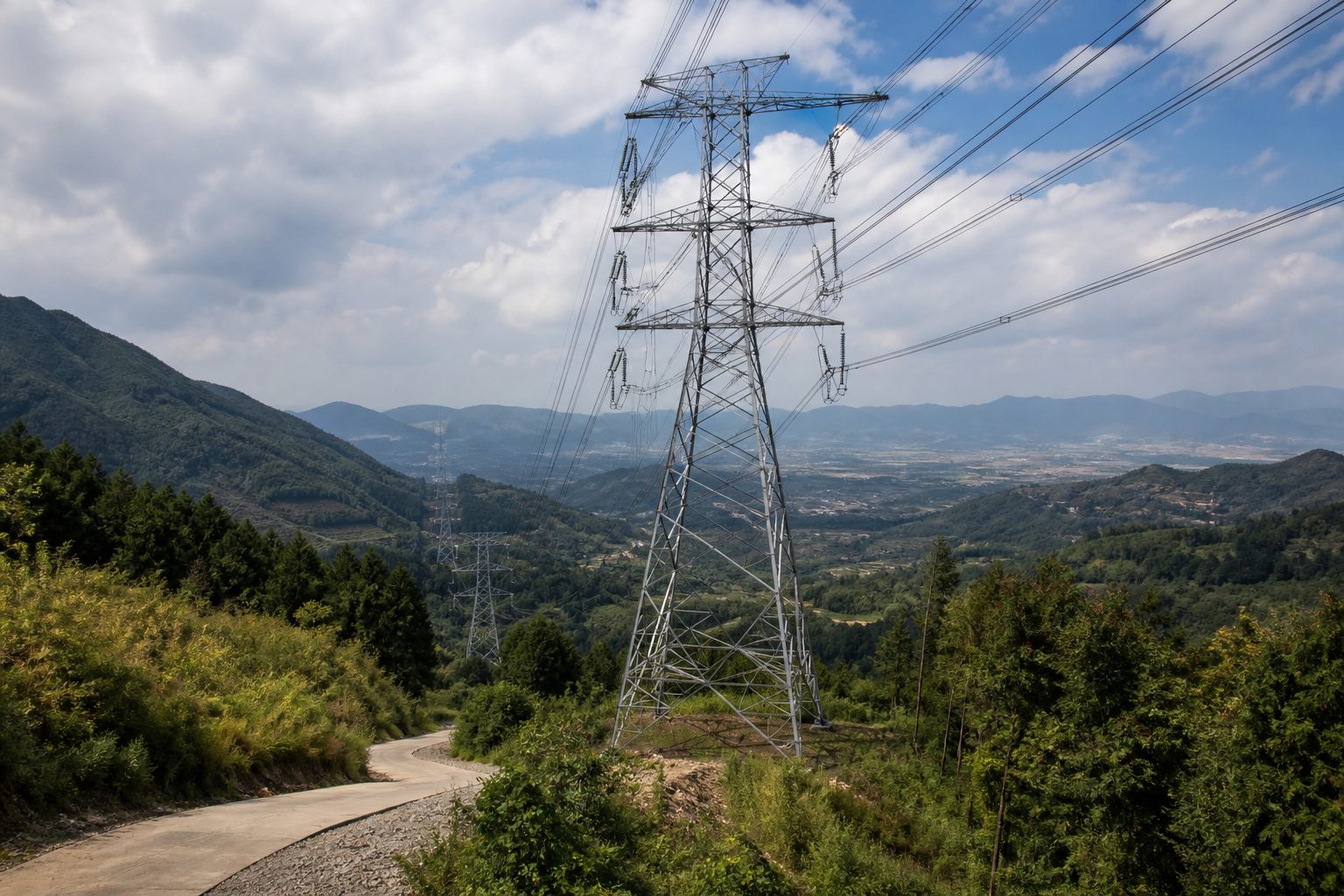
 No. 27 · Sep 2, 2026Three Mile Island Can Restart in 2027. The Grid May Not Take Its Power Until 2031.
 No. 55 · Sep 24, 202610 Gigawatts Overhead: The Orbital Data Centers the FCC Reviews One Filing at a Time
 No. 28 · Sep 3, 2026Norway and Iceland Join GOVSATCOM and IRIS²: Europe Extends Its Secure Satellite Architecture Into the Arctic and North Atlantic
 No. 25 · Sep 2, 2026China's Solar Capacity Crown Is Real. The Grid Beneath It Isn't.
Korea's plan reaches 130 gigawatts, and the capital region is the choke point
Korea plans the way other countries improvise. The 10th Basic Plan for Long-Term Electricity Supply and Demand, issued by the Korea Power Exchange and the responsible government ministry in February 2025, projects peak demand rising from about 95 gigawatts in 2024 to just under 130 by 2036, and it names AI data centers among the drivers [15]. The supply side leans on what Korea does best: more than two dozen reactors already generate roughly a third of its electricity, the plan adds new ones including Shin-Hanul units 3 and 4, and it targets about a third renewables and roughly a quarter nuclear in the 2036 mix [15].
Korea's paradox is that it curtails clean power in one region while rationing grid access in another. The capital region draws well over a third of national demand; new generation sits on the east coast and in the windy southwest. The Jeolla provinces now routinely curtail wind and solar because the lines out of the region are full, and curtailed volumes have grown every year since 2020 [15]. The 765-kilovolt backbone built for the nuclear era is being extended, but a major new line takes the better part of a decade, with local opposition along the route. The plan is credible on generation and candid on transmission. The wires are where it can slip.
Money is the other open question. Korea Electric Power Corporation, the monopoly retailer, spent the 2021-22 global gas crisis selling electricity below cost. Tariffs rose repeatedly in 2022, 2023 and 2024, yet KEPCO still carries a debt pile that peaked near 200 trillion won, about 150 billion US dollars, among the largest of any utility in Asia [16]. In that structure, any large new load priced at average tariffs is implicitly subsidized by every other customer and, eventually, by taxpayers. The government has pledged a national AI computing program and a sovereign AI fund, and AWS chose Ulsan in part because the power was already there [1]. Whether Korea writes a dedicated large-load tariff along Ohio lines, or keeps spreading costs through average rates, is one of the decisions that will determine how much of the AI buildout it actually keeps.
Short-term adequacy is not the issue. Reserves have been rebuilt to comfortable margins, and nothing in the 10th plan shows shortages this decade [15]. The risk to Korea's technology industry is subtler: higher costs and slower connections in exactly the years its chip and AI companies are racing everyone else.
Taiwan rations the grid to protect the fabs
Taiwan completed its nuclear phase-out on schedule. In July 2025 the last unit at Maanshan, on the island's southern tip, shut down for good, ending a reactor program that supplied more than 10 percent of Taiwan's power in the 2010s [17][19]. What remains is a system running roughly three-quarters on gas and coal, with renewables still under 10 percent of generation and far short of official targets: installed offshore wind is about half the 5.7 gigawatts the island wanted by 2025, and auction rounds in 2021 and 2024 attracted almost no bids [17][18].
The reliability record explains why anyone cares. Rolling blackouts hit the whole island four times between 2017 and 2022, from a gas-supply failure at one plant, a switchyard fault at another, and a transmission-tower collapse [17]. Northern Taiwan, home to Taipei, the science parks and most cloud infrastructure, imports a large slice of its power from the south over a corridor the government keeps promising to reinforce [18]. The April 2024 earthquake, the strongest in a quarter century, was the counterpoint: the grid held, and Taipower restored most customers quickly [17]. But chip customers and cloud tenants price both scenarios, the blackout and the quake, into where they put their next campus.
The financial plumbing is stretched the same way Korea's is. Taipower lost a record 226.2 billion New Taiwan dollars in 2022, roughly 7 billion US dollars, when LNG prices spiked; the government recapitalized it with successive injections totaling well over a hundred billion NT dollars, and tariffs rose by double-digit averages in both 2023 and 2024 [17]. Taxpayers paid through the injections, industrial customers through the tariffs.
Into this walked AI. TSMC alone consumes roughly 8 percent of the island's electricity, and its domestic fab roadmap keeps adding to that [17]. The government's answer for everyone else is rationing by contract: announced in 2024, new AI data centers must show renewable-energy contracts covering 60 percent of their load from 2025, rising to 100 percent by 2030 [18]. In a market that cannot yet meet existing green-power demand, that rule is effectively a queue, and it says the quiet part aloud: fabs first, AI campuses second. Taipower is spending more than half a trillion NT dollars over ten years to strengthen the grid, and new gas units at Taichung, Hsinta and Datan are scheduled to carry the balance through the late 2020s [17][18]. Every plan works if those arrive on time. "If" is the load-bearing word in Taiwan's supply reports.
On ten gigawatts, the answer for Taiwan is no, not this decade. The island's grid strategy mirrors its chip strategy: protect one irreplaceable industry by rationing everything else. Taiwan will host AI-adjacent capacity in the low gigawatts, not a national AI hub.
Who pays when AI plugs in
| System | How the last shock landed | What is changing |
|---|---|---|
| PJM (Virginia and 12 other states plus DC) | Capacity auction costs rose roughly sevenfold and flowed into retail bills [3][4] | Price collars; dedicated data-center tariffs spreading from Ohio's model [7] |
| ERCOT (Texas) | Energy-only market, no capacity buffer | Loads above 75 MW must be curtailable and pay the transmission they trigger [9] |
| Japan | Grid costs socialized across all ratepayers; households saw double-digit increases in 2022 and 2023 | Deposits and staged screening in the queue; "priority supply" pairing loads with local generation [12][14] |
| South Korea | Below-cost tariffs left KEPCO with debt near 200 trillion won [16] | Large-load tariff design still undecided |
| Taiwan | State injections and tariff hikes after the 2022 LNG shock [17] | AI data centers must contract green power: 60 percent now, 100 percent by 2030 [18] |
The rulebook emerging across all five systems is remarkably consistent: minimum-take commitments so reserving capacity costs money, curtailability so the grid can call on campuses in emergencies, co-location or on-site generation so the load builds its own supply, green-power contracting where carbon policy applies, and siting at the source. The industry's own behavior is the strongest evidence. Ulsan, Ishikari, and the fight over the Susquehanna nuclear plant are all the market voting for the same design: put the data center next to the electrons.
The 2026 test in each country is where the paperwork comes due. Japan is implementing the 7th plan: the next OCCTO project approvals, the first connections under the reformed queue, continued nuclear licensing [12][13]. Korea is executing the 10th plan: breaking ground on new reactors, deciding how to charge gigawatt-class loads, siting the national AI computing program [15]. Taiwan faces rate reviews, repair of the offshore wind auction pipeline, and milestones for new gas plants [17][18]. In the United States, federal regulators are rewriting co-location rules, PJM is running auctions under the new collar, and Texas is turning SB6 into binding procedure [4][9][10]. These decisions, more than any GPU launch, determine where data centers get built, who receives electricity, and who funds the upgrades.
Honest uncertainty cuts both ways. Queues have repeatedly been shown to double-count and speculate, and AI efficiency can shift fast; a buildout sized for ten gigawatts that lands at four strands wires on the same households. Virginia's experience is the proof that cost allocation does not stop the boom. It only decides who funds it. The right question for Asia is not whether AI demand is real. It is whether each system prices it honestly before it arrives.
Where the next ten gigawatts actually go
Read the evidence together, and a plausible distribution of North Asia's next ten gigawatts looks like this. Japan takes the largest share, three to four gigawatts by 2030, split among Hokkaido, Kyushu and Tohoku, with the Tokyo metro hosting only what tolerates latency, because the wires that could feed a gigawatt-scale Tokyo AI hub do not exist and will not before the mid-2030s. Korea takes two to four if it resolves tariffs and capital-region transmission; its southeast coast, Ulsan already, is the natural host because that is where power and land coincide. Taiwan takes one to two, rationed by its green-power rule and its loyalty to the fabs. The United States, meanwhile, keeps the largest single share near term, not because its grids are in better shape but because it has already absorbed the price and written the rules to keep going.
The differentiator is not generation. All three Asian systems can eventually make electricity; Japan has restarted reactors and a renewables build-out, Korea builds plants faster than almost anyone, Taiwan can burn gas it imports. The differentiator is the grid that moves power to where AI wants to be, and the tariff design that makes the entity causing the cost pay it.
Ulsan is the tell. The most sophisticated compute industry on earth, offered every option, chose to build beside a power plant and its fuel tanks rather than wait on a distant wire. Every government in the region wants the ribbon-cutting ceremony. The test of whether a household in Kyushu, Jeolla or Kaohsiung pays for it is being written now, in tariff schedules, queue rules and auction designs. The systems that make the load pay its own way will get the compute, the industry, and the affordable household power. The ones that do not will have to choose among the three.
Sources
- Reuters, reporting on Amazon Web Services' announced AI data-center investment in Ulsan with SK Gas (June 2025), reuters.com
- Lawrence Berkeley National Laboratory, "2024 United States Data Center Energy Usage Report" (December 2024), eta.lbl.gov
- PJM Interconnection, 2025/2026 Base Residual Auction results (July 2024), pjm.com
- PJM Interconnection, 2026/2027 Base Residual Auction results (July 2025), pjm.com
- PJM Interconnection, long-term load forecasts and interconnection queue analyses (2024-2025), pjm.com
- Dominion Energy, data-center connection pipeline disclosures in regulatory filings and public briefings (2024), dominionenergy.com
- Public Utilities Commission of Ohio, decision on AEP Ohio's data-center power tariff (early 2025), puco.ohio.gov
- Electric Reliability Council of Texas, load forecasts and large-load interconnection queue reports (2025), ercot.com
- Texas Legislature, Senate Bill 6 regarding large-load interconnection and transmission cost allocation (2025), capitol.texas.gov
- Federal Energy Regulatory Commission, order on the amended interconnection service agreement for co-located load at the Susquehanna nuclear plant (November 2024), ferc.gov
- United States Department of Energy, emergency orders under section 202(c) of the Federal Power Act (2025), energy.gov
- Organization for Cross-regional Coordination of Transmission Operators (OCCTO, 電力広域的運営推進機関), supply-demand outlooks and multi-year grid development plans (2024-2025), occto.or.jp
- Japan Ministry of Economy, Trade and Industry, 7th Strategic Energy Plan (cabinet decision, February 2025), meti.go.jp
- Japan Ministry of Economy, Trade and Industry, GENIAC program awards and AI-era energy policy outline (2024-2025), meti.go.jp
- Korea Power Exchange, 10th Basic Plan for Long-Term Electricity Supply and Demand (February 2025), kpx.or.kr
- Korea Electric Power Corporation, financial statements and disclosures (2022-2024), kepco.co.kr
- Taiwan Power Company (Taipower), financial results, reliability statistics, supply-demand reports and grid investment plan (2024-2025), taipower.com.tw
- Taiwan Ministry of Economic Affairs and Executive Yuan, energy transition reports and AI data-center power policy announcements (2024-2025), moea.gov.tw
- Reuters, reporting on the shutdown of Maanshan Unit 2 and the completion of Taiwan's nuclear phase-out (July 2025), reuters.com
Comments (3)
Continue exploring
10 Gigawatts Overhead: The Orbital Data Centers the FCC Reviews One Filing at a Time
SpaceX and Orbital Compute want to put AI data centers in orbit, filings that test whether the FCC can review a strategic system…
Norway and Iceland Join GOVSATCOM and IRIS²: Europe Extends Its Secure Satellite Architecture Into the Arctic and North Atlantic
Norway and Iceland are joining GOVSATCOM and IRIS², moving Europe's sovereign secure-satellite architecture into the North…
China's Solar Capacity Crown Is Real. The Grid Beneath It Isn't.
China's installed solar capacity has passed coal, but the grid cannot store, transmit or dispatch sunlight on demand, so coal…
Hmm, one thing I'm not sure the piece fully grapples with is that Japan's and Taiwan's power sectors are far more vertically integrated than PJM's, so the capacity-auction mechanism that did the damage in Virginia may not be the right warning sign to apply here. The cost-allocation problem looks identical from a household's perspective, but the regulatory tools available in Tokyo or Taipei probably look quite different from AEP Ohio's tariff or Texas's SB6.
For Taiwan specifically, where 10 GW would equal roughly a quarter of the all-time peak, is the article assuming this load gets absorbed through demand response and cross-strait interconnection, or is some new firm baseload capacity quietly being planned?
So the core argument is that the winners in North Asia will be whoever can deliver electrons to AI campuses cheaply, but the losers will be everyone else on the grid unless regulators force hyperscalers into take-or-pay contracts like AEP Ohio is now requiring. Practically, households in Seoul, Tokyo, and Taipei should be watching utility commission dockets right now, not just waiting for the next bill to arrive. The Ulsan AWS deal neatly dodged the problem by co-locating with SK Gas's existing LNG infrastructure, but that workaround only works for one site, not for ten gigawatts of pipeline.