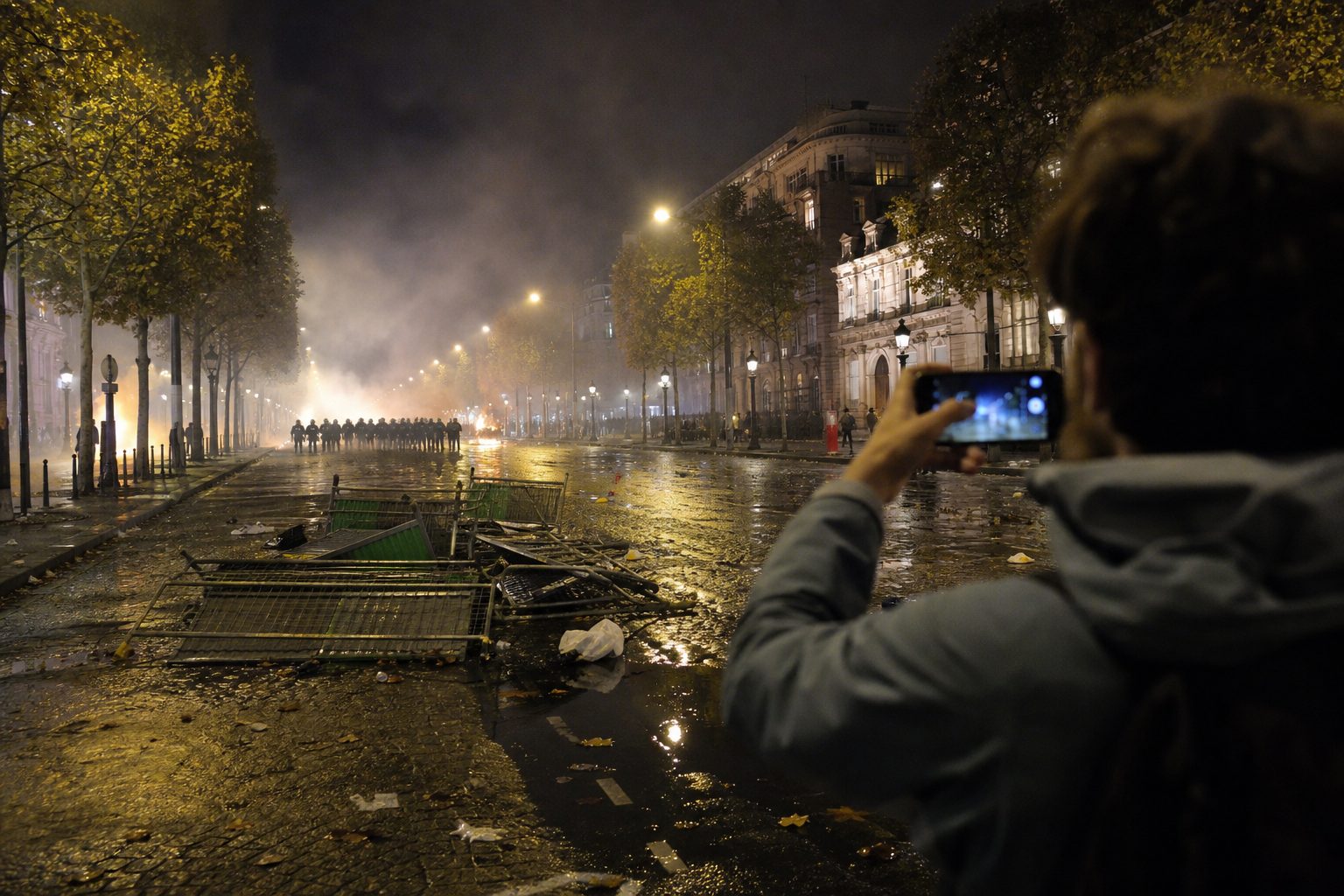
Dramatic footage from France’s October protests spread rapidly online. Some videos showed genuine clashes, fires, police actions, and looting. Others were old recordings reposted as new. Several of the most inflammatory images, including scenes at the Eiffel Tower and an alleged attack on an elderly couple, were generated or altered with artificial intelligence. Some of the disputed images accumulated millions of views. (France 24 Observers)
The result was a fragmented version of events. Real violence made false footage easier to believe, while mislabeled videos made the unrest appear larger, more uniform, or more politically charged than the available evidence shows.
The protests began in late September with students protesting staff shortages and deteriorating conditions in secondary schools. The movement widened to include trade unions, Yellow Vest activists, climate campaigners, and people angry about rising living costs. On October 17, demonstrations took place across France. The main marches in some cities were peaceful, but clashes, fires, vandalism, and looting were also reported in Paris, Lyon, Marseille, Lille, Rennes, Angers, Limoges, Grenoble, Avignon, Pau, Montpellier, and Valence. (BBC; RFI)
That mixture of genuine disorder and fabricated or misidentified media created ideal conditions for misinformation.
What happened on October 17?
The strongest evidence shows that the October 17 demonstrations were neither wholly peaceful nor a single nationwide riot.
In Paris, the main march proceeded for part of the afternoon, while clashes took place around the Place de la République. Police used tear gas and water cannon against masked demonstrators who threw fireworks and other objects. A car was set on fire, and fighting continued into the evening. (RFI; AP)
In Lyon, a tourist office was set alight while firefighters faced interference. In Marseille, people broke into the town hall and damaged furniture. Lille’s mayor’s office was also vandalized. Later reporting described fires and looting in other cities, including damage to shops, restaurants, municipal buildings, and an Apple store in Lille. (RFI; BBC)
The number of arrests reported by news organizations changed as the unrest developed. RFI cited 272 arrests during the early phase of the October 17 disturbances. The BBC later reported that more than 1,200 people had been arrested during the wider day of protests. AFP, citing later reporting, referred to nearly 2,400 arrests in connection with unrest on October 17 and 18. These figures may reflect different reporting windows and definitions, so they should not be combined into one definitive total without an official consolidated account. (RFI; BBC; AFP Fact Check)
The verified record therefore supports a mixed description: large demonstrations, some peaceful and some violent, with disorder concentrated in particular places and moments.
Which videos show real events?
Several widely circulated videos appear to show genuine October protests, although even authentic footage can be presented without important context.
The Guardian published video of police clashing with students and workers in Paris on October 17. AP also distributed footage of police using tear gas and water cannon at the Place de la République against people wearing hoods and masks and throwing objects at officers. These recordings document real police operations, but they do not establish that every protester in the surrounding crowd was involved in violence. (The Guardian; AP)
The BBC said its verification team authenticated footage showing masked men driving a tourist train through a narrow street in Grenoble toward riot police. The same report described fires, looting, and vandalism in multiple cities. (BBC)
RFI’s report also included firsthand accounts and local statements about the burning of Lyon’s tourist office, damage in Marseille and Lille, and confrontations in Paris. These accounts do not verify every individual clip posted online, but they corroborate the existence of the events depicted in many authentic recordings. (RFI)
Authentic footage still has limits. A short clip may show the moment police moved into a crowd without showing what happened before. A burning vehicle may be real but filmed in a different city or during a different phase of the protest. A peaceful march may disappear from the online picture because violent scenes attract more attention.
The correct question is not simply, “Is this video real?” It is also, “What exactly does this video prove?”
Which videos were old or miscaptioned?

Fact-checkers identified several videos that were genuine recordings but unrelated to the October 2026 protests.
One widely shared clip showed a woman dragging a guillotine through the streets. Posts presented it as current footage of French protesters invoking the Revolution and demanding President Emmanuel Macron’s resignation. VerificaRTVE traced the recording to a Paris demonstration in September 2025. The journalist who filmed it confirmed that it came from that earlier event. (RTVE Verifica)
AFP found that another compilation, showing overturned and burning vehicles and damage to a bus stop, came from protests in Paris on December 24, 2022. The unrest followed a shooting at a Kurdish cultural center, not the 2026 school protests. (AFP Fact Check)
A separate video of people dancing around a burning car near the Eiffel Tower was also miscaptioned. AFP traced it to violence following Paris Saint-Germain’s Champions League victory on May 30, 2026. People in the footage were wearing PSG clothing, and police records cited by AFP documented arrests and damage after the match. (AFP Fact Check)
Another clip showed a pro-Palestinian rally in Paris, with participants chanting, “We are all children of Gaza.” It circulated in October with claims that France’s student protests featured only “Islamic” flags and no French flags. AFP traced the video to a demonstration at the Place de la République on May 25, 2025. AFP photographs from the October protests showed both French and Palestinian flags. (AFP Fact Check)
Full Fact also examined a video of police using shields and batons that was presented as footage from the recent protests. The clip had been online since at least March 2023. (Full Fact)
These examples share an important characteristic: the underlying footage was not necessarily fabricated. The deception came from the caption, date, location, or explanation attached to it.
Where this story sits
5 related pieces
Hover a story · click to read
 No. 76 · Oct 21, 2026Who Controls Your Feed During a Crisis? France's October 2026 Crackdown Shows a Global Pattern
 No. 41 · Sep 7, 2026Stress-Testing the American Empire: Real Decline or Cyclical Strain?
 No. 77 · Oct 21, 2026Police Drones at Protests: The Tools, the Limits, the Records
 No. 25 · Sep 2, 2026China's Solar Capacity Crown Is Real. The Grid Beneath It Isn't.
 No. 74 · Oct 20, 2026ZeroGhost and the Privacy-Phone Mirage: What "Untraceable" Handsets Actually Deliver
Which images and videos were made with AI?
Some of the most emotionally charged material was not merely old. It was synthetic.
A video appeared to show large Palestinian and Jordanian flags hanging from the Eiffel Tower. Fact-checkers found several signs of generation or manipulation. Sections of the tower warped as the camera moved upward, and the flags were inconsistent. One appeared to include a star, which does not belong on the Palestinian flag. VerificaRTVE and Full Fact both concluded that the video was not genuine footage of the October protests. (RTVE Verifica; Full Fact)
Another AI-generated image showed a building on fire, a European Union flag, and a Palestinian flag. The image was shared with a claim that France was burning “in the name of Palestine.” VerificaRTVE’s analysis identified signs of AI generation, and the claim that France was the first G7 country to recognize Palestine was also false. The United Kingdom and Canada announced recognition before France in September 2025. (RTVE Verifica)
The most inflammatory example showed an elderly couple in their underwear beside masked people. Posts claimed the couple had been stripped and robbed during the riots, and some accounts added claims that the victims were Jewish. France 24 traced the image to an AI montage published by a pro-Israel account. Visual inconsistencies included a distorted hand, an apparent extra head, and an implausible street object. (France 24 Observers)
The alleged assault itself remained unverified. France 24 reported that journalist Dominique Rizet said he had received the information from a police source. But the Paris prosecutor’s office told Libération’s CheckNews that, roughly 48 hours after the alleged incident, it had received no report confirming such an attack. That does not prove that no assault occurred. It does mean the image cannot be used as evidence, and the underlying allegation lacked official confirmation in the reporting reviewed. (France 24 Observers; Full Fact)
Fact-checkers cited invisible watermarks, AI-detection tools, source tracing, and visual anomalies. Those methods can be useful, but no single detector should be treated as conclusive on its own. A strong verification combines technical analysis with the history of the file, the original uploader, location clues, independent reporting, and official records.
Who amplified the disputed material?

The available evidence shows several paths of amplification, but it does not establish a single coordinated operation behind all the misleading content.
The elderly-couple images spread widely on X, especially through far-right accounts. France 24 reported that one was shared by Alex Jones and that the images also appeared on an Israeli right-wing news channel and an Instagram account. The original montage was traced to the account Infos-Israel.news. (France 24 Observers)
The false Eiffel Tower video and the burning-building image were also circulated by accounts that fact-checkers described as recurring sources of misinformation. But identifying repeated sharing by particular accounts is not the same as proving that the accounts worked together or that they were directed by a common organization. The evidence does not provide a verified network analysis, platform records, or an independent estimate of coordinated behavior.
Nor is there reliable evidence showing the total number of people who saw every disputed post. VerificaRTVE reported that one guillotine video had been shared more than 19,000 times on X, the false burning-building image more than 25,000 times, the Eiffel Tower video more than 4,000 times, and the elderly-couple image more than 60,000 times. France 24 described the couple images as receiving millions of views, but platform-wide reach figures were not provided. (RTVE Verifica; France 24 Observers)

Those numbers measure posts or reported views, not the number of unique people who believed them.
Did the misinformation change public opinion or government action?
The evidence supports reach and recirculation. It does not establish that the disputed videos changed public opinion, altered news coverage at scale, or caused government decisions.
Politicians used the unrest in competing ways. Marine Le Pen argued that legitimate demands had been taken over by the far left. Jean-Luc Mélenchon criticized broadcasters for concentrating on violence rather than peaceful demonstrations. Prime Minister Sébastien Lecornu condemned the violence and warned that some groups were treating the protests as preparation for the presidential election. (BBC; RFI)
But those political responses followed real events documented by journalists, local officials, and video recordings. The available sources do not show that a particular AI image or recycled clip prompted a specific policy, police deployment, or public statement.
There is also evidence against the claim that fake footage dominated coverage. Professional news organizations reported genuine clashes and fires, while the BBC said it authenticated video and RFI gathered accounts from cities affected by the unrest. AFP, France 24, Full Fact, and VerificaRTVE published corrections identifying false material. The existence of misinformation did not make the underlying protests imaginary, and the existence of real violence did not validate every dramatic post.
How can viewers check a protest video?

Ordinary viewers do not need specialized forensic software to avoid most false conclusions. They can begin with a short verification routine.
1. Separate the video from its caption
Watch the footage without accepting the accompanying text. Ask what the video itself establishes. Does it show a recognizable landmark, a date, a city, or a specific event? If not, the caption may be supplying more information than the recording contains.
2. Search distinctive frames
Pause the video at a clear moment and use reverse-image search. Search several frames, not just one. Fact-checkers used this method to connect the guillotine video to September 2025, the burning vehicles to December 2022, and the PSG footage to May 2026. (RTVE Verifica; AFP Fact Check)
3. Look for location clues
Check street signs, storefronts, road markings, architecture, public transport, police uniforms, weather, flags, and landmarks. Compare them with maps, street-view imagery, and local news photographs. A familiar landmark can still be used in an old or edited video, so location alone does not prove the date.
4. Check the earliest traceable upload
Look for the oldest version, not the most popular repost. Examine the uploader’s description, timestamp, language, and previous posts. A video that first appeared months or years earlier cannot be treated as new simply because it resurfaced during a crisis.
5. Compare with independent reporting
Search the city, date, and event in local and national news. Genuine major incidents often leave multiple traces: statements from police or prefectures, fire-service records, photographs from professional journalists, eyewitness accounts, or local reporting.

The absence of a report is not proof that an event did not happen. But an extraordinary claim supported only by an anonymous post deserves caution.
6. Inspect for AI inconsistencies
Look closely at hands, faces, signs, flags, railings, smoke, reflections, and moving structures. AI-generated video may distort objects as the camera moves. In the Eiffel Tower video, the tower’s structure warped and the flags contained impossible details. In the alleged elderly-couple image, anatomy and objects in the street were inconsistent. (France 24 Observers; RTVE Verifica)
These clues are warnings, not final proof. A real low-quality video can also look strange after compression.
7. Treat labels and detectors as evidence, not verdicts
Platform labels, watermark checks, and AI detectors can help identify manipulated media. They should be combined with source tracing and independent confirmation. A detector result does not by itself prove when a video was made, who made it, or what the caption means.
8. Do not share while uncertain
If the claim is inflammatory, attacks a religious or ethnic group, or appears to show a shocking crime, pause before reposting. The emotional force of the material is often part of how misleading content spreads.
What remains unknown?
The available evidence does not provide a complete census of every viral video from the protests. It does not establish the total reach of misleading content across X, Facebook, TikTok, YouTube, and Instagram. Nor does it show how many viewers believed a false claim after seeing it.
The sources also do not prove that all false posts were part of a coordinated campaign. Some were likely deliberate miscaptioning, while others may have been careless reposts. The motives and relationships of individual accounts require platform data or further investigation.
What can be established is narrower and more useful. France experienced genuine protests and serious violence in October 2026. Alongside authentic footage, users circulated old recordings from 2022, 2025, and 2026, as well as AI-generated images and video. The false material did not erase the real events, but it altered the apparent context around them.
The most reliable habit is to verify two separate questions: “Did this recording exist?” and “Does it show what the post claims?” In France’s October protests, many videos passed the first test and failed the second.
Sources and references

- BBC News, “Violent clashes, looting and buildings ablaze in France as more than 1,200 arrested after protests,” October 2026
- RFI, “Violence mars day of action over poor state of French schools and rising prices,” October 17, 2026
- Associated Press, “Paris police use tear gas and water cannons to disperse protesters,” October 2026
- The Guardian, “Police clash with students and workers protesting in Paris,” October 17, 2026
- AFP Fact Check, “Old videos misrepresented as showing damage caused by France school protests,” October 9, 2026
- AFP Fact Check, “Old pro-Palestinian protest video falsely linked to student rallies in France,” October 22, 2026
- VerificaRTVE, “Desinformación sobre las protestas en Francia: vídeos descontextualizados e imágenes generadas con IA,” October 19, 2026
- France 24 Observers, “France riots: AI photos falsely depict elderly couple ‘stripped and robbed’,” October 19, 2026
- Full Fact, “France protests: fact checked,” October 22, 2026
Comments (3)
Continue exploring
Police Drones at Protests: The Tools, the Limits, the Records
From a Reaper circling Los Angeles to the 15,000-euro French fine for drone-filming protests: what police drones can actually…
China's Solar Capacity Crown Is Real. The Grid Beneath It Isn't.
China's installed solar capacity has passed coal, but the grid cannot store, transmit or dispatch sunlight on demand, so coal…
ZeroGhost and the Privacy-Phone Mirage: What "Untraceable" Handsets Actually Deliver
A $647 ZeroGhost Ghost Phone runs free software on a used Pixel, and the privacy gains are real, but no operating system can stop…
How would this verification framework work for a small newsroom or volunteer fact-checking group without access to AP, BBC, or RFI resources? Could a team of two or three people realistically confirm details like the Grenoble location, the protest date, and whether a clip shows the start or aftermath of a clash? The changing arrest figures also seem like a useful test case for a simple shared spreadsheet documenting sources and reporting windows.
The distinction between authentic footage and what it actually proves mirrors the verification work I’ve been following around open-source investigations in conflict zones. Geolocation, timestamps, and cross-checking landmarks have become just as important as detecting edits or AI generation. The Grenoble tourist-train clip is a good example: authentic video can still be misleading when its location or surrounding events are omitted. That layered approach feels especially important when a single dramatic scene can reach millions of viewers.
What evidence specifically supports the claim that the Eiffel Tower images and the elderly-couple scene were AI-generated or altered?