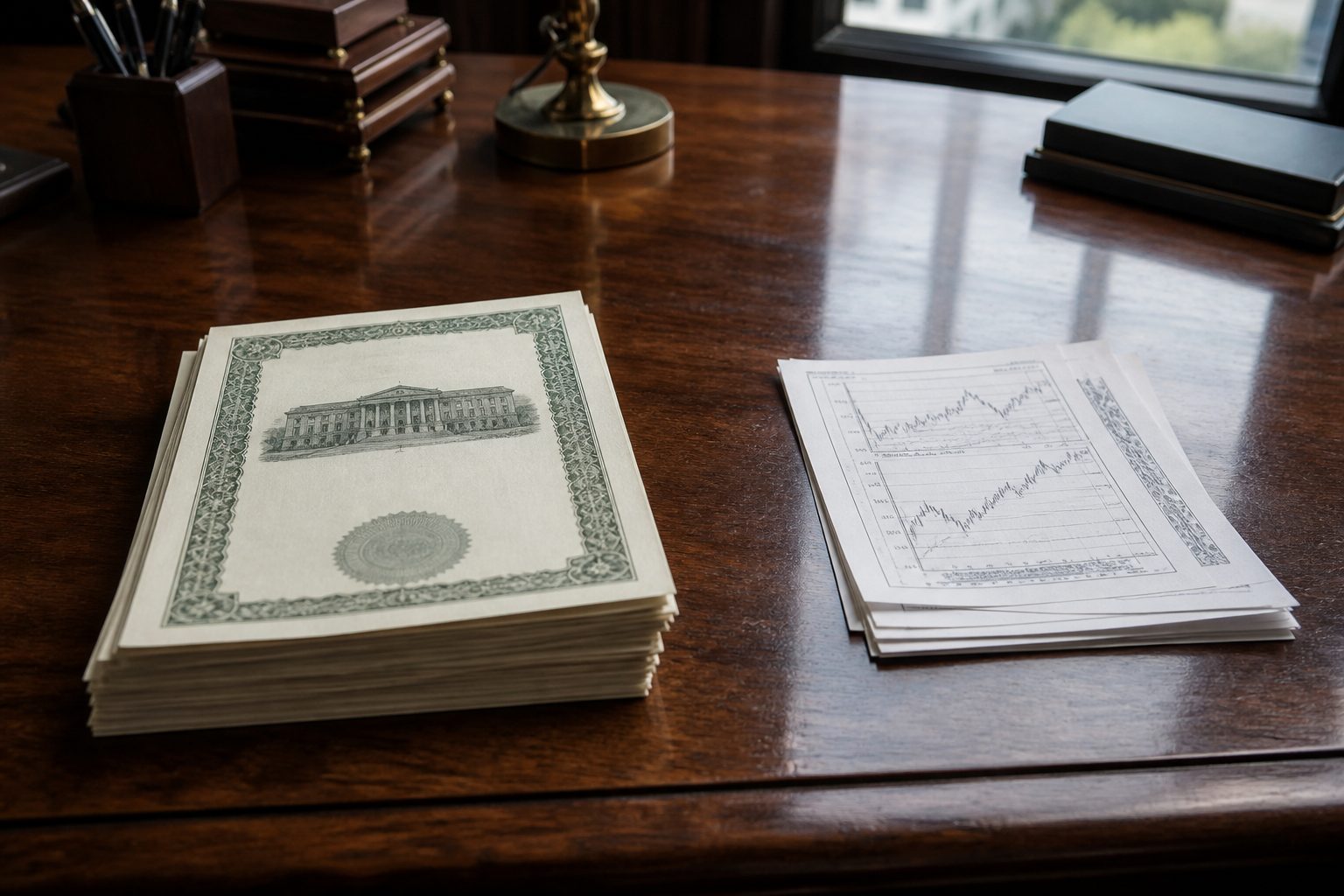
The most dangerous position in the U.S. Treasury market may not be a bet that interest rates will rise or fall. It may be a trade designed to avoid taking a directional view at all.
The Treasury basis trade pairs a long position in a cash Treasury security with a short position in a related Treasury futures contract. The price difference between the two instruments is usually small, but hedge funds borrow heavily to enlarge the position. In calm markets, the trade can produce steady returns while helping align cash and futures prices. Under stress, however, the same leverage can turn a manageable price discrepancy into a forced liquidation cycle.
That risk is no longer hypothetical. In March 2020, the basis trade was partly unwound as Treasury and repo markets came under severe strain. A commentary source estimates that the Federal Reserve purchased approximately $1.6 trillion in assets over ten days to prevent the market disruption from spiraling further, although that intervention addressed broader market stress and does not establish that the basis trade alone caused the crisis. (Equicurious, 2026; Federal Reserve, 2025) Since then, hedge fund Treasury exposures have grown substantially. By September 2025, large hedge funds had accumulated an estimated $4.0 trillion in gross Treasury exposures, including approximately $830 billion in cash-futures basis positions. Their repo borrowing had reached $3.0 trillion. (Federal Reserve, 2026)
Calling the basis trade a “time bomb” captures its potential to magnify a crisis, but it can also mislead. The trade is not inherently fraudulent, irrational, or certain to collapse. It serves a real economic function and can improve market liquidity under normal conditions. The danger arises from the combination of thin expected returns, enormous scale, short-term financing, derivatives margin, concentrated participation, and the possibility that many firms will try to exit simultaneously.
The central question is therefore not whether the basis trade will fail. It is whether the Treasury market can absorb a large, synchronized unwinding without requiring public intervention.
A small price gap with a large balance sheet behind it
The basis trade begins with a difference between two closely related instruments.
A hedge fund buys a Treasury security in the cash market and sells a Treasury futures contract that references a similar maturity. The fund finances the bond purchase through a repurchase agreement, or repo. In a repo transaction, the fund temporarily sells the Treasury to a lender and agrees to repurchase it later, effectively borrowing cash against the bond as collateral. (Federal Reserve, 2025; l0g, 2026)
The fund’s position has three linked parts:
- It owns the cash Treasury.
- It sells the Treasury futures contract.
- It borrows through repo to finance the cash bond.
The fund expects the price difference, or basis, to narrow as the futures contract approaches expiration. If the position is structured correctly, the fund is hedged against much of the change in the general level of interest rates. Its expected return comes from the convergence between the cash bond and the futures price, after financing and transaction costs. (l0g, 2026)
The spread is usually too small to generate an attractive return on unleveraged capital. That is why leverage is central to the strategy. A fund may finance most of the bond’s value through repo while posting only a relatively small amount of capital as collateral. It also posts margin against the futures position. The result is a large notional position supported by a comparatively small equity cushion. (l0g, 2026; Equicurious, 2026)
This structure creates an important distinction between economic exposure and financing exposure. A fund may have limited net interest-rate exposure because the cash bond and futures position offset each other. Yet it can still have enormous gross exposure and substantial liquidity risk. The hedge reduces one kind of risk, but it does not eliminate the need to meet repo calls or futures margin calls.
The trade is therefore “low risk” only under a particular set of assumptions: that repo financing remains available, haircuts remain stable, futures margin requirements do not jump sharply, price relationships remain orderly, and the fund can maintain the position until convergence. The trade becomes fragile when those assumptions fail together. (l0g, 2026)
The numbers have grown faster than the market around them
The Federal Reserve’s June 2026 analysis provides the clearest recent estimate of the trade’s scale.
Between 2023 and September 2025, large hedge funds’ gross U.S. Treasury exposures doubled to approximately $4.0 trillion. That total consisted of about $2.4 trillion in long Treasury exposure and $1.6 trillion in short exposure. Hedge funds’ Treasury securities holdings rose from roughly 4.5 percent of privately held Treasuries at the beginning of 2023 to approximately 8.5 percent by September 2025. Their Treasury holdings exceeded those of mutual funds and U.S.-chartered depository institutions. (Federal Reserve, 2026)
The Federal Reserve estimates that the cash-futures basis trade accounted for roughly $830 billion of long Treasury exposure in September 2025. That represented about 35 percent of hedge funds’ total long Treasury exposures. The estimate was approximately twice the previous peak reached in early 2020. (Federal Reserve, 2026)
The same analysis identified other large categories of Treasury positioning. Maturity-matched trades accounted for approximately $395 billion, or 17 percent, while steepener-like trades accounted for about $375 billion, or 16 percent. The remaining positions included flattener-like trades, unencumbered cash, and long-only investments. These figures matter because the entire $4.0 trillion exposure should not be described as basis trading. The basis trade is a large component of hedge fund Treasury activity, not its entirety. (Federal Reserve, 2026)
Repo borrowing expanded alongside these positions. Large hedge funds’ repo cash borrowing reached approximately $3.0 trillion in September 2025. Since the beginning of 2023, Treasury exposures, repo borrowing, and hedge fund turnover in Treasury markets had all more than doubled. The 50 largest funds accounted for roughly 90 percent of total hedge fund Treasury exposures, up from about 84 percent at the beginning of 2023. (Federal Reserve, 2026)
These measurements reveal the risk’s basic shape: a large and increasingly concentrated set of leveraged positions financed through markets that can reprice quickly.
They do not prove that a crisis is imminent. Nor do they show that all $3.0 trillion of repo borrowing funded basis positions. The Federal Reserve explicitly treats its decomposition as an approximation because hedge funds do not report their trades at the transaction level on Form PF. The figures are inferred from reported exposures, interest-rate sensitivities, derivatives, repo positions, and cash holdings. (Federal Reserve, 2026)
That limitation is not a technical footnote. It is part of the problem. Authorities can estimate the trade’s size, but they cannot observe every position, hedge, financing agreement, or exit plan directly.
Why funds pursue the trade
The basis trade exists because cash Treasuries and Treasury futures do not always trade at exactly the same price after adjusting for financing, delivery options, and other costs.
Treasury futures offer a convenient way for asset managers to obtain interest-rate exposure. A manager can buy futures without purchasing and financing the underlying securities. Demand for futures can push futures prices above their theoretical value relative to the cash bonds. The basis trader takes the opposite side by buying the relatively cheap cash security and selling the relatively expensive futures contract. (l0g, 2026)
The futures contract also gives the short party an option to choose which eligible Treasury security to deliver. This cheapest-to-deliver option affects the relationship between the futures price and the underlying cash securities. Financing conditions in the repo market also shape the spread. When Treasury collateral can be funded cheaply, the economics of buying the bond and selling the future become more attractive. (Equicurious, 2026; l0g, 2026)
The strategy can benefit the broader market. By trading simultaneously in cash securities and futures, basis traders help link the two markets. They can absorb demand from investors that prefer futures and supply demand for cash Treasuries. Their activity may improve price alignment and provide liquidity under normal conditions. (l0g, 2026)
This is the strongest argument against treating the trade as purely speculative. The market may rely on leveraged funds because other participants do not want to warehouse the same basis risk. Asset managers and dealers may want futures exposure or cash Treasuries for different reasons. Hedge funds step between those markets because the price discrepancy offers compensation. (l0g, 2026)
The compensation, however, is small relative to the balance sheet required. A fund must scale the trade substantially to turn a narrow spread into a meaningful return. That pressure encourages leverage. Leverage, in turn, makes the position sensitive to financing terms even when the underlying assets are U.S. government securities.
The Treasury may be safe from default. The trade that finances it may not be safe from liquidation.
Where this story sits
5 related pieces
Read it →
Hover a story · click to read
 No. 7 · Aug 25, 2026The Price of Certainty: How the Premier League’s Big Six Are Rewiring European Football’s Transfer Market
 No. 55 · Sep 24, 202610 Gigawatts Overhead: The Orbital Data Centers the FCC Reviews One Filing at a Time
 No. 46 · Sep 13, 2026Could a "Rogue AI" Cyberattack Push America Onto Stablecoin Rails?
 No. 16 · Aug 27, 2026Lake America: The Hidden Technology Problems Behind Trump’s Lake Ontario Order
 No. 53 · Sep 23, 2026Aurora's 96-MW Proof: Inside the Certification Bet on Software-Defined Grid Capacity
The March 2020 warning
The basis trade’s systemic risk became visible during the market turmoil of March 2020.
The basis trade was partly unwound during the March 2020 stress in Treasury and repo markets. Later analysis by the Federal Reserve described the trade as having increased again after declining between 2020 and 2022. (Federal Reserve, 2025)
For basis traders, the problem was not simply that Treasury prices fell. The cash bond and futures positions were intended to offset changes in interest rates. The problem was that their relationship moved sharply and financing became more difficult at the same time. The basis trade’s structure makes it vulnerable when cash and futures prices diverge while repo financing and futures margin requirements become more demanding. (Equicurious, 2026; l0g, 2026)
A fund facing higher repo haircuts must provide more collateral or repay part of its borrowing. A fund facing higher futures margin requirements must provide additional cash to its clearing broker. If the fund lacks spare liquidity, it may have to sell the Treasury securities that support the trade. (l0g, 2026)
That sale can widen the basis rather than narrow it. The fund sells cash Treasuries, prices fall, the value of its collateral declines, and lenders demand more collateral. Futures margin may rise as volatility increases. The fund sells more securities, adding to the pressure. (l0g, 2026)
The process can become self-reinforcing:
- Market volatility rises.
- Repo lenders demand more collateral or reduce financing.
- Clearing houses increase futures margin requirements.
- Leveraged funds sell cash Treasuries to raise cash.
- Treasury prices fall or price relationships deteriorate.
- Losses and margin calls increase.
- More funds sell.
The key point is that a hedged position can still generate forced selling. The fund may expect to earn a small arbitrage return over time, but it must survive the short-term liquidity demands created by market stress.
The Federal Reserve responded to the broader March 2020 turmoil with large-scale asset purchases and other measures. One commentary source estimates that the central bank purchased approximately $1.6 trillion in assets over ten days. That figure comes from a secondary commentary source rather than the Federal Reserve analyses cited here, and it should not be treated as a measure of intervention directed solely at the basis trade. (Equicurious, 2026)
The intervention was not proof that the basis trade alone caused the crisis. The Federal Reserve analysis identifies the trade as part of a wider episode of Treasury and repo market stress, not as the sole cause. The available sources therefore support the conclusion that leveraged Treasury strategies amplified the pressure, but they do not establish a complete causal account of every force operating in March 2020. (Federal Reserve, 2025; l0g, 2026)
March 2020 therefore supplied a warning rather than a complete causal verdict. It showed that Treasury market liquidity can deteriorate even when the underlying securities carry minimal credit risk. It also showed that leverage can transform a convergence trade into a source of forced sales.
The Federal Reserve’s 2025 analysis found that the basis trade had been partly unwound during the March 2020 stress and had expanded again in later years. It also noted that the trade’s growth was visible in hedge fund Treasury positions, short Treasury futures positions, and net repo borrowing. (Federal Reserve, 2025)
The cross-border blind spot

The basis trade is difficult to measure partly because the funds conducting it are often organized across jurisdictions.
The Federal Reserve’s October 2025 analysis found that hedge funds domiciled in the Cayman Islands accounted for most of the recent increase in Treasury exposures identified through Form PF. The authors estimated that Cayman-domiciled hedge funds’ Treasury holdings rose by approximately $1 trillion since 2022, reaching about $1.85 trillion at the end of 2024. (Federal Reserve, 2025)
That finding conflicts with what would be expected from the Treasury International Capital, or TIC, data. Those data do not show a comparable increase in Treasury securities held by Cayman-domiciled hedge funds. The Federal Reserve concluded that TIC data appear to undercount those holdings by approximately $1.4 trillion as of the end of 2024. (Federal Reserve, 2025)
The discrepancy does not establish that one dataset is fraudulent or that the funds are concealing positions. The Federal Reserve describes it as a measurement problem involving different data sources. TIC data are intended to capture cross-border securities and banking activity, while Form PF provides information about hedge fund positions. The two systems therefore produce materially different pictures of Cayman-domiciled funds’ Treasury exposure. (Federal Reserve, 2025)
The measurement problem has consequences beyond statistical accuracy. TIC data feed into U.S. balance-of-payments statistics and the Financial Accounts of the United States. If Treasury holdings and transactions are measured inaccurately, analysts may misread who owns U.S. government debt, who supplies financing, and where losses might appear during a stress event. (Federal Reserve, 2025)
The Federal Reserve’s findings also challenge simple narratives about foreign demand for Treasuries. A reported decline or lack of growth in holdings by one jurisdiction may coexist with a substantial increase in economic exposure recorded through hedge fund filings. The market’s ownership structure can be more complicated than official country-level totals suggest.
The liquidity paradox
The basis trade creates a liquidity paradox.
During normal periods, leveraged arbitrageurs can make the Treasury market more liquid by trading against temporary price discrepancies. Their activity helps keep cash bonds and futures aligned. More participation can reduce price differences between the two markets. (l0g, 2026)
During a crisis, however, the same traders may become forced sellers. Their leverage makes them sensitive to margin and funding conditions, and their positions can be concentrated in similar instruments. When many funds receive the same margin calls, they may sell similar securities at the same time. (l0g, 2026; Federal Reserve, 2026)
Liquidity supplied by leveraged investors is conditional. It is available when financing is available and volatility is contained. It can retreat precisely when the market needs it most.
This does not mean that hedge funds should be removed from the Treasury market. Eliminating arbitrage activity could widen price discrepancies and shift risk to dealers or other institutions. The policy challenge is to make the market less dependent on financing structures that can vanish abruptly. (l0g, 2026)
That challenge matters because Treasury securities serve as collateral in repo transactions and as the underlying instruments for Treasury futures and other forms of interest-rate trading. A disorderly Treasury market would therefore affect more than the funds holding the positions. (Federal Reserve, 2025; l0g, 2026)
The danger is not that a hedge fund loses money. The danger is that many funds try to raise cash by selling the same supposedly liquid asset, while dealers and lenders lack the balance sheet to absorb the flow.
Regulation moves toward central clearing
Regulators have responded with measures intended to make Treasury and repo transactions more transparent and resilient.
A major initiative is the expansion of central clearing. A July 2026 review of the trade states that cash Treasury transactions are scheduled to come under mandatory clearing by December 31, 2026, while repo transactions are scheduled for mandatory clearing by June 30, 2027. The review also describes the approval of additional clearing services and changes intended to reduce the problem of double margining. (l0g, 2026)
Because that source is a secondary review, these implementation dates and regulatory details should be treated as reported by that review rather than independently verified here against the underlying SEC rules. As of August 26, 2026, the review describes the deadlines as upcoming.
Central clearing can reduce bilateral counterparty risk by placing a clearinghouse between buyers and sellers. It can also standardize margin requirements and improve visibility into positions. If a fund defaults, the clearing process may make it easier to manage the position than a web of private bilateral agreements would. These are general functions of central clearing, while the July 2026 review presents them as potential effects in the Treasury basis-trade context. (l0g, 2026)
But clearing does not eliminate leverage. It changes where and how collateral is posted. If a trade previously relied on very low repo haircuts, central clearing may require more margin. That could reduce the profitability of the basis trade and shrink its size. It could also push activity toward less transparent financing channels if regulation becomes more expensive in the regulated core. (l0g, 2026)
The policy tradeoff is therefore difficult. More margin can reduce the probability that a fund fails after a modest price move, but it can also force funds to hold more cash and reduce their ability to provide liquidity. If margin requirements rise sharply during a crisis, they may intensify rather than relieve the pressure. (l0g, 2026)
A resilient system needs more than a clearinghouse. It needs margins that do not create destabilizing procyclical demands, financing arrangements that can withstand stress, better information about concentrated positions, and enough dealer and central-bank capacity to absorb temporary market imbalances. These are policy implications drawn from the financing and margin risks described in the sources cited here, not reported findings that the sources have already tested.
What the evidence does and does not show
The evidence supports several firm conclusions.
First, hedge fund Treasury activity has grown rapidly. Large funds’ gross Treasury exposures reached approximately $4.0 trillion by September 2025, and their Treasury holdings represented about 8.5 percent of privately held Treasuries. (Federal Reserve, 2026)
Second, the basis trade is a major component of that activity. The Federal Reserve estimates a cash-futures basis position of approximately $830 billion, or about 35 percent of hedge funds’ long Treasury exposure. (Federal Reserve, 2026)
Third, the trade relies on repo financing and derivatives infrastructure. Hedge fund repo borrowing reached approximately $3.0 trillion, although that total includes more than basis positions alone. (Federal Reserve, 2026)
Fourth, the positions are concentrated. The 50 largest funds accounted for approximately 90 percent of hedge fund Treasury exposures in September 2025. Concentration can simplify monitoring if authorities can identify the relevant institutions, but it also increases the possibility that a common shock will produce correlated behavior. The second point is an analytical inference from the reported concentration, not a direct finding that the Federal Reserve has attributed to the data. (Federal Reserve, 2026)
Fifth, the trade is difficult to measure precisely. The Federal Reserve’s estimates rely on fund-level regulatory data rather than direct trade-level reports. The cross-border ownership data also contain substantial discrepancies, especially for Cayman-domiciled hedge funds. (Federal Reserve, 2025)
The evidence does not establish that the basis trade will inevitably cause a Treasury market collapse. Nor does it show that the trade was the sole cause of the March 2020 turmoil. The available Federal Reserve analysis describes an expansion and partial unwinding of the trade within a wider episode of Treasury and repo market stress, while the Federal Reserve’s 2026 decomposition remains an estimate rather than a complete inventory of every fund’s strategy. (Federal Reserve, 2025; Federal Reserve, 2026)
The phrase “time bomb” is therefore best understood as a warning about conditional instability. The trade can remain profitable for years. It can also become a source of systemic stress if leverage, short-term funding, common positioning, and forced selling converge during a period when the market’s normal buyers are unable or unwilling to step in.
The real vulnerability is the exit
The basis trade is built on convergence. Cash and futures prices are expected to come together. That expectation may be correct over the life of the contract.
The danger lies in the time between the opening of the trade and its expected convergence.
A fund can be right about the long-run relationship and still fail in the short run if it cannot finance the position. This is the defining feature of leveraged arbitrage. The economic logic may remain intact while the balance sheet runs out of cash.
The Treasury market has long been treated as a safe market because the U.S. government is highly unlikely to default in nominal terms. But safety of the asset does not guarantee safety of the market structure around it. A Treasury can remain a high-quality claim on the government while becoming difficult to sell at the expected price during a liquidity shock. The sources cited here support the distinction between the credit quality of Treasuries and the financing and liquidity risks surrounding Treasury positions, but they do not quantify the probability of a government default or provide a separate measure of Treasury-market safety. (Federal Reserve, 2025; l0g, 2026)
The basis trade does not create that vulnerability by itself. It interacts with dealer balance sheets, repo lenders, derivatives clearing, foreign demand, Treasury issuance, monetary policy, and the distribution of collateral across the financial system. Of these elements, the sources cited here directly document the roles of repo financing, derivatives, hedge fund positioning, cross-border ownership data, and market liquidity. The broader list describes relevant areas for further analysis, but the sources cited here do not quantify each one’s contribution. (Federal Reserve, 2025; l0g, 2026)
The policy objective should not be to abolish the trade. It should be to prevent a trade that normally improves price efficiency from becoming a mechanism for synchronized liquidation.
That requires better position data, more accurate cross-border ownership records, stress tests that include simultaneous repo and futures margin shocks, careful design of central clearing, and credible liquidity backstops. These are recommendations derived from the documented weaknesses in measurement, leverage, financing, and margining. They are not a list of measures already shown by the sources cited here to have been adopted or proven effective.
It also requires recognizing that “hedged” does not mean “immune to forced selling.”
The time bomb, if the metaphor is useful, is not the existence of a small price gap between a bond and a future. It is the financial machinery built around that gap: trillions of dollars of gross exposure, short-term borrowing, thin capital cushions, concentrated strategies, and a market that may need leveraged traders in calm periods while being unable to absorb their exit in a crisis.
Sources / References
- Monin, Phillip J. “Decomposing Hedge Funds’ U.S. Treasury Exposures.” Federal Reserve Board, FEDS Notes, June 22, 2026.
https://www.federalreserve.gov/econres/notes/feds-notes/decomposing-hedge-funds-u-s-treasury-exposures-20260622.html
- Barth, Daniel; Beltran, Daniel; Hoops, Matthew; Kahn, Jay; Liu, Emily; and Perozek, Maria. “The Cross-Border Trail of the Treasury Basis Trade.” Federal Reserve Board, FEDS Notes, October 15, 2025.
https://www.federalreserve.gov/econres/notes/feds-notes/the-cross-border-trail-of-the-treasury-basis-trade-20251015.html
- l0g. “The Treasury basis trade: the leveraged arbitrage at the heart of US debt.” July 13, 2026.
https://l0g.fr/en/analysis/the-treasury-basis-trade/
- Equicurious. “The Basis Trade Time Bomb.” March 2026.
https://equicurious.com/commentary/the-basis-trade-time-bomb
Comments (8)
Continue exploring
Could a "Rogue AI" Cyberattack Push America Onto Stablecoin Rails?
A cyberattack blamed on rogue AI could accelerate America's shift toward stablecoins and tokenized deposits, and the legal…
Lake America: The Hidden Technology Problems Behind Trump’s Lake Ontario Order
Renaming Lake Ontario “Lake America” changes more than a map label. It creates challenges for geographic databases, search…
Aurora's 96-MW Proof: Inside the Certification Bet on Software-Defined Grid Capacity
Aurora's 96-MW AI factory is the first designed to a power-flexibility certification standard; scaling the model hinges on…
I ran basis books at a small fund from 2018-2021 and the 'steady returns in calm markets' framing is way too generous. We had stretches where the carry got wiped out by repo specialness spikes, and the convergence trade often stalled for weeks at a time. It felt more like picking up pennies in front of a steamroller than anything resembling steady.
Time bomb" is doing a lot of work here - calling a trade with $830B in outstanding positions a bomb feels like an understatement given how much repo leverage sits behind it.
The piece ends by asking whether the Treasury market can absorb a synchronized unwinding without intervention, and I'd like a follow-up that walks through what tools the Fed or Treasury could actually deploy before things cascade, because standing repo facilities alone aren't going to cut it.
For a fund running maybe $500M in basis rather than the $830B the Fed estimates at large players, do the same unwinding dynamics actually apply, or could a smaller book just unwind cleanly because nobody notices you're there?
The breakdown of the three linked parts in the early section was the most useful for me - I've read plenty about basis trades, but explicitly splitting out owning the cash bond, shorting the futures, and the repo leg made the leverage structure click in a way it hadn't before.
One thing not really addressed: the article treats repo as one homogeneous thing, but financing a cash bond through a primary dealer versus taking it off the run via bilateral repo leads to very different unwind dynamics, and the Fed's numbers don't distinguish between them.
This connects directly to what we saw with the BOJ's yield curve control unwind in 2024 - when one crowded trade gets squeezed, the cross-border repo channels the article mentions light up almost overnight.
I was on a repo desk during March 2020 and the part about the Fed stepping in with massive asset purchases lines up exactly with what we saw - bid-ask spreads on off-the-run Treasuries went to multiples of normal and our internal risk limits became basically meaningless within hours.