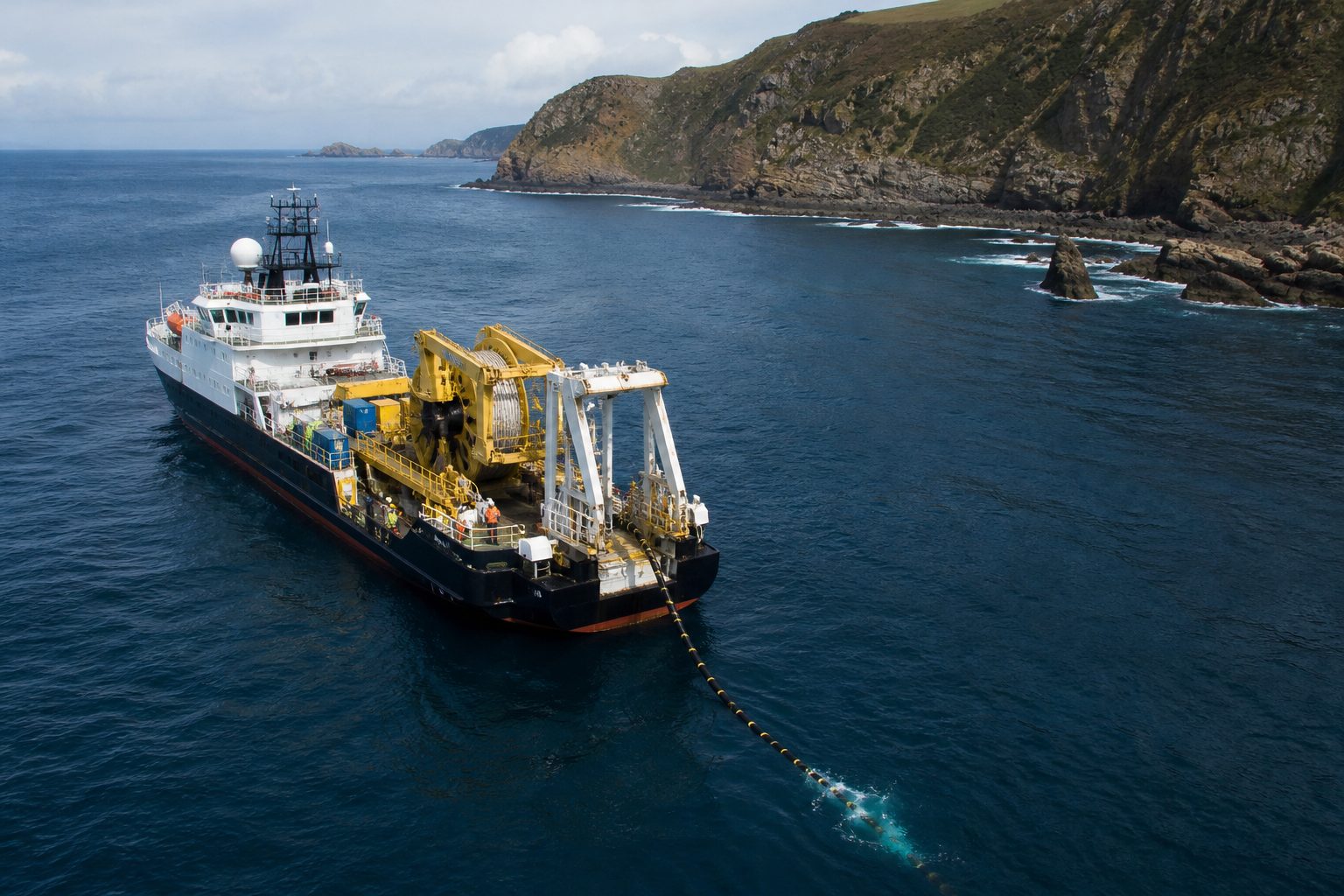
Most international internet traffic does not travel through satellites. It travels through fiber-optic cables laid across the ocean floor.
Those cables carry internet data, phone calls, cloud services, government communications, and financial transactions. They are owned mainly by private companies, operated through commercial consortia, and repaired by specialized vessels. Governments protect them indirectly through maritime law, licensing rules, coast guards, intelligence services, and infrastructure policy.
That arrangement creates a difficult question: how can governments defend a privately owned network without using security threats as a reason to control communications, restrict competition, monitor private data, or bypass due process?
The evidence points to a less dramatic answer than emergency nationalization or unrestricted surveillance. The main weaknesses are usually physical vulnerability, limited route diversity, slow repairs, poor information-sharing, and unclear responsibility. More government power may help in specific areas, but broad authority over private networks could create risks that cable security does not require.
Why a broken cable can affect people far from the sea
A submarine cable fault does not always disconnect an entire country. Modern networks can reroute traffic through other cables, terrestrial fiber, satellites, or alternative landing stations. That redundancy is why a cable can fail while most users notice only slower connections or intermittent service. The Congressional Research Service describes route redundancy, automated detection, and repair vessels as important sources of resilience in the global cable network. [1]
But redundancy is uneven. Some countries and islands have several independent international routes. Others depend on one or two cables. When a volcanic eruption severed Tonga's main international cable in January 2022, the outage disrupted communications, recovery efforts, financial activity, and remittances. The cable linking the main island to Tonga's outer islands also remained out of service for longer. [1]
The impact of a failure depends on what is lost and what remains available:
- Internet traffic may be rerouted through longer paths, increasing latency and congestion.
- Cloud applications may become slower if data centers must communicate through less direct routes.
- Businesses may lose access to payment platforms, authentication services, suppliers, or overseas customers.
- Banks and trading firms may face higher latency and reduced capacity between markets.
- Emergency services and government agencies may have fewer reliable communications paths.
- Repair costs, insurance premiums, and congestion-related costs may rise even when service continues.
Undersea cables carry about 99 percent of transoceanic digital communications, according to a Congressional Research Service report. The report also describes the cables as carrying trillions of dollars in international financial transactions each day. [1] A 2024 CSIS report estimates that subsea cables carry more than 95 percent of international data and notes that one major international bank moves an average of $3.9 trillion through these systems each workday. [2]
The figures vary because organizations use different definitions and datasets. The underlying point is consistent: satellites are not a practical substitute for the world's main intercontinental data network. Submarine cables carry far more capacity at lower cost and lower latency. [1][2]
Private companies own the network, but governments shape its security
The cable network is private in ownership but public in consequence.
Telecommunications companies, cloud providers, technology companies, and cable consortia finance and operate many systems. Google, Amazon, Meta, and Microsoft own or lease around half of global subsea bandwidth, according to CSIS. The companies may own the physical cable, purchase long-term capacity, or lease capacity from another operator. [2]
A small group of specialized companies manufactures and installs much of the world's cable infrastructure. CSIS reported that SubCom, Alcatel Submarine Networks, and NEC held a combined 87 percent of the cable manufacturing and installation market in 2021, while China's HMN Technologies held another 11 percent. [2]
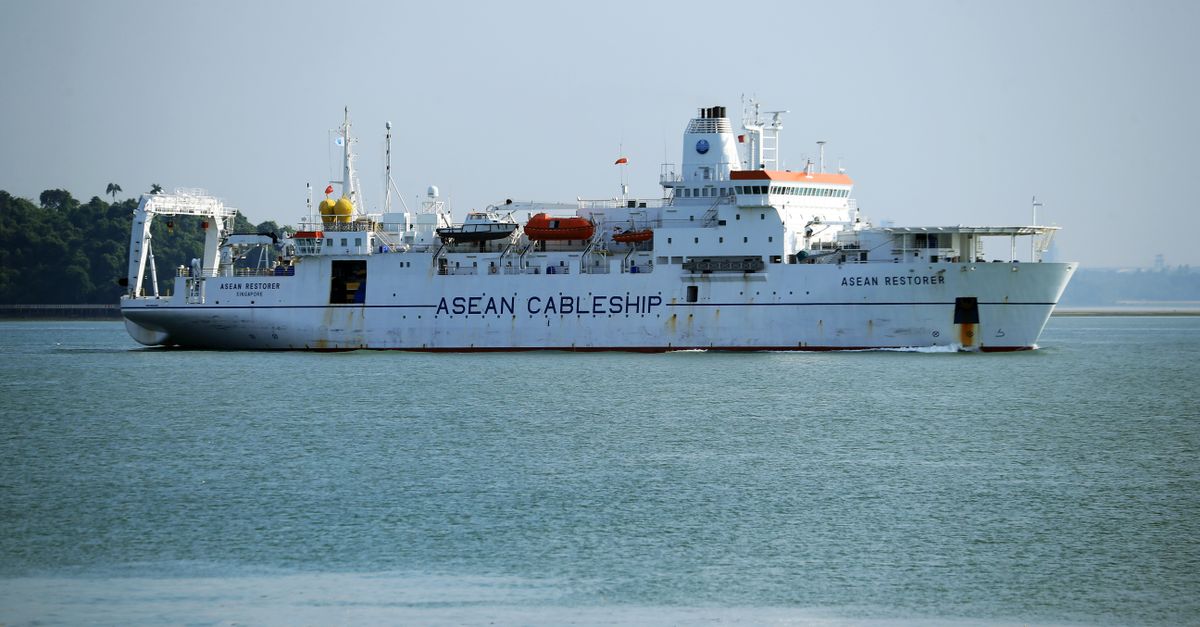
This concentration creates both efficiency and vulnerability. Specialized manufacturers and repair operators provide expertise that would be difficult for governments to reproduce. At the same time, dependence on a small number of manufacturers, repair operators, equipment suppliers, landing stations, or routes can create points of failure. The concentration of manufacturing and installation capacity is documented; the security consequences depend on the specific system and contingency arrangements. [2]
Governments already influence the network in several ways:
- They license cables that land within their territory.
- They review foreign ownership and foreign participation.
- They regulate landing stations and related telecommunications facilities.
- They establish maritime safety rules and protected areas.
- They investigate incidents and enforce criminal or civil law.
- They restrict equipment considered untrusted.
- They coordinate coast guards, navies, intelligence agencies, and private operators.
- They decide how much public money to invest in repair vessels, monitoring, and route diversity.
The United States has strengthened foreign-ownership review, restricted some untrusted equipment, established cable-outage reporting, encouraged trusted infrastructure investment, and expanded its cable-repair fleet, according to the Congressional Research Service. [1]
Those tools do not require governments to own the cables or inspect the content moving through them. That distinction matters. A government can regulate the conditions under which a cable is built, landed, repaired, or connected without gaining a general right to read the traffic it carries.
Most cable damage is still accidental

The security debate often begins with sabotage, but ordinary maritime activity causes most cable faults.
Fishing gear, anchors, dredging, and other human activity can damage a cable. Earthquakes, landslides, volcanic eruptions, and severe weather can also break or bury cables. The Congressional Research Service cited government findings that most disruptions result from human activity or natural disasters, while also noting that the global network has remained resilient because of route redundancy, automated detection, and repair vessels. [1]
Industry estimates commonly place the number of cable faults at roughly 100 to 200 per year. CSIS cited an estimate of 100 to 150 cable breaks annually, mostly caused by fishing equipment or anchors. Al Jazeera cited a higher range from TeleGeography. [2][3]
The frequency of accidental breaks creates a problem for investigators. A hostile actor can potentially make deliberate damage resemble an ordinary accident. Dragging an anchor across the seabed may look similar whether the anchor was dropped by mistake or used intentionally.
That makes motive alone insufficient. Investigators need physical and operational evidence.
Where this story sits
5 related pieces

Hover a story · click to read
 No. 62 · Oct 7, 2026The Authorized Leak: When Lawful Access to National ID Systems Becomes the Vulnerability
 No. 14 · Aug 26, 2026The Quiet Relay: How China-Linked Hackers Turned IoT Devices Into Espionage Highways
 No. 15 · Aug 27, 2026Russia's Dawei Bet: A Megaport on the Front Line of Myanmar's Civil War
 No. 46 · Sep 13, 2026Could a "Rogue AI" Cyberattack Push America Onto Stablecoin Rails?
 No. 55 · Sep 24, 202610 Gigawatts Overhead: The Orbital Data Centers the FCC Reviews One Filing at a Time
How investigators distinguish accidents from deliberate attacks

An investigation may examine:
- The ship's location and course before and during the incident.
- Whether its anchor was deployed and for how long.
- Automatic identification system records and gaps in transmission.
- The vessel's ownership, flag, crew, cargo, and previous activity.
- The location and pattern of seabed damage.
- Whether multiple cables were damaged in a short period.
- Weather, currents, fishing activity, and navigational conditions.
- Statements from the crew and records from the vessel's equipment.
- Whether the ship tried to report the damage or continued on its route.
- Whether the incident fits a wider pattern of state pressure or maritime activity.
None of these indicators proves intent by itself. A ship can lose its anchor, experience faulty navigation equipment, or switch off its automatic identification system for reasons unrelated to sabotage. Conversely, deliberate action may be designed to look accidental.
Recent incidents in the Baltic Sea and around Taiwan show why attribution remains difficult. After the Chinese bulk carrier Yi Peng 3 was associated with damage to two Baltic Sea cables in November 2024, Sweden's Accident Investigation Authority reported in April 2025 that it had found no conclusive evidence that the ship deliberately dragged its anchor. [4]
That finding does not establish that sabotage was impossible. It establishes a narrower point: suspicion and unusual circumstances are not the same as proof.
Taiwanese and European authorities have investigated multiple cable incidents since 2023, including cases involving vessels suspected of dragging anchors. Authorities have raised the possibility of gray-zone activity, but legal jurisdiction, evidence collection, and the rules governing ships in international waters complicate prosecution. [3]
A government that treats every suspicious break as an act of war could escalate a maritime accident into an international crisis. A government that treats every incident as accidental could miss deliberate coercion. The answer is not automatic attribution. It is better evidence, independent investigations, and procedures that allow contested findings to be reviewed.
Who protects and repairs the cables?
Responsibility is divided.
Cable owners and operators are responsible for designing networks, monitoring performance, maintaining contracts, and arranging repairs. They generally build redundancy because a single cable failure is an expected operational risk, not an extraordinary event. [1]
Repair operators maintain specialized ships, crews, cable-handling equipment, and spare cable. Repair vessels must often obtain permission to enter waters, work near shore, or cross maritime jurisdictions. That can make a repair delay a regulatory problem as well as a technical one.
Governments are responsible for the public framework around the network. They can:
- Establish cable-protection zones.
- Mark cable routes on nautical charts.
- Restrict anchoring, dredging, or fishing in sensitive areas.
- Coordinate maritime surveillance.
- Protect landing stations and shore facilities.
- Set reporting requirements for cable damage.
- Speed emergency permits for repair vessels.
- Share information with neighboring states.
- Pursue criminal or civil cases when evidence supports them.
- Support regional repair capacity where commercial incentives are insufficient.
International law also matters. Article 113 of the United Nations Convention on the Law of the Sea addresses the obligation to criminalize or penalize the willful or negligent breaking or injury of submarine cables under specified conditions. The convention does not give one government unlimited authority over cables everywhere. Jurisdiction depends on the location of the vessel, the cable, and the relevant coastal or flag state. [5]
This division of responsibility is a strength when it works. It becomes a weakness when no institution knows who should act first, who may share information, or who pays for resilience measures that benefit the wider public.
The real bottleneck may be coordination, not authority
The United States has faced delays in reviewing cable applications. A 2023 Lawfare analysis reported that Team Telecom reviews, initially expected to take about 120 days, could extend much longer because of repeated questions and screening stages. The article also described disagreements between government officials and industry over which risks deserve priority. [6]
Government officials tend to focus on espionage, foreign ownership, and deliberate tampering. Cable companies may focus more heavily on competition, construction costs, repair access, and ordinary network reliability. Both perspectives are legitimate, but they can produce different decisions. [6]
If national-security reviews become too slow, they can delay new routes and reinforce dependence on existing infrastructure. If governments impose broad restrictions without supporting alternative suppliers, they may reduce competition and increase costs. If industry keeps security information private, governments may struggle to identify coordinated attacks or systemic weaknesses.
A better policy does not begin with emergency powers. It begins by defining the responsibilities that already exist.
Governments should publish clear review timelines, explain the national-security conditions attached to approvals, and provide meaningful avenues for appeal. Cable operators should report outages and credible threats through protected channels while retaining control over commercially sensitive information. Regulators should distinguish between information needed to protect infrastructure and information that would expose customers' communications or business strategies.
Security measures can create surveillance and censorship risks
Undersea cable protection does not inherently require access to the content of communications. The security problem is primarily physical and operational. A government can protect a landing station, monitor a restricted maritime zone, or inspect a repair vessel without collecting the contents of emails, calls, or cloud files.
But infrastructure security can become a pretext for broader control.
Governments could require operators to route traffic through favored facilities, demand access to network logs, pressure companies to disconnect politically disfavored users, or classify ordinary telecommunications decisions as national-security matters. Emergency rules could restrict access to courts, conceal government decisions, or allow indefinite surveillance.
The risks are especially serious because cable infrastructure sits at a chokepoint. A small number of landing stations and international routes connect large populations to the wider internet. Control over those facilities can affect journalists, businesses, civil-society groups, and ordinary users.

Any new security measure should therefore include safeguards:
- Narrow authority. Rules should target physical infrastructure, repair operations, equipment integrity, and specific security threats, not general communications content.
- Judicial oversight. Surveillance or data-access requests should require a lawful basis, independent authorization, and limits on collection.
- Transparency. Governments should publish the legal basis, duration, and general scope of emergency measures, subject to narrowly defined secrecy requirements.
- Independent review. Communications regulators, data-protection authorities, courts, legislatures, and inspectors should be able to examine how powers are used.
- Sunset clauses. Emergency authorities should expire unless renewed through ordinary democratic procedures.
- Competition safeguards. Security rules should not become a way to exclude suppliers or competitors without evidence that a restriction is necessary and proportionate.
- Privacy by design. Operators should share threat information in aggregated or minimized form whenever detailed customer data is not necessary.
- Due process for operators. Companies should receive notice of restrictions and a meaningful opportunity to challenge them, except where immediate action is necessary to prevent imminent harm.
These safeguards are not obstacles to security. They make security measures more credible and reduce the chance that infrastructure protection becomes a permanent expansion of state power.
What better protection looks like in practice
The most defensible approach combines physical protection with network resilience.
Protect cable routes without militarizing the ocean
Protected zones, accurate nautical charts, route marking, and communication with fishing and shipping industries can reduce accidental damage. Maritime authorities can focus surveillance on areas where cables converge near shore or where a failure would isolate a region.
Protection should be risk-based. Not every stretch of seabed requires the same level of monitoring, and broad restrictions on maritime activity could harm fishing, shipping, and coastal communities.
Build more independent routes
Redundancy is more than adding another cable along the same path. Two cables landing at the same station or crossing the same hazard zone may fail together. Operators and regulators should assess whether routes are physically separated, whether they use different landing stations, and whether a country can continue operating if its main route fails.
Governments can encourage route diversity through permitting, public financing, regional agreements, and transparent resilience standards. They should avoid prescribing a single technical design when operators can achieve resilience through different architectures.
Expand repair capacity
A cable network is only as resilient as its ability to restore service. Governments can support repair vessels, spare cable inventories, regional maintenance agreements, and pre-cleared access for repair ships.
Pre-approval does not mean giving repair operators unlimited privileges. It means establishing procedures before an emergency occurs, when delays are most costly.
Improve incident reporting and evidence preservation
Operators, coast guards, maritime authorities, and investigators need compatible reporting systems. Vessel tracking data, seabed surveys, cable alarms, weather records, and repair evidence should be preserved quickly and shared with investigators under clear rules.
The goal is not to publish sensitive security information. It is to prevent every incident from becoming a dispute between governments making public accusations and companies withholding technical evidence.
Separate resilience from content control
The strongest measures address redundancy, equipment security, physical access, repair logistics, and accountability. They do not require governments to control the messages or transactions moving through the network.
That boundary should be written into law, not left to informal assurances.
The lesson from recent failures

Recent cable incidents have exposed real weaknesses, but they have not proved that governments need unlimited emergency authority.
The Tonga outage showed the consequences of geographic dependence. Baltic incidents showed how difficult it can be to distinguish an accident from a deliberate act. U.S. reviews showed how security screening can become slow and burdensome. The broader network shows that redundancy can absorb many failures, but not equally everywhere. [1][4][6]
The evidence supports a practical division of labor. Cable owners should invest in route diversity, monitoring, maintenance, and repair agreements. Governments should protect maritime space, coordinate investigations, set transparent security standards, and provide the legal and financial conditions that make resilience possible. Courts, legislatures, communications regulators, and privacy authorities should constrain the exceptional powers that security agencies may seek.
The central question is not whether governments should protect private cables. They already must. The question is whether protection will mean making the network harder to break, or making it easier for the state to control.
The safer answer is the narrower one: protect the infrastructure, strengthen the evidence, speed the repairs, preserve competition, and keep access to communications outside the reach of unnecessary emergency power.
Sources / References
- Jill C. Gallagher, Congressional Research Service, Undersea Telecommunication Cables: Technology Overview and Issues for Congress, September 13, 2022.
https://www.congress.gov/crs-product/R47237
- Daniel F. Runde, Erin L. Murphy, and Thomas Bryja, Center for Strategic and International Studies, Safeguarding Subsea Cables: Protecting Cyber Infrastructure amid Great Power Competition, August 16, 2024.
https://www.csis.org/analysis/safeguarding-subsea-cables-protecting-cyber-infrastructure-amid-great-power-competition
- Erin Hale, Al Jazeera, As undersea cables break off Europe and Taiwan, proving sabotage is tough, March 10, 2025.
https://www.aljazeera.com/news/2025/3/10/as-undersea-cables-break-down-proving-sabotage-a-difficult-task
- Reuters, Swedish probe finds no conclusive evidence of deliberate cable damage by Chinese ship, April 15, 2025.
https://www.reuters.com/world/europe/swedish-probe-finds-no-conclusive-evidence-deliberate-cable-damage-by-chinese-2025-04-15/
- United Nations, United Nations Convention on the Law of the Sea, Article 113 and related provisions.
https://www.un.org/depts/los/convention_agreements/texts/unclos/unclos_e.pdf
- Joseph B. Keller, Lawfare, The Disconnect on Undersea Cable Security, May 7, 2023.
https://www.lawfaremedia.org/article/the-disconnect-on-undersea-cable-security
The reading behind this research
What the desk leaned on for this piece. Each link goes to the retailer, where the price is shown.
It safeguards the login credentials that could be disrupted when undersea cable failures affect authentication services.
View on Walmart
Netgear Orbi RBK752 Mesh Wi‑Fi 6 System (2‑Pack)
When undersea cable faults raise latency, a strong mesh Wi‑Fi keeps your home connection stable and fast.
View on Walmart
Anker USB‑C to Ethernet Adapter (Gigabit, Shielded)
It lets you keep a stable, low‑latency wired link, which matters as the article notes rerouted traffic can increase latency and congestion.
View on Walmart
SAMSUNG T7 Shield MU PE1T0S 1TB Portable Encrypted SSD USB Gen USB C connector bit AES Black
Because undersea cables are physically vulnerable, having an encrypted SSD lets you keep a secure local copy of essential files.
View on WalmartPaid links. Calibre Code USA may earn a commission from purchases made through these links. This does not affect what we write or what we recommend.
Comments (7)
Continue exploring
Russia's Dawei Bet: A Megaport on the Front Line of Myanmar's Civil War
Russia is backing a deep-sea port on Myanmar's Andaman coast while the army burns villages to clear the land around it, a sign…
Could a "Rogue AI" Cyberattack Push America Onto Stablecoin Rails?
A cyberattack blamed on rogue AI could accelerate America's shift toward stablecoins and tokenized deposits, and the legal…
10 Gigawatts Overhead: The Orbital Data Centers the FCC Reviews One Filing at a Time
SpaceX and Orbital Compute want to put AI data centers in orbit, filings that test whether the FCC can review a strategic system…
The Tonga case was the most useful section because it shows concretely how losing one main cable can disrupt remittances, emergency communication, and outer-island service at the same time.
How does the reported 87 percent market share of three manufacturers affect repair timelines when several cables fail at once?
When a regional cable had trouble near me, video calls dropped and payment terminals stopped working. The rerouting kept basic browsing alive, but it was not a minor slowdown.
I’ve had a cable outage leave my connection completely unusable for nearly a day, not merely slower or intermittent as the redundancy discussion suggests. The backup routes clearly did not help my region much.
The article’s warning about route concentration fits the cable damage reports I’ve been following in the Red Sea—redundancy matters when repairs cannot happen quickly.
The article concludes that broad government authority is unnecessary, but what evidence shows that existing licensing, reporting, and coast-guard tools are enough during a coordinated attack? I’d be excited to see comparative data from countries with stronger versus weaker public oversight.
Private in ownership but public in consequence” is accurate. The companies pay for the infrastructure, while everyone else absorbs much of the disruption when it fails.