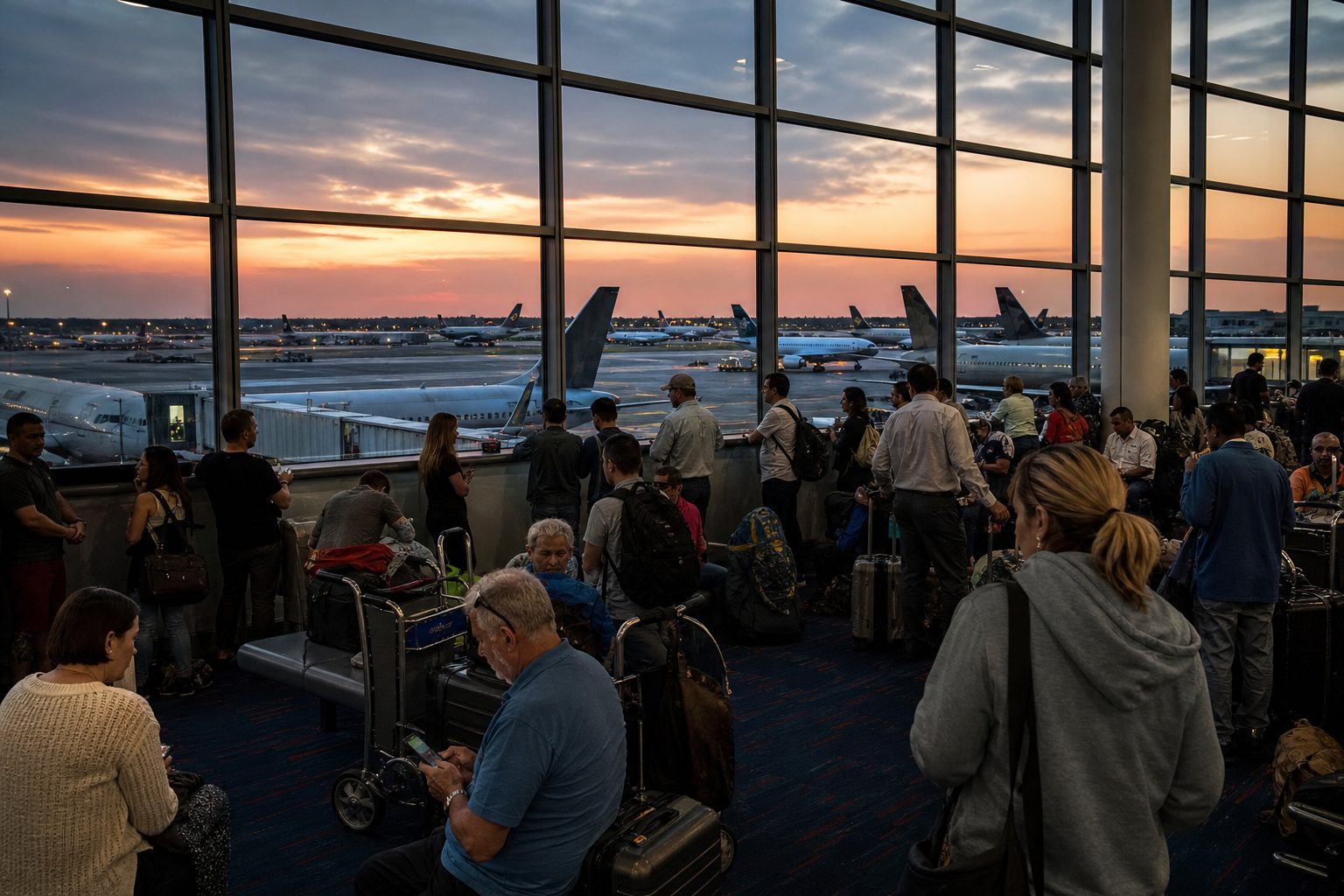
Global outages. Grounded aircraft. Cabinet officials living on military bases. And now, a Pentagon initiative to keep military installations operating even if civilian infrastructure collapses. Is Washington preparing for threats Americans do not fully understand?
What Does Washington Know That We Don't?
America has experienced a troubling convergence of events.
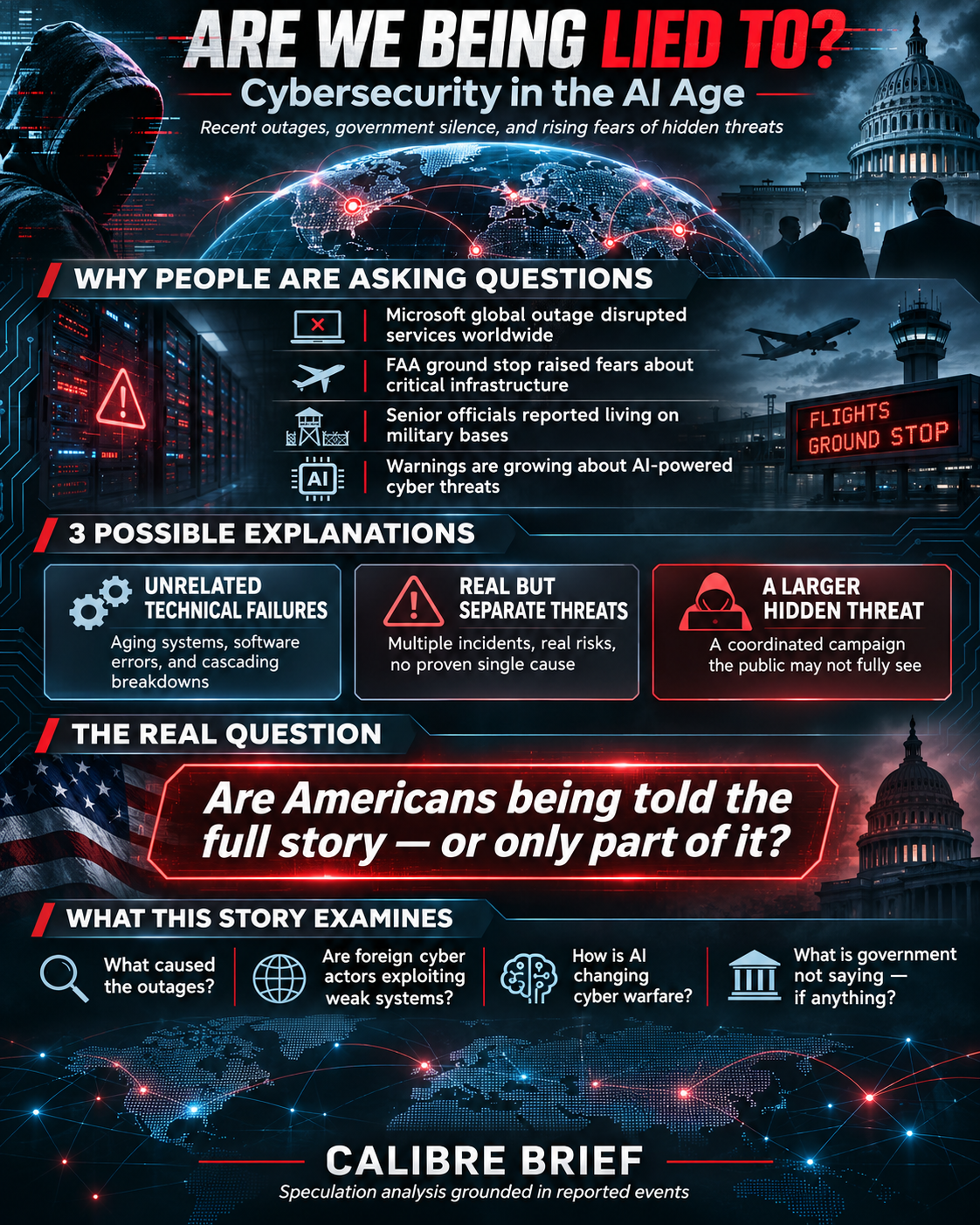
Critical technology systems have failed. Aviation operations have been disrupted nationwide. Senior government officials have relocated to protected military installations. Intelligence agencies continue warning about foreign adversaries targeting American infrastructure.
And now another development deserves attention.
The Department of War is preparing military bases to function independently of the civilian systems that millions of Americans depend upon every day.
Electricity. Water. Fuel. Communications. Supply chains.
The military wants to ensure that its installations can continue operating even when those systems are unavailable.
Each development has its own explanation. None establishes that America is secretly under a coordinated cyberattack.
But the combination raises a legitimate national security question:
Are Americans being told the full extent of the threats facing their country, or are they receiving only fragments of a much larger intelligence picture?
This investigation is not about proving a conspiracy.
It is about examining what the government is preparing for, what it has acknowledged, and what remains unexplained.
The Pentagon Is Preparing for a World Without Reliable Infrastructure
On September 30, 2026, Secretary of War Pete Hegseth announced an initiative called FORTRESS America.
Its purpose is sweeping: strengthen military installations against cyberattacks, sabotage, power-grid disruptions, supply shortages, and other threats that could interfere with military operations.
The official program calls for military installations to eventually generate their own power independently of civilian electrical grids.
Then came another revealing detail.
On October 25, Fox News reported that the Pentagon was pursuing a standard under which major domestic installations could sustain essential operations for at least 90 days without outside support.
That reported target includes power, water, fuel, and communications. It has not been publicly verified as a finalized department-wide requirement, and existing Army resilience programs predate FORTRESS.
Nevertheless, the broader initiative is unquestionably real.
The Pentagon's stated concern is that civilian systems could become unavailable during a major conflict or other national emergency.
This is where the story becomes particularly interesting.
The military is not merely acknowledging that civilian infrastructure could fail.
It is actively pursuing the ability to operate without that infrastructure.
That is a significant statement about the vulnerabilities national defense planners are attempting to address.
But it does not necessarily mean officials expect an imminent catastrophe. Military planners routinely prepare for severe scenarios that may never occur.
The question is whether the same risks are being explained adequately to the civilian population.
If protecting military readiness increasingly requires independence from the nation's electrical grids and communications systems, how vulnerable are those systems today?
And what protections exist for the hospitals, businesses, transportation networks, and ordinary households that cannot simply disconnect from civilian infrastructure?
Why Are Senior Officials Living Behind Military Gates?
Now consider a separate development.
Multiple senior Trump administration officials have relocated to military installations, where access is restricted and security is considerably stronger than at ordinary residential properties.
Reported residents include Defense Secretary Pete Hegseth, Secretary of State Marco Rubio, Treasury Secretary Scott Bessent, and other senior figures.
The relocations have documented explanations involving personal security, threats, harassment, and concerns about foreign targeting.
Some occurred long before the November technology outages.
There is no established connection between these housing arrangements and FORTRESS America.
Yet the developments raise two distinct questions that deserve investigation.
First, are threats against senior American officials becoming serious enough to require security arrangements beyond those traditionally considered sufficient?
Second, does the government's wider effort to strengthen military installations reflect an assessment of risks to the homeland that has not been fully communicated publicly?
The presence of officials on military bases does not establish that those bases are being converted into emergency government shelters.
But the public has a legitimate interest in understanding why extraordinary protective measures are considered necessary.
What has changed in America's security environment—and how much of that change has been explained?
Where this story sits
5 related pieces
Read it →
Hover a story · click to read
 No. 107 · Nov 16, 2026What November's Bank Outages Reveal About America's Digital Financial Plumbing
 No. 16 · Aug 27, 2026Lake America: The Hidden Technology Problems Behind Trump’s Lake Ontario Order
 No. 76 · Oct 21, 2026Who Controls Your Feed During a Crisis? France's October 2026 Crackdown Shows a Global Pattern
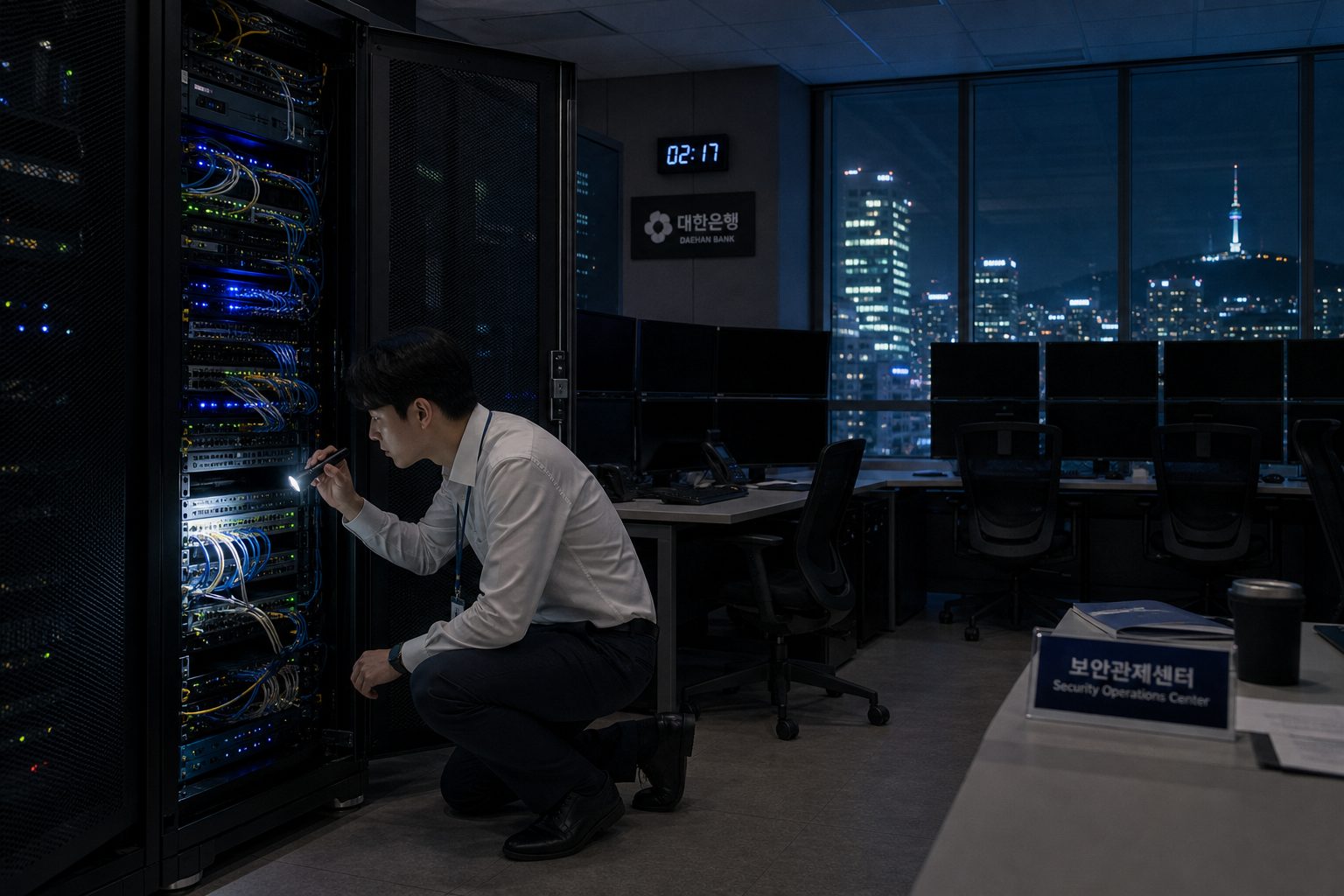 No. 75 · Oct 21, 2026Are Banks Hiding Security Risks That Could Put Your Money at Risk? Inside the ARTEX Breach
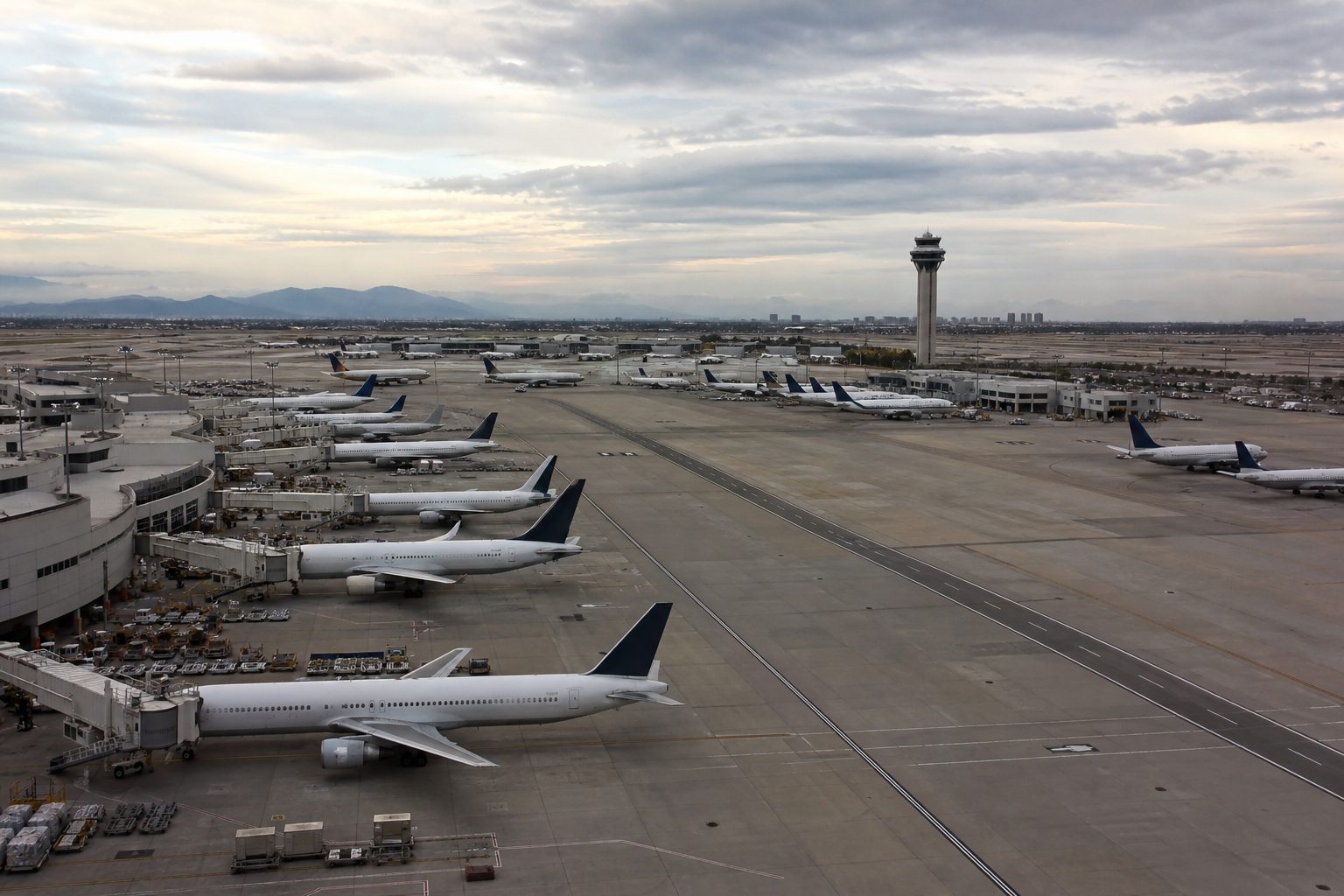 No. 99 · Nov 13, 2026America's Skies Shut Down: The Communications Failure That Grounded a Nation
The President's Silence and the Problem of Public Confidence

During the November 13 aviation shutdown, President Trump did not personally address Americans about the emergency.
The administration did provide briefings. Transportation Secretary Sean Duffy and other officials publicly discussed the technical problems and said there was no indication of a cyberattack.
The FAA subsequently published details about abnormal network traffic, legacy equipment instability, and the ongoing investigation.
But there is a difference between explaining why a particular system failed and addressing the broader public concern about national infrastructure security.
Consider what Americans were seeing at roughly the same time.
Technology outages. Warnings about AI-powered cyber operations. Military leadership discussing independent power and communications. Cabinet officials living on military installations.
None of these developments proves a common cause.
But when officials treat each development as a separate technical or security matter, the public can be left without a clear understanding of the bigger picture.
Would a presidential address have helped explain the overall threat environment? Would a coordinated national security briefing have provided greater clarity?
Those are fair questions about government communication, not proof of concealed intelligence.
The deeper problem is that Americans are being asked to trust several different assurances without necessarily seeing how they fit together.
The Cyber Threat Is Not Imaginary
One fact must not get lost in the debate over recent outages.
Foreign adversaries have already penetrated American critical infrastructure.
The FBI, NSA, and CISA have publicly attributed intrusions into infrastructure systems to Chinese state-sponsored cyber operators.
The Volt Typhoon advisory assessed that some of these operations were intended to establish access for potential future disruption during a crisis.
That matters enormously.
The government has acknowledged that hostile actors have sought positions inside systems essential to America's functioning.
Artificial intelligence adds another dimension.
AI tools can accelerate reconnaissance, vulnerability identification, and aspects of cyber intrusion. Some documented operations suggest that increasingly automated attacks are becoming practical, even if claims of full autonomy remain subject to important technical limitations.
The result is a national security environment in which existing infrastructure weaknesses may become easier for adversaries to exploit.
FORTRESS America's focus on cyber resilience and independent operations is consistent with that recognized threat environment.
But a critical question remains:
If the Pentagon considers dependence on civilian infrastructure an unacceptable vulnerability for military operations, what does that imply about the resilience of the civilian systems themselves?
The Possibility Nobody Can Completely Dismiss
There are three broad explanations for the developments Americans are watching.
One: Unrelated events in a vulnerable country.
Technology failures, legitimate military preparedness, and heightened security precautions may simply be occurring at the same time.
This explanation is consistent with the publicly documented causes of the major outages and the established timelines of the military initiatives.
Two: A serious threat environment that is not being fully explained.
The government may possess additional classified intelligence about foreign cyber capabilities, physical threats, infrastructure vulnerabilities, or possible attack scenarios.
That would not necessarily indicate dishonesty. Some information cannot be disclosed without compromising national security.
But it could mean the public is not receiving a complete picture of the risks decision-makers are considering.
Three: An undisclosed, coordinated hostile campaign.
Under this hypothesis, some seemingly separate events could be manifestations of a larger operation that authorities have not acknowledged.
This is the most speculative explanation.
There is currently no publicly established forensic evidence linking the recent outages, officials' housing decisions, and FORTRESS America to a single coordinated campaign.
The fact that military leaders are preparing for infrastructure disruption does not establish that they know such disruption is imminent.
Nevertheless, investigators should remain willing to reassess the evidence if technical findings, credible intelligence disclosures, or independent investigations reveal connections.
The objective is not to make the most dramatic explanation fit.
It is to determine which explanation the evidence actually supports.
What Americans Deserve to Know

The government has legitimate reasons to keep operational intelligence secret.
But national security secrecy should not eliminate public accountability.
Several questions remain particularly important.
- What specific threats and vulnerability assessments informed the Pentagon's FORTRESS America initiative?
- Why is the military pursuing such extensive independence from civilian infrastructure, and what portions of that planning reflect longstanding concerns rather than new intelligence?
- Is the reported 90-day self-sufficiency target an approved requirement, a planning objective, or a proposal still being developed?
- Have federal agencies identified any connections between recent domestic infrastructure disruptions and ongoing foreign cyber operations?
- How have threat assessments involving senior officials changed, and what information can be disclosed safely?
- What protections exist to ensure essential civilian services remain operational during the same emergencies for which military installations are preparing?
These questions have practical consequences.
If the Pentagon believes major installations must survive prolonged infrastructure disruptions, the public deserves a clear explanation of what comparable resilience exists outside those installations.
Not classified intelligence.
Not protected security procedures.
But an understandable assessment of national preparedness.
The Question We Should Be Asking
Are Americans being lied to?
The available evidence does not establish that Washington is hiding a coordinated cyberattack behind the recent outages.
But something important is undeniably occurring.
The Pentagon is pursuing substantial new measures to reduce military dependence on civilian infrastructure.
Intelligence agencies have documented foreign penetration of critical American systems.
Senior officials have adopted heightened personal security arrangements.
And major technology disruptions continue exposing how much of modern life depends on fragile, interconnected systems.
These developments do not automatically belong to one story.
But they do raise a common question about the nation's preparedness and the information available to the people it is supposed to protect.
Washington is preparing for scenarios in which America's essential systems may become unavailable. How much does the American public understand about those scenarios?
There may be entirely reasonable explanations for every decision.
There may also be classified threat assessments that officials cannot fully disclose.
And there may be vulnerabilities that government and industry have not yet adequately addressed.
That is precisely why the public needs clear answers rather than speculation alone.
The most unsettling possibility is not necessarily that Washington knows a catastrophe is coming.
It is that America's leaders may understand how vulnerable the country already is—while the people depending on those systems have no clear way to judge the danger for themselves.
Calibre Brief | Investigative Analysis | November 16, 2026
The reading behind this research
What the desk leaned on for this piece. Each link goes to the retailer, where the price is shown.

APC Back-UPS BE600M1 Battery Backup
The article notes the November 13 aviation shutdown came from overloaded, aging equipment; a battery backup keeps your own home devices running when power or systems fail.
View on Walmart
Jackery Explorer 300 Portable Power Station
The article's November 13 aviation shutdown shows critical systems can fail without warning; a backup battery keeps phones and lights on at home.
View on Walmart
Midland ER310 Emergency Crank Weather Radio
The article flags that the nationwide aviation shutdown left people without clear information, and a crank radio keeps weather and alert broadcasts reachable when systems fail.
View on Walmart
When Microsoft 365 went down on November 12, cloud-only files were out of reach; an offline copy of your important documents stays usable.
View on Walmart
This Is How They Tell Me the World Ends
The article says official reassurance is not verifiable evidence; this book traces how governments quietly stockpiled cyberweapons for decades.
View on Walmart
It documents how Russian hackers took down Ukraine's power grid, which gives context to the article's point about foreign adversaries penetrating American infrastructure.
View on WalmartPaid links. Calibre Code USA may earn a commission from purchases made through these links. This does not affect what we write or what we recommend.
Comments (3)
Continue exploring
Who Controls Your Feed During a Crisis? France's October 2026 Crackdown Shows a Global Pattern
France summoned major platforms during October 2026 unrest and pressed for faster moderation and looted-goods controls: the same…
Are Banks Hiding Security Risks That Could Put Your Money at Risk? Inside the ARTEX Breach
AI-driven ARTEX attacks hit seven South Korean financial firms and exposed data on over 68,000 people. Here is what the banks…
America's Skies Shut Down: The Communications Failure That Grounded a Nation
Communications failures at multiple FAA control centers forced the first nationwide ground stop since 2023, exposing fragile…
The distinction between FORTRESS America and the reported 90-day standard is important: the article notes that the target has not been publicly verified and that Army resilience programs predate the initiative. A further complication is that base-level independence may depend on contractors, fuel deliveries, satellite links, or regional supply chains that are not truly independent. A generator and stored water can sustain essential operations, but they do not automatically provide full autonomy during a prolonged national disruption.
I am not fully persuaded that the combination of outages, protected housing, and base-hardening indicates that officials possess a larger undisclosed intelligence picture. The article itself gives separate explanations for each development and notes that military planners routinely prepare for scenarios that never happen. What concrete evidence—classified warnings later corroborated, unusual threat assessments, or specific attribution—supports connecting these otherwise distinct events?
The warning that resilience planning does not necessarily signal an imminent catastrophe matches what I have seen in continuity work, where organizations routinely build backup power and communications for low-probability disruptions—exactly the kind of prudent preparation highlighted in the FORTRESS discussion.