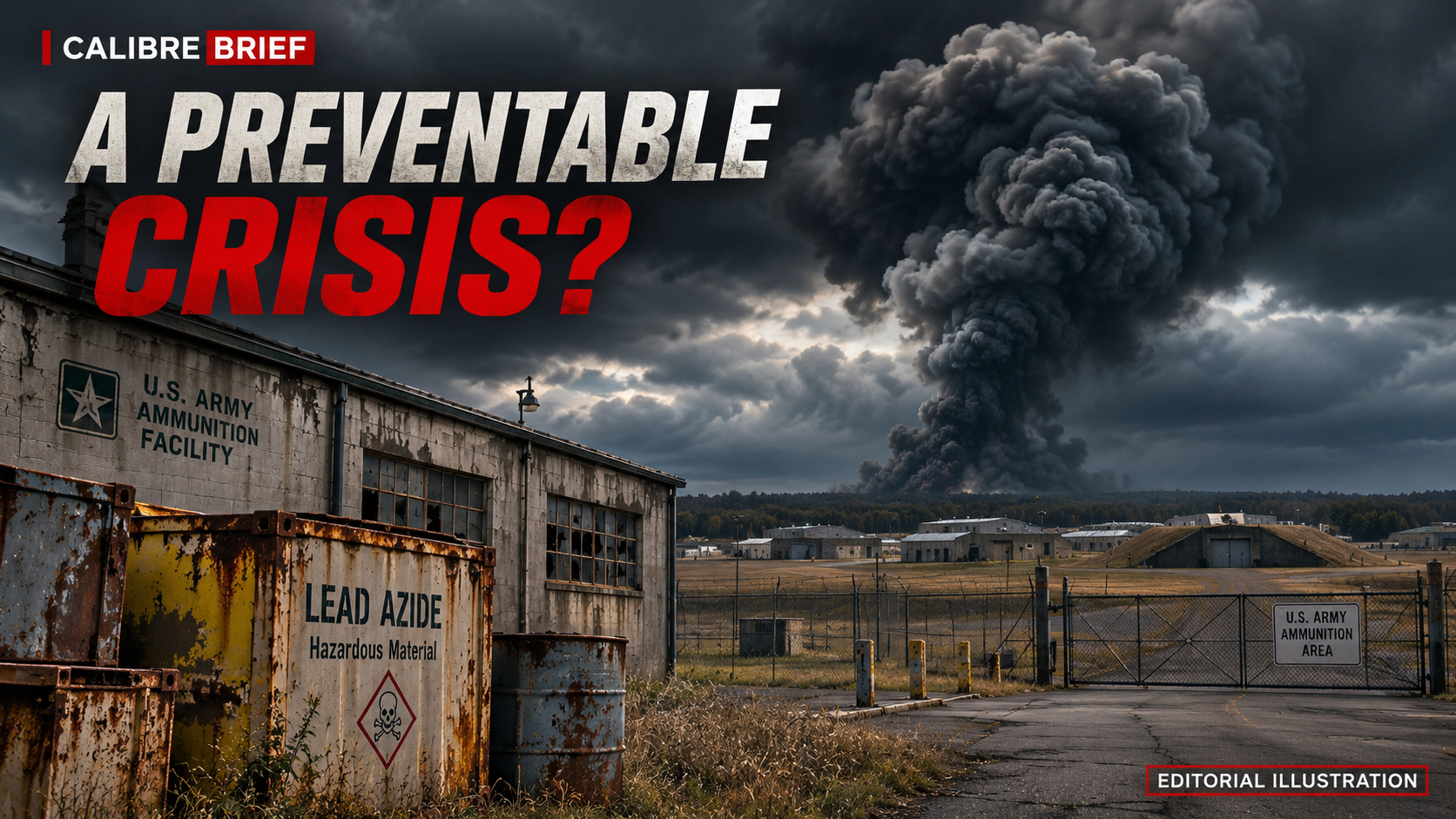
The Army’s detonation may have been the safest option once the material had recrystallized inside aging containers. But the public record also shows that disposal planning began months before the Army says it recognized an emergency. The unresolved question is not simply whether the final blast was justified. It is whether earlier inspection, treatment, or disposal could have prevented officials from choosing between a dangerous chemical operation and nearly five tons of explosives.
Key takeaways
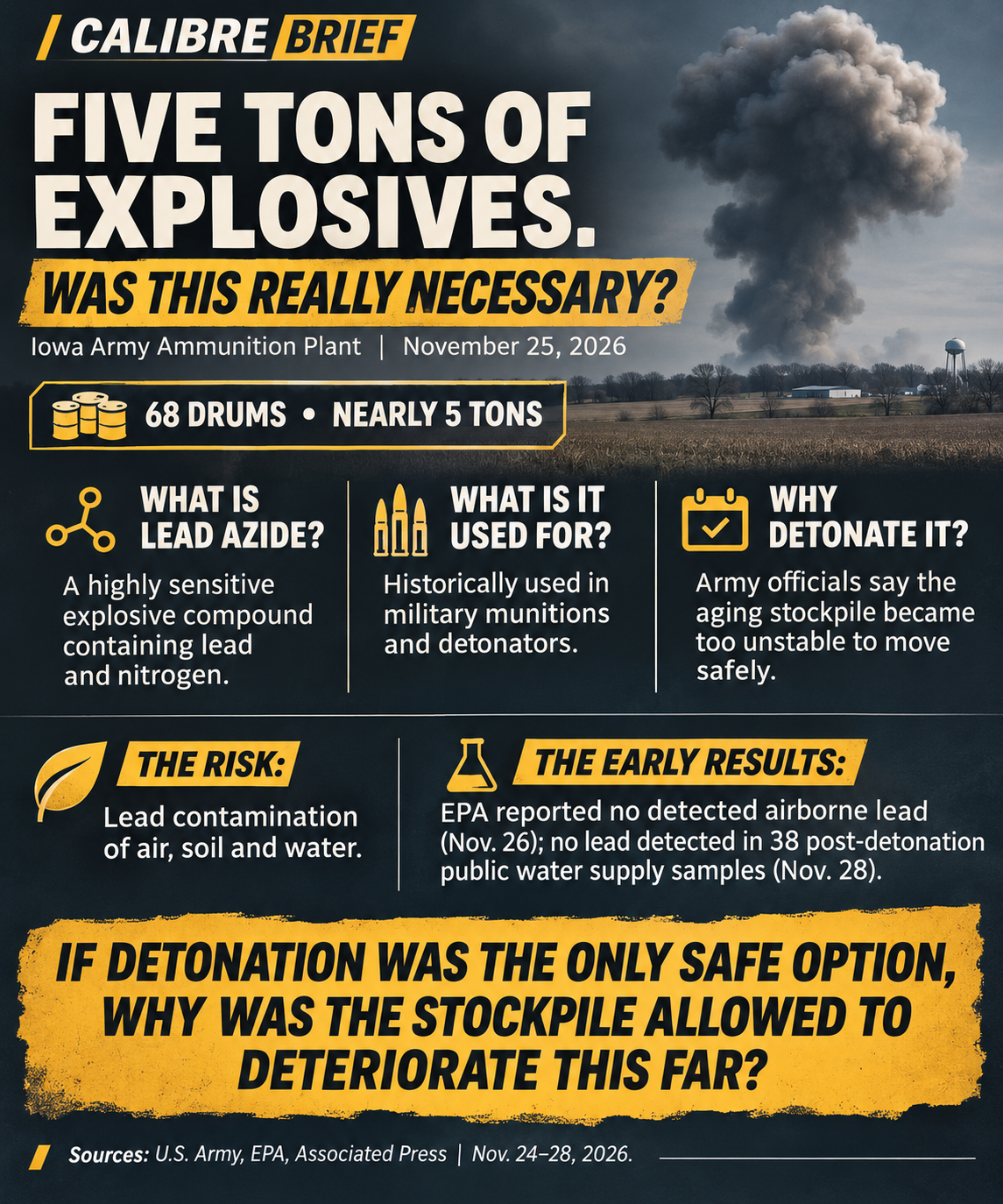
- The Iowa Army Ammunition Plant held roughly 9,500 to 10,000 pounds of lead azide, much of it already decades old when the stockpile was consolidated there around 2009. (Associated Press)
- Chemical neutralization was considered, and a contractor received a contract, but Army officials concluded that opening or disturbing the crystallized containers posed an unacceptable explosion risk. (Iowa Public Radio)
- Documents reviewed by reporters indicate that disposal concerns surfaced by September 2025, months before the Army’s public account of the March 2026 discovery. (The Washington Post)
- EPA permitting and monitoring addressed the immediate operation, but the available public record does not establish that important environmental questions about airborne lead, soil, water, and wildlife have been resolved. (EPA)
Why the Army stored lead azide in Iowa

Lead azide is a primary explosive, meaning it is designed to initiate a larger, less-sensitive explosive. Its chemical formula is Pb(N₃)₂. It is used in small initiating charges in detonators, primers, blasting caps, cartridges, and artillery or grenade fuzes. (U.S. Army Medical Center of Excellence)

That sensitivity is its military purpose and its disposal problem. Lead azide can react to impact, friction, heat, and vibration. With age, it can crystallize or recrystallize into a more dangerous form. The crystals may adhere to surfaces inside containers, creating hazards when workers try to open or move them. (CDC, “D. Lead Azide”)
The Iowa plant did not manufacture or store the material by accident. The Army consolidated lead azide from other facilities at the Middletown installation around 2009. The stockpile occupied 68 containers in earth-covered magazines. Some of the material was already decades old. (Associated Press)
That decision created a long-term management obligation. Lead compounds were already identified as potential contaminants at the installation under its federal facility environmental agreement. (EPA, Iowa Army Ammunition Plant Federal Facility Agreement) The issue was therefore both an explosives-safety problem and a hazardous-waste problem.
The timeline raises a question the blast did not answer

The Army says a routine safety inspection on March 11, 2026, found that the lead azide had partially crystallized. The condition increased its sensitivity to friction, shock, vibration, heat, and falling temperatures. Officials feared that the material could detonate without an initiating event. (U.S. Army)
The Army notified the EPA about the emergency around March 12. By March 24, officials described the lead azide as recrystallized and increasingly dangerous to handle. A multiagency panel reportedly recommended chemical neutralization on March 19. The Army awarded MuniRem Environmental a contract on March 25, and documents in April identified the contractor’s chemical reagent as the preferred treatment. (Iowa Public Radio)
But the March inspection was not necessarily the first warning. American Ordnance, the plant operator, contacted MuniRem for a disposal quotation on September 24, 2025. A federal contracting notice posted that month also contemplated lead-azide neutralization. The Washington Post reported that internal emails showed disposal concerns before the Army’s public account of its discovery. (The Washington Post)
Those facts do not prove that the Army ignored a known imminent explosion. They do establish a narrower and important conflict: disposal planning appears to have begun months before the Army publicly described the stockpile as an emergency. The record does not yet show exactly what officials knew in September, who was responsible for escalating the concern, or whether the earlier inquiry described the same deterioration later found in March.
Where this story sits
5 related pieces
Read it →
Hover a story · click to read
 No. 36 · Sep 5, 2026The Army Is Turning Military Land Into an AI Compute Platform
 No. 40 · Sep 7, 2026The Army's launched-effects bet: a faster upgrade cycle for autonomous strike systems
 No. 98 · Nov 13, 2026Brooklyn Building Collapse: Eight Dead, Earlier Warnings, and Questions About Construction Oversight
 No. 93 · Nov 6, 2026The Learjet Had an Earlier Turbulence Struggle. Was Something Missed?
 No. 82 · Oct 27, 2026When a Prime Minister Orders an Attack, Who Can Stop It?
Why chemical treatment was abandoned
Chemical neutralization offered an environmental advantage. Instead of detonating the explosive and dispersing combustion products and lead-bearing dust, workers would use a reagent to render the lead azide non-explosive. The Iowa Environmental Council described it as the principal non-detonation alternative because it could substantially reduce airborne lead emissions. (Iowa Environmental Council)

MuniRem’s proposal was not shown to have failed in laboratory chemistry. According to Iowa Public Radio’s account of the documents, laboratory tests supported the neutralization process. The unresolved danger was physical access to the material. Workers would still have to open, manipulate, wet, or otherwise contact containers holding shock-sensitive crystals. Army, Bureau of Alcohol, Tobacco, Firearms and Explosives, and explosives-safety reviewers concluded that this handling could trigger an uncontrolled detonation. (Department of the Army filing)
That distinction matters. Chemical neutralization may have been safer for the environment while being more dangerous for the workers performing it. The Army’s decision therefore compared two different kinds of risk: a planned blast with modeled and monitored releases, versus prolonged hands-on work around material that might explode during the first steps of treatment.
On May 8, former Army Secretary Dan Driscoll selected controlled detonation. The Army formally declined to exercise the chemical-treatment portion of MuniRem’s contract on May 14. A planned technical meeting with the contractor was requested but never held, according to Iowa Public Radio. (Iowa Public Radio)
The record documents why the Army considered detonation the safer emergency option. It does not independently establish that chemical treatment was operationally safe or that the alternative received a complete comparison before the decision was made. That gap is the central weakness in the claim that the explosion was simply unavoidable.
What the blast risked, and what monitoring can prove
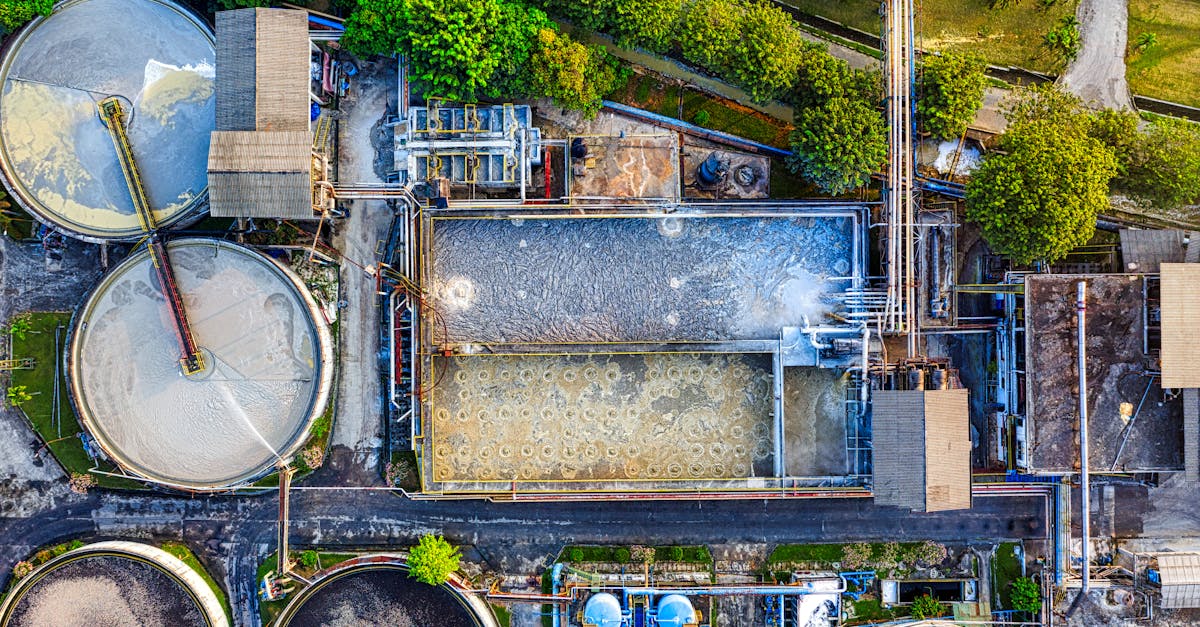
The Army used earth-covered magazines and planned sand barriers, water walls, gel blocks, foam, drones, atmospheric modeling, and extensive air, soil, water, and dust monitoring. (U.S. Army)
Those controls reduce risk. They do not make the event risk-free. A detonation can produce a blast wave, debris, smoke, and airborne particles. Lead is persistent and toxic, so possible environmental pathways include dust settling on soil and farmland, runoff into surface water, and exposure to workers, residents, livestock, and wildlife. The presence of a potential pathway is not proof that contamination occurred.
The EPA issued an emergency hazardous-waste permit effective November 13 and coordinated monitoring connected to the operation. (EPA) Missouri officials also coordinated monitoring of public surface-water systems because connected waterways could affect regional drinking-water supplies. (Missouri Department of Natural Resources)
The strongest responsible conclusion is limited. Monitoring was designed to determine whether the detonation released measurable contaminants. The public record available here does not establish that surrounding farmland, drinking water, or wildlife were contaminated, and it does not establish that they were unaffected. Final air, soil, water, and dust results, sampling locations, detection limits, and follow-up plans matter more than online maps or speculation about a visible fallout path. The Associated Press found that widely circulated maps claiming to show such a path were false. (Associated Press)
Earlier action could have changed the choice
The available evidence does not prove that an earlier intervention would have made chemical treatment safe. Lead azide can deteriorate gradually, and the point at which a container becomes too dangerous to open may arrive before officials have a practical way to empty it.

It does show why the Army’s oversight deserves scrutiny. A plant operator sought disposal assistance in September 2025. The Army says it discovered the acute condition during a March 2026 inspection. Between those dates, no public record identified here explains whether the stockpile received enhanced inspection, whether the containers were tested without disturbing them, or why disposal planning did not produce a completed treatment before the situation worsened.
The accountability chain is also divided. The Army made the disposal decision, American Ordnance operated the facility, and the EPA issued the emergency permit. Iowa environmental officials and neighboring states focused on monitoring and public protection. Environmental groups challenged the permit, but the Eighth Circuit ultimately allowed the operation to proceed. (Associated Press)
That structure can protect the public during an emergency, but it can also make responsibility diffuse. The next meaningful test is documentary: release the inspection records, the September disposal inquiry, the alternatives analysis, the MuniRem technical proposal, the Army’s risk calculations, and the complete environmental results. Those records could show whether the blast was the least dangerous available option, or the endpoint of a preventable delay.
The detonation may have been necessary by November. The evidence now available is not strong enough to say that the emergency itself was unavoidable.
Sources/References

- U.S. Army Medical Center of Excellence, “Occupational Health: The Soldier and the Industrial Base, Chapter 9: Military Energetic Materials,” https://medcoe.army.mil/pfw-images/borden/occ-health/OHch9.pdf
- Centers for Disease Control and Prevention, “D. Lead Azide,” https://stacks.cdc.gov/view/cdc/204943/cdc_204943_DS1.pdf
- Associated Press, “The US Army has detonated a 5-ton stockpile of lead azide in Iowa. Here’s what to know,” https://apnews.com/article/bcf34962047409a8b770208c71c0d5bb
- U.S. Army, “Public Safety Advisory: Controlled, Mitigated Detonation of Unstable Lead Azide at Iowa Army Ammunition Plant,” https://www.army.mil/article/297039/public_safety_advisory_controlled_mitigated_detonation_of_unstable_lead_azide_at_iowa_army_ammunition_plant
- Iowa Public Radio, “Army chose to blast unstable lead azide days after contractor submitted a chemical treatment plan,” November 24, 2026, https://www.iowapublicradio.org/environment/2026-11-24/army-blast-unstable-lead-azide-contractor-chemical-treatment-plan
- The Washington Post, “Warning signs at Iowa plant emerged months before Army says it knew, emails show,” November 24, 2026, https://www.washingtonpost.com/climate-environment/2026/11/24/warning-signs-iowa-plant-emerged-months-before-army-says-it-knew-emails-show/
- U.S. Environmental Protection Agency, “Iowa Army Ammunition Plant, Middletown, Iowa,” https://www.epa.gov/ia/iowa-army-ammunition-plant-middletown-iowa-3
- U.S. Environmental Protection Agency, “Iowa Army Ammunition Plant Federal Facility Agreement,” https://www.epa.gov/system/files/documents/2025-06/iowaarmyammunitionplant_1991.pdf
- Iowa Environmental Council, “IEC Issues Statement in Response to Detonation Delay and Lawsuit Developments, Plus FAQ Document,” https://www.iaenvironment.org/newsroom/council-news/statementfaq
- Department of the Army, opposition to emergency motion for stay, https://www.bleedingheartland.com/static/media/2026/11/26-3374_Documents-opposition-to-emergency-motion-for-stay.pdf
- Missouri Department of Natural Resources, “Iowa Lead Azide Detonation,” https://dnr.mo.gov/iowa-lead-azide-detonation
- Associated Press, “FACT FOCUS: Maps online falsely claim to show the path of fallout from Iowa lead azide detonation,” https://apnews.com/article/8bed026de43c6c68abf8e7230a6d4f4c
The reading behind this research
What the desk leaned on for this piece. Each link goes to the retailer, where the price is shown.

Water Testing Kits for Drinking Water: 125 Strips 16 in 1
The article notes the EPA record leaves open whether airborne lead reached soil and water, so checking a home tap for lead is one way to follow up.
View on Walmart
Temtop M10 Air Quality Monitor
The article notes the public record has not resolved questions about airborne lead after the blast, so checking particulate levels at home gives some data.
View on Walmart
ZeroWater 10-Cup Water Filter Pitcher
The article notes questions about lead in water near the Iowa plant remain unresolved; a pitcher certified to reduce lead can help at the tap.
View on Walmart
Toxic Truth: A Scientist, a Doctor, and the Battle over Lead by Lydia Denworth
The article says airborne lead, soil, and water questions remain unresolved; this book explains how scientists proved lead's harm.
View on Walmart
3M Aura 9205+ N95 Respirator (pack)
The article says questions about airborne lead after the Iowa blast remain open; a fitted respirator is basic protection against that kind of dust.
View on Walmart
Levoit Core 300 HEPA Air Purifier
The article notes the EPA record leaves open questions about airborne lead after the blast; a HEPA filter can cut fine particles in indoor air.
View on WalmartPaid links. Calibre Code USA may earn a commission from purchases made through these links. This does not affect what we write or what we recommend.
Comments (9)
Continue exploring
Brooklyn Building Collapse: Eight Dead, Earlier Warnings, and Questions About Construction Oversight
Months before eight people died at 1321 Flatbush Avenue, a survey documented cracks in the building and the neighboring project…
The Learjet Had an Earlier Turbulence Struggle. Was Something Missed?
A Learjet that crashed in Florida had earlier struggled to maintain altitude near Newark. The public evidence raises questions…
When a Prime Minister Orders an Attack, Who Can Stop It?
Reports that Israel’s military chief sought written authorization for possible Iran action reveal how law, intelligence, and…
In my experience handling aged primary explosives, remote opening and sampling of sealed containers was completed without incident, so the article’s suggestion that any disturbance was necessarily unacceptable seems too broad.
The distinction between a disposal concern in September and an imminent detonation risk in March is excellent. Those are not the same threshold, and the article is right not to treat them as proof of negligence. I would also like to see how temperature records, container histories, and inspection methods affected that change in risk.
The phrase “long-term management obligation” is accurate. Consolidating roughly 9,500 to 10,000 pounds into 68 containers around 2009 created a foreseeable stewardship problem. The later emergency did not erase that earlier decision.
The discussion fits a broader pattern in hazardous-material management, where regulators approve an immediate operation while longer-term contamination questions remain open. The article’s references to airborne lead, soil, water, and wildlife resemble the unresolved monitoring issues that followed other demolition projects. In practice, the post-blast sampling plan can matter nearly as much as the permit for the blast itself.
The central lesson is that a technically defensible final blast can still reflect years of inadequate hazardous-material planning. Practically, facilities storing aging lead azide should set inspection, escalation, and treatment triggers well before crystallization becomes an emergency.
What specific evidence led officials to conclude that MuniRem’s reagent was too dangerous or impractical after the March 25 contract was awarded?
I am not entirely convinced that the September 24, 2025 quotation request proves the Army had an earlier warning about this exact deterioration, since the article acknowledges that the records may concern a broader disposal effort. It is a fair reason to demand clarification, but not yet a strong basis for assigning fault.
The timeline section was the most useful because it puts the September 24, 2025 quotation request beside the Army’s March 11 inspection and March 2026 emergency account. That makes the unresolved responsibility issue concrete rather than abstract.
How would the proposed chemical neutralization process work for a smaller installation without the Army’s multiagency panel, EPA involvement, and specialized contractor support? That comparison would be fascinating.