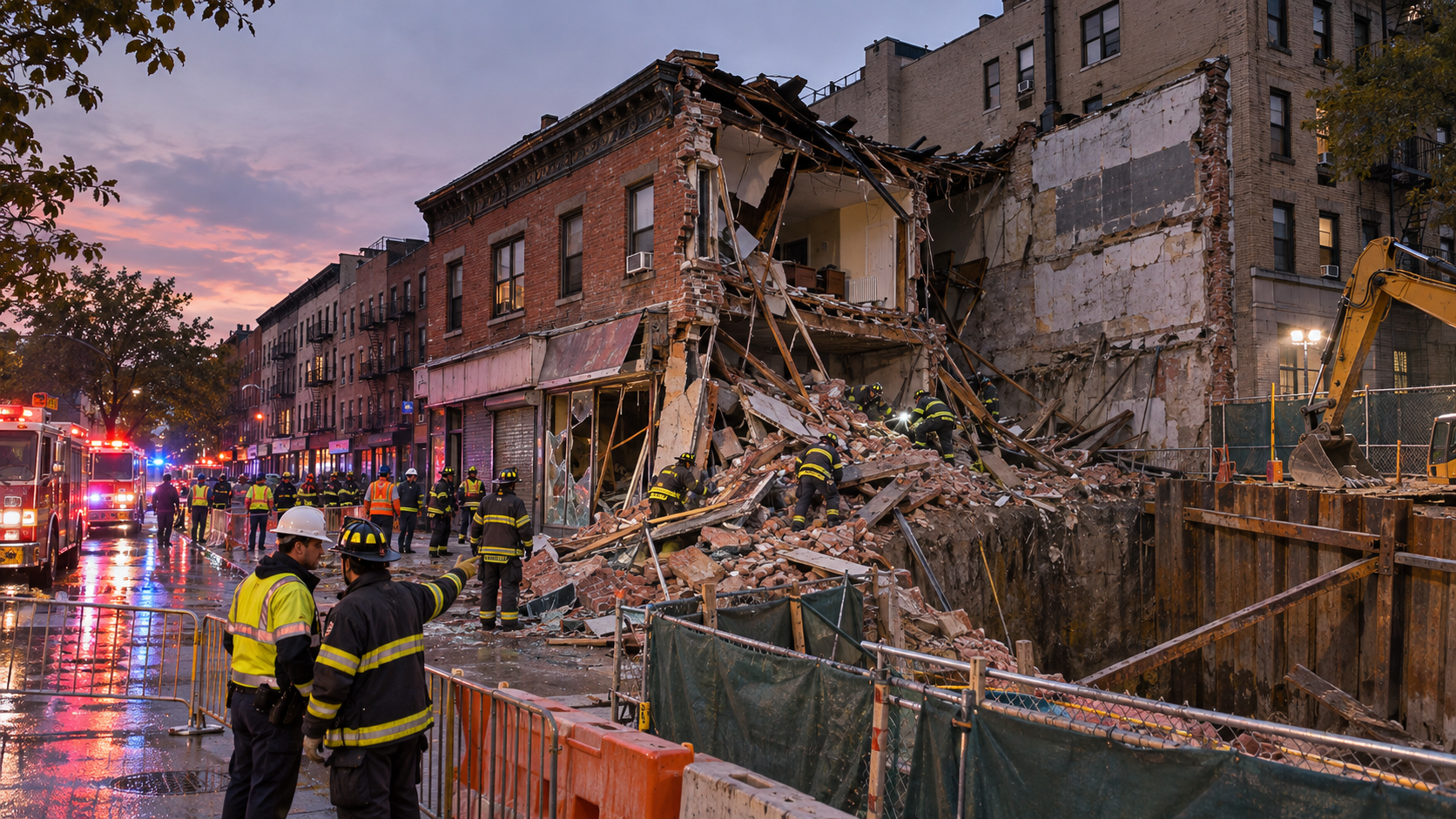
Eight people, including two children, died on November 11 when a three-story building at 1321 Flatbush Avenue in Brooklyn collapsed beside an active excavation at the neighboring construction site, 2625 Bedford Avenue. As many as 18 others were injured, among them firefighters who dug through the rubble (ENR; AP).
The collapse was sudden. The warnings were not. A survey filed with the city in March photographed cracks in the building's facade and rated the wall facing the excavation "poor" (News 12). That same month, city inspectors shut the neighboring project down for failing to protect adjacent properties, and in April they caught the contractor working anyway, in defiance of the order (Construction Dive).
Whether those were isolated paperwork problems or missed chances to prevent a disaster is now the central question for investigators and for a city that has ordered inspections at roughly 100 other construction sites tied to the companies involved (ABC News). The honest answer, for now, is that the record shows documented violations and plausible contributing factors, but no proven cause. The gap between those three things is where this story lives.
How the collapse unfolded
The building that fell was a mixed-use structure dating to 1930, with a medical-uniform store at street level and four apartments above (AP; property records). On November 11 it fell into the adjoining excavation at 2625 Bedford Avenue, where workers were digging for a new development (AP).
Firefighters reportedly reached the scene in under a minute, pulled people from the damaged neighboring building, and began searching the debris for survivors (ABC7). Six victims were pronounced dead at the scene; two more died at hospitals overnight. By Thursday afternoon, the day after the collapse, the FDNY had searched the entire site, determined no one remained trapped, and concluded rescue operations (ABC News). Mayor Zohran Mamdani confirmed the final toll: six adults and two children dead (AP).
The site was then handed to the Department of Buildings and the NYPD for recovery work, structural inspections, and a criminal and regulatory investigation. Officials issued a stop-work order, placed three nearby buildings under vacate orders, and ordered the inspection sweep of sites linked to the companies on the project (ABC News).
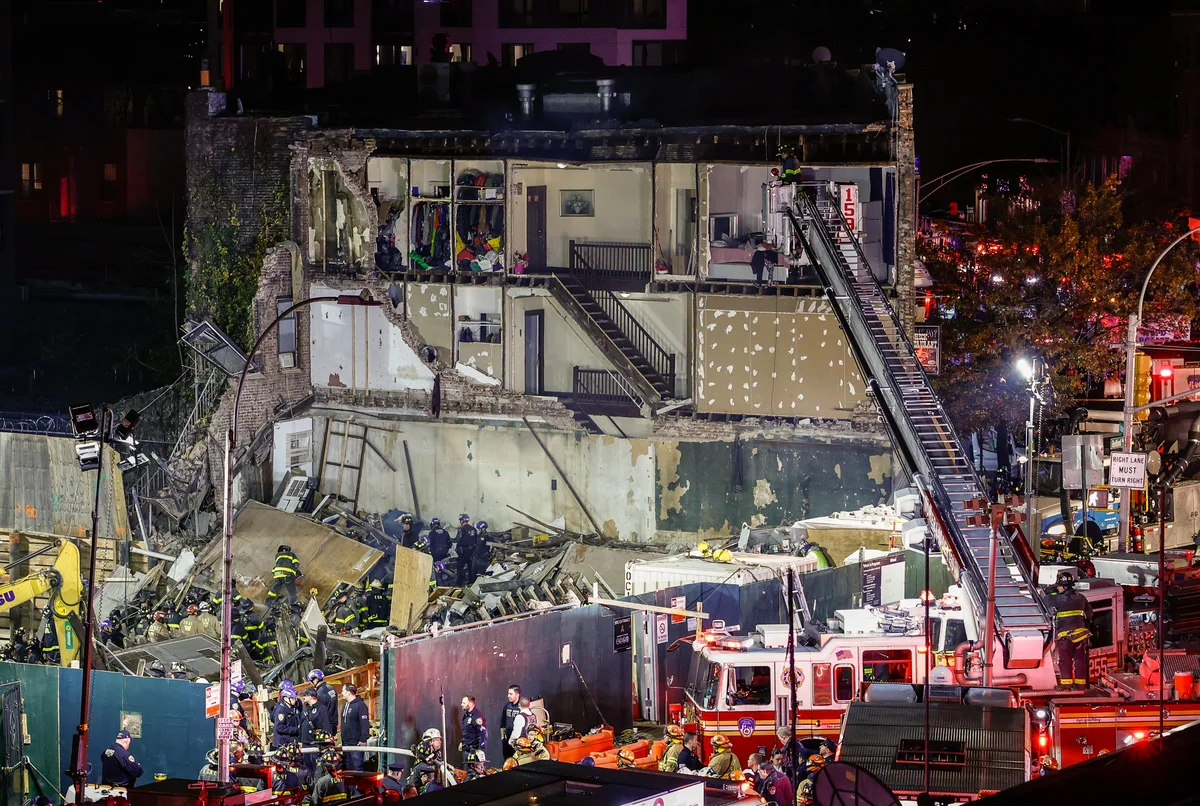
At a press conference, Mamdani was careful about causation: investigators have not established what caused the failure, though the timing makes the neighboring excavation a central focus (NYC Mayor's Office).
A 96-year-old building with nearly 100 open violations
The building's own condition is one of two threads investigators are pulling. City data and news reports indicate 1321 Flatbush Avenue had 98 open housing violations when it fell, though the exact count varies by database and reporting date (CBS New York). One property-record compilation lists 56 violations and seven complaints with the Department of Housing Preservation and Development since 2012, while noting the broader citywide count was substantially higher (Building Report).
Property records associate the building with landlord Olufemi Falade and entities including Femi Realty, with some reporting also identifying Isolag Realty (News 12). Separate reporting described Falade as having a long history of tenant-neglect cases and prior jail time connected to conditions at other Brooklyn properties, though those earlier cases did not necessarily involve this building (The Spokesman-Review).
Housing violations, however, mostly measure habitability, not structural soundness. A backlog of leak and vermin complaints does not by itself explain why a building that stood for 96 years fell on a particular Wednesday. For that, investigators are looking next door.
What a March survey said about the cracks

Before a developer excavates next to an existing building in New York, the project team typically files a preconstruction survey: a documented record of the neighboring building's condition, meant partly to establish a baseline so later damage can be identified.
The survey for this project, filed March 5 with the Department of Buildings, did exactly what it was supposed to do. It photographed visible cracks and masonry misalignments at 1321 Flatbush Avenue and rated the north facade, the side adjoining the planned excavation, as "poor," a category defined as involving "a wide range of major deficiencies" (News 12). Photographs submitted with the survey showed one exterior crack on the north facade and two more elsewhere on the building (Fox 5 NY). The report was filed as part of the 2625 Bedford Avenue project (NY1).
The project's geotechnical documentation reportedly went further, warning that adjoining structures would require underpinning and could be adversely affected by excavation and construction vibration (ENR).
So the fragility of the building was not a secret. The public record confirms that the Department of Buildings and the project team had access to the survey. What it does not establish is whether the landlord, the tenants, or nearby residents were ever directly given a copy (ABC7). A document that accurately describes a hazard protects no one unless it changes what happens on the ground.
Where this story sits
5 related pieces
Read it →
Hover a story · click to read
 No. 93 · Nov 6, 2026The Learjet Had an Earlier Turbulence Struggle. Was Something Missed?
 No. 100 · Nov 14, 2026When Microsoft Went Dark: How One Network Failure Disrupted the World
 No. 96 · Nov 12, 2026Spain's Train Disaster: 17 Minutes, 170 Safety Failures, and the Unverified Third-Train Near Miss
 No. 21 · Aug 30, 2026The air base decides: Niger's 24-hour mutiny and the technology of regime survival in the Sahel
 No. 103 · Nov 16, 2026No Hackers Required: The Week America's Critical Systems Started Failing
How digging next door can bring a building down
Understanding why that survey mattered requires understanding what excavation does to a neighboring building.

Older buildings like 1321 Flatbush typically sit on shallow foundations that rely on the soil around and beneath them staying put. When a contractor digs a deep pit next door, that soil can shift toward the open hole, and the neighboring foundation can settle, tilt, or lose support entirely. The standard defenses are underpinning, which extends or reinforces the neighbor's foundation down to a stable depth, and a support-of-excavation system, a designed wall of piles, sheeting, or bracing that holds back the earth. Vibration from heavy equipment or blasting adds a further load that a cracked, aging masonry wall is poorly placed to absorb.
The paperwork for this project acknowledged all of this. The filed support-of-excavation documents required field verification of conditions, movement-monitoring points on adjacent structures, and assigned responsibility for damage caused by soil-retention movements or construction methods (SOE filing, NYC DOB).
And the dig was not trivial. The Department of Buildings issued earthwork and support-of-excavation permits in September, and city records show excavation and rock blasting began that month (ENR). Project records indicate the excavation could extend as deep as 14 feet, with rock blasting included in the contractor's notice to the city (NBC New York).
That combination produces the question investigators must answer: were the specified shoring, underpinning, monitoring, and excavation sequence actually installed and followed, or did they exist only on paper (Gothamist)?
A stop-work order, defied and then lifted
The project's enforcement history gives that question weight, because the record already shows one instance of rules being ignored.

On March 20, Department of Buildings inspectors issued a stop-work order and a violation after finding that required overhead protection for neighboring properties, such as netting or sidewalk shielding, was absent (Construction Dive). The violation carried a reported $2,500 penalty and concerned the demolition contractor, N Tech Design of America (amNewYork).
When inspectors returned on April 23, demolition had resumed despite the active order. That follow-up inspection generated a second violation, for unlawfully continuing work under a stop-work order, with a reported $10,000 penalty (Construction Dive; CIVL).
The contractor then submitted correction documentation, and on May 8 the department lifted the order after determining the cited conditions had been corrected (Construction Dive). It is worth being precise about what that means. Under city rules, a certificate of correction is an affidavit asserting that the cited conditions were lawfully fixed; it is not a finding that the work could never contribute to later damage (NYC DOB).
The spring violations concerned demolition-phase protection, not the excavation that began in September. They do not prove the excavation was done badly. What they establish is a documented pattern: this project was caught once failing to protect its neighbors, and caught again working through the order meant to stop it.
Three stories approved, nine stories sought

A further oversight wrinkle emerged after the collapse. The city's buildings commissioner said the approved plan on file was for a three-story project, while a separate, unapproved application sought a nine-story building (NBC New York). The public record so far does not show that construction was being performed to the larger, unapproved design. But the mismatch between what was approved and what was sought is now part of what investigators must untangle, because the scale of a planned building shapes how deep and aggressive its foundation work needs to be.
What counts as a warning, and what counts as proof
It is tempting to draw a straight line from the March survey and the spring violations to the November collapse. The evidence does not yet support that line, and officials have said so.
What is documented: the cracked, "poor"-rated facade; geotechnical warnings about underpinning and vibration; an excavation that could reach as deep as 14 feet, with rock blasting, next to a 1930 masonry building; two enforcement actions for failing to protect neighbors and defying a stop-work order; and nearly 100 open housing violations on the building itself (News 12; ENR; NBC New York; CBS New York).

What is alleged or preliminary: the Department of Buildings' post-collapse stop-work order cited unsafe construction operations as causing the adjacent building to fail, but officials have not publicly established whether the excavation, the shoring, preexisting defects, or some combination produced the collapse (Construction Dive).
What is unknown: whether underpinning was installed, whether the movement-monitoring points required by the filed plans were established and read, whether any monitoring data showed the building moving before it fell, and who, among the developer, contractors, engineers, landlord, and regulators, failed to meet a specific obligation. Investigators are examining the building's history, permit records, engineering drawings, excavation methods, and any monitoring data (ABC News).
Responsibility, if any, will be assigned by that investigation and potentially by prosecutors and courts, not by the timeline alone.
The citywide sweep and the questions still open
The city's response reaches well beyond one block. Officials ordered inspections at approximately 100 sites linked to the companies involved in the Bedford Avenue project, alongside the criminal and regulatory investigation into the collapse itself (ABC News). That sweep is itself a kind of admission: if these companies cut corners here, the city wants to know where else they are working.
The larger question the investigation will have to confront is about the system, not just this site. New York's framework for protecting buildings next to excavations is built on documents: preconstruction surveys, geotechnical reports, support-of-excavation plans, monitoring requirements, stop-work orders, certificates of correction. On this project, nearly every one of those documents existed. A survey flagged the fragile wall. The plans required monitoring. Inspectors issued orders. Paper moved through the system more or less as designed.
Eight people died anyway. Whether that happened because the paper was ignored in the field, because enforcement relied too heavily on a contractor's own affidavit of correction, because the building was already failing, or because of a combination no single rule anticipated, is what the formal investigation now has to determine. Taken together, the documented facade distress, the sensitive excavation, the prior violations, and the required safety controls point to several moments where intervention was possible (NBC New York). Which of them, if any, would have changed the outcome is the answer the families of the dead are owed.
Sources / References

- Associated Press, "Firefighters dig through rubble after NYC building collapse kills 2 and traps people in wreckage" — https://apnews.com/article/202ddc195fbf2dcf14e85d004f3ac130
- Associated Press, "Brooklyn collapse killed 2 children and 6 adults, Mamdani says" — https://apnews.com/article/brooklyn-building-collapse-dead-rubble-digging-292b3ece5d9ba6e375413c9f4671cf00
- ABC News, "8 dead, including 2 children, after building collapses in Brooklyn, New York" — https://abcnews.com/US/rescue-operations-underway-after-building-collapses-brooklyn-new/story?ICID=ref_fark&id=138059620
- ABC News, "NYC building collapse investigation focuses on structure's history, nearby construction" — https://abcnews.com/US/brooklyn-building-collapse-investigation-focuses-structures-history-nearby/story?id=138076254
- ABC7 New York, "Brooklyn building collapse: Rescue operations conclude for victims" — https://abc7ny.com/post/flatbush-brooklyn-building-collapse-leaves-2-dead-17-injured-search-continues/20035354/
- ABC7 New York, "What caused Brooklyn building collapse: Cracks found on facade months earlier" — https://abc7ny.com/post/brooklyn-building-collapse-cracks-found-facade-months-earlier/20036664/
- NYC Mayor's Office, "Transcript: Mayor Mamdani Holds Press Conference on Brooklyn Building Collapse" — https://www.nyc.gov/mayors-office/news/2026/11/transcript--mayor-mamdani-holds-press-conference-on-brooklyn-bui
- NYC Department of Buildings, filed support-of-excavation documents (SOE-200), 2625 Bedford Avenue project — https://a810-dobnow.nyc.gov/Publish/DocumentStage/PortalDownloadedDocuments/BROOKLYN/B01330433/S3/Supporting%20Documents/20261111064107993266858782/Other%20Documents%20-%20Prior%20to%20Approval.pdf
- NYC Department of Buildings, "Stop Work Order" (certificate-of-correction definition) — https://www.nyc.gov/site/buildings/property-or-business-owner/stop-work-order.page
- Engineering News-Record, "Eight Dead, 18 Injured in Brooklyn Building Collapse Next to Construction Site" — https://www.enr.com/articles/64269-eight-dead-18-injured-in-brooklyn-building-collapse-next-to-construction-site
- Engineering News-Record, "One Dead, at Least Nine Injured in Brooklyn Partial Building Collapse" — https://www.enr.com/articles/64267-one-dead-at-least-nine-injured-in-brooklyn-partial-building-collapse
- NBC New York, "Brooklyn building collapse: History of building and site" — https://www.nbcnewyork.com/brooklyn/what-was-the-work-being-done-at-construction-site-next-to-brooklyn-building-collapse/6570888/
- News 12 Brooklyn, "Report Documented Cracks Months Before Flatbush Collapse; Neighboring Site Had Prior Violations" — https://brooklyn.news12.com/report-documented-cracks-months-before-flatbush-collapse-neighboring-site-had-prior-violations
- News 12 Brooklyn, "2 Children Among 8 People Killed in Brooklyn Building Collapse; Rescue Operations Conclude" — https://brooklyn.news12.com/2026/11/13/2-children-among-8-people-killed-in-brooklyn-building-collapse-rescue-operations-conclude/1Vs4EkfBCbkjYsdhTho8Qu
- Fox 5 NY, "Brooklyn building had cracks showing months before deadly collapse, records show" — https://www.fox5ny.com/news/brooklyn-building-had-cracks-showing-months-before-deadly-collapse-records-show
- NY1, "Cracked facade flagged months before building collapse" — https://ny1.com/nyc/all-boroughs/politics/2026/11/13/cracked-facade-flagged-months-before-building-collapse-dob-records
- CBS New York, "Flatbush, Brooklyn building that collapsed had 98 open violations, city records show" — https://www.cbsnews.com/newyork/news/flatbush-brooklyn-building-collapse-violations/
- Construction Dive, "Brooklyn building collapses into adjacent construction site, leading to multiple deaths" — https://www.constructiondive.com/news/brooklyn-building-collapses-adjacent-construction-site-fatalities/874484/
- Construction Dive, "Construction site next to fatal Brooklyn collapse previously violated stop-work order: DOB" — https://www.constructiondive.com/news/project-fatal-brooklyn-collapse-stop-work-order/874545/
- amNewYork, "Brooklyn building collapse: Workers' rights advocates emphasize importance of legal protections" — https://www.amny.com/law/brooklyn-building-collapse-workers-rights/
- CIVL, "Collapsed Brooklyn building had nearly a hundred open housing violations, many decades old" — https://civl.com/partners/collapsed-brooklyn-building-had-nearly-a-hundred-open-housing-violations-many-0df744bf
- Gothamist, "Developer at Brooklyn collapse site had record of flouting orders from city agency" — https://tollbit.gothamist.com/news/developer-at-brooklyn-collapse-site-had-record-of-flouting-orders-from-city-agency
- The Spokesman-Review, "Contractor, landlord at site of deadly Brooklyn building collapse cited for numerous violations" — https://www.spokesman.com/stories/2026/nov/12/contractor-landlord-at-site-of-deadly-brooklyn-bui/
- Building Report, 1321 Flatbush Avenue property records — https://buildings.mice.nyc/report/3052110073
The reading behind this research
What the desk leaned on for this piece. Each link goes to the retailer, where the price is shown.

The survey that photographed facade cracks shows why cracks matter; this membrane only seals small ones under tile, not structural walls.
View on Walmart
Klein Tools Digital Angle Gauge and Level
The March survey rated a cracked wall 'poor' before the collapse; a gauge like this lets you check whether a wall is leaning or shifting over time.
View on Walmart
After the Flatbush collapse beside an excavation, this book explains in plain terms how walls and foundations carry loads and what makes them fail.
View on Walmart
Wyze Battery Cam 2K HD Wireless Outdoor Security Camera, Color Night Vision, Spotlight & Siren, IP65
Inspectors caught the contractor working despite an April stop-work order; a camera facing a neighboring site can record that kind of activity.
View on Walmart
Explains in plain terms how walls and foundations carry loads, which helps make sense of why an excavation next door can bring down a building.
View on WalmartPaid links. Calibre Code USA may earn a commission from purchases made through these links. This does not affect what we write or what we recommend.
Comments (7)
Continue exploring
Spain's Train Disaster: 17 Minutes, 170 Safety Failures, and the Unverified Third-Train Near Miss
On the morning of October 28, 2026, a Renfe AVE high speed train traveling from Madrid to Seville struck a stationary Iry…
The air base decides: Niger's 24-hour mutiny and the technology of regime survival in the Sahel
When mutinous soldiers attacked Niamey's Air Base 101 in August 2026, Russia's Africa Corps, not Niger's own army, settled the…
No Hackers Required: The Week America's Critical Systems Started Failing
In the second week of November 2026, five separate pieces of digital infrastructure failed within seven days. GitHub stalled…
The distinction between housing violations and structural defects is exactly right. In my work managing older apartment buildings, leak and vermin complaints often pile up without telling you much about load-bearing walls. We had a separate structural engineer identify serious masonry movement that never appeared in the housing-violation records.
Could the March survey’s photographs be compared with the building’s condition immediately before the collapse to determine whether the cracks worsened during the excavation?
This fits the pattern I’ve been following in New York excavation cases: stop-work orders mean little when a contractor can keep digging and face consequences only after something fails. The April violation for working through the order is the most damning fact here.
The central takeaway is that documented violations and suspicious timing establish serious warning signs, but they do not yet prove the collapse mechanism. The building’s 98 open violations, the March “poor” wall rating, and the contractor’s apparent defiance of a stop-work order need to be analyzed together rather than treated as interchangeable evidence. Practically, excavation permits should trigger mandatory monitoring and immediate, documented escalation when adjacent walls show movement.
That has not been my experience: on one excavation project, the preconstruction survey was treated as a checkbox and no one took meaningful follow-up measurements after work began.
Will you follow up on what the inspection sweep of roughly 100 sites actually finds? I’m especially interested in whether those projects share the same contractor, engineer, or pattern of ignored stop-work orders. It would also help to know whether the city has a standard for requiring real-time movement monitoring after a survey rates an adjacent wall as “poor.
I have seen neighboring-building surveys document facade cracks and still leave everyone arguing later about whether excavation made them worse.