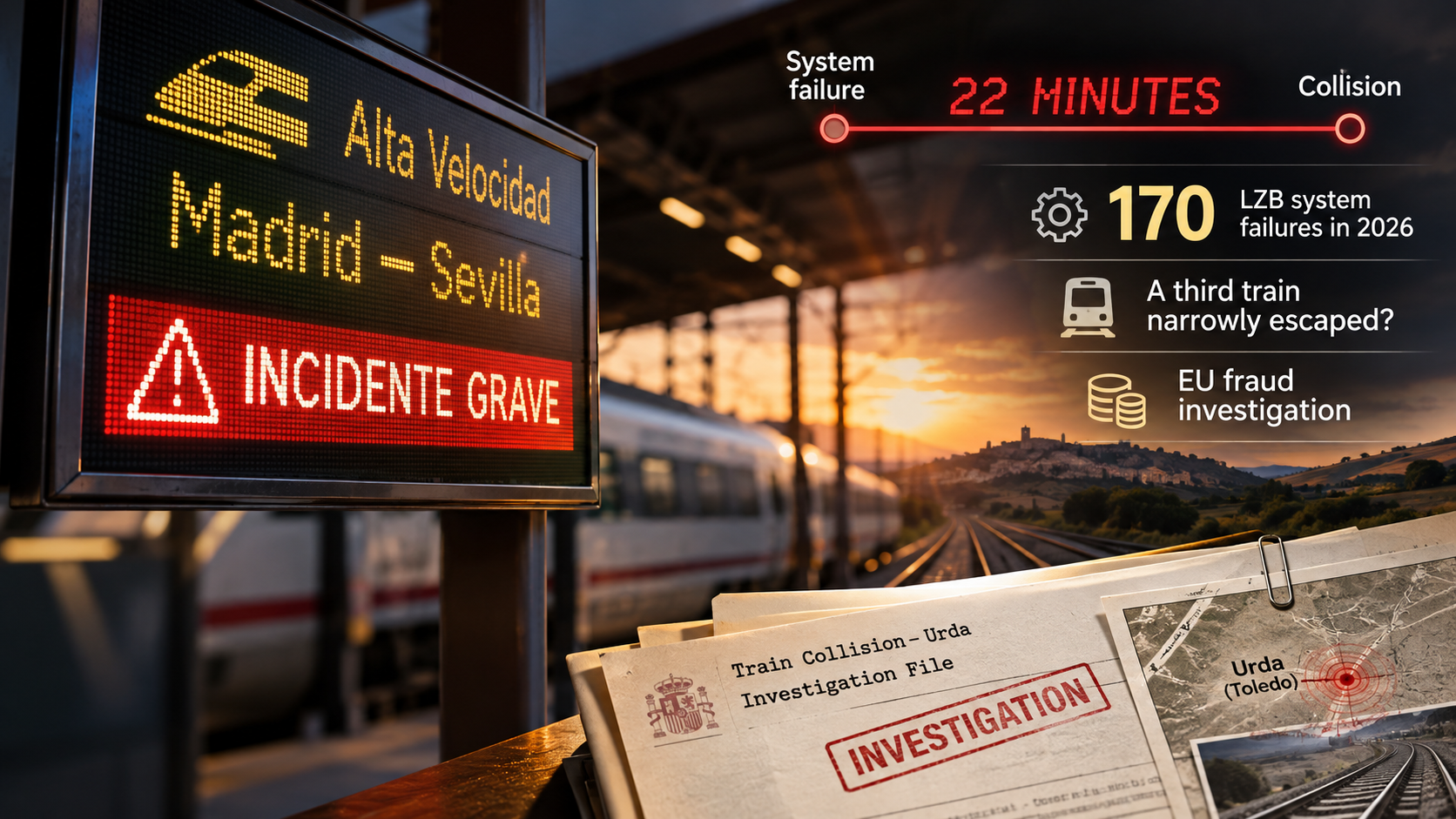
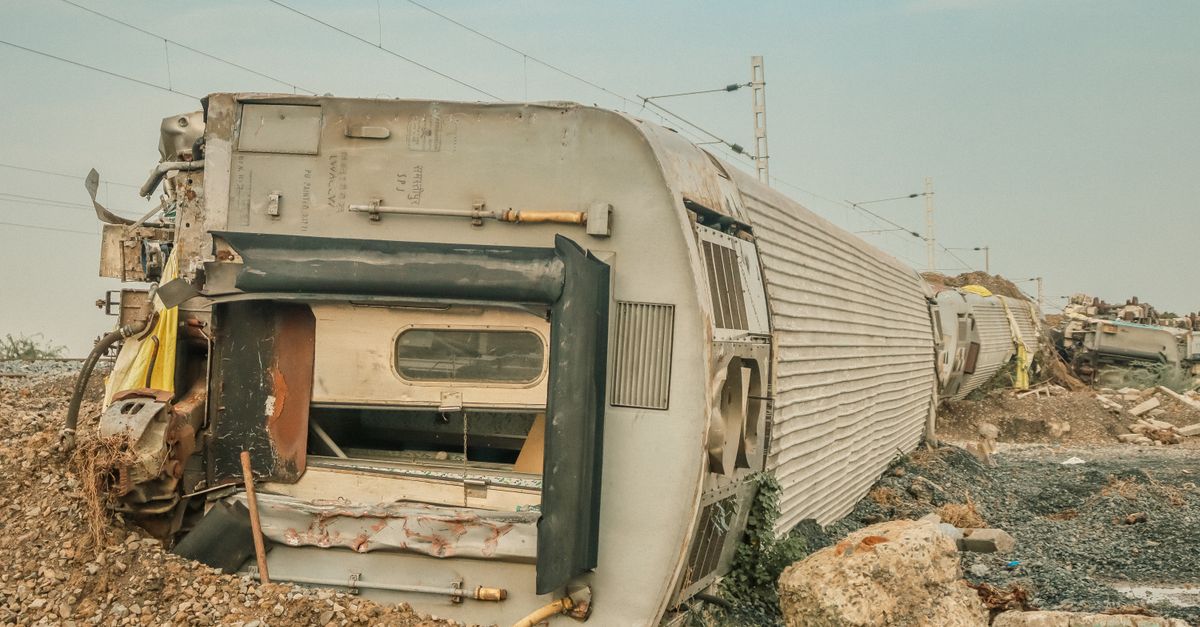
On the morning of October 28, 2026, a Renfe AVE high-speed train traveling from Madrid to Seville struck a stationary Iryo passenger train near Urda, in Toledo province, killing 69 people and injuring more than 100 (AP). The collision happened on a line protected by an automatic safety system specifically designed to prevent exactly this kind of rear-end crash. That system had failed roughly 170 times during 2026 (La Cerca).
Two weeks on, the public evidence includes leaked control-room recordings, a reconstructed timeline of the final 17 minutes, failure statistics for the line's aging protection system, and two European fraud investigations into how EU money meant to modernize that system was spent. Taken together, the record points less toward a single person's mistake and more toward a chain of weaknesses that had been accumulating for years, a reading that Spain's own officials and independent analysis increasingly support (AP).
This article walks through what the evidence establishes, what remains allegation, and whether widely circulated claims that a third train came within 400 meters of the wreckage can currently be believed.
What happened near Urda on October 28
The immediate trigger was an apparent failure of LZB, the automatic train-protection system on the Madrid-Seville high-speed line. The failure stopped multiple trains and forced traffic management onto control-room procedures and fallback systems (Le Monde). Investigators have said the signaling failure automatically halted trains across roughly 63 kilometers of track (KVIA/CNN).
One of the stopped trains was an Iryo high-speed service, stationary on the line near Urda. Behind it, an AVE was cleared to move again. At approximately 8:53 a.m., the AVE struck the Iryo from behind (RTVE). Spain later held a state funeral for the 69 victims (AP).
The final 17 minutes, as the recordings and timeline show them
The reconstruction that has emerged from leaked audio, official briefings, and verified reporting covers the window between the critical control-room instruction and the impact.
8:36 a.m. With the protection system down, control of the affected traffic had shifted to the Madrid Atocha control center. According to recordings reported by El País, the Atocha controller told the AVE driver: disconnect and reconnect LZB, then "resume with normal running" (El País). The Spanish government's own account identifies this 8:36 instruction as the moment of human error in the chain (El País).
8:41 a.m. The Iryo driver told the control center that her train remained stopped after losing transmission and could not proceed normally (Euronews).
About 8:48 a.m. A further communication reportedly confirmed that the Iryo was still stationary and that its LZB could not be restored. Even then, the AVE driver was not ordered to stop (Euronews).
8:53 a.m. The collision occurred, roughly five minutes after that later warning (RTVE).

Seventeen minutes separated the fatal authorization from the impact. Within those minutes sat at least two documented chances to intervene: the Iryo driver's 8:41 call and the 8:48 confirmation. Why neither triggered an order to halt the AVE is one of the central unresolved questions of both the technical and judicial investigations (Euronews).
What is LZB, and what should have happened when it failed
LZB, from the German Linienzugbeeinflussung, is a continuous automatic train-protection system that has guarded the Madrid-Seville line since it opened in 1992. It communicates with trains through equipment along the track, supervising their speed and position continuously. When it works, a train physically cannot be driven at full speed into an occupied section: the system intervenes.
When LZB fails, the railway falls back to a degraded operating mode. Under the fallback procedure in force that morning, known as BSL, trains were reportedly required to proceed "on sight": slowly enough to stop short of any obstruction, at no more than 40 km/h (Railvolution). Driving on sight is the railway equivalent of creeping through fog with your foot over the brake. It is slow, but it is survivable.
That is the protocol the 8:36 instruction reportedly bypassed. The Atocha controller's order to resume at "normal speed" omitted the crucial visual-running restriction even though the protection system was unavailable (Sur in English; RTVE). On a line engineered for very high speeds, the gap between "on sight, below 40 km/h" and "normal running" is the difference between an incident and a catastrophe.
Where this story sits
5 related pieces
Read it →
Hover a story · click to read
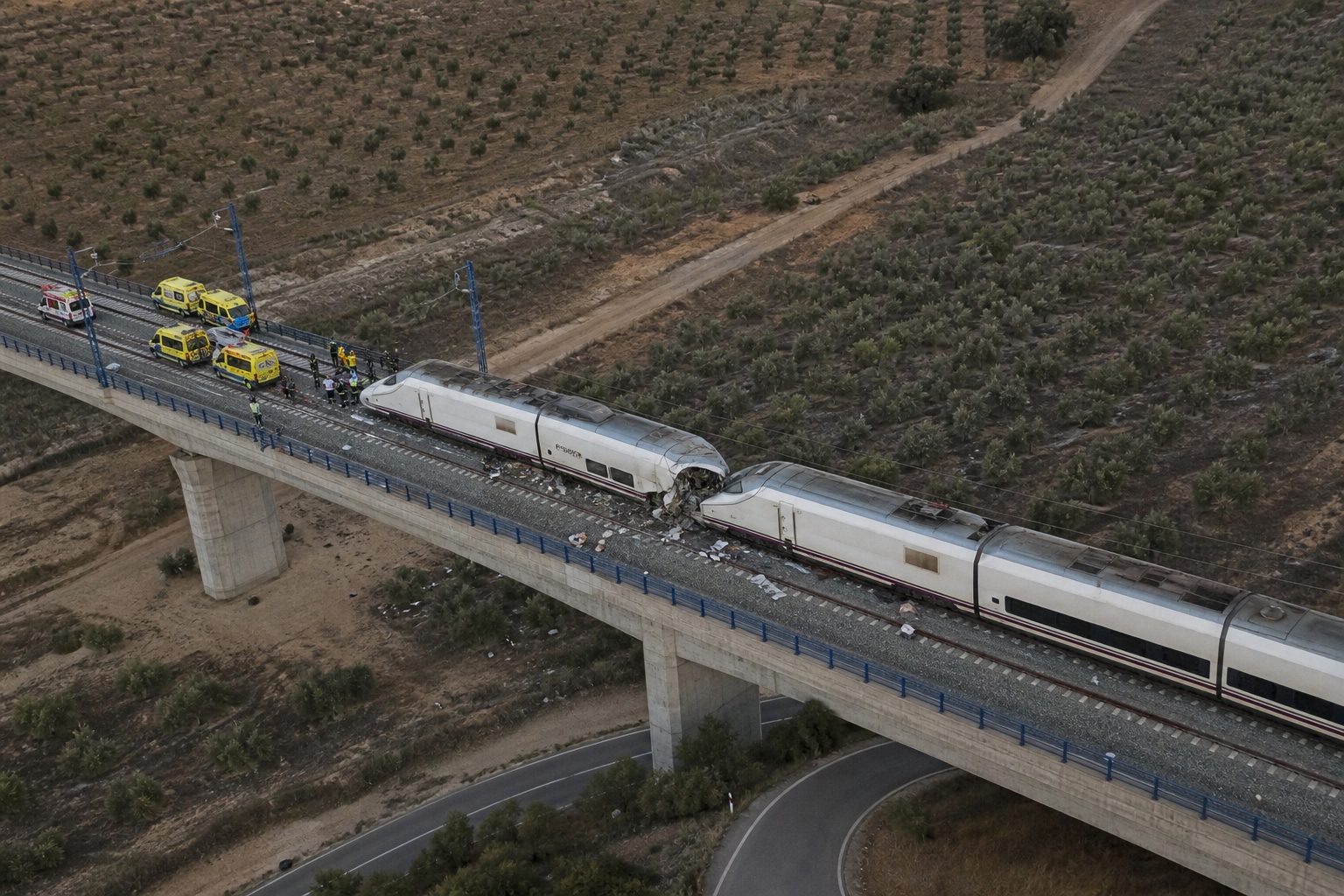 No. 84 · Oct 28, 2026Spain’s Deadly Train Collision: What Failed?
 No. 87 · Nov 1, 2026The Train Stopped. Then It Was Told to Go
 No. 89 · Nov 3, 2026Why Was a Renfe Train Allowed Toward a Stopped Train?
 No. 12 · Aug 26, 2026The wall of mud that crossed a border: inside the August 26, 2026 Nepal-Tibet flood disaster
 No. 81 · Oct 26, 2026Why AI-agent safety may depend on the software around the model
The order officials called "inexplicable"

Spanish officials have described the control-center decision as "inexplicable," while stressing that responsibility remains subject to formal investigation (Euronews). Reporting based on the leaked recordings and official briefings consistently describes the same sequence: after traffic control shifted to Madrid, the AVE driver was told to disconnect and reconnect the system and then proceed at normal speed (Le Monde).
Two investigations are now running in parallel: a judicial inquiry, which will determine criminal responsibility, and Spain's independent technical investigation, which examines causes and has not issued a final determination (El País). The question both must answer is not only who issued the instruction, but why the system around that person allowed a single ambiguous or erroneous order to send a high-speed train toward an occupied track with no automatic backstop. The investigation has focused heavily on the control center's role (EFE), and the central unresolved issues include why the AVE was cleared to proceed at normal speed, why the control center did not warn it after the Iryo's calls, and whether technical failures, protocol violations, or both caused the fatal chain of events (Euronews).
170 failures in a year: was the line's weakness already known?
The 8:36 order did not happen on a healthy railway. According to Transport Minister Óscar Puente, the Madrid-Seville corridor recorded 170 LZB safety-system incidents during 2026, a figure he characterized as within normal European operating ranges (La Cerca).
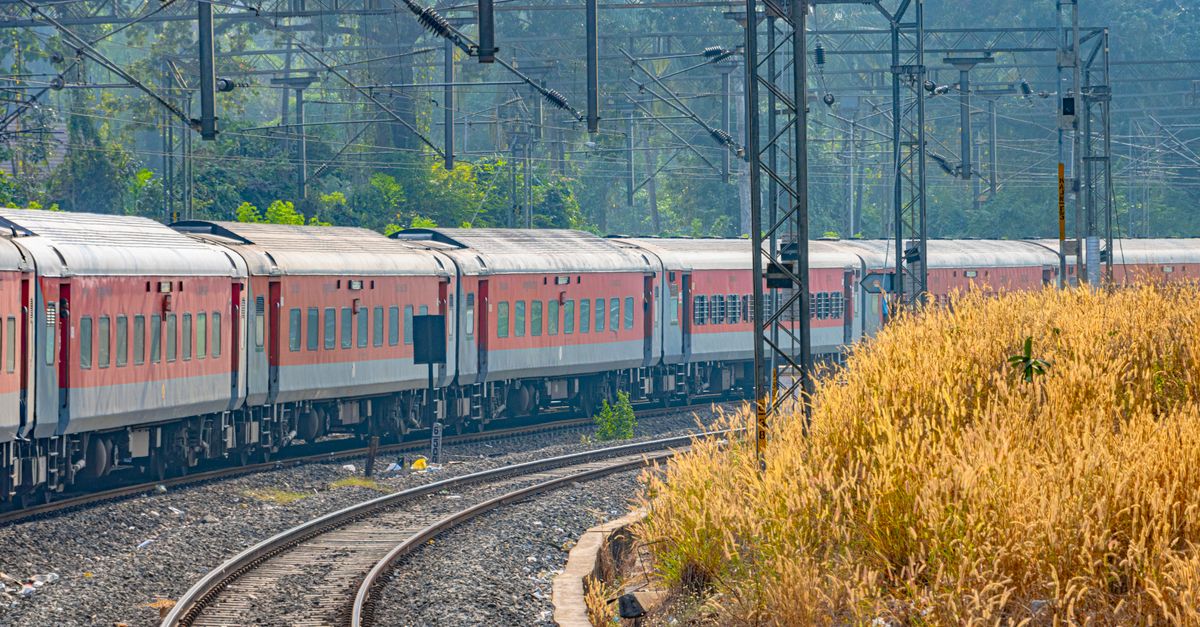
Independent analysis frames the same number differently. The failures averaged more than one every two days across the corridor. The Urda section where the collision occurred reportedly experienced 13 LZB breakdowns, and the corridor accumulated 14 publicly reported incidents over roughly two months, including four signalling failures, despite approximately 700 million euros of related investment (El Riu).
The replacement was already planned. A contract to swap the 1990s-era LZB for ERTMS, the modern European train-control standard, was signed in 2021, but implementation has reportedly fallen behind schedule (El Riu). Technical experts consulted after the crash attribute the system's vulnerability to its age, outdated software, inadequate maintenance, and possible "cannibalization" of components, meaning parts stripped from one installation to keep another running. Those remain investigative hypotheses, not findings (Sur in English).
So the answer to whether warnings existed is yes, in the form of a visible failure pattern. Whether those warnings were ignored, tolerated as routine, or genuinely judged acceptable is precisely what the investigations must establish. The minister's position, that 170 incidents is ordinary for a line of this type, and the critics' position, that a safety system failing every other day is a system in decay, cannot both survive the final technical report.
Did a third train narrowly avoid the wreckage?
Among the most alarming claims to circulate after the crash is that a third train received a similar instruction to proceed, and that a passenger's warning helped prevent another collision roughly 400 meters from the wreckage. A related claim holds that the Iryo driver warned of live overhead electrical cables while traffic continued in the area for several more minutes.
These accounts, which circulated in Spanish-language reporting and online discussion after the crash, could not be corroborated against the official record. Neither the technical investigation nor the judicial inquiry has publicly confirmed a third-train near miss or a delayed electrical shutdown. The claims do not appear in the verified minute-by-minute reconstructions published by El País, RTVE, or Euronews, and no primary document, recording, or official statement released so far supports them.
That does not mean the accounts are false. Degraded-mode operations of the kind in force that morning affected multiple trains across tens of kilometers of track, so the scenario is not implausible on its face. But as of today, the third-train story is an unverified allegation. Readers should treat the specific details, the identical instruction, the passenger intervention, the 400-meter distance, as unconfirmed until investigators or primary records substantiate them. Given how much of the verified record emerged through leaked recordings, further disclosures may yet settle the question in either direction.
The second disaster on this route in under a year
Urda was not an isolated shock. Less than a year earlier, in January 2026, three rear carriages of an Iryo train derailed at Adamuz, in Córdoba province, crossed into the opposite track, and collided with an oncoming Renfe Alvia service (Spanish Transport Ministry). Early official information placed both trains at roughly 200 km/h, and subsequent investigation focused on a possible broken rail or track defect rather than a confirmed signalling failure (CIAF investigation note).

The two accidents had different immediate mechanisms, a suspected track defect at Adamuz, a protection-system failure plus an erroneous authorization at Urda. What they share is the same high-speed network between Madrid and Andalusia and the same underlying question: whether the infrastructure and its maintenance regime were being kept to the standard that 300 km/h operation demands. The day after Urda, Spanish press reports carried the blunt accusation that authorities "knew the Madrid-Seville line wasn't safe" (Le Monde). That is an allegation the investigations will test, not a settled finding.
What the EU fraud investigations actually cover
On November 6, 2026, the European Public Prosecutor's Office opened a second investigation into possible fraud involving EU funds allocated to modernize the Madrid-Seville high-speed railway, following an earlier inquiry into the same corridor's funding. Investigators carried out measures at ADIF, Spain's railway infrastructure administrator, at the State Railway Safety Agency, and at the Spanish Court of Auditors, supported by the Guardia Civil's central investigative unit (EPPO).
The suspected financial misconduct concerns EU-funded renovation and upgrading of safety, signaling, and communications systems on the line (RTÉ). Two limits on this evidence matter. First, EPPO has disclosed no findings, named no suspects, and has said further details will not be released while investigative measures continue (EPPO). Second, prosecutors have not alleged that fraud caused the collision (RTÉ).
The investigations are nonetheless significant for the systemic question. If money designated for the very safety and signaling systems that failed was misspent, that would connect the financial record to the failure record. For now, that connection is a hypothesis under investigation, nothing more.
One mistake or a system that was waiting to fail?

The honest answer, on the current evidence, is that the 8:36 instruction was a human error committed inside a system that had removed its own margins for error.
A single wrong order at a control desk should not be able to kill 69 people on a modern high-speed railway. It could at Urda because several layers failed at once: the automatic protection system that would normally have stopped the AVE was down; the fallback procedure that should have capped speed at 40 km/h was reportedly overridden or misapplied; the control center did not act on the Iryo driver's warnings at 8:41 and 8:48; and the degraded-mode procedures left room for an instruction that officials themselves now call inexplicable (Euronews; Euronews).
Independent analysis of the accumulated evidence reaches the same conclusion: the strongest reading supports a cascading systems failure, built from obsolete or unreliable protection, weak fallback controls, ambiguous procedures, and an erroneous authorization, rather than an isolated mistake, while the fraud allegations remain investigations rather than proof of corruption (AP). The 170 failures recorded in a single year reinforce that reading: the error that killed was the last event in a long sequence, not the first.
What has changed since the crash, and what still has no answer
Spanish authorities have announced responses to the disaster, with the investigation focusing heavily on the control-center failure. But announced measures are not the same as implemented safeguards, and neither the Urda nor the Adamuz investigation has reached final causal findings (EFE).
The questions that remain open are the ones that will determine whether this disaster changes anything:
- Why did the control center authorize normal-speed running with the protection system unavailable, and why did two subsequent warnings from the stranded Iryo produce no order to stop (Euronews)?
- What did control-room displays show about track occupation during those 17 minutes?
- Were the third-train near miss and the delayed response to warnings about live cables real? No official confirmation exists for either.
- Did misspent EU funds contribute to the state of the signaling and safety systems (EPPO)?
- When will the delayed ERTMS replacement, contracted in 2021, actually take over from the system that failed (El Riu)?
Seventeen minutes was enough time to stop a train. A hundred and seventy recorded failures was, arguably, enough warning to fix a system. The investigations will decide who bears legal responsibility for the order given at 8:36 that morning. But the evidence already public suggests a more uncomfortable conclusion: by the time that instruction was spoken, the layers of protection that should have made it survivable had been eroding for years, failure by logged failure, on a line everyone was still trusting at full speed.
The reading behind this research
What the desk leaned on for this piece. Each link goes to the retailer, where the price is shown.
Meltdown: Why Our Systems Fail and What We Can Do About It by Chris Clearfield and András Tilcsik
The article shows the crash came from a chain of weaknesses, not one error; this book explains how such chains form in complex systems.
View on Walmart
The Checklist Manifesto by Atul Gawande
The article's 8:36 instruction and the two missed chances to halt the AVE show how fixed verification steps could catch a controller's lapse under pressure.
View on Walmart
Anker 737 Power Bank (PowerCore 24K)
The article notes the signaling failure halted trains across 63 km of track; a charged phone matters if you are stuck on a stopped train for hours.
View on Walmart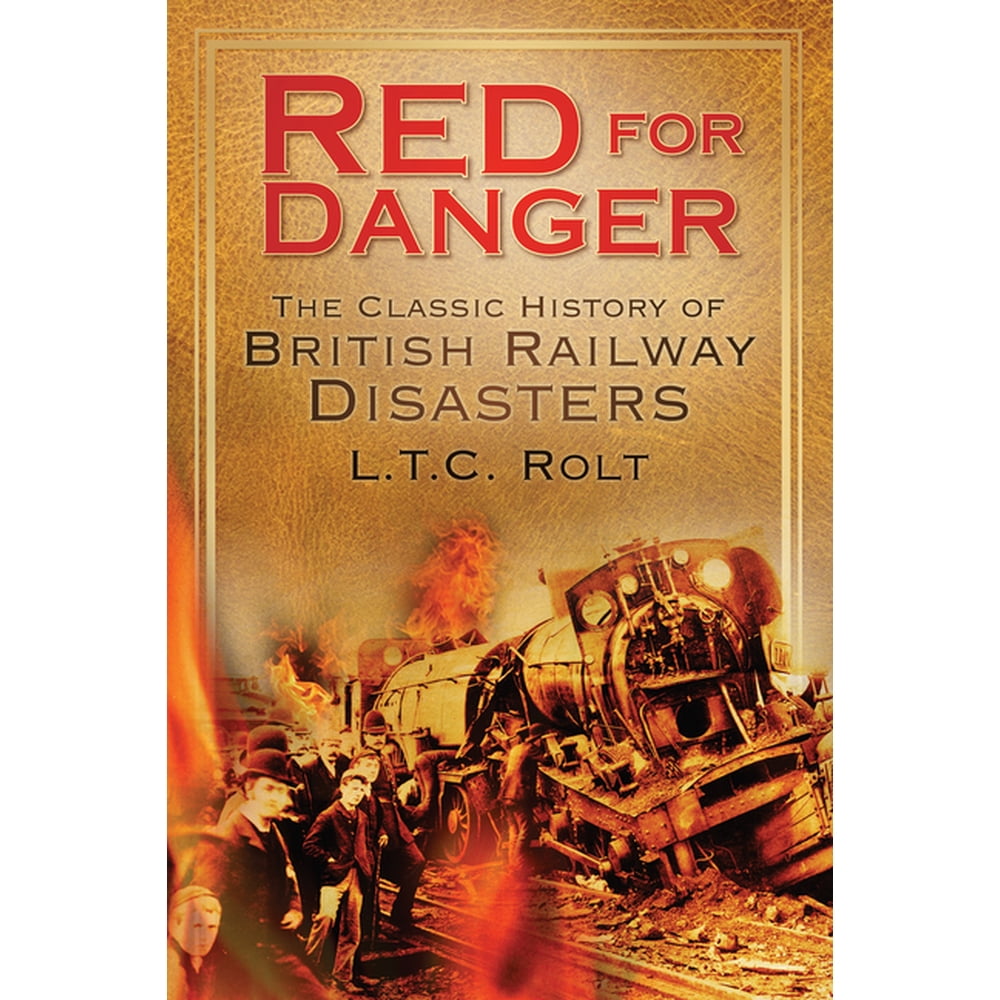
This history of past rail crashes shows, like the Urda record, that disasters grow from chains of weaknesses, not one person's error.
View on Walmart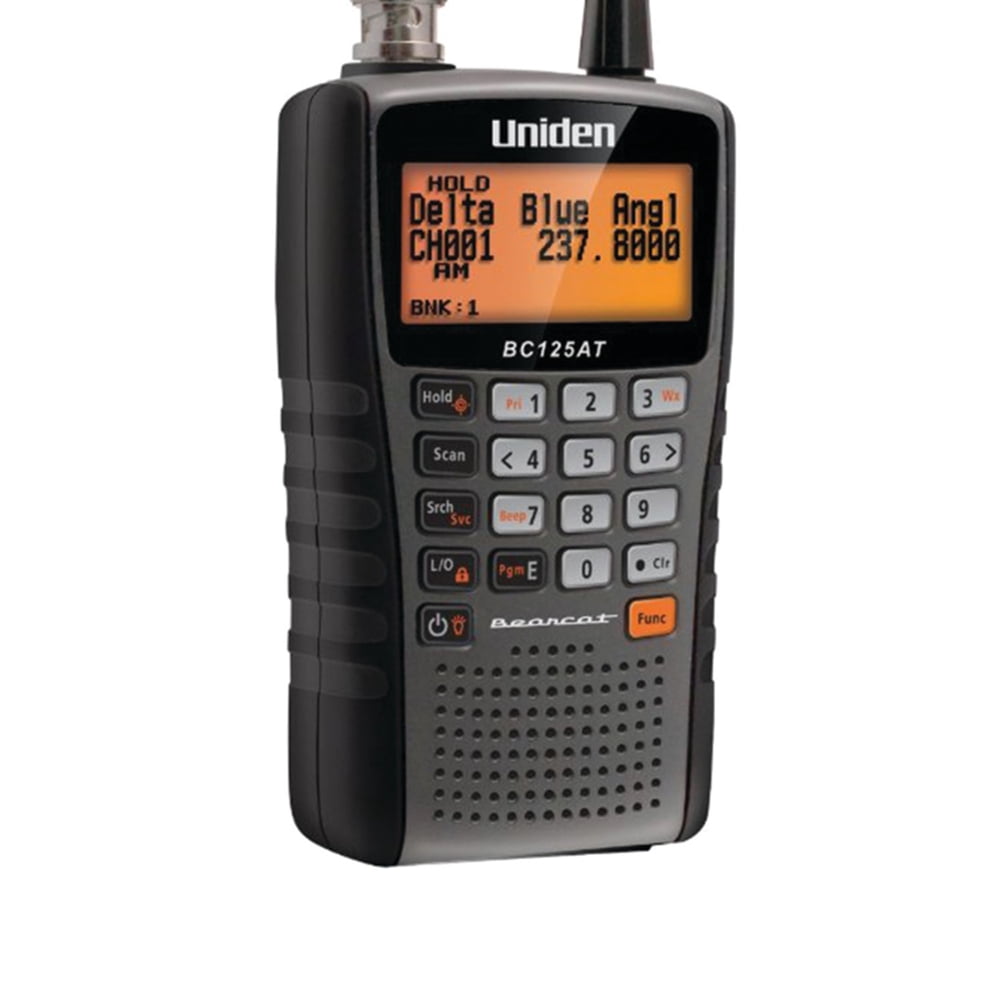
Uniden Bearcat BC125AT Handheld Scanner
The 17-minute timeline rests on controller-to-driver radio calls; this lets you hear local public-safety and transit radio traffic yourself.
View on WalmartPaid links. Calibre Code USA may earn a commission from purchases made through these links. This does not affect what we write or what we recommend.
Comments (8)
Continue exploring
Why Was a Renfe Train Allowed Toward a Stopped Train?
The Urda collision followed an LZB signalling failure, a disputed restart order, and the breakdown of safeguards meant to protect…
The wall of mud that crossed a border: inside the August 26, 2026 Nepal-Tibet flood disaster
Before anyone understood what was coming The clearest record of the disaster's first seconds comes from a fixed security camer…
Why AI-agent safety may depend on the software around the model
Model filters are only one layer of AI-agent security. Software supply-chain controls and isolated runtimes determine what an…
The central takeaway is that a failed safety system became deadly because fallback procedures and communications did not compensate for it. I am still cautious about assigning blame before the recordings and technical logs are fully authenticated, but rail operators should already audit every instruction given during degraded operation.
I have actually traveled on this line during an LZB disruption, and our train was allowed to continue well above the 40 km/h limit described here after the driver received repeated authorization from control. It felt orderly and safe, not improvised, which makes me wonder whether the BSL rule was more conditional than the article suggests. That experience does not explain the Urda crash, but it definitely complicates the idea that every LZB failure automatically meant simple on-sight running at 40 km/h.
I was on an AVE service during an LZB outage a few years ago, and the change in operating procedure was immediately noticeable. The train slowed repeatedly while the crew waited for instructions, and announcements made clear that the protection system was unavailable. I remember thinking how dependent the journey was on clear communication between the driver and control room, which makes the 8:36 instruction especially troubling.
The reported 170 LZB incidents also fit a broader pattern I have been following in European rail safety: aging infrastructure can remain operational while quietly increasing dependence on procedural workarounds. The two EU fraud investigations make the modernization question more than a maintenance issue. It will be important to compare procurement records with the actual condition of the equipment along the 63-kilometer affected section.
The article treats the crash as a chain of failures rather than one person's mistake, but what evidence actually proves that conclusion? The 170 reported LZB incidents show a serious reliability problem, yet they do not by themselves establish that those failures caused this collision. I would like to see the investigation separate documented facts from interpretation more sharply.
The final 17-minute timeline was the most useful section because it identifies concrete intervention points rather than discussing the crash only in general terms. The 8:41 call and the approximately 8:48 confirmation give investigators specific communications to test against dispatch logs and operating rules.
Could the investigators publish the exact BSL wording and explain why the 8:41 and 8:48 warnings did not automatically require the AVE to stop?
I’m not fully sold on calling 8:36 the human error and leaving it at that. If the system had failed 170 times and the Iryo was still reported stationary at 8:48, the procedures and control-room design deserve just as much scrutiny as the person who gave the instruction.