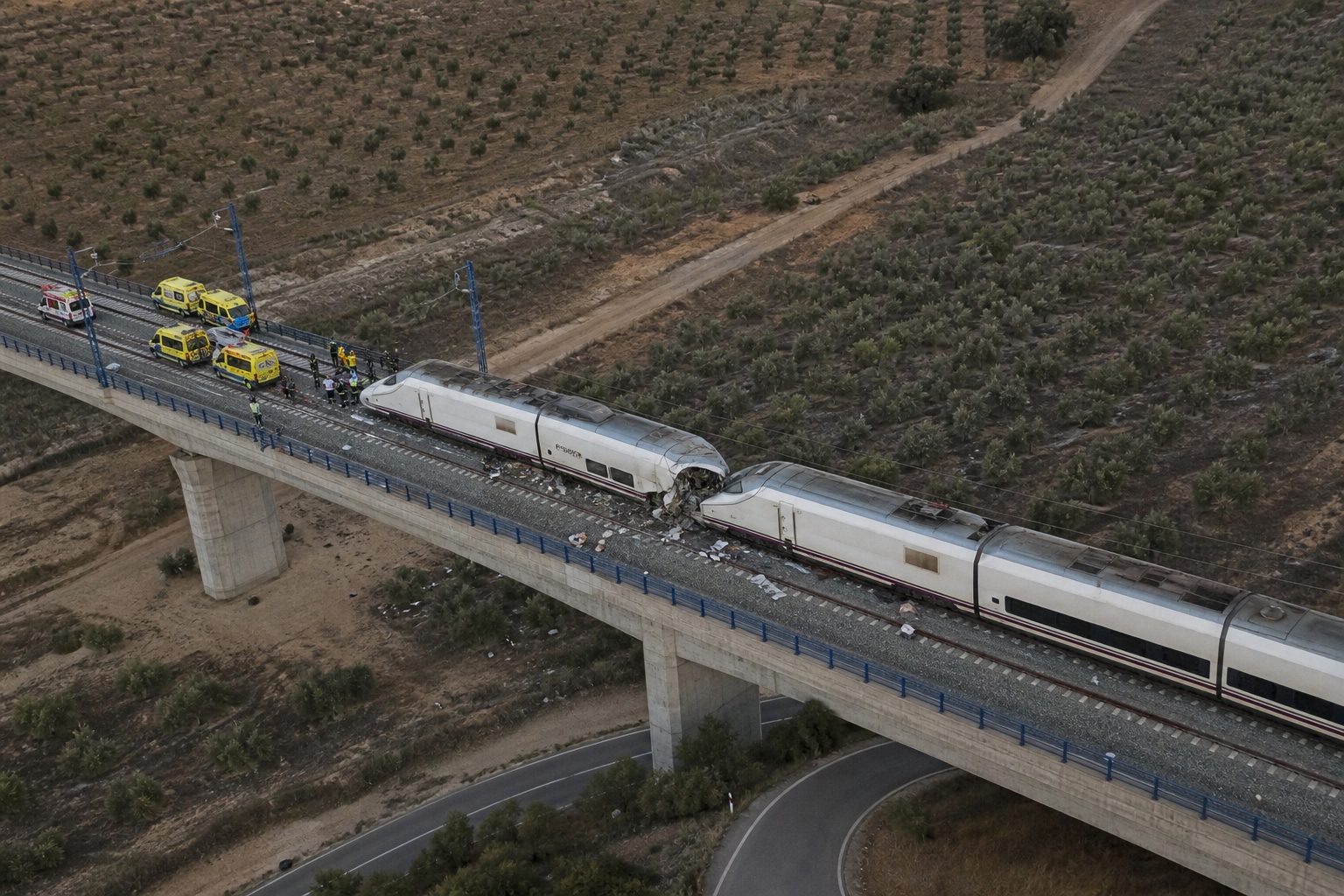
A Renfe AVE train rear-ended a stationary Iryo high-speed train near Urda, in Toledo province, on Wednesday, October 28, 2026. At least 68 people were killed and dozens were injured, according to Spanish public broadcaster RTVE. The Iryo train carried 147 passengers and five crew members. The Renfe train carried roughly 397 passengers, according to rail authorities and the operators. (RTVE)
The collision occurred on the Madrid-Seville high-speed line between Los Yébenes and Urda. Renfe identified its train as a Series 103 AVE. Iryo said its Madrid-Seville service, train 6076, had left Madrid at 7:54 a.m. with 147 passengers and was struck from behind near kilometer point 118. (Renfe, Iryo)
The immediate technical explanation is incomplete. Investigators are examining a failure in the LZB train-protection system, which automatically stopped several trains after losing communication along about 63 kilometers of track. The central question is what happened after that protection system stopped working.
The early evidence points to a possible failure of degraded-operation procedures: a following AVE may have been allowed to resume normal-speed running even though the primary protection system was unavailable and the Iryo train remained stopped ahead. Several outlets have reported that sequence, but it has not yet been established as the final cause. Spain’s formal railway investigation remains pending.
What happened before the collision?
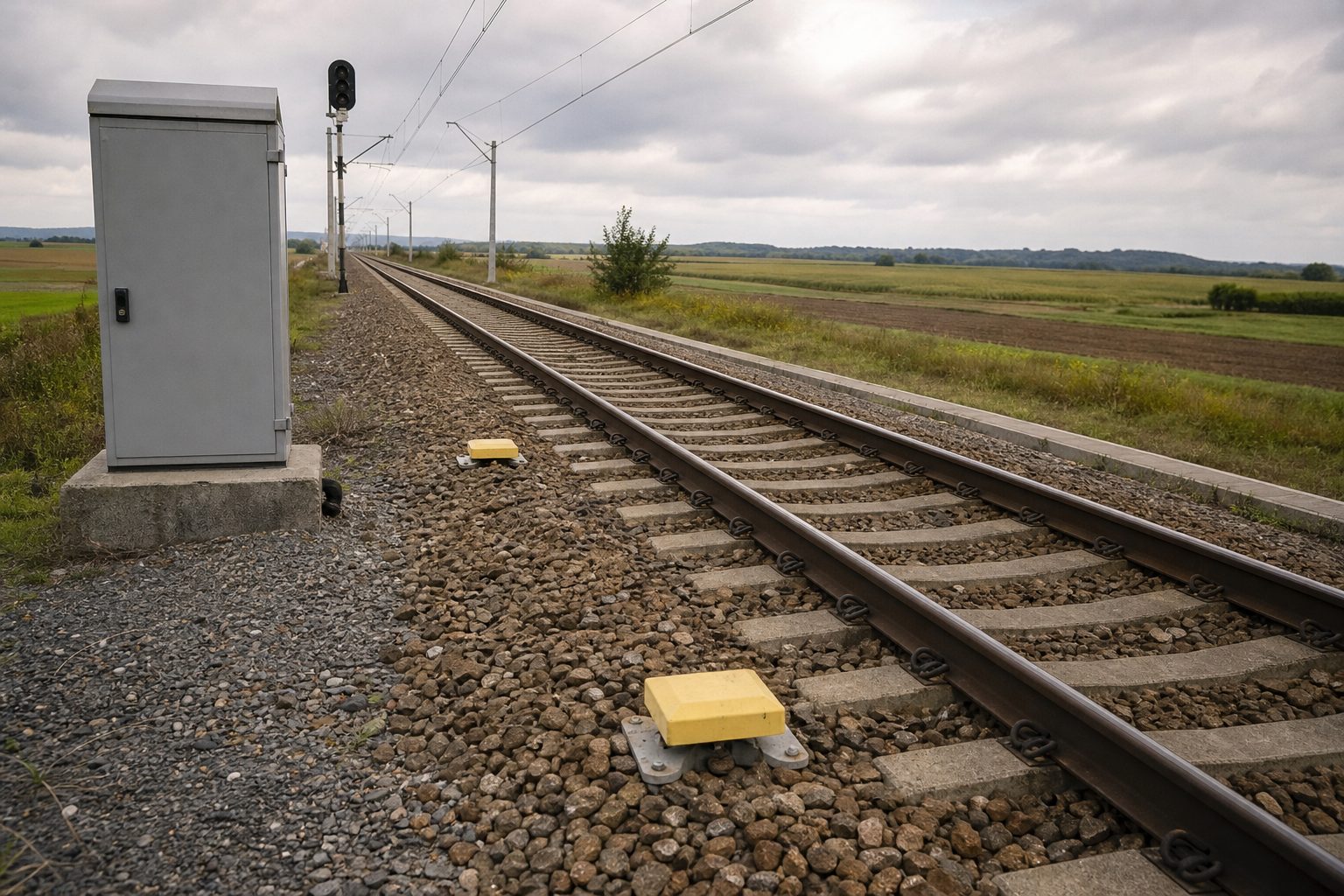
The broad sequence reported on October 28 is as follows:
- At approximately 8:30 a.m., the LZB system lost communications over a long section of the Madrid-Seville line. The malfunction automatically stopped about six trains, according to Euronews. (Euronews)
- Trains then had to operate under fallback procedures because the normal in-cab protection system was unavailable.
- The Iryo train remained stopped near Urda. Cadena SER reported that its driver told Adif’s Atocha control centre that the train was stopped at an entrance signal after losing transmission and receiving a target speed of 40 km/h. (Cadena SER)
- According to reporting by El País, controllers instructed the AVE driver to disconnect and reconnect the LZB equipment and then continue under BSL, the lineside-signalling fallback system, at normal running speed. (El País)
- The AVE travelled approximately 25 kilometers over about 17 minutes. RTVE reported that it continued despite an active red signal and may have approached 200 km/h before the impact. That speed remains a reported estimate, not a confirmed final figure. (RTVE)
- Iryo said the collision occurred at 8:48 a.m. Other reconstructions placed the impact at approximately 8:53 or 8:54, leaving a reported five- to six-minute discrepancy that investigators will need to resolve. (Iryo, Sur in English)
The timeline matters because the reported distance and duration created opportunities to detect the danger. If the AVE was moving for roughly 17 minutes toward a train that had not cleared the line, the safety question is not limited to the initial LZB failure. It also concerns the traffic picture held by the control centre, the information passed between the centre and the drivers, and the authority given to the AVE.
What is LZB, and what should it have done?
LZB is a continuous train-protection system used on parts of Spain’s high-speed network. It sends movement-authority and speed information directly to the train cab. It also monitors the train’s speed and can apply automatic braking if the train exceeds its permitted movement authority or fails to brake as required. (El País, Adif)

In normal operation, a high-speed train does not rely only on the driver seeing a trackside signal. The signalling system continuously communicates how far the train may travel and at what speed. If the train approaches a limit too quickly, the protection system is intended to intervene.
That does not mean LZB alone prevents every collision. It must receive accurate information, remain available, and operate within a wider system that includes track circuits or other train-detection equipment, signals, traffic control, dispatch rules, driver procedures, and communication between the infrastructure manager and train operators.
When LZB fails, Spain’s railway rules provide a fallback. The relevant regulation requires a transition to BSL, a lineside-signalling block system, with the driver informed that automatic protection has been disconnected. (Boletín Oficial del Estado)
Under such arrangements, separation depends more heavily on secured blocks, signal indications, controller instructions, and restricted driving. The rules also provide for trains stopped after an automatic-protection intervention to resume only when the circulation controller authorizes movement under specified conditions. (Boletín Oficial del Estado)
The fallback system is therefore not simply “turn off the computer and continue.” It is a different operating mode with different protections and restrictions.
Why was the Iryo train still stopped?
The available accounts agree on the central fact: the Iryo train was stationary when the AVE struck it from behind. The reason it remained stopped, and whether that status was correctly communicated, is still being investigated.
Iryo said its train had been stopped after the LZB problem and that its driver had requested permission to resume. Reporting based on Iryo-linked sources said the driver sought authorization at about 8:38 a.m. and received no response from Adif’s control centre. (laSexta)
Cadena SER reported that the driver told controllers the train was stopped at an entrance signal because it had lost transmission and had a target speed of 40 km/h. The same report described a response from the control centre that effectively left the train waiting for further instructions. (Cadena SER)
These accounts do not yet establish whether the controller knew the Iryo train was still occupying the line when the AVE was authorized to proceed. They do establish why investigators will examine voice recordings, signalling logs, train data, controller screens, and the exact wording of the instructions.
The key issue is not merely whether the Iryo was stopped legally. A train can be stationary for a legitimate safety reason. The issue is whether every person and system responsible for traffic separation knew that it was still there.
Where this story sits
5 related pieces
Hover a story · click to read
 No. 17 · Aug 27, 2026The Kidnappers Outsmart Nigeria’s Surveillance State
 No. 81 · Oct 26, 2026Why AI-agent safety may depend on the software around the model
 No. 49 · Sep 15, 2026Replicator Promised Thousands of Autonomous Systems. The Public Count Stands at Hundreds
 No. 82 · Oct 27, 2026When a Prime Minister Orders an Attack, Who Can Stop It?
 No. 13 · Aug 26, 2026America's Invisible Clock: What Happens If GPS Timing Fails?
Why was the AVE allowed to move?
Transport Minister Óscar Puente described the reported instruction as “inexplicable,” according to Euronews. The minister said that after the LZB failure, the train should either have remained stopped or proceeded under “marcha a la vista,” a restricted form of movement requiring the driver to travel slowly enough to stop within the visible distance ahead. (Euronews)
El País reported that recorded communications showed controllers telling the AVE driver to disconnect and reconnect the LZB system, then continue under BSL with normal running. The same account said a following AVE was authorized to resume despite being about 25 kilometers behind the stationary Iryo. (El País)
If that account is confirmed, it would represent a critical gap between the technical state of the railway and the operating instruction issued to the driver. The primary protection system was unavailable. The train ahead had not moved. Yet the following train may have been told to continue at normal speed rather than under a restricted visual procedure.
The driver’s conduct must also be examined, but the existence of a red signal and the content of the controller’s instruction are separate questions. A driver may be expected to obey a stop indication, while a controller may also be responsible for issuing a safe and lawful movement authority. The investigation must determine what the driver was told, what the cab systems displayed, what the driver understood, and what the rules required in that precise operating condition.
Could the collision have been prevented?
The early evidence suggests several possible prevention points, although none has yet been assigned a final legal or technical finding.
First, the LZB malfunction should have triggered a controlled transition to a fallback mode. The automatic stoppage of several trains suggests that the system initially responded defensively. The reported danger emerged during the next stage, when traffic began moving again.
Second, investigators will need to establish whether the stationary Iryo remained visible to the traffic-control system and to the staff managing the affected section. If the control centre’s traffic picture showed the Iryo as occupying the route, an instruction for the AVE to proceed at normal speed would require explanation.
Third, the AVE should have encountered a stop indication or a restricted movement authority. RTVE reported that the train passed or proceeded despite an active red signal. Investigators will need to establish whether the signal was visible, whether it was operating correctly, and whether the train’s onboard equipment displayed a warning or enforced a braking intervention. (RTVE)
Fourth, the communication chain appears to have mattered. El País reported that the Iryo driver later said the train still could not restart and that this continuing obstruction was not passed to the approaching AVE. That account remains subject to verification through recordings and logs. (El País)
The safety system is therefore broader than LZB. It includes technical detection, formal fallback rules, controller decisions, driver response, and confirmation of what is physically happening on the track.
What is known about the impact?
The collision was a rear-end impact involving a moving Renfe AVE and the stationary Iryo train. The trains’ exact speeds at impact have not yet been definitively established in the material available on October 28.
RTVE reported that the AVE may have reached close to 200 km/h after travelling about 25 kilometers in 17 minutes. The report described that figure as part of a preliminary reconstruction. It should not be treated as a final recorder-based measurement. (RTVE)
The investigation should be able to compare several sources of evidence:
- event recorders from both trains;
- onboard signalling and speed data;
- braking commands and automatic-braking status;
- driver and controller voice recordings;
- LZB communication logs;
- track-occupancy and signal records;
- maintenance and fault records;
- the exact positions of both trains;
- and physical evidence from the wreckage.
Until those records are examined, it is safer to describe the speed as reported or estimated. The difference between a train travelling near line speed and one already braking could determine how much time was available for avoidance and which safeguards failed first.
Who is investigating?
The formal railway investigation remains pending, according to Renfe’s public statement. The technical inquiry will need to examine the LZB failure, traffic-control records, signal indications, train data, communications, operating instructions, and the physical evidence from the collision. Renfe confirmed the crash and service disruption without endorsing a definitive causal sequence. (Renfe)
Adif, Renfe, and Iryo will each hold records relevant to different parts of the sequence, including infrastructure and signalling data, train information, driver communications, and operating procedures. The Transport Ministry is already examining the reported control-centre decisions, while the formal technical investigation remains pending.
The most important unresolved questions include:
- What caused the LZB communications failure?
- Did the failure affect only the protection system, or also the traffic-control picture?
- What did the relevant signals display?
- Did the control centre know the Iryo remained stationary?
- What exact authorization did the AVE driver receive?
- Was normal-speed running permitted under the applicable fallback rules?
- What warnings did the drivers receive?
- Did any onboard system attempt to brake?
- When did the AVE crew first receive a warning of danger?
- Were maintenance, training, staffing, or communication procedures contributing factors?
Those questions cannot be answered reliably from early statements alone.
What happened to services and passengers?
The crash disrupted service on the Madrid-Seville line. Renfe confirmed the accident and interruption. The full rescue, recovery, passenger-assistance, and service-restoration picture was still developing on October 28. (Renfe)
Further official information should clarify the number of people treated, the condition of those seriously injured, the reopening of the line, replacement transport, and compensation arrangements.
For now, the confirmed operational consequence is clear: a major high-speed route was interrupted after a collision involving two trains carrying hundreds of people.
The failure may have occurred after the computer stopped the trains

The evidence available so far does not establish that the LZB malfunction alone caused the disaster. The system appears to have stopped multiple trains when it lost communications, which is the kind of defensive response a railway protection system is designed to produce.
The harder question is what the railway did once the protection system was unavailable.
If the reported communications and instructions are confirmed, the collision may have resulted from a chain that began with a technical failure but continued through traffic-control decisions, incomplete information about the stationary Iryo, and movement at a speed inconsistent with the restricted conditions. That is an interpretation of the emerging evidence, not a final investigation finding.
The distinction matters. A train-protection system can fail without a collision occurring if the fallback rules reliably maintain separation. Conversely, a contained technical failure can become catastrophic when the response to that failure removes the barriers that were supposed to replace it.
The official investigation will determine whether that is what happened near Urda. Until the data, recordings, signalling logs, and operating records are examined, the most defensible conclusion is narrower: the primary protection system failed, the trains entered degraded operation, and the safeguards that should have kept a moving AVE away from a stationary Iryo did not prevent the collision.
Sources / References
- RTVE, “Accidente de tren en Toledo: Mapas y datos de la tragedia,” October 28, 2026
- RTVE, “Óscar Puente apunta a un error humano en el accidente de tren de Toledo,” October 28, 2026
- Euronews, “‘Inexplicable’ order by control centre investigated after Spain train crash,” October 28, 2026
- El País, “What is the LZB signaling system, one of the key factors in the fatal train accident in Spain?,” October 28, 2026
- El País, “El controlador de Atocha, al maquinista del AVE: ‘Desconecte y vuelva a conectar y reanude con marcha normal’,” October 28, 2026
- Renfe, “Comunicado sobre el accidente entre Los Yébenes y Urda,” October 28, 2026
- Iryo, “Comunicado de prensa: accidente ferroviario en Urda,” October 28, 2026
- Cadena SER, “La maquinista de Iryo llamó al centro de control de Adif porque no podía arrancar el tren,” October 28, 2026
- laSexta, “Iryo niega que el tren alcanzado por un AVE en Toledo estuviera parado por tener un problema,” October 28, 2026
- Sur in English, “Toledo train crash update: LZB failure and stationary Iryo preceded collision,” October 28, 2026
- Boletín Oficial del Estado, Real Decreto 664/2015, Reglamento de Circulación Ferroviaria
- Adif, LZB system description in its 2026 railway technical documentation
The reading behind this research
What the desk leaned on for this piece. Each link goes to the retailer, where the price is shown.
Garmin inReach Mini 2, Lightweight and Compact Satellite Communicator, Hiking Handheld, flame red
When the LZB system lost communications, a satellite messenger ensures you stay reachable even if ground signals fail.
View on Walmart
Anker 20, 000mAh Power Bank, 30W Fast Charging, Digital Display, 3-Port Portable Charger
When the LZB system failed, crews depended on portable devices for fallback communication, so a 20 000 mAh charger keeps them powered.
View on Walmart
Motorola Solutions T470 TalkAbout Two-Way Radio Black/Yellow 2-Pack
When the LZB system went down, clear voice links were essential—these radios let crews stay in constant contact.
View on Walmart
Genuine Dickies Hi-Vis Synthetic Work Vest, 3M Scotchlite Reflective Taping, ANSI Class 2
During the fallback‑procedure period when normal signalling failed, a high‑vis vest makes workers on the tracks easier to spot.
View on WalmartPaid links. Calibre Code USA may earn a commission from purchases made through these links. This does not affect what we write or what we recommend.
Continue exploring
Replicator Promised Thousands of Autonomous Systems. The Public Count Stands at Hundreds
Replicator was supposed to deliver thousands of autonomous systems by August 2025. The most detailed public accounting says…
When a Prime Minister Orders an Attack, Who Can Stop It?
Reports that Israel’s military chief sought written authorization for possible Iran action reveal how law, intelligence, and…
America's Invisible Clock: What Happens If GPS Timing Fails?
The Night the Clocks Went Wrong in San Diego On a January evening in 2007, residents of San Diego, California, began noticing…
Comments
No comments yet. Start the conversation below.