Urda Train Disaster: A Cascading Failure Beyond One Mistake | The Calibre Brief Ep. 74
About this episode
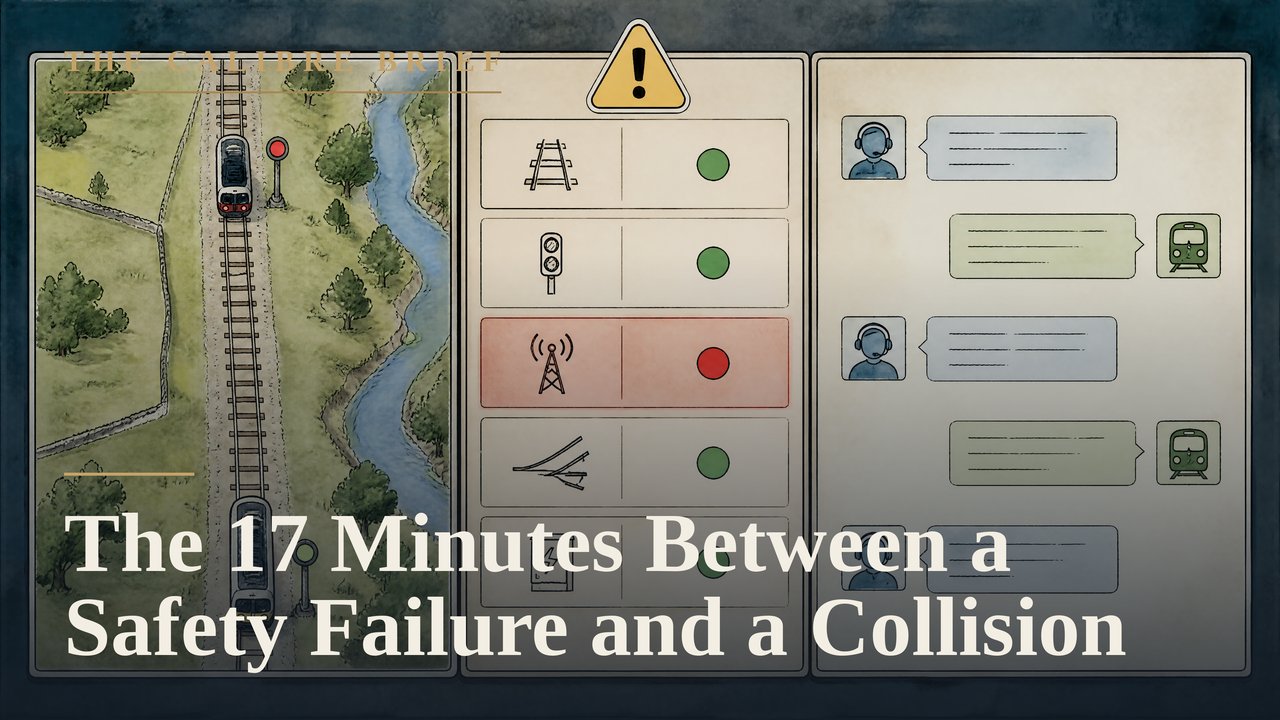
On October 28, 2026, an AVE train struck a stationary Iryo train near Urda, Spain, killing 69 people and injuring more than 100. This episode follows the 17 minutes between a reported 8:36 a.m. instruction to resume normal running and the collision at about 8:53, after the LZB protection system failed.
Verified reporting establishes that the AVE was authorized to proceed, the Iryo remained stopped, and the corridor recorded 170 reported LZB incidents in 2026. The evidence points to a cascading safety failure involving degraded protection equipment, fallback procedures, control-room decisions, and missed opportunities to stop the AVE.
Criminal responsibility and the precise causal chain remain unresolved. Investigators have not established why normal-speed running was authorized, why later warnings did not trigger a stop order, or whether delayed modernization and maintenance failures violated protocols. Alleged fraud involving EU funds is under investigation, but no suspects or findings have been publicly established, and no connection to the crash has been proven.
0:00 A high-speed train, a stopped train ahead 0:19 At 8:53, the trains crashed 0:50 LZB, the line's safety system, stops trains 1:14 That order looks like a serious human error 1:46 The deeper issue is design 2:09 One order may have set off this crash 2:23 That's The Calibre Brief from Calibre Code USA
Stock footage: MEISTERvideo via Pexels (https://pixabay.com/videos/id-32000/)
Key topics
Key moments
- 0:00 A high-speed train, a stopped train ahead
- 0:20 At 8:53, the trains crashed
- 0:50 LZB, the line's safety system, stops trains
- 1:15 That order looks like a serious human error
- 1:46 The deeper issue is design
- 2:09 One order may have set off this crash
- 2:24 That's The Calibre Brief from Calibre Code USA
Transcript
Show transcript
Welcome to The Calibre Brief, a Calibre Code USA production.
A high-speed train, a stopped train ahead, and seventeen minutes to stop a disaster. What happens when every safety layer fails at once?
On October 28, 2026, an AVE train left Madrid for Seville. Near Urda, in Toledo province, an Iryo train sat still on the same line. At 8:36, the control room told the AVE driver to go back to normal speed. At 8:53, the trains crashed. Sixty-nine people died. More than one hundred were hurt.
LZB, the line's safety system, stops trains on its own. That morning it failed across sixty-three kilometers. The backup rule: drive on sight, at most forty kilometers an hour. Instead, records say, the control room told the AVE to run at normal speed. Minutes later, the Iryo driver warned her train was still stopped.
That order looks like a serious human error. But those safeguards had worn down for years. The line logged 170 LZB incidents in 2026, a number officials call normal and critics call alarming. Its planned new system was years behind schedule. A claimed third-train near miss is not confirmed, and the EU fraud case has named no suspects and shown no link to the crash.
The courts and crash experts must explain why the AVE was cleared to run at full speed, and why repeated warnings never stopped it. The deeper issue is design. Rail safety is built in layers, so the system still works when one person gets it wrong. Near Urda, that layer was gone before anyone spoke.
One order may have set off this crash. It turned deadly inside a system with no safeguards left. We're not hunting one mistake, but asking why nothing caught it.
That's The Calibre Brief from Calibre Code USA. When one error turns deadly after every safeguard fails, who is to blame, the person or the system? Comment, like, subscribe on YouTube, and follow the podcast.