In the second week of November 2026, five separate pieces of digital infrastructure failed within seven days. GitHub stalled twice in one day. Visa clearing files arrived late to card programs. Text messages to AT&T subscribers stopped delivering. Microsoft lost Outlook, Teams, and other services for millions of users worldwide in an hourslong global outage. Then, on November 13, a malfunction in the Federal Aviation Administration's telecommunications network forced a nationwide ground stop that disrupted more than 20,000 flights.
Nothing in the public record points to an attacker behind any of these failures. Federal officials found no evidence at the time linking the FAA failure to Microsoft, artificial intelligence, or a malicious cyberattack, and Microsoft reported no indication of a cyberattack in its own incident. Independent reporting that reviewed the week concluded the verified incidents were separate service failures, not one coordinated event.
That raises a more uncomfortable question than sabotage would. If nobody attacked these systems, why did so many of them fail in the same week, and in such similar ways? The evidence from the postmortems points to a recurring mechanism: routine technical changes, such as a router installation, a capacity upgrade, or a database migration, triggered traffic overloads that cascaded through systems whose safeguards failed or made things worse. Whether that amounts to a documented pattern of fragility or a run of bad luck is the question this article tests against the record.
What actually failed between November 9 and 15
The week's verified timeline, drawn from official status pages and incident records, looks like this:
November 9, GitHub, two incidents. From 09:23 to 11:40 UTC, a degraded job-queue cluster delayed webhooks, Actions runs, Dependabot, and dependency-graph updates. GitHub later explained that a host had been slowing one Kafka broker, a message-routing server, since November 7, and that the broker had stopped reporting the metrics its alerting system needed, so detection was delayed until the cluster stalled. Average webhook delay reached 26 percent and peaked at 30 percent, with some deliveries delayed by as much as 3.5 hours. A second incident ran from 18:07 to 18:59 UTC, after a planned migration of a core Actions database from GitHub's own datacenter to a new cloud region. Once traffic shifted, request volume exceeded the new region's configured capacity and rate limits, causing workflow failures and knock-on effects in Webhooks, Pages, and Copilot code review. GitHub mitigated the failure by shifting some traffic back to the original region and reported that 28 percent of workflow runs were affected on average, 65 percent at peak (GitHub Status).
November 10, Visa clearing delays. Card issuer-processor Marqeta reported delays in Visa clearing files, customer reports, and clearing webhooks for North American and European card programs. Marqeta attributed the delay to Visa's upstream file delivery, said Visa applied a fix, and described a roughly two-hour incident in which delayed batches were later processed (StatusStack incident record). A separate processor, Lithic, documented a Visa-network clearing delay earlier in November that left Settlement API data incomplete for some customers, which indicates the disruption sat on the network side rather than inside one processor (Lithic Status).
November 11, Twilio and AT&T. Twilio reported delivery failures for messages sent from 10DLC numbers, the registered business phone numbers used for application-to-person texting, to AT&T subscribers in the United States. The incident was limited to AT&T-bound 10DLC SMS, not all Twilio messaging, and Twilio closed it at 22:02 Pacific Time after observing recovery (Twilio Status).
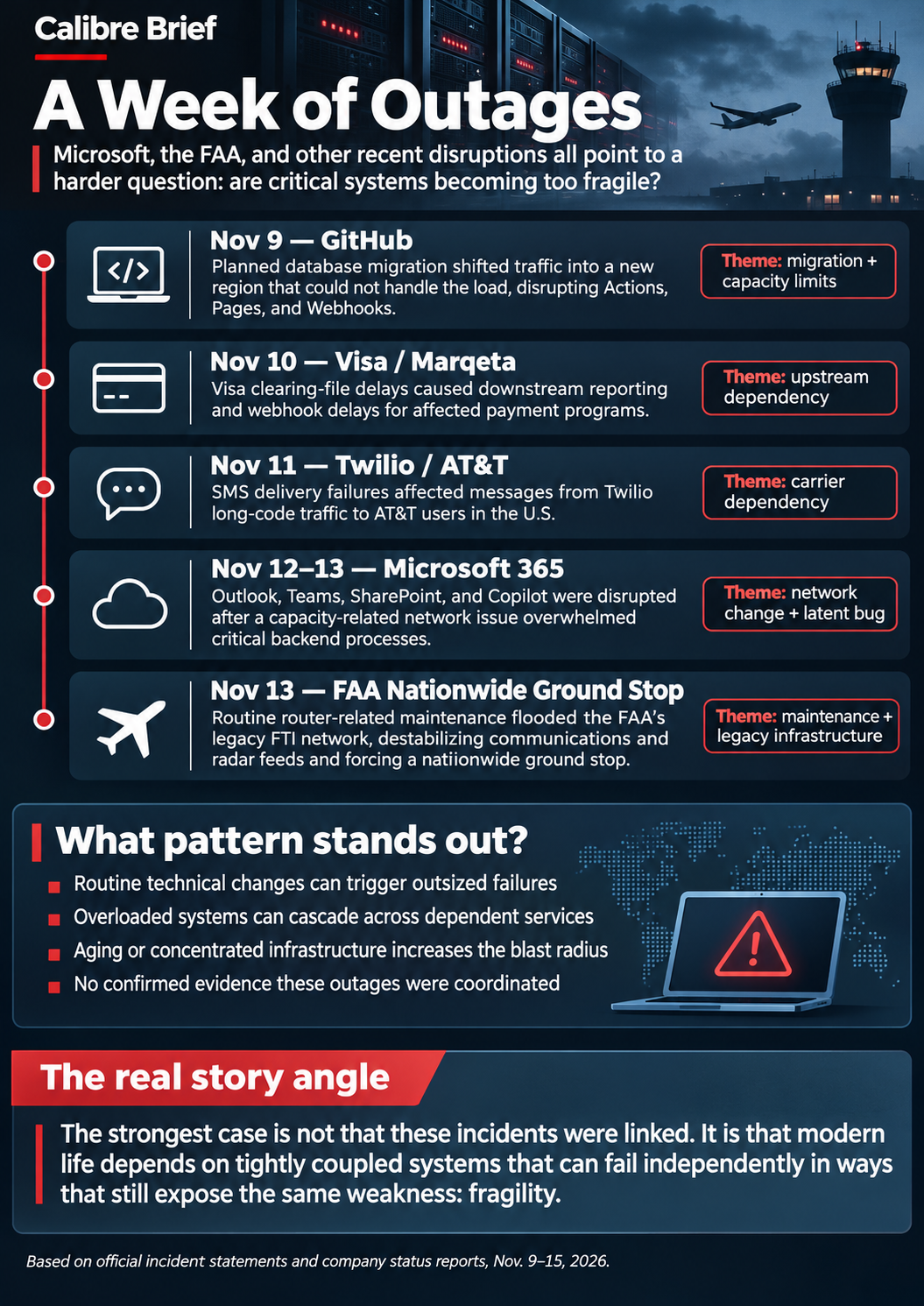
November 12, Microsoft. Outlook, Microsoft 365, Teams, and other services went down for millions of users worldwide (Tom's Guide live coverage). Microsoft later said services were fully restored after an hourslong global outage (AP). In the United Kingdom, Sky News reported effects on the NHS, police, and schools (Sky News).
November 13, the FAA. A nationwide ground stop halted departures for more than four hours and disrupted over 20,000 flights, with the disturbance spreading to 17 of the FAA's 22 en-route centers, the facilities that manage high-altitude traffic between airports (MWC syndicated report).
Two of these incidents, Visa and Twilio, were bounded and resolved within hours with limited published detail about root cause. The other three produced substantial technical accounts, and those accounts are where the pattern, if there is one, has to be found.
How a months-old upgrade took Microsoft offline

Microsoft's outage was tracked internally as MO1550821, with the Exchange Online component identified separately as EX1550543. The company initially reported elevated load across multiple regions, connectivity failures, and an unexpected increase in a particular category of service traffic. Its subsequent investigation reversed the obvious interpretation: the load was not primarily caused by a surge of incoming traffic, but by multiple servers becoming unexpectedly unavailable, which overburdened the infrastructure that remained (Microsoft Q&A incident thread).
The affected servers were failing automated health checks, the routine tests that decide whether a server receives traffic, apparently because a core processing component became overwhelmed and stopped responding (community incident record). Healthy-looking capacity kept shrinking, and the shrinking capacity concentrated more load on fewer machines.
The origin was older than the outage. Months earlier, Microsoft had upgraded network gateways to add capacity, and that upgrade introduced a latent software bug (Sky News). The defect stayed dormant until a subsequent network change surfaced it, at which point Outlook, Teams, and other services went down (AP). Recovery required validating an alternative health-check method and applying it across the affected infrastructure, alongside restarting and repairing servers, rebuilding some with an earlier software configuration, and restricting traffic to stabilize the system (Tom's Guide; incident reporting). Microsoft reported no indication of a cyberattack or AI-agent involvement.

The irony is that Microsoft's own engineering guidance describes this failure class. Its architecture documentation warns that retries and heavy traffic can amplify a localized capacity problem into a cascading failure unless retry budgets and shared-resource limits are enforced (Microsoft Azure Architecture Center). The November incident followed that script: servers dropped out, load concentrated, and the mechanisms meant to protect the system, health checks apparently among them, participated in taking capacity offline.
How one router in Arkansas grounded flights nationwide
The FAA incident began during contractor work, not during an attack and not during normal operations. L3Harris technicians at a facility in El Dorado, Arkansas, were replacing aging copper communications lines with fiber-optic service and installing a new router (CBS News). Officials said the new or replacement router began flooding other network routers with traffic, producing intermittent failures in voice communications, radar feeds, and data links (Hindustan Times explainer).
The FAA's own account describes unstable telecommunications, excessive connection traffic, and intermittent radar and voice failures that exposed weaknesses in aging air-traffic infrastructure, while stating that the exact root cause remains under investigation (FAA Q&A). Investigators have not determined whether the initiating fault involved contractor error, installation mistakes, defective equipment, or software behavior (WNYC/NPR). That uncertainty matters: the flooding mechanism is reported by officials, but responsibility for why the router misbehaved is unresolved.

What is not in dispute is the scale and the policy conclusion officials drew from it. The disturbance reached 17 of 22 en-route centers, leaving controllers with inconsistent access to communications and operational information, and the ground stop disrupted over 20,000 flights, making it one of the largest aviation interruptions in decades (MWC syndicated report). Transportation Secretary Sean Duffy's response was blunt: "we have to get off old network" (CBS News). Federal officials found no evidence at the time linking the failure to Microsoft, AI, or a malicious cyberattack (AP).
Where this story sits
5 related pieces
Read it →
Hover a story · click to read
 No. 99 · Nov 13, 2026America's Skies Shut Down: The Communications Failure That Grounded a Nation
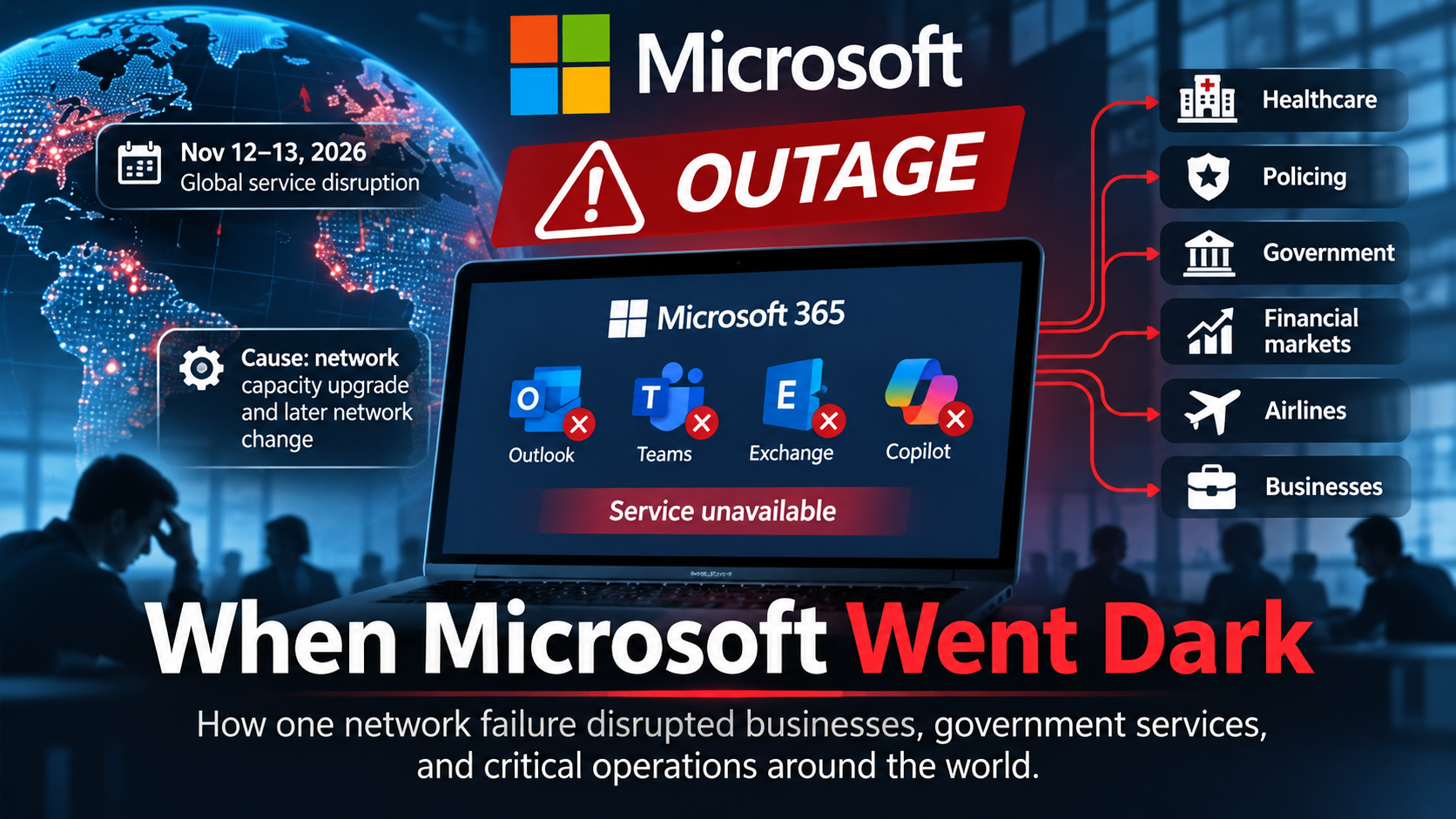 No. 100 · Nov 14, 2026When Microsoft Went Dark: How One Network Failure Disrupted the World
 No. 14 · Aug 26, 2026The Quiet Relay: How China-Linked Hackers Turned IoT Devices Into Espionage Highways
 No. 107 · Nov 16, 2026What November's Bank Outages Reveal About America's Digital Financial Plumbing
 No. 70 · Oct 16, 2026Day 30 Without Supply: Why America's Older Weapons May Outlast Its Newest Ones
The same mechanics, three different companies

Set the three detailed incidents side by side and the resemblance is specific, not vague.
A routine change was the trigger. Microsoft's failure traced to a capacity upgrade whose defect surfaced after a later network change. The FAA's began during a planned copper-to-fiber modernization. GitHub's second November 9 incident followed a planned database migration to a new cloud region. In each case, the initiating event was maintenance or improvement work, the kind of change these organizations perform constantly.
Traffic overload was the mechanism. The FAA router flooded its peers. Microsoft's surviving servers were overburdened by load redistributed from failed ones. GitHub's migrated traffic exceeded the new region's configured capacity and rate limits. Three different systems, one physics: when load exceeds what a component can absorb, failure spreads to whatever absorbs the overflow next.
The safeguards failed or backfired. GitHub's Kafka broker stopped reporting the metrics its alerting needed, so the monitoring designed to catch degradation went quiet precisely when degradation began. Microsoft's automated health checks apparently marked overwhelmed servers unhealthy, removing capacity and deepening the overload, and recovery required building an alternative health-check method mid-incident. These are not cases of missing safety systems. They are cases where the safety systems were entangled with the failure.
Dependencies carried the damage outward. GitHub's degraded Actions infrastructure produced secondary effects in Webhooks, Pages, and Copilot code review. The FAA disturbance crossed from one facility into most of the en-route network. This mirrors GitHub's earlier August 17, 2026 outage, which lasted 7 hours 47 minutes and spread across Actions, webhooks, pull requests, logs, and dependent services (GitHub Blog); GitHub's availability report for that month describes network saturation exhausting load-balancer flow limits and degrading shared authentication, spreading errors across APIs, Actions, Copilot, issues, and pull requests (GitHub availability report, August 2026).

The Visa and Twilio incidents fit the dependency picture more than the overload picture. Marqeta's delay originated upstream at Visa and rippled to downstream processors; Lithic's separate record suggests the disruption lived in the shared network layer. Twilio's failure was confined to one delivery path, 10DLC messages bound for AT&T. Neither incident has a published root cause comparable to the big three, and it would overstate the evidence to fold them into the same mechanism. What they demonstrate is narrower but still relevant: when a shared upstream provider hiccups, every business built on top of it inherits the hiccup.
Coincidence, pattern, or both?
The hypothesis worth testing is whether this week reveals systemic fragility rather than extraordinary bad luck. The evidence supports a carefully bounded version of that claim.
First, the incidents were genuinely independent. The Washington Post's review of the week found separate service failures, not evidence of one coordinated cyberattack (Washington Post). The FAA, for its part, says the exact root cause of its own failure remains under investigation (FAA Q&A). Taken together, the record supports systemic concentration and operational fragility, but not the claim that all of the week's disruptions arose from one common technical dependency. No shared root cause connects Redmond, El Dorado, and GitHub's datacenters.
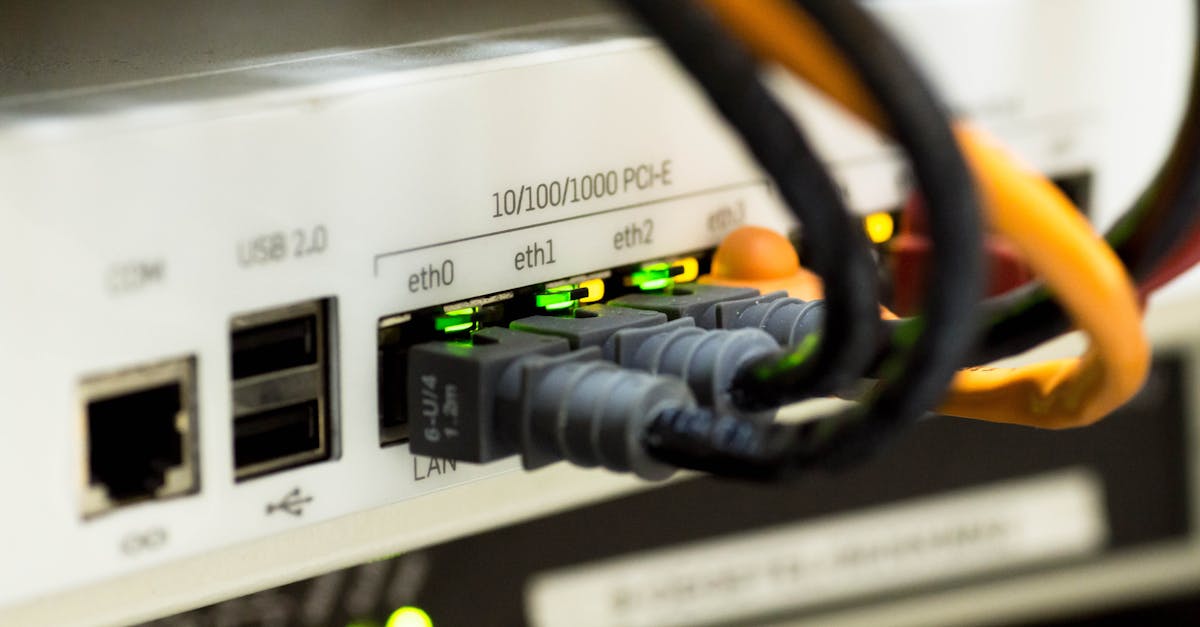
Second, independence does not mean randomness. Risk analysts reviewing the Microsoft outage concluded that the recurring pattern across such incidents is not a single component failure but the concentration of many dependent services around common networks, identity systems, cloud platforms, and vendors (Control Risks). The week's failures were separate draws from the same distribution: complex, interconnected systems in which routine changes carry outsized blast radius.
Third, the failure class has a documented history that predates this week. AT&T's February 22, 2024 nationwide cellular outage, which disrupted connectivity and some emergency communications, resulted from an incorrectly executed network-expansion process, not a cyberattack (AT&T letter). The July 19, 2024 CrowdStrike incident showed a related mechanism: a faulty security-content update crashed roughly 8.5 million Windows devices and disrupted aviation, healthcare, and other critical services (CrowdStrike root-cause analysis; GAO). Square's payment outage in the United States was caused by a bad deployment in provider security tooling that propagated globally, while DNS and backend dependencies impaired transaction processing (Square incident write-up). The structural point that emerges from these records is uncomfortable: redundancy often failed not because backups were absent, but because primary and fallback systems shared networks, vendors, configurations, or recovery bottlenecks (Square incident write-up).
So the honest answer splits the question. The clustering of five incidents into one week appears to be coincidence; nothing in the record connects their triggers. The fact that major infrastructure keeps failing this way, from routine changes, through overload, past safeguards that share fate with the systems they protect, is a documented pattern with years of precedent.
Are failures actually getting worse?

Digital infrastructure lacks the decades of standardized reliability data that would settle this definitively, but the electric grid offers an instructive parallel, because it is the one critical system where researchers have measured the question carefully.
The grid findings are sobering in a specific way. Large, long-duration outages occur more often than extrapolations from smaller events would predict, according to the National Academies, whose account of the August 14, 2003 Northeast blackout, in which incomplete situational awareness, inadequate alarm functionality, and vegetation-related line trips combined to collapse service across eight states and two Canadian provinces, remains the canonical cascading-failure case study (National Academies). Lawrence Berkeley National Laboratory found that worsening annual reliability trends were driven chiefly by the increasing severity of major events rather than by ordinary interruptions becoming uniformly more frequent (LBNL). Extreme events remain a small minority of total consumer interruptions but disproportionately increase annual outage hours, because wide-area disasters slow restoration across many assets simultaneously (grid reliability analysis). One dataset attributes roughly 46 percent of electricity-outage incidents to natural or weather-related events and 28 percent to grid-system causes (Journal of Critical Infrastructure Policy).
The pattern that emerges, big failures are disproportionately damaging and arrive more often than small-event statistics suggest, maps closely onto November's digital incidents. The 2003 blackout's alarm system failed when operators needed it, just as GitHub's broker metrics went silent and Microsoft's health checks misfired. And NERC's recent reliability analysis adds a restoration lesson that applies directly: recovery performance depends not only on event size but on damaged equipment, sequencing decisions, and whether operators can defer noncritical work during emergencies (NERC 2025 State of Reliability). Microsoft's recovery, which required inventing an alternative health-check method, rebuilding servers on an earlier configuration, and throttling traffic, was exactly that kind of improvised sequencing under pressure.
What cannot be claimed from available evidence is a measured upward trend in digital-infrastructure outage frequency comparable to the grid literature. The within-year signal is suggestive, GitHub alone logged a 7-hour-47-minute August outage, a significant earlier incident that same month, and two November incidents, but suggestive is not proven, and this article will not promote it beyond that.
What remains unknown, and what is being fixed

The unresolved questions are concrete. For the FAA: whether the router flooding stemmed from contractor error, installation mistakes, defective equipment, or software behavior, a determination still under investigation (WNYC/NPR; FAA). For the Visa clearing delays and the Twilio-AT&T messaging failure: detailed root causes beyond the operators' brief status notices. For GitHub's November 9 afternoon incident: a published root-cause analysis had not yet appeared on its status page as of mid-November (GitHub Status).
The corrective directions, by contrast, are already visible. Microsoft deployed its alternative health-check validation across affected infrastructure. GitHub mitigated its migration failure by shifting traffic back and retains the capacity findings for future cutovers. The FAA's leadership has framed the ground stop as an argument for accelerating the replacement of aging network infrastructure (CBS News), though the El Dorado incident carries its own warning: the failure happened during modernization work, which means the fix and the risk are the same activity.
That is the real lesson of the week, and it is less dramatic and more durable than any attack narrative. No hacker was required because none was needed. The systems that run email for hospitals, radar feeds for air traffic controllers, code pipelines for software companies, and clearing files for card payments are dense webs of shared dependencies in which an upgraded gateway, a new router, or a migrated database can set off an overload that the safety mechanisms cannot contain, and sometimes amplify. The incidents of November 9 through 15 were separate. The weakness they exposed is not.
Sources / References

- Associated Press, "Microsoft says services fully restored after hourslong global outage," https://apnews.com/article/ca395c0f1e51af784b6d70afb6554f6a
- Associated Press, "What to know about flights after the US nationwide ground stop," https://apnews.com/article/8a7ea4fe27804b52bf79eaaec1308180
- Federal Aviation Administration, "Nationwide Ground Stop: Questions and Answers," https://www.faa.gov/newsroom/nationwide-ground-stop-questions-and-answers
- CBS News, "Ground stop shows 'we have to get off old network,' Transportation Secretary Sean Duffy says," https://www.cbsnews.com/news/ground-stop-faa-telecom-network-sean-duffy-face-the-nation/
- WNYC/NPR, "FAA blames Friday's ground stop on 'equipment issue' during telecoms network upgrade," https://wnyc.org/npr/nx-s1-6040952
- Hindustan Times, "How one router flooding the FAA's network forced a nationwide US ground stop," https://www.hindustantimes.com/ht-explainers/faa-ground-stop-router-network-disruption-how-it-works-101794731142073-amp.html
- MWC syndicated report, "US aviation shutdown blamed on L3 Harris installed router," https://d2233.cms.socastsrm.com/2026/11/14/us-aviation-shutdown-blamed-on-l3-harris-installed-router/
- Microsoft Q&A, "Is Microsoft Experiencing an Outage" (incident MO1550821 / EX1550543), https://learn.microsoft.com/en-us/answers/questions/6069133/is-microsoft-experiencing-an-outage?page=1
- Sky News, "Microsoft outage latest: NHS, police and schools affected," https://news.sky.com/story/microsoft-outage-latest-hundreds-of-thousands-of-users-affected-as-fix-not-going-as-expected-13611764?postid=12827456
- Tom's Guide, "Outlook, Microsoft 365, Teams and more down for millions worldwide," https://www.tomsguide.com/news/live/microsoft-outlook-down-live-updates-outage-11-12-26
- r/outages community record, "Microsoft Outage History," https://www.reddit.com/r/outages/comments/1xuno6w/microsoft_outage_history/
- r/sysadmin incident discussion of Microsoft recovery status updates, https://www.reddit.com/r/sysadmin/comments/1xun96p/i_have_never_seen_such_a_remarkable_status_update/
- The Washington Post, "A bad week of outages after ground stop, and Microsoft Outlook went down," https://www.washingtonpost.com/technology/2026/11/14/bad-week-outages-after-ground-stop-microsoft-outlook-went-down/
- GitHub Status, November 9, 2026 incident records, https://www.githubstatus.com/
- The GitHub Blog, "The August 17 outage, and the work ahead," https://github.blog/news-insights/company-news/the-august-17-outage-and-the-work-ahead/
- The GitHub Blog, "GitHub availability report: August 2026," https://github.blog/news-insights/company-news/github-availability-report-august-2026/
- StatusStack, "Delayed clearing webhooks files from Visa - Marqeta Incident on Nov 10, 2026," https://statusstack.com/service/marqeta/incidents/01a1c5d0-8c40-7a95-bebd-457259bd3511
- Lithic Status, Visa-network clearing delay record, https://status.lithic.com/
- Twilio Status, November 11, 2026 10DLC/AT&T incident, https://status.twilio.com/
- Control Risks, "Microsoft outage: a dependency decades in the making," https://www.controlrisks.com/our-thinking/insights/microsoft-outage-a-dependency-decades-in-the-making
- Microsoft Azure Architecture Center, "Transient fault handling best practices," https://github.com/microsoftdocs/architecture-center/blob/main/docs/best-practices/transient-faults.md
- AT&T, "Addressing the February 22 outage" letter, https://about.att.com/ecms/dam/snrdocs/network-employee-letter.pdf
- CrowdStrike, "Root Cause Analysis: Channel File 291, Executive Summary," https://www.crowdstrike.com/wp-content/uploads/2024/08/Executive-Summary_Root-Cause-Analysis_Channel-File-291.pdf
- U.S. Government Accountability Office, "
The reading behind this research
What the desk leaned on for this piece. Each link goes to the retailer, where the price is shown.

Anker A1336011 Prime 20k Mah Power Bank [200w] 2 Usb C Ports
During the November 13 FAA ground stop, travelers sat for hours relying on phones to rebook and check updates, so a spare charge matters.
View on Walmart
The November 13 FAA ground stop disrupted over 20,000 flights; a tracker shows where your bag is even when airline systems fail.
View on Walmart
When Microsoft 365 went down for hours on November 12, cloud-only files were out of reach; a local copy of your work still opens in an outage.
View on Walmart
Meltdown: Why Our Systems Fail and What We Can Do About It (Chris Clearfield & András Tilcsik)
The article says routine changes like a router install or database migration cascaded into outages; this book explains why complex systems fail that way.
View on Walmart
How Infrastructure Works: Inside the Systems That Shape Our World (Deb Chachra)
The article's postmortems show routine upgrades like router installs cascading into failures; this book explains why the systems we depend on are built that way.
View on WalmartPaid links. Calibre Code USA may earn a commission from purchases made through these links. This does not affect what we write or what we recommend.
Comments (7)
Continue exploring
The Quiet Relay: How China-Linked Hackers Turned IoT Devices Into Espionage Highways
The QScan and QTRouter takedown reveals how ordinary routers, cameras, and other connected devices can become hidden relay points…
What November's Bank Outages Reveal About America's Digital Financial Plumbing
Major U.S. banks suffered simultaneous access failures on November 16, 2026; the evidence shows no cyberattack or systemic…
Day 30 Without Supply: Why America's Older Weapons May Outlast Its Newest Ones
A 30-day cutoff of rare earths, chips, energetics and titanium would ground America's newest combat systems while older ones keep…
The article is right to separate the incidents, but it still leans heavily on the three outages with detailed postmortems. Visa and Twilio were both described as network-side or upstream failures with little public root-cause information, so they do not clearly support the same cascading-failure pattern. That makes the apparent clustering interesting, but probably weaker evidence than the article's broader framing suggests.
The conclusion that these incidents document a recurring pattern of infrastructure fragility needs more evidence than the five-day clustering and three detailed postmortems provide.
The verified timeline was the most useful section because it separates the five events instead of implying a single attack. The figures—26 percent average webhook delay, 28 percent of workflow runs affected, and 17 of 22 FAA centers disrupted—make the scale and differences between incidents concrete.
At a previous company, a Kafka broker stopped reporting accurate health metrics while continuing to accept some traffic. Our dashboards looked normal until the queue began backing up, and the delayed alerts made the eventual recovery much harder. That experience closely matches GitHub's description of a broker that stopped reporting the metrics its alerting system needed.
The detail about GitHub shifting traffic back to its original region is especially interesting. Could the postmortem say whether the new cloud region failed because of raw capacity, an overly conservative rate limit, or a mismatch in the traffic profile? It would be useful to know which safeguard would have prevented the 65 percent peak impact.
How does the GitHub migration lesson apply to a 10-person engineering team that cannot maintain a second region or elaborate traffic controls? The article needs a lower-cost version of that advice.
The phrase "safeguards failed or made things worse" captures the central risk well. It would be useful to distinguish safeguards that were misconfigured from those that amplified the outage through retries, failover, or traffic shifting.