Five Independent Failures Exposed a Shared Weakness in Critical Systems | The Calibre Brief Ep. 90
About this episode
In one November 2026 week, GitHub, Visa clearing, Twilio-to-AT&T messaging, Microsoft 365, and the FAA telecommunications network suffered significant failures. The reporting establishes that these were separate incidents, with no evidence of a coordinated attack or shared technical cause.
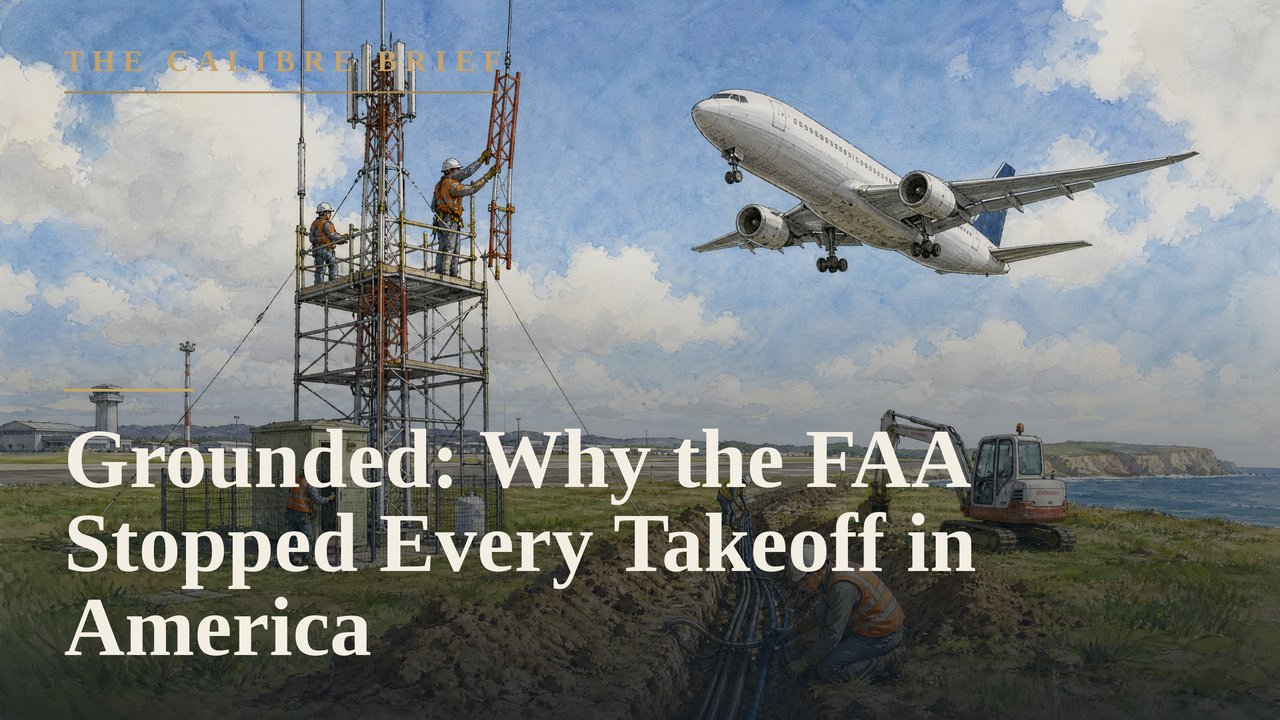
Detailed accounts of the GitHub, Microsoft, and FAA outages show a recurring failure pattern: routine upgrades or migrations triggered overload, while monitoring and health-check systems failed or amplified the damage. The FAA disruption grounded departures for more than four hours and affected over 20,000 flights.
The FAA’s exact root cause remains under investigation, and responsibility for the router behavior has not been determined. The Visa and Twilio incidents have no published root causes, so they cannot be assigned the same mechanism. The episode examines what these failures reveal about modernization, shared dependencies, and the risks built into critical systems.
0:00 The obvious question was who did it 0:18 Then Microsoft went dark worldwide for millions 0:46 The best documented failures share one shape 1:12 Visa and Twilio never explained theirs 1:44 This wasn't new 2:09 The record shows no attacker 2:26 Tell us in the comments
Stock footage: Life-Of-Vids via Pexels (https://pixabay.com/videos/id-6414/) Stock footage: cipnt via Pexels (https://pixabay.com/videos/id-14900/)
Key topics
Key moments
Transcript
Show transcript
Welcome to The Calibre Brief, a Calibre Code USA production.
In a single week, the systems behind American flights, payments, and messages failed, one after another. The obvious question was who did it.
It started on November 9, 2026, when GitHub broke twice in one day. Visa's card files ran late, and business texts to AT&T phones stopped landing. Then Microsoft went dark worldwide for millions. Four days in, the FAA grounded flights nationwide, disrupting more than 20,000 of them. Officials and Microsoft reported no sign of attack.
The best documented failures share one shape. In El Dorado, Arkansas, crews swapping copper lines for fiber installed a new router. Officials say it flooded the FAA's network with traffic, reaching 17 of 22 en route centers. At Microsoft, a hidden bug from an earlier upgrade surfaced, and traffic piled onto fewer and fewer servers.
Here's the twist: the safety tools joined the failures. GitHub's failing part stopped reporting the numbers its alarms needed, so monitoring went blind. Microsoft's health checks apparently pulled struggling servers offline, deepening the overload. Yet no shared cause links the five failures, and the FAA hasn't learned what started the flood. Visa and Twilio never explained theirs. The timing looks like chance; the pattern does not.
This wasn't new. In 2024, a botched network expansion took down AT&T nationwide, and a bad CrowdStrike update crashed roughly 8.5 million Windows devices. Transportation Secretary Sean Duffy said, "we have to get off old network." But notice the catch: the FAA outage happened during exactly that kind of upgrade.
The record shows no attacker, and that is the harder lesson. Five chance failures revealed one shared weakness: in deeply connected systems, routine work carries an outsized blast radius.
How should operators upgrade aging systems without the upgrade becoming the next outage? Tell us in the comments. Like and subscribe on YouTube, and follow The Calibre Brief podcast from Calibre Code USA.