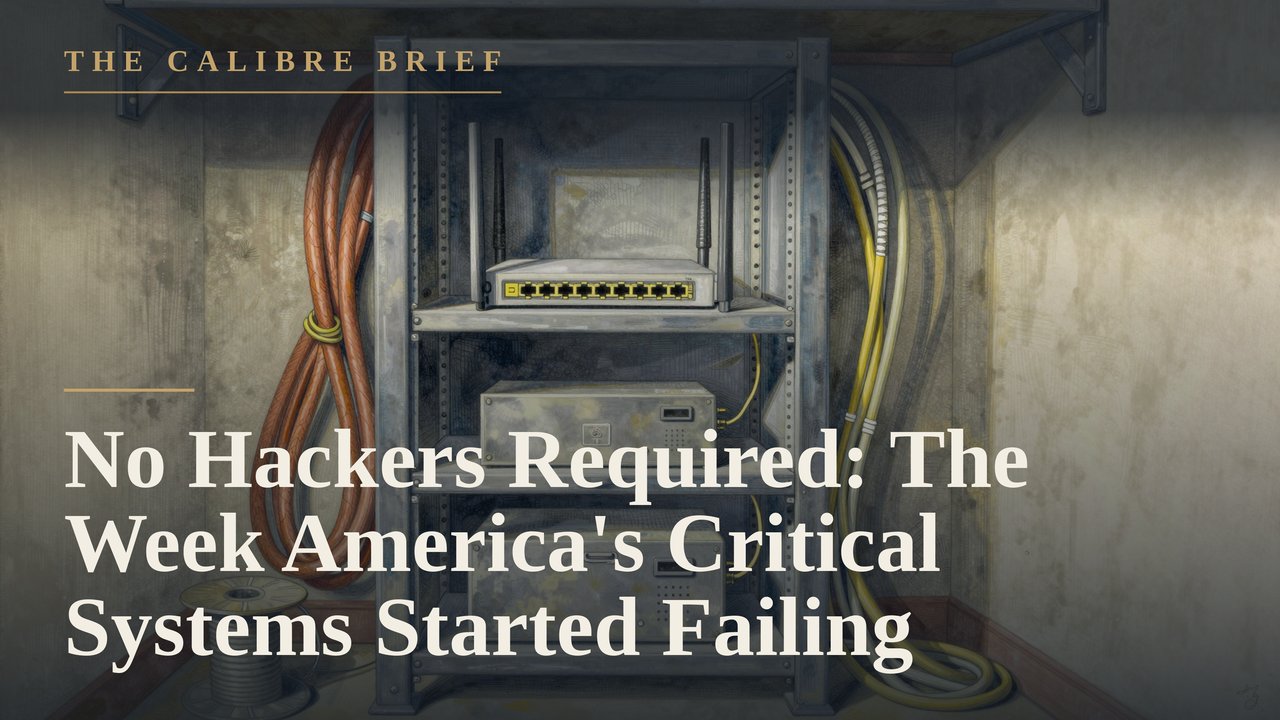
Why the FAA Halted Nationwide Departures After Communications Failures | The Calibre Brief Ep. 81
About this episode
On November 13, 2026, the FAA ordered departing aircraft across the United States to remain on the ground after communications failures affected multiple air-route traffic-control centers. This episode explains how flights rely on connected control centers, radio systems, data links, and other communications infrastructure as they cross the country—and why stopping departures was the safest available response when reliability could not be confirmed.
Verified reporting establishes that the event was a nationwide ground stop, not a total shutdown of air traffic or a confirmed collapse of air-traffic control. It also places the incident against a documented history of aging FAA systems, incomplete modernization, shared dependencies, and weaknesses in backup testing.
The FAA has not publicly identified a root cause. A cyberattack, telecommunications-provider outage, software failure, human error, or failed backup remains unestablished, as does the specific equipment or sequence involved. The central unresolved question is whether the incident reflects an immediate failure, deeper resilience problems, or both.
0:00 One November morning, that promise wavered 0:16 It was the first nationwide ground stop since 2023 0:42 Each zone is run by its own control center 1:06 The FAA has not named a cause 1:35 The brake worked, but it left a national backlog 1:54 The shutdown doesn't tell us what broke 2:07 That's The Calibre Brief from Calibre Code USA
Stock footage: mariohagen via Pexels (https://pixabay.com/videos/id-47339/) Stock footage: Life-Of-Vids via Pexels (https://pixabay.com/videos/id-10874/)
Key topics
Key moments
- 0:00 One November morning, that promise wavered
- 0:17 It was the first nationwide ground stop since 2023
- 0:43 Each zone is run by its own control center
- 1:07 The FAA has not named a cause
- 1:35 The brake worked, but it left a national backlog
- 1:55 The shutdown doesn't tell us what broke
- 2:08 That's The Calibre Brief from Calibre Code USA
Transcript
Show transcript
Welcome to The Calibre Brief, a Calibre Code USA production.
Air traffic depends on one quiet promise: that controllers can always reach the planes they guide. One November morning, that promise wavered.
On November 13, 2026, the FAA's national command center in Warrenton, Virginia made a rare call. Every flight waiting to take off would stay on the ground. Trouble with radio and data links had hit several control centers that guide planes flying high between airports. It was the first nationwide ground stop since 2023.
A flight crossing the country passes through a chain of invisible zones. Each zone is run by its own control center. Each handoff depends on radios, phone lines, and data links. If controllers in several regions can't trust those links, every takeoff adds another plane they might not reach. Stopping takeoffs shrinks that risk.
The FAA has not named a cause. Nothing public proves an attack, a broken backup, or worn out gear. Audits, though, had flagged 51 of the FAA's 138 systems as unsustainable, not fit to keep running. Backups can share hidden weak points with the systems they guard. That history made this day foreseeable, but it does not prove what failed this time.
The brake worked, but it left a national backlog, and not every delay traces back to this one failure. The country is rebuilding a safety critical network while flying on it nonstop. November 13 now adds weight to a long worry: the weak spots may be growing faster than the fixes.
The shutdown doesn't tell us what broke. It tells us what the FAA could no longer assume: that its voice to the skies was sound. Stopping was safer than guessing.
That's The Calibre Brief from Calibre Code USA. Should blame fall on the failure itself, or on years of delayed fixes? Comment below, then like and subscribe on YouTube and follow the podcast.