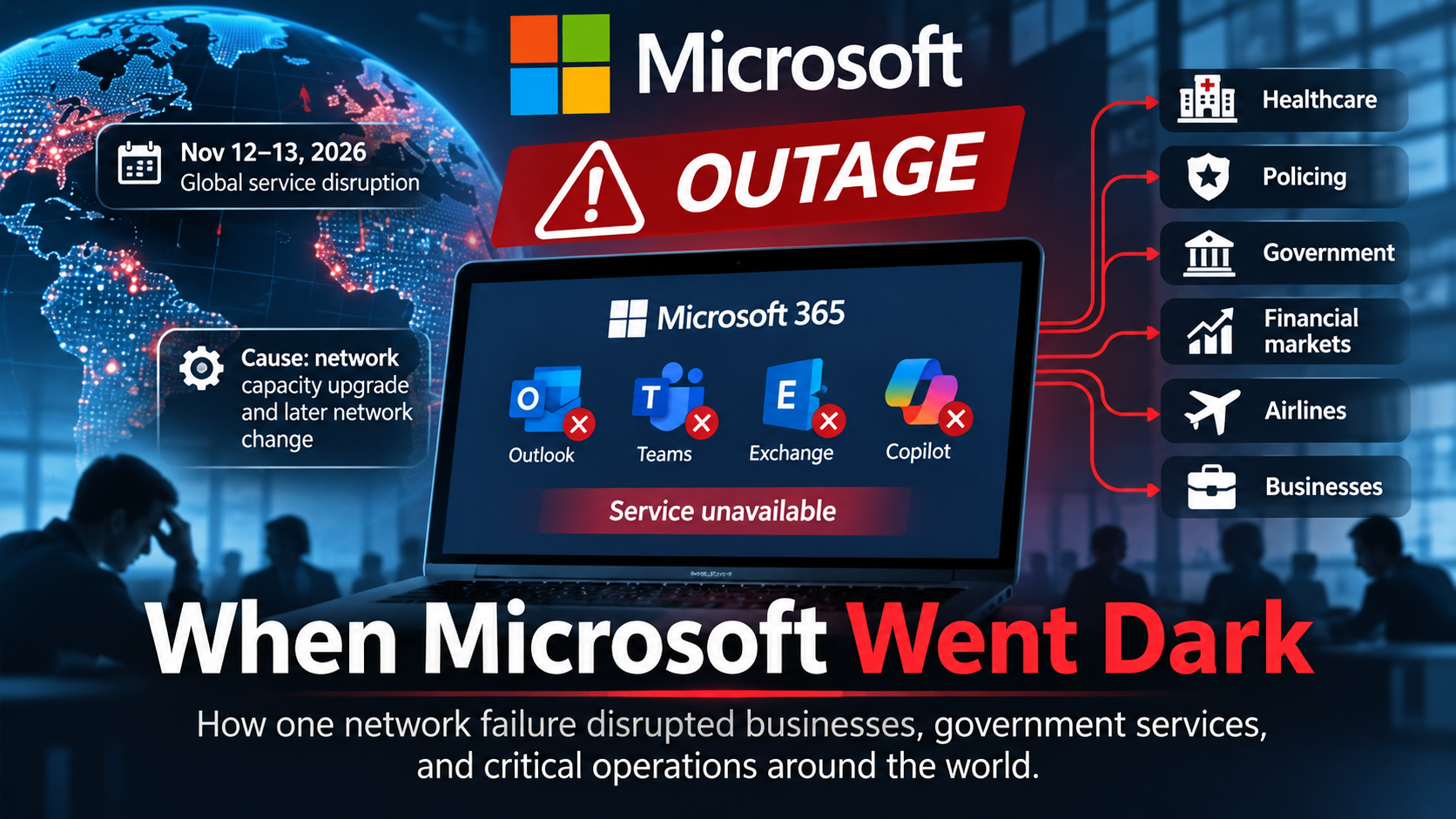
Shortly after midday Eastern time on Thursday, November 12, 2026, email stopped working for Microsoft 365 users around the world. Within roughly an hour, the outage-tracking service Downdetector had logged user reports from 74 countries and territories, a sign that the failure had blown past any single region almost immediately (AP). Over the following hours, the disruption spread from Exchange Online, the service that runs Outlook mailboxes, into Teams, Copilot, SharePoint, OneDrive, and even some of the administration portals that IT departments needed to manage the crisis (The Guardian).

The consequences reached well beyond inboxes. In the United Kingdom, Sky News reported that the NHS, police forces, and schools were affected (Sky News). In the United States, the outage hit courts, Congress, government agencies, and financial institutions (Axios). Reuters reported delays at trading firms, a halted European bond repurchase, and disruptions at some Hong Kong banks (Reuters via StreetInsider).

Microsoft said it was "deeply sorry," insisted the incident was "not related to cyber or AI" (The Guardian), and promised a full post-incident report (Ars Technica). What the company has disclosed so far points to something more unsettling than a hack: a hidden defect, introduced during an earlier network upgrade, that lay dormant until a later network change set off a chain reaction inside otherwise healthy systems.
What actually broke inside Microsoft's network
Microsoft's explanation shifted as its engineers dug deeper, and the sequence of those explanations tells its own story.
The company's first public statements attributed the symptoms to elevated load and unavailable servers. Only later did Microsoft identify a deeper infrastructure problem involving network capacity and routing (Xurrent). Its status updates described servers failing automated health checks, the routine tests that confirm a server is fit to handle traffic; servers that failed those checks became unavailable and were removed from service (Ars Technica; EL PAÍS).
Microsoft later offered a more specific account: an earlier network-capacity upgrade had introduced a defect, and a more recent network change exposed it, causing cascading failures in systems that were themselves healthy (Sky News; AOL). The company also said a core process responsible for establishing secure connections became overwhelmed, which caused affected servers to stop processing requests (XenoSpectrum).

Outside analysts, working from observable network behavior, pointed to network gateways, BGP routing, or DNS-related traffic management as the likely failure domain, though Microsoft has not confirmed that level of detail (The Guardian).
How one failure cascaded into a global outage
The spread followed a pattern familiar to anyone who studies large distributed systems: the safety mechanisms themselves amplified the damage.
When servers failed their health checks or crashed outright, Microsoft's infrastructure did what it is designed to do and redirected their traffic to the servers that remained. But with the total pool of working capacity shrinking, each surviving server inherited a larger share of the load. Those servers then became overloaded and failed in turn, in what EL PAÍS described as a cascading capacity failure (EL PAÍS). Available reporting indicates the overload was not primarily caused by an unusual surge in user demand but by reduced effective capacity after servers failed (XenoSpectrum).
The failure began in Exchange Online, where users reported failed mailbox access, delayed or rejected email, broken attachment downloads, search problems, authentication errors, and Outlook web sign-in failures (University of Pennsylvania incident records). The disruption then expanded to Outlook.com, OneDrive, OneNote, Microsoft To Do, Teams, Microsoft 365 for the web, Copilot, SharePoint, Purview, Power BI, and some administration portals (The Guardian).
Not everything went down equally. Teams was degraded, but core chat, group messaging, calls, meetings, and standard channels largely kept working, particularly for users who were already connected when the failure hit (Business Standard). That distinction mattered in practice: organizations that could not send email may still have been able to coordinate over chat.
Why the fix kept slipping

Microsoft's immediate mitigation was to validate an alternative health-check method, return affected servers to service, and then apply that change more broadly (Ars Technica). According to Microsoft's own running status updates, compiled by system administrators as the incident unfolded, recovery also involved applying an upstream authentication-and-routing patch, expanding the fix region by region, and isolating affected infrastructure before gradually reintroducing traffic (incident updates for EX1550543 / MO1550821).
That gradual, region-by-region approach is deliberate. Reintroducing all traffic at once to a weakened system risks triggering exactly the same overload cascade that caused the outage. But it also meant recovery was slow and uneven, and the fix did not initially go as expected (Sky News).
The monitoring firm Infoblox observed significant recovery beginning around 11:20 GMT on Friday, November 13, after the outage had lasted more than 21 hours (The Guardian). Even then, the incident was not over for everyone. Microsoft reported improving availability and sharply reduced email queues on Friday, but intermittent connectivity, delayed delivery, and residual failures persisted during recovery, meaning some users faced disruption for around a full day or more after the first failures (Penn incident summary; The Guardian).
Where this story sits
5 related pieces
Read it →
Hover a story · click to read
 No. 103 · Nov 16, 2026No Hackers Required: The Week America's Critical Systems Started Failing
 No. 89 · Nov 3, 2026Why Was a Renfe Train Allowed Toward a Stopped Train?
 No. 27 · Sep 2, 2026Three Mile Island Can Restart in 2027. The Grid May Not Take Its Power Until 2031.
 No. 30 · Sep 3, 2026The Portsmouth experiment: can 10 gigawatts of AI compute avoid shifting grid costs onto its neighbors?
 No. 99 · Nov 13, 2026America's Skies Shut Down: The Communications Failure That Grounded a Nation
Who was hit, and how badly

The documented impact map reads like an inventory of modern institutional life.
- Healthcare and emergency services. Sky News reported that the NHS and police forces in the UK were among those affected, along with schools (Sky News).
- Government and courts. In the US, the outage reached courts, Congress, and government agencies (Axios).
- Financial markets. Reuters reported delays at trading firms, a halted European bond repurchase, and disruptions at some Hong Kong banks, and characterized the outage as impairing communications for businesses and governments globally for more than 12 hours (Reuters via StreetInsider).
- Everyone else. The AP reported the outage disrupted Outlook, Teams, Copilot, and other services across numerous countries (AP).
One caution about the numbers: Downdetector's figure of reports from 74 countries measures where users submitted complaints, not a verified count of affected people or organizations (AP). A verified count of affected users or tenants had not been published as of Friday, with key details awaiting Microsoft's promised post-incident report (AOL).
Was this a cyberattack?
No evidence supports that. Microsoft stated it found no evidence of malicious activity, and its public explanation, infrastructure failures and servers failing automated health checks, is consistent with an internal engineering fault rather than an intrusion (Ars Technica). The company explicitly said the incident was "not related to cyber or AI" (The Guardian). Claims circulating during the outage that it was a confirmed attack were unsupported by the available evidence.
Did Microsoft's safeguards work?
This is the harder question, and the honest answer is: partially, and not well enough.

Microsoft's own published guidance describes exactly the kind of defenses this incident needed. Its incident-management framework emphasizes incident command, standardized communications, scripted fixes, rollback procedures, and explicit recovery-time objectives (Microsoft Learn). Its reliability documentation says zone-redundant deployments can avoid customer action during an availability-zone failure (Microsoft reliability docs). Much of that machinery visibly operated: Microsoft isolated infrastructure, developed and validated a fix, and rolled it out in a controlled way.
But the safeguards did not prevent a defect introduced during a capacity upgrade from sitting undetected until a later change detonated it, and they did not stop healthy servers from being dragged down by the resulting load shift. Notably, Microsoft's own continuity documentation warns that catastrophic recovery may restore service before full datacenter redundancy is re-established, leaving a temporary resilience deficit (Microsoft service continuity documentation). In other words, the company's own planning acknowledges that "service restored" and "fully resilient again" are different milestones.
There is also recent history. In July 2024, a separate Azure Central US failure involving a storage allow-list problem degraded virtual machines and downstream services including Cosmos DB, SQL Database, and Entra ID (Azure status history). A day later, the CrowdStrike Falcon update, a third-party defect rather than a Microsoft one, crashed roughly 8.5 million Windows devices (Microsoft; CrowdStrike root cause analysis) and taught the industry that full fleet recovery can lag initial mitigation by days: CrowdStrike introduced automated remediation on July 22 and reported approximately 99% of Windows sensors online only by July 29 (House hearing record). The November 2026 outage repeated a now-familiar pattern: a single change, insufficient containment, global blast radius.
What the post-incident report still has to answer
Microsoft has promised a full post-incident report covering root cause and "defense-in-depth" actions (Ars Technica). As of now, several central questions remain open (AOL):
- What exactly was the initiating defect? Microsoft has described a problem introduced during a network-capacity upgrade but has not identified the precise flaw.
- Why did health checks fail simultaneously across so much infrastructure? Health checks are supposed to catch individual sick servers, not declare entire fleets unfit at once.
- What was the full dependency chain? The report needs to explain how a network-layer defect reached Exchange Online, then Teams, Copilot, SharePoint, and administration portals.
- Why didn't the triggering change get caught? Microsoft investigated whether a recent network or configuration change triggered the health-check failures but did not initially confirm that correlation as the definitive root cause (Nacionale). The report should establish it.
- What will prevent the overload cascade next time? Load redistribution turned a partial failure into a global one. The promised defense-in-depth actions need to address that amplification directly.
The uncomfortable lesson about single-provider dependence
The deepest finding of this outage is not technical. It is that users in 74 countries and territories reported failures within roughly an hour (AP), while courts, government agencies, police forces, hospitals, banks, and trading desks discovered how much of their daily operations ran through one company's network, with few ready alternatives when a defect inside that network surfaced (Axios).

Microsoft restored most services in about a day. The structural condition that made it a global event, deep institutional dependence on a single productivity and communications provider, was still fully intact as the email queues drained. The post-incident report will explain what broke inside Microsoft. It will not answer the question the outage posed to everyone else: what is your plan for the day it happens again?
Sources / References
- Associated Press, "Is Outlook down? Widespread outage hits Microsoft email and other apps," November 2026. https://apnews.com/article/6376045281feb430c0b923e3a4b251c2
- Associated Press, "Microsoft outage shows the risks of relying on a single technology provider for essential services," November 2026. https://apnews.com/article/d92547a821930290db2964388016979a
- The Guardian, live coverage: "Microsoft outage live: company 'deeply sorry' for disruption affecting millions," November 13, 2026. https://www.theguardian.com/technology/live/2026/nov/13/microsoft-outage-down-today-live-update-outlook-teams-365-when-fixed-latest-status-cause-news?page=with%3Ablock-6af72afe8f08dd819d9f4dc8 and https://www.theguardian.com/technology/live/2026/nov/13/microsoft-outage-down-today-live-update-outlook-teams-365-when-fixed-latest-status-cause-news?page=with%3Ablock-6af745058f080d8d1c27a1dc
- Ars Technica, "Microsoft blames failed server health checks, not hackers, for global outage," November 2026. https://arstechnica.com/tech-policy/2026/11/microsoft-blames-failed-server-health-checks-not-hackers-for-global-outage/
- Sky News, "Microsoft outage latest: NHS, police and schools affected," November 2026. https://news.sky.com/story/microsoft-outage-latest-hundreds-of-thousands-of-users-affected-as-fix-not-going-as-expected-13611764?postid=12829843
- Axios, "Microsoft outage hits courts, Congress," November 13, 2026. https://www.axios.com/2026/11/13/microsoft-outage-hits-courts-congress
- Reuters (via StreetInsider), "Hours-long Microsoft outage disrupts businesses, governments globally," November 2026. https://www.streetinsider.com/Reuters/Microsoft%2Boutage%2Bhits%2BOutlook%2C%2BTeams%2Band%2BCopilot%2Bworldwide/27334788.html
- EL PAÍS English, "Microsoft outage: What went wrong, and why is it taking so long to fix?," November 13, 2026. https://english.elpais.com/technology/2026-11-13/microsoft-outage-what-went-wrong-and-why-is-it-taking-so-long-to-fix.html?outputType=amp
- XenoSpectrum, "Microsoft 365 Outage: Server Failures, Not a Traffic Surge, Overloaded Remaining Infrastructure," November 2026. https://xenospectrum.com/en/microsoft-365-outage-exchange-dependency-server-capacity/
- Xurrent, "Microsoft 365 outage: timeline, failure mode and incident response breakdown," November 2026. https://www.xurrent.com/blog/microsoft-365-outage
- AOL News, "Was Microsoft hacked? Company says cyberattack not suspected," November 2026. https://www.aol.com/articles/microsoft-hacked-company-says-cyberattack-182404000.html
- Business Standard, "Microsoft 365 outage continues as company sees limited recovery in services," November 13, 2026. https://www.business-standard.com/amp/technology/tech-news/microsoft-365-outage-continues-as-company-sees-limited-recovery-in-services-126111300464_1.html
- University of Pennsylvania ISC, Microsoft incident records for PennO365 (EX1550543 / MO1550821 symptoms and recovery status). https://mailservices.isc.upenn.edu/computing/email/penno365/alerts/ms-incidents.html and https://mailservices.isc.upenn.edu/computing/email/penno365/alerts/ms-incidents.html?q=EX1256020
- r/sysadmin, compiled Microsoft status updates for incidents EX1550543 / MO1550821, November 2026. https://www.reddit.com/r/sysadmin/comments/1xus565/microsoft_365_outage_ex1550543_mo1550821/
- Nacionale, "Router command, bad config: Microsoft's past outage reports," November 2026. https://www.nacionale.com/en/articles/how-did-microsoft-explain-past-outages-post-incident-reports-outlook-azure
- Microsoft Learn, "Service health and continuity, Service Descriptions." https://learn.microsoft.com/en-us/office365/servicedescriptions/office-365-platform-service-description/service-health-and-continuity
- Microsoft Learn, "Develop an Incident Management Practice to Recover from Disruptions, Azure Well-Architected Framework." https://learn.microsoft.com/en-us/azure/well-architected/design-guides/incident-management
- MicrosoftDocs reliability documentation, "incident-response.md." https://github.com/MicrosoftDocs/reliability-docs/blob/main/articles/reliability/incident-response.md
- Microsoft, "Helping our customers through the CrowdStrike outage," July 20, 2024. https://blogs.microsoft.com/blog/2024/07/20/helping-our-customers-through-the-crowdstrike-outage/
- CrowdStrike, "External Technical Root Cause Analysis, Channel File 291 (Executive Summary)," August 2024. https://www.crowdstrike.com/wp-content/uploads/2024/08/Executive-Summary_Root-Cause-Analysis_Channel-File-291.pdf
- U.S. House of Representatives hearing record, "An Outage Strikes: Assessing the Global Impact of CrowdStrike's Faulty Software Update," 2024. https://www.govinfo.gov/content/pkg/CHRG-118hhrg60030/html/CHRG-118hhrg60030.htm
- Microsoft Azure status history (Central US incident, July 2024). https://azure.status.microsoft/en-us/status/history/?trackingId=1K80-N_8
The reading behind this research
What the desk leaned on for this piece. Each link goes to the retailer, where the price is shown.

The article notes OneDrive went down with Exchange and Teams; keeping a local copy of key files on a drive like this means an outage can't lock you out.
View on Walmart
Acronis Cyber Protect Home Office (1 PC, 1 year)
The outage took down OneDrive along with Outlook and Teams, so a local backup of your files is a copy that doesn't depend on Microsoft's network.
View on Walmart
Synology DiskStation DS224+ 2-Bay NAS
The outage took OneDrive and SharePoint offline for hours; keeping your own copies of files at home means they stay reachable when the cloud fails.
View on Walmart
Meltdown: Why Our Systems Fail and What We Can Do About It by Chris Clearfield and András Tilcsik
It explains how safety features like redirecting traffic can amplify damage, as the article describes with Microsoft's cascading server failures.
View on Walmart
Normal Accidents: Living with High-Risk Technologies by Charles Perrow
The article describes safety mechanisms amplifying the damage, which is exactly the kind of cascading failure in tightly coupled systems this book explains.
View on WalmartPaid links. Calibre Code USA may earn a commission from purchases made through these links. This does not affect what we write or what we recommend.
Comments (3)
Continue exploring
Three Mile Island Can Restart in 2027. The Grid May Not Take Its Power Until 2031.
Constellation plans to restart Three Mile Island in 2027 to power Microsoft data centers. PJM says the grid may not take its full…
The Portsmouth experiment: can 10 gigawatts of AI compute avoid shifting grid costs onto its neighbors?
SoftBank, OpenAI, and NVIDIA are assembling 10 gigawatts of privately powered AI compute at a former uranium plant in Ohio…
America's Skies Shut Down: The Communications Failure That Grounded a Nation
Communications failures at multiple FAA control centers forced the first nationwide ground stop since 2023, exposing fragile…
Did the failure of administration portals prevent engineers from changing health-check thresholds or routing policies during the incident? The article says those portals were among the affected services, but it does not explain whether that materially delayed recovery.
I’m not fully persuaded by the article’s conclusion that reduced effective capacity, rather than an unusual demand surge, was the main driver of the overload. The reporting cited here describes the outcome, but does it include traffic, capacity, or request-rate data that can distinguish those causes? That evidence would also clarify how much of the cascade came from the original defect versus Microsoft’s failover design.
This reminds me of the AWS us-east-1 outage analyses I’ve been following, where automated failover ended up amplifying the original fault.