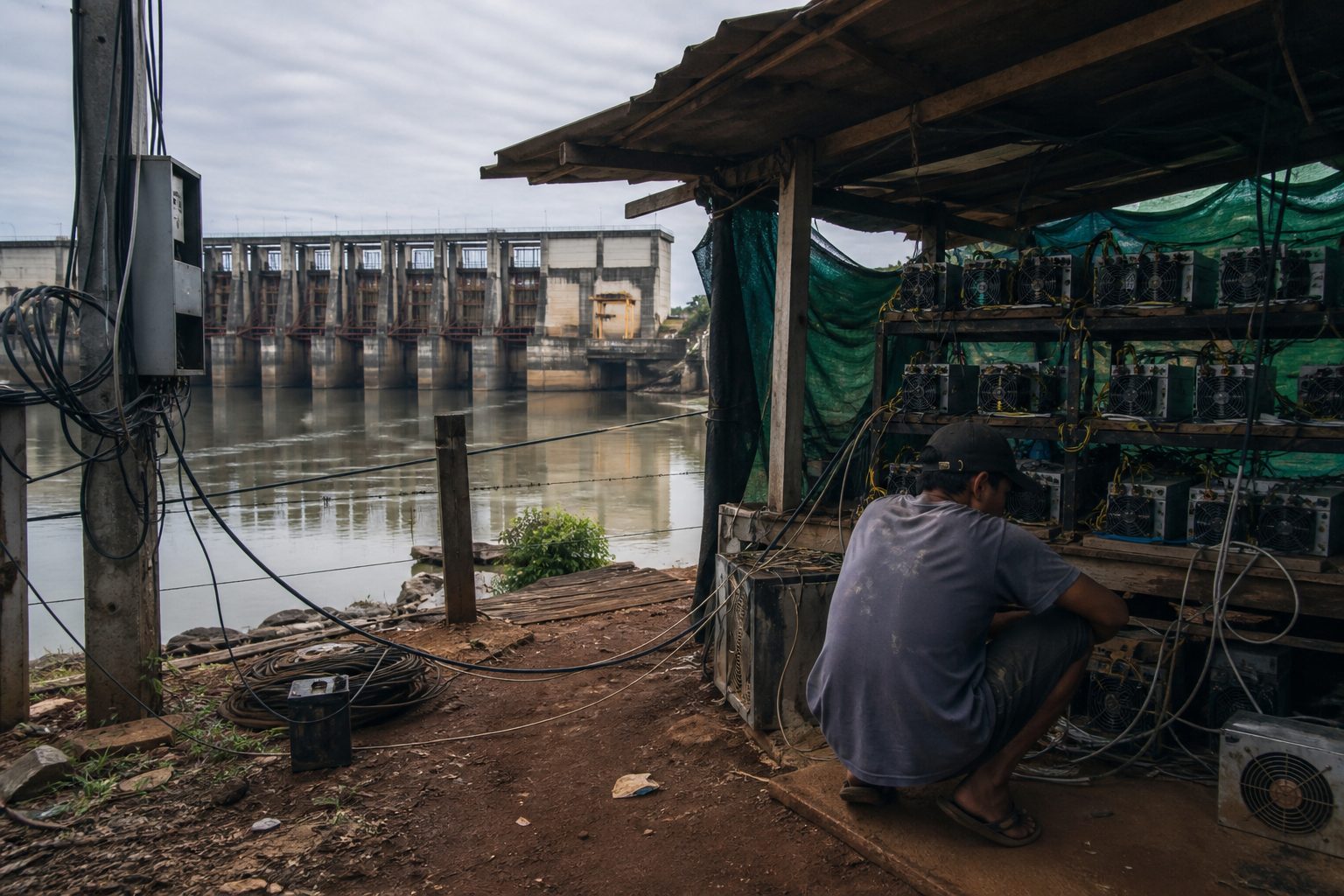
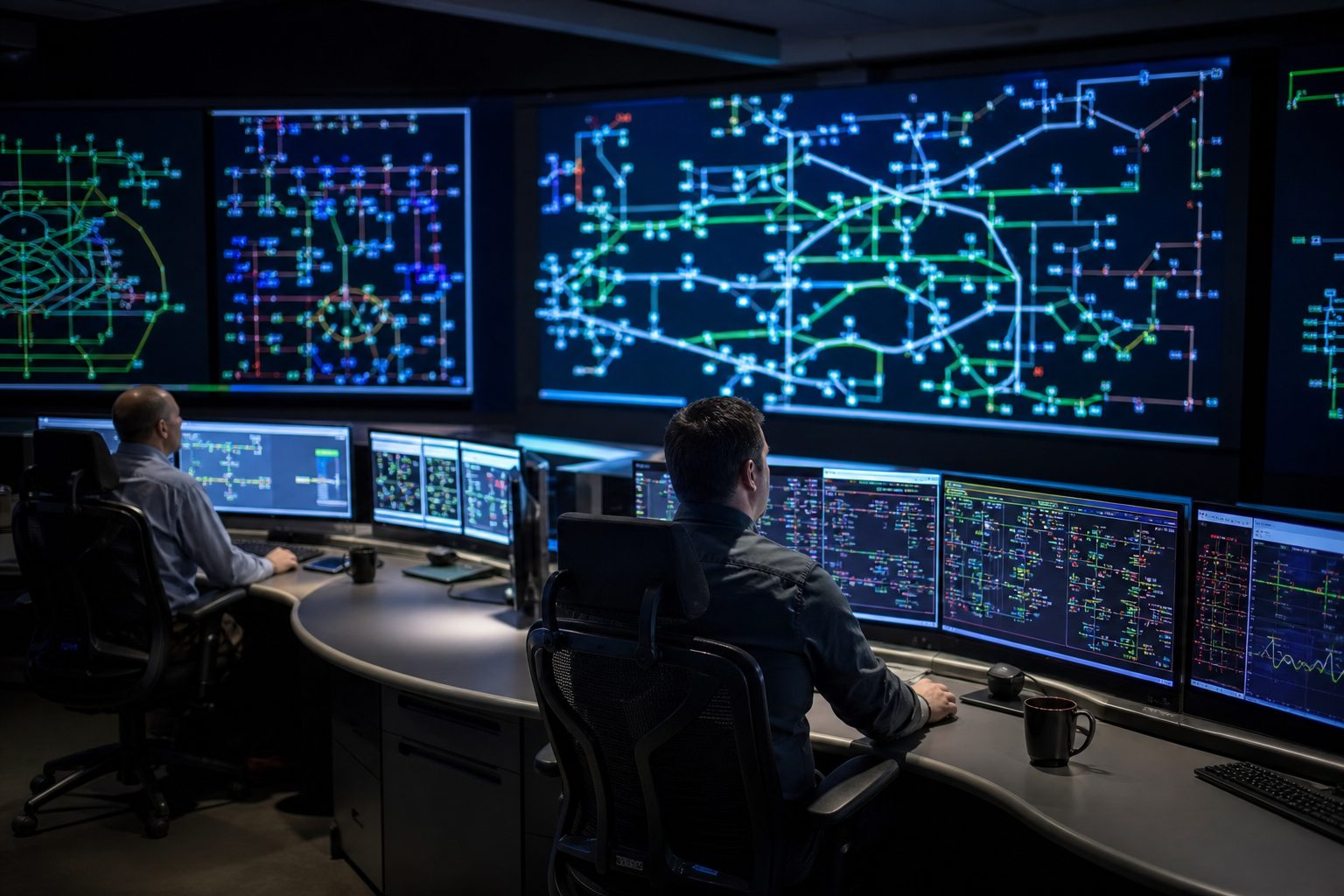
On May 28, 2024, technicians at Paraguay's state power company noticed something wrong with a medium-voltage feeder running into Barrio San Blas, a neighborhood of Salto del Guairá, a border city facing Brazil across the Paraná River. Artificial intelligence software combing data from the utility's SCADA monitoring system had flagged a load pattern consistent with a direct, unmetered tap on the grid. When inspectors went to look, they found a property that, according to ANDE's own incident report, was "presumably" in the business of mining cryptocurrency.
The next day, prosecutors, national police, and the country's joint task force moved in. Inside were 2,738 specialized mining computers and five distribution transformers, one of them rated at 3,150 kilovolt-amperes, for a total installed capacity of 7,150 kVA. ANDE estimated the unmetered draw was costing it 1.096 billion guaraníes a month, roughly $150,000. It was, the utility said, the largest illegal direct medium-voltage connection feeding a crypto mining operation it had ever recorded in the country.
It would not hold that distinction for long in spirit, if not in size. Paraguay is in the grip of an electricity crime wave built around bitcoin mining, and the paradox at its center is striking. This is the last country on Earth that should have an energy theft problem. Its grid runs effectively entirely on hydropower. It is a net electricity exporter. And yet its utility loses almost a third of the power it produces, clandestine mining farms keep surfacing in warehouses and on rural properties, and the courts' latest answer, two-year prison sentences announced in June 2026, was suspended, just as the 2023 convictions for the same crime had been.
How did a country floating on surplus hydropower get here, and what would it actually take to stop the siphoning?
The river of surplus
Paraguay's strange position begins with Itaipú, a 14,000-megawatt dam on the Paraná River operated jointly with Brazil under a 1973 treaty that splits output equally between the two countries, as Southern Pulse and Rest of World have documented. Brazil secured the roughly $27 billion in loans that built it, and for decades Paraguay, with a population of around 7 million and little heavy industry, used only a fraction of its half and sold the rest to Brazil at low, treaty-negotiated prices. The arrangement became a standing national grievance, even as the plant itself set a production record of 103 million megawatt-hours in 2016, as Rest of World reported. Paraguay's average draw from Itaipú in 2024 was 2,320 MW, according to Itaipu Binacional data cited by Canal Solar, still a fraction of its entitlement.
Cheap, abundant, renewable electricity is exactly what industrial bitcoin miners hunt for. Mining is a contest to solve cryptographic puzzles, and the machines that do it, application-specific integrated circuits, or ASICs, each draw on the order of two to three kilowatts and run around the clock, which means the price of power largely determines whether a mining operation makes money. Once the electricity is converted into hashes pointed at an offshore mining pool, the resulting bitcoin carries no fingerprint of the power behind it. The crime scene is the transformer, not the ledger.
So the miners came. Agence France-Presse reported that more than 60 crypto mining sites were established in Paraguay in the three years to August 2024, representing more than $1.1 billion in investment, according to Bruno Vaccotti of Penguin Group, a legal operator whose soccer-field-sized data center near Itaipú combines mining with AI and cloud work. The trade press counted 72 legally registered mining firms with 391 MW of contracted capacity and requests for roughly 400 MW more, a figure consistent with ANDE's own count of 72 legal firms reported by Southern Pulse. Hive Digital Technologies alone consumes approximately 300 MW, Franklin Miguel, CEO of the trading firm Electra Energy, told Canal Solar.
ANDE was making real money from the legal side of this boom, some $12 million a month, according to Jimmy Kim of Paraguay's Digital Assets Mining Chamber, Capamad. But the same physics that made Paraguay attractive to legitimate miners made it attractive to thieves.
How a megawatt gets stolen
The documented methods are not sophisticated. They are industrial.
The first is the full bypass: wire a property directly into a medium-voltage line with no meter at all. That was the Salto del Guairá model. It was also the model in Minga Guazú, where a raid on April 25, 2024, found a property with only a basic low-voltage supply on paper but a hidden direct connection feeding a 1,000 kVA transformer, 476 mining processors, and roughly 300 meters of illicit cabling, according to ABC Color. ANDE put that farm's damage at 270 million guaraníes a month, about $36,000. Weeks later, a June 2024 raid in La Colmena, Paraguarí, documented in another ANDE release, found 271 processors behind a connection nominally arranged for a 45 kVA supply; the property actually held transformers totaling 3,195 kVA, and the estimated monthly loss was 889 million guaraníes, roughly $120,000.
The second method keeps the meter but corrupts it. In Hernandarias in August 2024, inspectors found a mining shed whose meter had been tampered with to register 749.5 kW while the true load was 2,151 kW, ANDE reported, as covered by Bitcoin.com News. That single manipulation erased about 65 percent of the farm's operating costs. The raid netted 693 machines and a 4,000 kVA transformer, and ANDE estimated losses of $60,000 a month; AFP's account of the same operation confirms the location, the scale, and the figure.

The scale is the point. A single ASIC drawing two or three kilowatts runs like two or three window air conditioners never switched off; a farm of several thousand machines pulls megawatts, continuously, from infrastructure designed for neighborhoods. Opposition senator Salyn Buzarquis, speaking to AFP, put it bluntly: such farms "consume the equivalent of what a whole city consumes," and, he argued, "they are easy to detect." His follow-up question, why aren't more found, hangs over the whole story.
The arithmetic of the losses, honestly told
Two figures get repeated about this crisis, and neither survives contact with the actual numbers.
The first is that crypto mining consumes roughly 30 percent of Paraguay's national power generation. No official figure supports that. What ANDE officials have actually said is narrower and broader at once: in March 2024, commercial director Hugo Rolón told Diario Hoy that illegal connections of every kind, for crypto mining and other purposes, accounted for about 28 percent of electricity consumption, and ANDE itself later conceded to AFP that the utility loses almost a third of all the power it produces, though not exclusively to illegal crypto mining. That one-third figure is a network-wide loss number, not a crypto-specific metric; by ANDE's own framing, illegal mining is only part of it.
Simple arithmetic on the published numbers suggests crypto's slice of national generation is far smaller than a third: even if all 391 MW of legally contracted mining capacity ran flat out, it would equal about a sixth of the 2,320 MW Paraguay itself drew from Itaipú in 2024, and roughly 7 percent of Paraguay's own half of the dam's record annual output, before counting Yacyretá and Acaray. The illegal sector adds an unquantified amount on top, but nothing in ANDE's loss accounting puts total mining anywhere near 30 percent of generation.
The second figure is a projected national blackout in 2029. ANDE has published no projection of a nationwide blackout in that or any other year, and none appears in the planning figures publicized to date. What exists is the utility's Maestro Plan demand outlook, reported by Canal Solar: projected load growth of 6.9 to 9.4 percent a year between 2024 and 2027, followed by a projected contraction of 3.2 to 6.7 percent in 2027-2028, when special intensive-consumption contracts expire. That is a planning challenge, not a countdown clock.
The real fragility is older than the miners. Paraguayans endure frequent power cuts driven by poor maintenance and underinvestment in the distribution network, AFP reported, and 23 percent of households still cook with wood or charcoal, a figure that nearly doubles in rural areas. A country that exports electricity is somehow short of it at home. Illegal mining did not create that paradox, but every stolen megawatt deepens it.
The measured toll is still large. As of August 2024, ANDE had opened 71 criminal proceedings and seized roughly 10,000 mining computers and 50 transformers, Sosa told AFP; Southern Pulse reported that investigators now hunt farms with drones and AI software, and local daily Última Hora calculated that illegal connections cost ANDE $8.7 million in just the first five months of 2024. Vaccotti estimates the losses from illegal crypto mining at nearly $3 million a month. And in June 2026, ABC Color reported ANDE's calculation that just 36 clandestine mines had inflicted $20.2 million in patrimonial damage.
Where this story sits
5 related pieces
Read it →
Hover a story · click to read
 No. 10 · Aug 26, 2026The AI Energy Gridlock
 No. 25 · Sep 2, 2026China's Solar Capacity Crown Is Real. The Grid Beneath It Isn't.
 No. 53 · Sep 23, 2026Aurora's 96-MW Proof: Inside the Certification Bet on Software-Defined Grid Capacity
 No. 37 · Sep 5, 2026U.S. Grid Cyber Rules Are Finally Catching Up With Virtualized Operations
 No. 30 · Sep 3, 2026The Portsmouth experiment: can 10 gigawatts of AI compute avoid shifting grid costs onto its neighbors?
The insider question
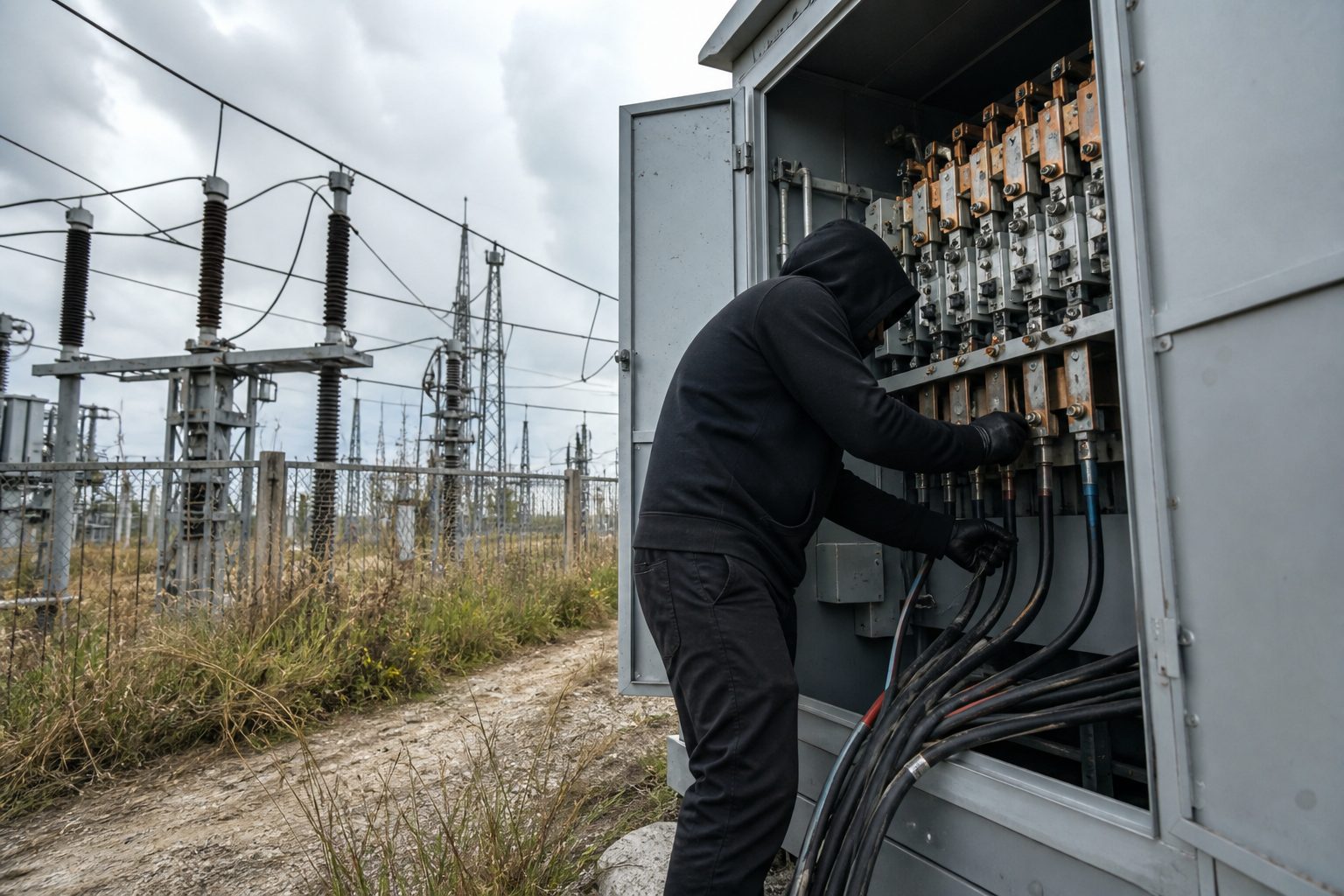
You cannot drag a 3,150 kVA transformer onto a rural property and tap a medium-voltage line without electricians who know what they are doing, property owners who know what is happening, and, investigators suspect, people inside the system looking away.
In June 2024, ANDE president Félix Sosa told a local radio station that the administration was cooperating with the Public Ministry to investigate claims that ANDE's own employees or contractors may have helped set up the very farms stealing from the grid. A pair of opposition senators called on Sosa to undergo more stringent questioning. Buzarquis went further, accusing government officials of protecting illegal mines in exchange for bribes, an allegation that remains unproven.
What the public record shows so far is not a single coordinated cartel but something more typical of Paraguay's border economy: networks of operators, accommodating landlords, and, as the ongoing insider investigation suggests, possible complicit help from within the system itself, all operating at industrial scale. The most consequential prosecution to date targeted exactly that structure.
Suspended sentences and a ten-year law
Paraguay's legal response moved in steps. A comprehensive crypto mining regulation was vetoed by then-president Mario Abdo Benítez in 2022 and never revived, Southern Pulse recounts. A proposed temporary ban on mining failed to advance in April 2024. Then, in July 2024, the Senate approved legislation raising the maximum prison sentence for energy theft tied to unauthorized mining to ten years, AFP and Southern Pulse reported.
Convictions have followed. In 2023, Edgar Saavedra and Rodrigo Suárez received two-year sentences for mining-related energy theft; the sentences were suspended. In August 2024, Carlos Raúl Rojas was sentenced to 18 months after his farm caused more than $1.5 million in losses to ANDE. Both earlier convictions appear in Bitcoin.com News's account of the latest case, and the outlet's August 2024 coverage noted the 18-month sentence days after it was handed down.
Then, on June 19, 2026, ANDE announced the outcome of criminal case 6529/2024, the prosecution arising from the Minga Guazú raid. A sentencing tribunal found Cristian Daniel Jara Villalba and Ramón Martínez Morínigo guilty as author and coauthor of illegal energy subtraction, imposing two-year prison terms, again suspended. What made the ruling matter, ABC Color reported, is that Martínez Morínigo was the registered holder of the property's meter. He could not prove he did not know what was happening on his land, and the court held him liable anyway.
ANDE called it a powerful precedent establishing that justice would reach "not only those who carry out illegal connections but also those who facilitate, permit, or benefit" from them, according to its statement. The convicted men also owe the stolen energy, the intervention costs, and fines. Suspension has been the rule in the convictions ANDE has publicized, which blunts the deterrent, but the facilitation doctrine gives prosecutors a tool aimed at the network's real infrastructure: the landlords, meter and contract holders, and insiders who make the farms possible.
The legal miners push back
The licensed industry has its own grievance, and it is not frivolous. Legal miners pay for their power at a premium; ANDE charges the sector more than 50 percent above the conventional rate, Kim told AFP, while watching competitors run unmetered loads nearby. Companies like Penguin accuse the government of weak enforcement and unpredictable tariff policy. "Our companies are looking at Brazil," Kim warned, "as there is no legal security" in Paraguay.

Their economic argument has a sharper edge than simple self-interest. Paraguay sells its surplus power to Brazil for roughly $15 per megawatt-hour; miners pay up to three times that, Miguel told Canal Solar. A megawatt-hour sold to a legal miner can bring the state up to three times what the same energy fetches under the export arrangement. Every megawatt stolen earns it nothing and drives out the paying customer. The 2027 contract expirations in ANDE's demand forecast make the choice urgent: the legal load is not guaranteed to stay.
The Brazil equation
The background bargain is quietly ending. In 2025, ANDE raised its Itaipú withdrawals by averages of roughly 600 MW for July and 800 MW for August, increases of 31 and 48 percent over projections, as Paraguay prioritized domestic consumption, Canal Solar reported, with ripple effects on Brazilian price forecasts. On the Argentina border, a decree by President Javier Milei raised Yacyretá's power price from $17 to $28 per MWh; Paraguay committed to withdrawing an average of 425 MW there, while Argentina may take up to 85 percent of the available capacity when Paraguay leaves its quota unused.
Paraguay is keeping more of its own river. The financial terms of the 1973 treaty that the 2023 debt payoff opened for renegotiation, a process miners once hoped to shape, as Rest of World reported, are no longer abstract. A megawatt stolen in 2026 displaces power Paraguay now intends to use or sell at a real price, not a treaty relic. The theft has shifted from nuisance to strategic loss.
What stopping the siphon would take
The evidence points to five requirements, none of them exotic.
First, keep scaling what already works. The Salto del Guairá and La Colmena busts began with AI analysis of feeder data and telecontrolled switches on the SCADA network, per ANDE's releases (Salto del Guairá; La Colmena), and the utility pairs that with drones and a public reporting form, its website's mascot, a smiling lightbulb in a work jacket holding a wrench, warning visitors that stealing energy is a crime, per Southern Pulse. Detection is no longer the bottleneck; the farms keep being found.
Second, convert findings into deterrents. Seventy-one criminal proceedings against a business this profitable will not change behavior if the convictions keep ending with the jail time suspended. The Minga Guazú precedent matters precisely because it moved liability up the chain to facilitators; it will matter more when someone of consequence serves time or pays full damages.
Third, clean the inside. The investigation into possible complicity by ANDE employees and contractors that Sosa himself acknowledged is where the corruption question will be answered or buried.
Fourth, keep the legal market alive with stable rules and predictable tariffs, because the licensed industry is both revenue and an enforcement ally: it is the sector that pays ANDE some $12 million a month on Kim's figures, and the illegal farms directly anger licensed operators like Penguin, AFP reported. Nor is the theft problem Paraguay's alone: Argentina's tax authority has conducted its own series of raids on clandestine farms, Southern Pulse notes.
Fifth, fix the grid the thieves exploit. The one-third loss figure reflects more than the mining boom, since by ANDE's own framing illegal crypto is only part of it. Reducing those losses is the deepest fix, and the slowest.
Paraguay's problem was never scarcity. The dam that anchors its economy generated enough electricity in a single record year to power the entire country for seven years or Latin America for more than a month, as Rest of World calculated. The fight in Barrio San Blas and dozens of warehouses like it is over something more basic: whether the state can enforce the simplest transaction in an electrified society, that you pay for the power you take. The suspended sentences of June 2026 say the courts have found the legal language to describe the crime. The machines still in police custody, and the transformers still humming somewhere undiscovered, are waiting to learn whether anyone believes it.
Sources / References

- Administración Nacional de Electricidad (ANDE). "Continúa la mayor intervención de criptominería con conexión directa en Media Tensión registrado en el país." May 29, 2024. https://www.ande.gov.py/interna.php?id=12334
- Administración Nacional de Electricidad (ANDE). "Intervención de un establecimiento con conexión directa dedicado a la criptominería en La Colmena, Paraguarí." June 5, 2024. https://www.ande.gov.py/interna.php?id=12373
- Bogarín, Silvana. "Criptominería ilegal: ANDE logra condena para responsables de millonario robo de energía." ABC Color, June 20, 2026. https://www.abc.com.py/economia/2026/06/20/criptomineria-ilegal-ande-logra-condena-para-responsables-de-millonario-robo-de-energia/
- Goschenko, Sergio. "Paraguay Convicts Two Bitcoin Miners to Jail Sentences for Large-Scale Energy Theft." Bitcoin.com News, June 22, 2026. https://news.bitcoin.com/paraguay-convicts-two-bitcoin-miners-to-jail-sentences-for-large-scale-energy-theft/
- "National Power Administration of Paraguay Seizes 693 Miners in Illegal Bitcoin Mining Operation." Bitcoin.com News, August 23, 2024. https://news.bitcoin.com/national-power-administration-of-paraguay-seizes-693-miners-in-illegal-bitcoin-mining-operation/
- Agence France-Presse. "Paraguay's abundant hydropower draws crypto miners, legal and not." RFI, August 29, 2024. https://www.rfi.fr/en/international-news/20240829-paraguay-s-abundant-hydropower-draws-crypto-miners-legal-and-not
- Majcher, Kristin / Southern Pulse. "Paraguay's Power Struggles: Electricity Theft and Higher Tariffs Test Crypto Mining Boom." August 23, 2024. https://southernpulse.substack.com/p/paraguays-power-struggles-electricity
- "How one of South America's biggest dams became a Bitcoin battleground." Rest of World, 2022. https://restofworld.org/2022/paraguay-bitcoin-dam/
- Sil, Antonio Carlos. "Paraguay's growing demand for Itaipu energy affects Brazilian market." Canal Solar, July 2025. https://canalsolar.com.br/en/demand-paraguay-energy-itaipu-brazilian-market/
Comments (2)
Continue exploring
Aurora's 96-MW Proof: Inside the Certification Bet on Software-Defined Grid Capacity
Aurora's 96-MW AI factory is the first designed to a power-flexibility certification standard; scaling the model hinges on…
U.S. Grid Cyber Rules Are Finally Catching Up With Virtualized Operations
FERC now lets U.S. grid operators virtualize critical control systems; whether resilience outpaces the new risks depends on…
The Portsmouth experiment: can 10 gigawatts of AI compute avoid shifting grid costs onto its neighbors?
SoftBank, OpenAI, and NVIDIA are assembling 10 gigawatts of privately powered AI compute at a former uranium plant in Ohio…
I love the reporting here, but the article oversells the suspended two-year sentence as the central failure. The Salto del Guairá site had 2,738 machines wired straight into a medium-voltage line with no meter at all - that is an infrastructure gap, not something courts can deter. If ANDE's SCADA only flagged the abnormal load pattern after the fact, the real fix is feeder-level metering and physical access controls at distribution transformers, which the Minga Guazú raid and its hidden 1,000 kVA transformer behind a basic low-voltage supply make obvious. Stiffer penalties that get immediately suspended will not change the economics for the next warehouse full of ASICs. I would have liked to see the piece spend more time on what ANDE is actually doing to seal those tap points rather than on the prison sentence theater.
The crime scene is the transformer, not the ledger" is a tidy line, and the article earns it with specifics. A single Salto del Guairá property with 7,150 kVA of installed capacity and an estimated 1.096 billion guaraníes a month in unmetered draw shows how concentrated the losses can be at one feeder. The piece also notes ANDE loses close to a third of the power it produces, which puts the supposed surplus from Itaipú in a different light. If a 14,000 MW shared dam can sit next to a grid where almost a third of generation simply disappears, calling the country one with abundant renewable electricity is doing a lot of work as a description. The transformers, not the blockchain, are where the accounting breaks down.