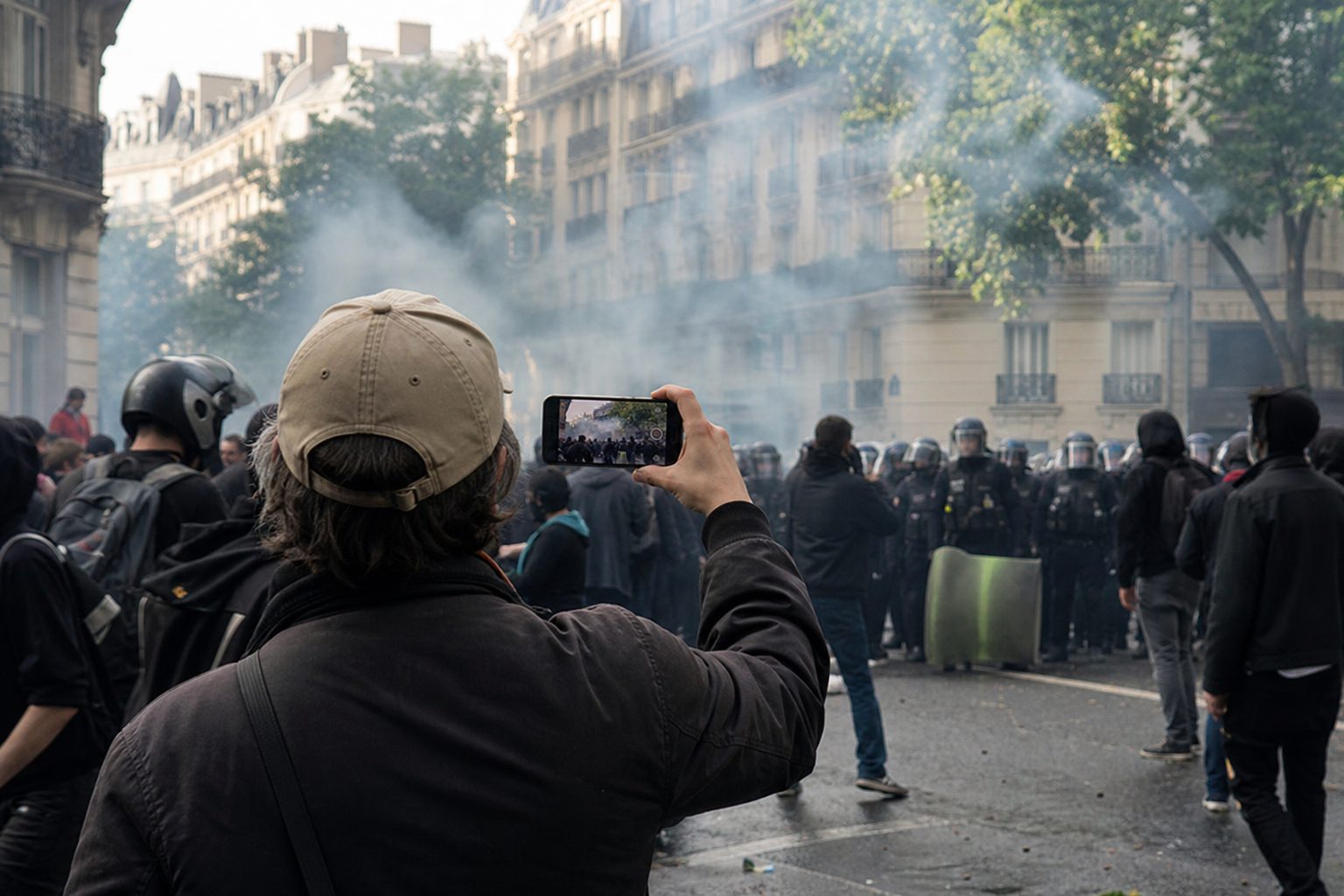
A video can settle an argument in seconds, but it rarely settles the facts by itself. During protests, the decisive questions are usually less visible: Who recorded it? Is this the original file? When and where was it filmed? What happened just before the clip began? Has it been edited, recycled, miscaptioned, or generated?
France does not have a general ban on filming police officers in public. The Constitutional Council rejected a 2020 provision that would have punished the publication of officers’ faces or identifying features when the alleged purpose was to cause them physical or psychological harm. Public-event images can generally be shared without the consent of every person shown, provided ordinary rules on privacy, dignity, defamation, incitement, and personal data are respected. (Conseil constitutionnel; Service-Public.fr; Le Monde)
But filming and publication are not risk-free. A newer criminal provision, Article 223-1-1, targets the disclosure of private, family, or professional information that identifies or locates a person when publication creates a directly foreseeable risk of harm. The enhanced penalty applies when the victim is a public-authority official, including a police officer. The provision is aimed at dangerous doxxing, not ordinary protest footage, but the distinction depends on the facts of each case. (Légifrance)
That creates the central problem: the people closest to an event often hold the evidence first, while the people best placed to authenticate it may not be able to reach the original file, the witness, the scene, or the platform that stores the data.
No single institution can currently fill that gap. Rapid verification is distributed among eyewitnesses, journalists, fact-checkers, lawyers, researchers, prosecutors, courts, and sometimes the police themselves. Their conclusions can overlap, but their standards and incentives do not.
The law leaves room to film, but risk does not disappear
The legal position is more permissive than public debate often suggests. France’s Constitutional Council censured the most controversial part of the Global Security Law because the offence was not defined with sufficient precision. The court did not create an unlimited right to publish anything recorded during a demonstration. It rejected a broad restriction whose wording could have penalized publication based on an asserted intention to harm officers. (QPC360)
Other legal limits remain. Publishing personal information that exposes a person or their relatives to a foreseeable risk can be criminal. Defamation, incitement, privacy violations, and attacks on dignity can also create liability. These rules matter most when footage is accompanied by identifying information, accusations, or calls for retaliation.
The distinction between recording and exposure is therefore critical. A wide shot of a demonstration, an officer striking a protester, or a police line dispersing a crowd raises different questions from a post that identifies an officer’s home address. The same video can be lawful evidence in one context and part of an unlawful targeting campaign in another.
Police surveillance creates a second legal tension. In December 2024, the Conseil d’État upheld the framework for police use of drone imagery while emphasizing requirements such as authorization, necessity, and limits on facial recognition, audio capture, and cross-database matching. (Conseil d’État)
The result is an uneven evidence environment. Protesters and journalists may record events, but the law imposes limits on what they can publish and how they can identify people. Police can also collect imagery, but their access is governed by a different institutional framework. The legal question is not simply whether a camera was present. It is who controls the resulting record, who can inspect it, and under what conditions.
The first verifier is usually not an institution
There is no universal “first verifier” for crisis footage. The earliest discoverable recording may come from an eyewitness, livestreamer, activist, journalist, police officer, or bystander. Verification normally follows publication, often after a clip has already acquired a caption and begun circulating.
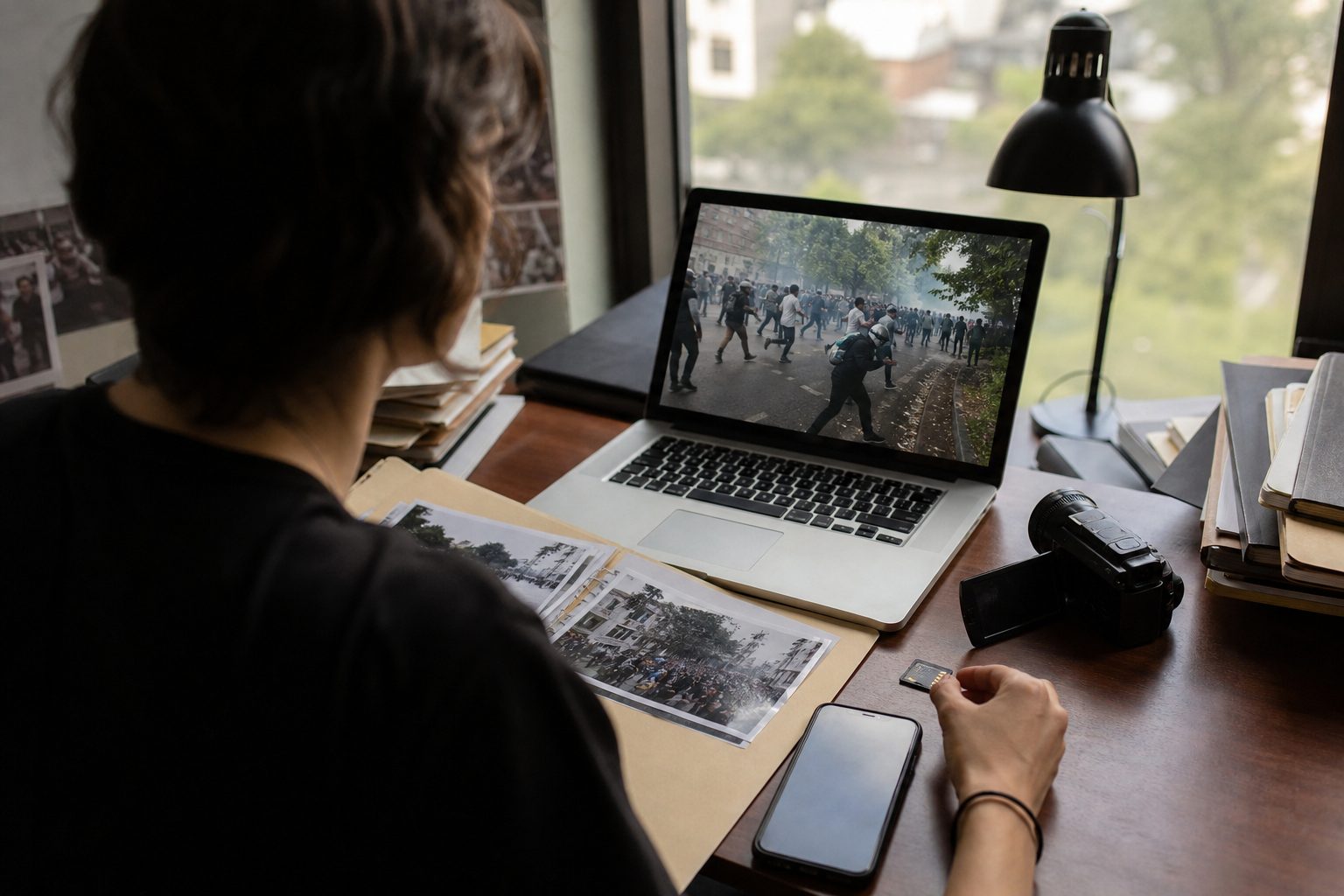
That timing matters. A person who records an incident knows what they saw, but may not preserve the original file or understand what metadata could reveal. A journalist may obtain several recordings but lack access to the location. A fact-checker may identify where a clip was filmed while remaining unable to determine what happened outside the frame.
AFP describes its digital investigation process as having two parts. “Endogenous” examination looks inside the file through metadata readers, forensic filters, and visual inspection. “Exogenous” research examines the file’s wider context through reverse searches and other web evidence. (AFP)
Bellingcat’s methodology similarly separates several questions that are often collapsed into one:
- Is the file or account genuine?
- Where was the footage recorded?
- When was it recorded?
- Has the clip been edited?
- What does it actually show?
- Why might the uploader have presented it in a particular way?
Its investigators may compare landmarks, satellite imagery, maps, weather, language, uniforms, upload history, and other recordings. (Bellingcat; Bellingcat Justice and Accountability Unit)
Amnesty’s Evidence Lab adds witness accounts, chronolocation, dialect, clothing, weather, and cross-platform comparison. WITNESS emphasizes source protection, consent, chain of custody, and the difference between proving that a file is authentic and proving that its caption is true. (Amnesty Citizen Evidence Lab; WITNESS)
These methods are complementary, not interchangeable. A reverse-image search can show that a video was online years earlier. It cannot by itself prove who recorded it. Metadata can help establish a file’s history, but social-media platforms often strip or alter it. A landmark can establish location without proving the date. A witness can explain what happened before the recording began, but may be mistaken, frightened, or unavailable.
Authentication is therefore a chain of narrower findings, not a single stamp of approval.
A genuine video can still mislead

The most important distinction in crisis-footage verification is between an authentic file and reliable evidence of an event.
A video may be genuine while its caption is false. It may show a real French protest but not the protest named in the post. It may show an injury without revealing who caused it. It may establish that an object entered the frame without proving that the person who launched it intended to hit someone.
AFP’s fact-checking record from France illustrates these limits. In one 2018 case, footage said to show a metro train blocking Paris’s périphérique appeared plausible when viewed in isolation. The complete sequence and production credits revealed that it was a digitally created student video. (AFP Factuel)
In another case, a video widely presented as showing police deliberately targeting a Yellow Vest protester with a grenade did not establish that intention. The available footage and the accounts of the police and protester did not prove the claim. (AFP Factuel)
Misidentification can happen even inside professional newsrooms. The Associated Press reported that French broadcasters CNEWS and LCI aired Albanian protest footage as scenes from Paris and Lyon. The images were real. Their location was wrong. (AP)
That is why a verification report should not end with “real” or “fake.” It should state what has been established and what remains unresolved:
- authentic file, wrong location;
- real event, wrong date;
- genuine footage, incomplete context;
- edited excerpt, original sequence located;
- location confirmed, intention unproven;
- synthetic or manipulated image;
- or insufficient evidence.
The caption is part of the evidence claim. It must be tested separately from the recording.
Where this story sits
5 related pieces

Hover a story · click to read
 No. 79 · Oct 22, 2026Sorting France’s October 2026 Protest Videos: Real, Misleading, or AI-Made?
 No. 76 · Oct 21, 2026Who Controls Your Feed During a Crisis? France's October 2026 Crackdown Shows a Global Pattern
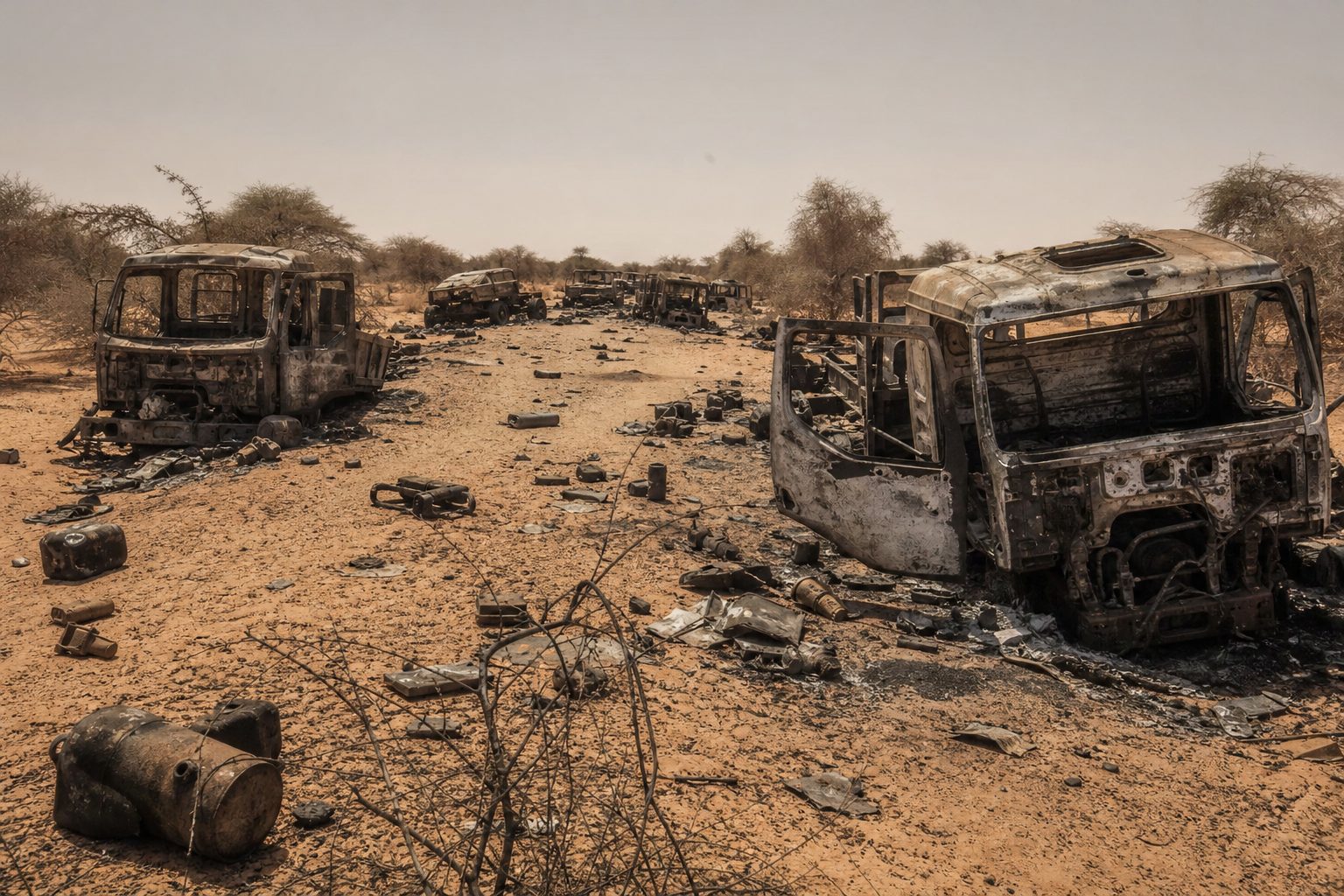 No. 65 · Oct 11, 2026Wagner's Sahel Drone War: What Three Years of Evidence Actually Show
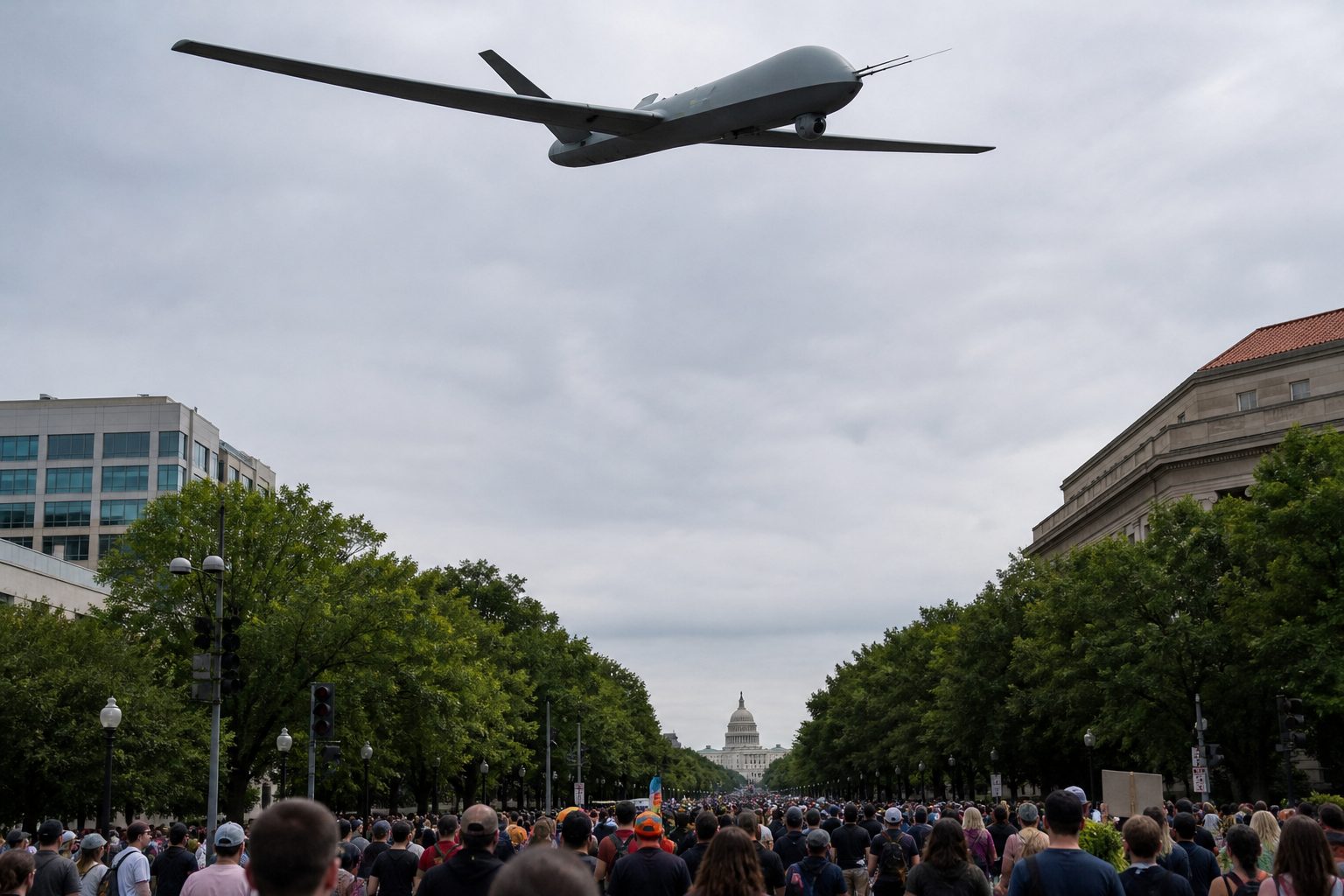 No. 77 · Oct 21, 2026Police Drones at Protests: The Tools, the Limits, the Records
 No. 62 · Oct 7, 2026The Authorized Leak: When Lawful Access to National ID Systems Becomes the Vulnerability
French protest cases show why context takes time
Detailed reconstructions often succeed because investigators combine several partial records rather than relying on one decisive clip.
Le Monde’s investigation into the serious injury of a Yellow Vest protester at Paris’s Place d’Italie on 16 November 2019 used amateur and professional videos, three-dimensional modelling, projectile identification, timing, distance, and firing angle. That approach could examine the physical sequence in a way that a short viral clip could not. (Le Monde)
Forensic Architecture describes a similar method of synchronizing recordings spatially and temporally. Investigators use buildings, landscapes, sound, movements, and other visual anchors, especially when timestamps are unreliable. (Forensic Architecture)
That process can be powerful, but it is not a rapid substitute for access. It requires multiple recordings, technical expertise, time, and a scene that remains sufficiently legible. Crowds, smoke, poor lighting, blocked sightlines, missing files, and compressed video can prevent a definitive reconstruction.
The June 2023 killing of Nahel Merzouk shows the public consequence of a single recording arriving before a settled official account. A mobile-phone video contradicted the initial account that the teenager had driven toward the officer, helping change the public understanding of the incident. The video did not answer every legal question, but it changed the evidentiary starting point. (The Local)
Other cases show the opposite. Footage can be authentic and still fail to establish intent, sequence, or responsibility. A clip can reveal that someone was struck without showing the preceding movement. It can show a projectile without identifying its source. It can contradict one account without proving the complete alternative.
The evidentiary value of footage depends on what question it is being used to answer.
Courts do not use the same test as social media
French criminal procedure follows a principle of free proof: courts may consider relevant evidence, while police reports receive special evidentiary weight in certain circumstances and can be challenged through writings or witnesses. That does not mean every video is automatically accepted as reliable, or that a court must treat a recording as conclusive. (Légifrance)
The practical questions are closer to these:
- Who supplied the recording?
- Is the file complete?
- Can its date and location be established?
- Has it been edited?
- Does another record corroborate it?
- Can witnesses explain what happened outside the frame?
- Is the recording relevant to the legal issue?
- Can the opposing side challenge its meaning?
A court may therefore admit a video while rejecting the interpretation attached to it. It may rely on a recording for one factual point but require other evidence for another. The same footage can carry a different weight in a criminal prosecution, an administrative investigation, a disciplinary proceeding, or a public news report.
The Cour de cassation’s February 2025 ruling concerning police officers shown in an online video illustrates a related point. Officers could not automatically be denied standing as civil parties merely because the video primarily criticized another officer. Publication-related offences and procedural rights depended on the content of the video and the alleged harm, not on a blanket rule against filming officers. (Cour de cassation)
The law therefore does not provide a single national answer to the question “Is this footage valid?” It provides procedures through which the reliability, relevance, harm, and meaning of footage can be argued.
Independence is the hardest part

Speed and independence often pull in opposite directions.
Police and gendarmerie systems may hold body-camera, CCTV, drone, radio, or operational records soon after an incident. Their access can be immediate, but those records are produced or controlled by institutions whose conduct may be under scrutiny. A recent report on the Sainte-Soline irrigation protest raised the concern that police-generated body-camera material may be reviewed within command structures before outside investigators examine it. (Mediapart)
Independent investigators face the reverse problem. They may be less exposed to institutional pressure, but they often depend on voluntary submissions, public posts, journalists, lawyers, or later access to records. They may not be able to inspect the original device, question every witness, preserve a chain of custody, or obtain material held by a platform or public authority.
Platforms introduce another layer. They can preserve, remove, compress, label, recommend, or restrict access to recordings. A removal may reduce harm, but it can also eliminate the easiest public route to evidence. A platform archive may preserve a copy while withholding the original file, upload history, account information, or other data needed to assess provenance.
Faster access to platform-held evidence could improve investigations, but it would create risks. Metadata can expose the location of a witness. Account records can identify activists or journalists. Rapid disclosure without safeguards could turn an evidence-preservation system into a surveillance channel.
A credible system would need both preservation and protection: rapid retention of original material for authorized investigations, combined with strict limits on disclosure, secure submission channels, anonymization, and independent custody.
What can be scaled, and what cannot?
Some verification methods can be applied widely:
- reverse-image and reverse-video searches;
- frame extraction;
- duplicate detection;
- upload-history checks;
- landmark comparison;
- weather and shadow analysis;
- multilingual searches;
- cross-platform comparison;
- structured source interviews;
- clear labels for confirmed, disputed, and unknown claims.
These tools can identify recycled footage, false captions, and obvious manipulation quickly. AFP’s work on miscaptioned protest videos shows the value of matching keyframes, language, landmarks, and street-level imagery. (AFP Fact Check)

Other methods remain scarce. Three-dimensional reconstruction, acoustic analysis, satellite comparison, forensic examination of original files, and large-scale synchronization require specialist staff and time. They cannot be reliably automated without increasing the risk of false confidence.
Synthetic media complicates the problem further. Full Fact reported that some imagery attributed to French protests was AI-generated or linked to earlier demonstrations, with visual distortions and provenance clues exposing the false context. Detection tools can provide leads, but they should not become the sole basis for declaring an image fabricated. (Full Fact; Full Fact)
The most scalable model is therefore layered. Automated tools can sort and prioritize material. Human investigators must test the claim, preserve uncertainty, and determine whether the available evidence answers the relevant question.
Responsibility cannot end with the uploader
When footage disappears or is wrongly treated as proof, responsibility is distributed.
The person who uploads it may have misidentified the event, edited the clip, or acted in good faith with incomplete information. A journalist may repeat a caption before verification is complete. A platform may remove content without preserving the material needed for later review. A public authority may release selected footage while withholding other records. An investigator may overstate what a file proves. A court or disciplinary body may give a recording more weight than its provenance supports.
The answer is not to treat every video as suspect or every official record as trustworthy. It is to make the evidentiary chain visible.
That means preserving original files where possible, recording who handled them, documenting transformations, separating authentication from interpretation, and publishing corrections when an earlier conclusion changes. It also means protecting the people who provide evidence. WITNESS warns that the same metadata that helps establish provenance can reveal a source’s identity or location. (WITNESS)
France’s existing network can authenticate some protest footage quickly. AFP, Bellingcat, Amnesty, journalists, lawyers, and open-source researchers already use methods that can expose recycled, altered, or miscaptioned material. Available materials also indicate that French courts assess the reliability and relevance of video through the broader rules of evidence rather than through a single, France-wide authentication hearing modeled on U.S. procedure. Detailed reconstructions have changed the understanding of specific incidents. (Fair Trials)
But no independent verifier can manufacture missing evidence. If the original file is gone, the witness cannot be found, the scene cannot be reconstructed, or the platform will not preserve relevant data, verification may stop at a qualified conclusion.
That is the lasting lesson of protest footage in France. Trustworthy evidence is controlled by no single camera, newsroom, court, police service, or platform. It emerges when several imperfect records can be compared, challenged, and preserved without exposing the people who created them to unnecessary danger.
When that chain breaks, the problem is not simply that the public lacks a video. It is that no one can reliably determine what the video was allowed to prove.
Sources / References
- Conseil constitutionnel, Commentaire de la décision n° 2021-817 DC
- Service-Public.fr, Droit à l’image et respect de la vie privée
- Le Monde, Manifestation interdite ou spontanée, “technique de la nasse”, motifs d’interpellation: les réponses à vos questions
- Légifrance, Article 223-1-1 of the Penal Code
- Conseil d’État, Exploitation des images enregistrées par drones pour le maintien de l’ordre
- AFP, An update on digital investigation at AFP
- AFP Factuel, Video shows protest in Indonesia, not Muslims clashing with officers in France
- AFP Factuel, Des “gilets jaunes” bloquent le périph’ avec une rame de métro ?
- AFP Factuel, Des policiers visent délibérément ce “gilet jaune” avec une grenade ?
- Bellingcat, A Beginner’s Guide to Social Media Verification
- Bellingcat Justice and Accountability Unit, Metadata
- Amnesty International Citizen Evidence Lab, An open source methodology for mapping tear gas misuse
- WITNESS Media Lab, When Eyewitness Footage Cannot Be Verified
- Forensic Architecture, Synchronisation
- Le Monde, Enquête vidéo sur la blessure d’un “gilet jaune” à la place d’Italie
- The Local, French prosecutors seek policeman’s trial over teen killing
- Légifrance, French Code of Criminal Procedure, Articles 427 to 457
- Cour de cassation, Pourvoi n° 24-82.090
- Mediapart, French minister orders probe after revelations about gendarmes’ conduct at Sainte-Soline
- Fair Trials, ProCam Country Report: France
- Associated Press, French TV channels apologize after airing Albanian protests as Paris and Lyon
- Full Fact, France protests: fact checked
- Full Fact, Viral imagery of Pink Panther protester in France is AI-generated
Comments (8)
Continue exploring
Wagner's Sahel Drone War: What Three Years of Evidence Actually Show
Russian jets, Turkish drones and untested air defenses have reshaped the war in Mali, Burkina Faso and Niger since 2022, but the…
Police Drones at Protests: The Tools, the Limits, the Records
From a Reaper circling Los Angeles to the 15,000-euro French fine for drone-filming protests: what police drones can actually…
The Authorized Leak: When Lawful Access to National ID Systems Becomes the Vulnerability
National ID systems are being exploited through their lawful periphery, not their core, as incidents in Denmark, Nigeria, and…
The section separating authenticity, location, date, editing, and meaning was the most useful to me. The example that a clip can be authentic but old shows exactly why a simple real-or-fake label is inadequate. I also appreciated the sample conclusion distinguishing what is probable from what remains unknown; that is a practical model for publishing responsibly.
The point that access matters as much as technical skill is exactly right. In our legal-aid casework, a longer witness recording resolved a timeline dispute that frame analysis alone could not touch. No software recovered the missing thirty seconds; a person did.
The recommendation to hash files and preserve copies is excellent, but implementation raises a real security problem. Small groups may not have encrypted storage, documented access controls, or a safe way to retain files that contain faces and location data. A preservation workflow should explain who may access the archive, how long it is kept, and how witness privacy is protected. That would make the practical model much easier to adopt enthusiastically rather than just admire.
The nine-step chain is sensible, but hashing a file after acquisition cannot prove that the acquired file was the camera original.
The core takeaway seems to be that protest footage should be treated as a chain of qualified findings rather than a self-authenticating verdict. I am slightly uneasy about how much time and access the nine-step process assumes, so smaller newsrooms may need a triage version that prioritizes preservation, source lineage, and clear uncertainty labels.
How would this verification chain work for a two-person local newsroom without legal access to platform data or time for extensive geolocation? A scaled version distinguishing essential checks from best-practice checks would be valuable.
The discussion of platform access opens an important question: what practical legal procedures would let independent investigators preserve deleted livestreams or obtain account history without exposing witnesses? It would be useful to compare France’s existing preservation mechanisms with the powers available to prosecutors and police. Could a neutral court-appointed process give journalists or researchers limited access to relevant data? That follow-up would make the article’s concern about disappearing evidence much more concrete.
I have preserved the untouched original and its metadata for every protest clip I recorded, even when posting compressed copies online!