America’s November Outages Were Unconnected Failures—and a Warning | The Calibre Brief Ep. 93
About this episode
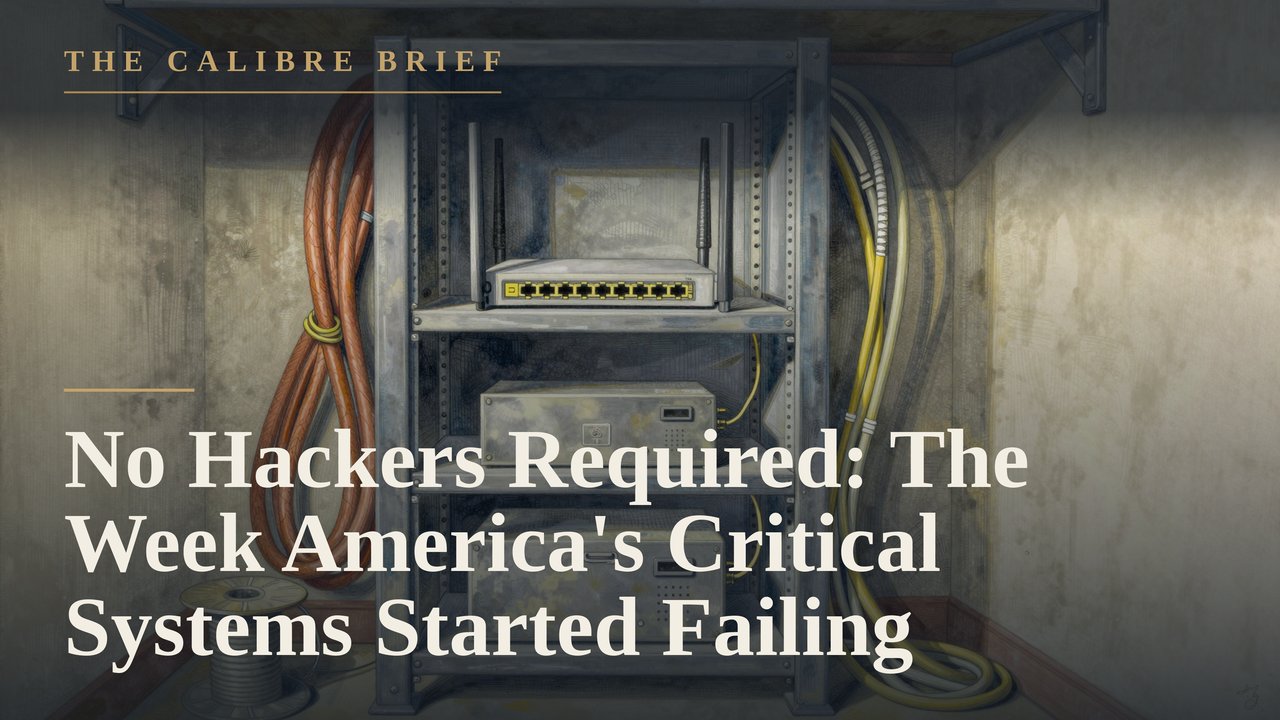
Between November 12 and 17, 2026, failures at the FAA, Microsoft 365, JPMorgan Chase, United Airlines, Apple, Workday and other services disrupted flights, payments and office work. Publicly explained causes were ordinary technical problems—including software bugs, configuration changes and excessive traffic on legacy systems—not an identified attack.
The episode examines why that finding still matters. The FBI, Palo Alto Networks and Anthropic have documented AI-assisted intrusion campaigns in which capable groups used agentic tools to compress work that once took teams weeks into hours. These cases indicate reduced labor and time requirements for established attackers—not that sophisticated attacks are now available to anyone.
The FAA says it found no evidence of a cyberattack, but its investigation into the November 13 traffic flood remains active. No public evidence establishes a common cause among the outages, or any connection between them and AI-enabled operations. Whether smaller banks, utilities and other organizations can keep pace remains unresolved.
0:00 For one week, planes stopped, payments stalled 0:18 The FAA says it found no sign of an attack, so far 0:43 That same week, Microsoft 365 failed and a Chase 1:09 Here the easy story breaks 1:40 Hold both facts at once 2:07 The relief and the warning are the same fact 2:22 That was The Calibre Brief, from Calibre Code USA
Stock footage: Life-Of-Vids via Pixabay (https://pixabay.com/videos/id-991/) Stock footage: 46923267 via Pixabay (https://pixabay.com/videos/id-247143/) Stock footage: Scott Precious via Pexels (https://www.pexels.com/video/scrolling-smartphone-news-feed-in-close-up-35888104/)
Key topics
Key moments
- 0:00 For one week, planes stopped, payments stalled
- 0:18 The FAA says it found no sign of an attack, so far
- 0:43 That same week, Microsoft 365 failed and a Chase
- 1:09 Here the easy story breaks
- 1:41 Hold both facts at once
- 2:07 The relief and the warning are the same fact
- 2:23 That was The Calibre Brief, from Calibre Code USA
Transcript
Show transcript
Welcome to The Calibre Brief, a Calibre Code USA production.
For one week, planes stopped, payments stalled, and office software across America went dark. No one attacked anything, and that's exactly what worries the experts.
On November 13, 2026, the FAA held every departing flight in the country. More than a thousand connection attempts every few seconds choked aging phone lines carrying radar between route centers. The FAA says it found no sign of an attack, so far. And that was one failure in a week full of them.
That same week, Microsoft 365 failed and a Chase software bug delayed payments at other banks. Every explained case was mundane, but a system that falls by accident can be pushed on purpose. And the FBI says one open source AI tool, ARTEX, has gained deep access in real attacks in under three hours.
Here the easy story breaks. No public evidence links those outages to each other or to any attacker, and timing alone proves nothing. An Axios review even found bot networks pushing the conspiracy version online. Nor have these AI tools opened hacking to everyone. The documented cases show already skilled groups moving faster with smaller teams, less labor rather than less skill.
Hold both facts at once. These systems can fail at national scale under ordinary strain, and the cost of attacking them is falling. The tools are open source code no one can recall, with 1,608 live ARTEX control panels online. The outages didn't reveal an attack. They measured how little pressure the system can absorb.
The relief and the warning are the same fact. Accidental breakdowns map the damage an attacker could choose, and whether smaller banks and utilities keep pace is unknown.
That was The Calibre Brief, from Calibre Code USA. If systems fail nationwide with no attacker, who should pay to fix the fragility? Comment below, like and subscribe on YouTube, and follow the podcast.