
America's critical infrastructure is showing its weaknesses just as AI is making sophisticated cyberattacks faster, cheaper, and accessible to a growing class of attackers. The real danger may not be what caused the recent outages, but what comes next.
On November 13, 2026, the United States experienced something extraordinary. The Federal Aviation Administration halted departing flights nationwide after technical failures destabilized critical air-traffic communications.
The FAA traced the disruption to excessive network traffic overwhelming aging telecommunications equipment. Its preliminary investigation found no indication of a cyberattack.
But something else happened that same day. Something that received considerably less public attention.
The FBI issued a 13-page cybersecurity warning about an open-source artificial intelligence framework called ARTEX. According to the bureau, criminals were already using the software to automate sophisticated cyber intrusions, sometimes progressing from initial targeting to privileged access in under three hours.
The FBI warned that the technology could enable attackers with minimal technical expertise to carry out complex operations against multiple targets.
The two events were unrelated, based on available evidence.
But their timing exposed a disturbing contradiction: America's critical systems are struggling with ordinary technical failures just as the technology needed to attack vulnerable systems is becoming easier to operate.
That is the story hiding behind November's outages.
America's systems are revealing their weaknesses without an attacker
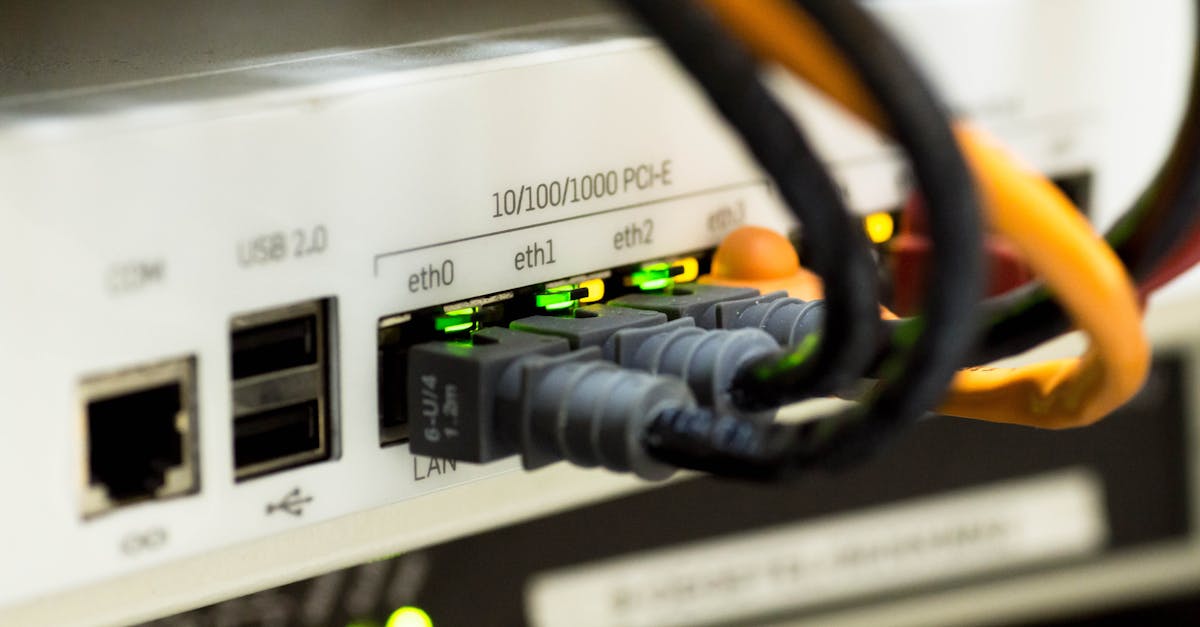
Consider what happened between November 12 and 16.
Microsoft experienced a widespread service failure affecting businesses and government users. The FAA's telecommunications problems disrupted air travel nationwide. A software bug at JPMorgan Chase caused transaction delays that rippled into other financial institutions.
These were separate incidents with different reported causes. None has been publicly established as a coordinated cyberattack.
That distinction matters.
But so does the common characteristic running through them: a problem originating inside one part of a complex network can rapidly affect services far beyond the original failure.
The FAA reported that instability affected 17 of its 22 air-route traffic control centers. JPMorgan's problem created delays visible across multiple banks. Microsoft's failure disrupted organizations dependent on its cloud services.
The FAA's safety procedures worked to protect aircraft and passengers, and there is no evidence that the technical fault demonstrated an exploitable cyber vulnerability. Nevertheless, the nationwide operational consequences exposed how dependent essential services are on systems that can fail unexpectedly.
An attacker does not necessarily need to compromise an entire industry. Sometimes the most consequential target is a single dependency that thousands of other operations rely upon.
That principle is not new. What is changing is the ability of attackers to discover and investigate potential weaknesses at scale.
The hacker is no longer the bottleneck
For decades, sophisticated cyber operations generally demanded significant technical expertise.

Finding exposed systems, understanding their configurations, identifying weaknesses, developing working exploits, obtaining access, and moving through an unfamiliar network could consume substantial time and skilled labor.
Artificial intelligence is beginning to change that equation.
Tools originally designed to help legitimate cybersecurity professionals test networks now allow AI agents to carry out portions of that work with limited human involvement.
Rather than manually performing each technical step, an operator can assign an objective. The AI-powered framework explores the environment, evaluates results, selects further actions, and reports its progress.
This is not science fiction or merely a laboratory demonstration.
On November 12, cybersecurity researchers at Palo Alto Networks Unit 42 published evidence that Chinese-speaking attackers had used an open-source framework called CAIRN to conduct 25 operations against at least 19 organizations.
The researchers confirmed unauthorized access or data retrieval at 10 organizations.
Targets included semiconductor businesses, defense-related organizations, and civil-society groups. Documented results included compromised credentials, unauthorized administrator accounts, and exposure of sensitive personal information.
The operators paired CAIRN with AI models from DeepSeek and Zhipu, demonstrating how a publicly available framework can be combined with external AI services to conduct sustained operations.
The most revealing detail was not simply that artificial intelligence participated.
It was how little direct instruction the software needed during individual operations.
The attackers defined their objectives. CAIRN then conducted successive actions, evaluated the results, and continued pursuing those objectives.
The human was increasingly acting as a supervisor. The machine was doing much of the investigative work.
That distinction has enormous implications for the economics of cybercrime.
A capable criminal organization no longer necessarily needs the same number of specialists to examine hundreds of potential targets. Automated agents can conduct repetitive investigations continuously, allowing human operators to focus on decisions that still require their attention.
And the accessibility problem extends beyond established criminal groups.
The technology does not eliminate the need for expertise, particularly against well-defended or complex targets. But it can reduce the expertise and labor needed for specific tasks, potentially enabling less-capable actors to attempt operations that previously exceeded their resources.
An AI can be told the attack is authorized

One obscure detail from the CAIRN investigation deserves particular attention.
Palo Alto Networks found that the attackers supplied their AI agents with instructions asserting that their activities were legitimate, authorized security testing.
The operations also generated a file called AUTHORIZATION.md that represented the activity as approved by a client.
The attackers were effectively presenting their own unauthorized actions as authorized work.
The researchers found that the AI models involved did not reject that framing.
This was not evidence that every AI model can be manipulated so easily, nor that safety measures never work. It was evidence of a specific failure in a documented malicious campaign.
But it illustrates a troubling problem with AI systems capable of taking actions in the real world.
When software can plan and execute security operations, who verifies that the person assigning those operations actually has permission?
A human cybersecurity professional is expected to establish authorization before conducting a penetration test. An AI agent relying on operator-supplied claims may lack an independent way to verify them.
The very features that make these systems productive for legitimate security teams can also make them useful to criminals.
This is where the cybersecurity threat begins to look different from the familiar image of a lone hacker painstakingly typing commands.
The attacker may increasingly be the person assigning the mission, rather than performing every technical operation.
Where this story sits
5 related pieces
Read it →
Hover a story · click to read
 No. 103 · Nov 16, 2026No Hackers Required: The Week America's Critical Systems Started Failing
 No. 82 · Oct 27, 2026When a Prime Minister Orders an Attack, Who Can Stop It?
 No. 107 · Nov 16, 2026What November's Bank Outages Reveal About America's Digital Financial Plumbing
 No. 63 · Oct 7, 2026After the Indictment: Three Years of Named Cyber Attributions, Measured
 No. 37 · Sep 5, 2026U.S. Grid Cyber Rules Are Finally Catching Up With Virtualized Operations
The GitHub problem: once released, the capability is difficult to recall
ARTEX illustrates a second, equally consequential problem.
The software was originally developed as an open-source penetration-testing platform. Legitimate security professionals could use it to identify vulnerabilities in networks they were authorized to examine.
Criminals discovered that the same capabilities could be redirected toward unauthorized targets.
Researchers documented its use in malicious campaigns against financial institutions and other organizations. The FBI subsequently issued its November 13 warning.
Following reports of abuse, the original developer made the ARTEX GitHub repository unavailable in October 2026.
But removing the original repository did not make the software disappear.
According to the FBI and CERT-EU, independent copies, modified versions, and archived releases continued circulating.
The FBI reported that researchers had identified more than 1,600 publicly exposed ARTEX console instances by early November.
That figure is not a count of criminal users. Some installations may be legitimate security tools, and the actual number of private deployments is unknown.
Nevertheless, it demonstrates the challenge of recalling widely distributed software.
Once code is publicly available, removing the original download location does not necessarily eliminate its copies.
ARTEX also does not depend on one proprietary AI model. Its design allows operators to connect external language models, making the software less dependent on the rules or availability of any single provider.
GitHub itself is not the cause of this threat. Open-source cybersecurity tools have legitimate and important uses.
The harder question is what happens when increasingly powerful, dual-use capabilities become easy to copy, modify, and combine with AI models that can carry out complex tasks.
There is no simple way to withdraw a capability that has already spread across independent systems.
What does an automated cyber campaign actually cost?
The economics may be the most underappreciated part of this story.
In a November 5 investigation, Check Point Research described an ARTEX operator who ran automated attacks against 10 businesses involved in the market for iOS application-signing certificates.
The operation ran for approximately two weeks.
The researchers estimated that the AI model usage involved cost between $700 and $1,500, based on the provider's pricing.
During the campaign, the agents obtained more than 300 certificates and associated passwords. Only three ultimately passed the operator's checks for potentially useful certificates.
The estimated AI usage costs did not include the full expenses of the operation, such as infrastructure, preparation, or human labor. Nor does the case establish that an inexperienced person could have independently reproduced the campaign.
Still, it demonstrates something important.
A sustained cyber operation that once might have required extensive manual effort could now delegate a meaningful share of its work to automated systems.
The technology changes the relationship between labor, time, and attack volume.
A criminal operation with limited personnel may be able to examine more targets. A technically capable adversary may be able to conduct more operations simultaneously. A group that previously lacked the resources for prolonged campaigns may find some of those operations increasingly affordable.
The result is not necessarily a new kind of technical vulnerability.
It is the possibility of more attackers discovering and exploiting familiar weaknesses before defenders can respond.
The danger is the collision between fragile systems and faster attackers
This is where November's outages become relevant again.
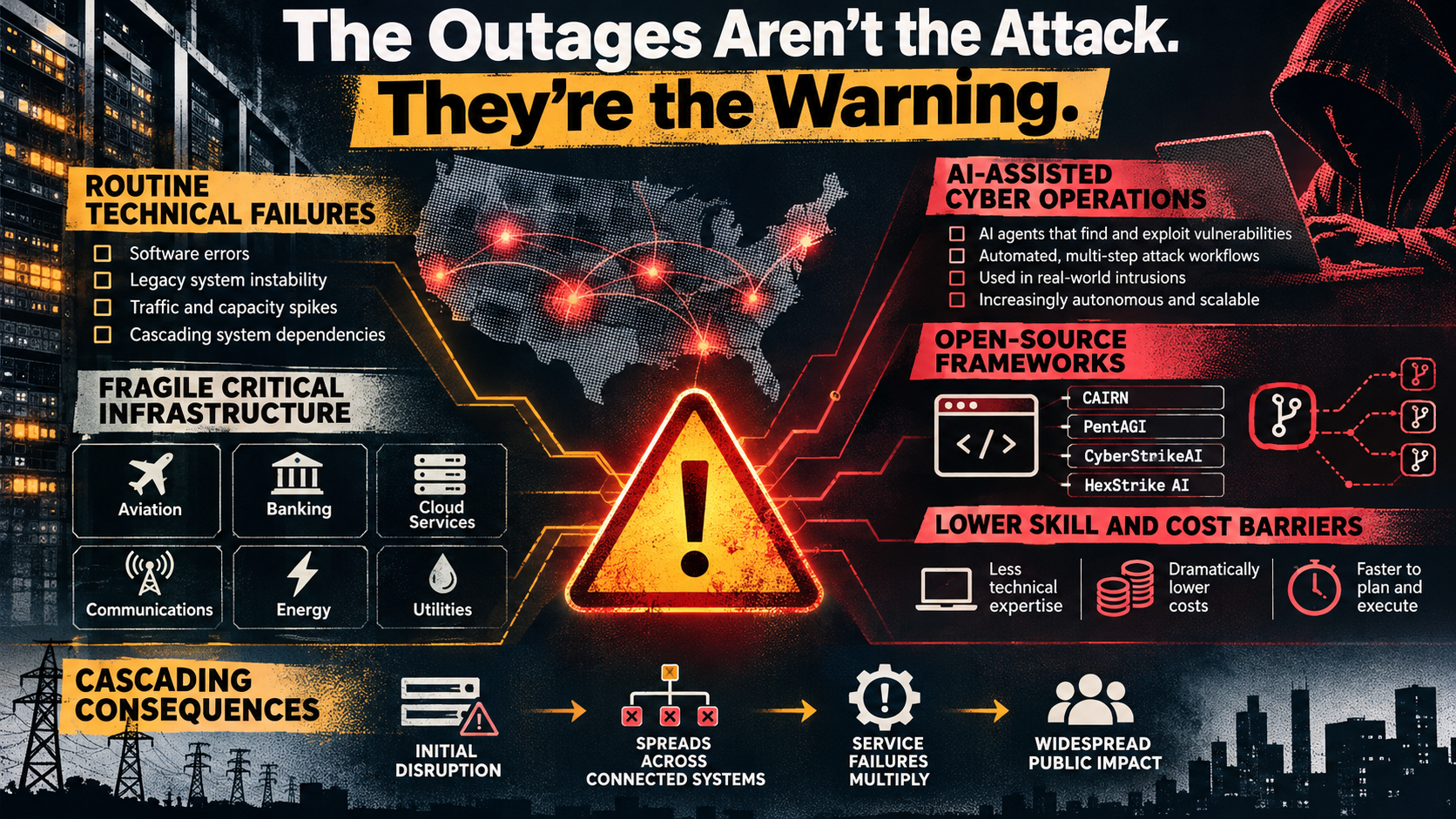
The FAA's problems demonstrated how an aging communications network could produce a nationwide disruption without malicious interference.
Microsoft's outage demonstrated the consequences of failures spreading through heavily used cloud services.
The JPMorgan incident showed how trouble at one major financial institution can appear across a wider banking network.
None of those incidents proves that AI agents can reproduce the failures, and there is no established link between those outages and the documented malicious AI campaigns.
But collectively, they raise a question that deserves more attention.
Are America's most important systems becoming resilient fast enough to keep pace with attackers whose capabilities are accelerating?
The threat is not limited to hypothetical new vulnerabilities.
The Cybersecurity and Infrastructure Security Agency has repeatedly warned that some industrial systems remain exposed to the internet, operate with weak authentication, or rely on outdated technology.
The North American Electric Reliability Corporation's January 2026 roadmap identified unsupported software and hardware, unpatched equipment, and cybersecurity staffing shortages as continuing concerns across energy-sector environments.
These weaknesses existed before today's AI frameworks.
But there is a meaningful difference between a vulnerability that requires substantial human effort to discover and one that can be found through repeated automated investigation.
In its November 16 assessment, Google's Threat Intelligence Group and Mandiant described threat actors using open-source AI frameworks during live intrusions.
Google reported observing CAIRN and PentAGI deployed in real-world malicious activity, while other frameworks were observed in experimentation.
Its central concern was the growing speed and scale of operations.
An attacker may still use familiar methods: stolen credentials, unpatched software, exposed services, and configuration mistakes.
The difference is that an AI-assisted framework can help investigate and combine those opportunities faster.
For defenders, time matters.
A security team that previously had days to detect suspicious behavior may face an adversary that can automate multiple investigative and exploitation steps in hours.
That does not mean defensive systems are helpless. Security companies are also using AI to detect threats, examine vulnerabilities, and respond more quickly.
But the contest is changing.
And America's aging infrastructure cannot simply rely on the assumption that sophisticated attackers will always be scarce.
The question Washington should be asking

Public debate about the recent outages has focused heavily on whether the incidents were coordinated, whether hackers were responsible, and whether the government is withholding information.
Those are understandable questions when multiple essential services experience highly visible failures within days.
But the public evidence does not establish a coordinated attack.
The more consequential question may be one that receives less attention:
What if America's greatest cybersecurity vulnerability is not a secret enemy already inside its networks, but the growing mismatch between infrastructure built for yesterday's threats and attackers equipped with tomorrow's tools?
The FBI has documented autonomous frameworks being used in actual cybercrime.
Google and Palo Alto Networks have documented AI-assisted attacks operating beyond simple demonstrations.
European security researchers have warned that public availability could accelerate adoption.
Meanwhile, the organizations responsible for essential services continue to contend with aging equipment, software faults, complex dependencies, and uneven cybersecurity resources.
The evidence does not show that an untrained individual can simply download an application and disable the American power grid or national banking system.
It does show that some aspects of sophisticated cyber operations are becoming more automated, more scalable, and less dependent on large teams of experts.
That is significant enough without exaggeration.
The central challenge for policymakers is therefore not simply how to prevent the next spectacular cyberattack.
It is how to reduce the number of fragile systems, exposed services, and shared dependencies that attackers can potentially exploit.
It is also how to ensure that operators of critical infrastructure can detect and respond to threats that may progress far faster than traditional incident-response procedures anticipate.
And it is how to confront a world in which software developed for legitimate security testing can also be repurposed for malicious activity and continue circulating after its original distribution disappears.
The warning was not the outage itself
November 2026 may eventually be remembered as a week of unrelated technical failures.

That would be consistent with the evidence available today.
But dismissing the incidents as unrelated glitches would miss the larger lesson.
America has demonstrated how much disruption can emerge from failures inside interconnected systems.
At almost precisely the same time, cybersecurity researchers and federal authorities are documenting an accelerating transformation in the tools available to malicious actors.
One trend reveals the consequences of failure.
The other suggests that some barriers to deliberately exploiting weaknesses are falling.
The two developments are not proof of a hidden cyberattack. They are a warning about future risk.
The most alarming possibility is not that an adversary caused November's outages.
It's that increasingly capable adversaries may be watching the same failures, learning where disruption spreads, and gaining tools that make searching for exploitable weaknesses faster and cheaper.
The systems failed without an attacker this time.
What happens when someone decides to try?
The reading behind this research
What the desk leaned on for this piece. Each link goes to the retailer, where the price is shown.

APC Back-UPS BE600M1 battery backup
The article shows small faults cascading through interconnected systems; a backup keeps your router and modem up through short home power blips.
View on Walmart
Seagate Portable 2TB external hard drive
The week's outages, like Microsoft 365 going down on November 12, show cloud files can vanish for hours, so a local copy keeps your data reachable.
View on Walmart
Anker PowerCore 10000 power bank
The article notes outages at Microsoft 365, banks, and airlines came from small faults cascading, so a charged phone matters when services go down.
View on Walmart
Click Here to Kill Everybody by Bruce Schneier
The article says the FAA system failed under accidental traffic spikes; this book explains why such fragile connected systems are so easy to break.
View on Walmart
The article notes a system that fails under accidental traffic can be knocked out on purpose; this book shows how that happened to Ukraine's grid.
View on WalmartPaid links. Calibre Code USA may earn a commission from purchases made through these links. This does not affect what we write or what we recommend.
Comments (9)
Continue exploring
What November's Bank Outages Reveal About America's Digital Financial Plumbing
Major U.S. banks suffered simultaneous access failures on November 16, 2026; the evidence shows no cyberattack or systemic…
After the Indictment: Three Years of Named Cyber Attributions, Measured
Named indictments from LockBit to Lumma have not delayed the next attack; the data shows faster rebuilds, leaner crews, and a…
U.S. Grid Cyber Rules Are Finally Catching Up With Virtualized Operations
FERC now lets U.S. grid operators virtualize critical control systems; whether resilience outpaces the new risks depends on…
How should a five-person security team apply the article’s warning about AI-driven, large-scale target discovery?
Could the three-hour path from targeting to privileged access become even shorter as ARTEX-style tools improve?
The article is right that one dependency can matter more than an entire industry. In my work, a failed identity provider blocked six unrelated customer systems even though each application was operating normally.
Our experience with AI-assisted testing has not reduced the need for expertise as much as this article suggests. The agents produced noisy findings, and senior analysts spent more time validating them than they saved on initial investigation.
The central lesson is that ordinary failures can expose the same concentration risks that attackers would exploit. Organizations should map shared dependencies and rehearse failure scenarios before adding more automation.
I’d be interested in a follow-up on how operators should identify the single dependencies whose failure could affect thousands of organizations.
The claim that AI will substantially lower the expertise barrier is compelling, but what evidence shows that these tools work reliably against well-defended targets?
We saw the same cascade described here when a cloud provider outage disrupted several supposedly independent services at once.
The recommendation implied by these incidents is difficult to implement when organizations cannot inventory every telecommunications, cloud, and banking dependency they inherit.