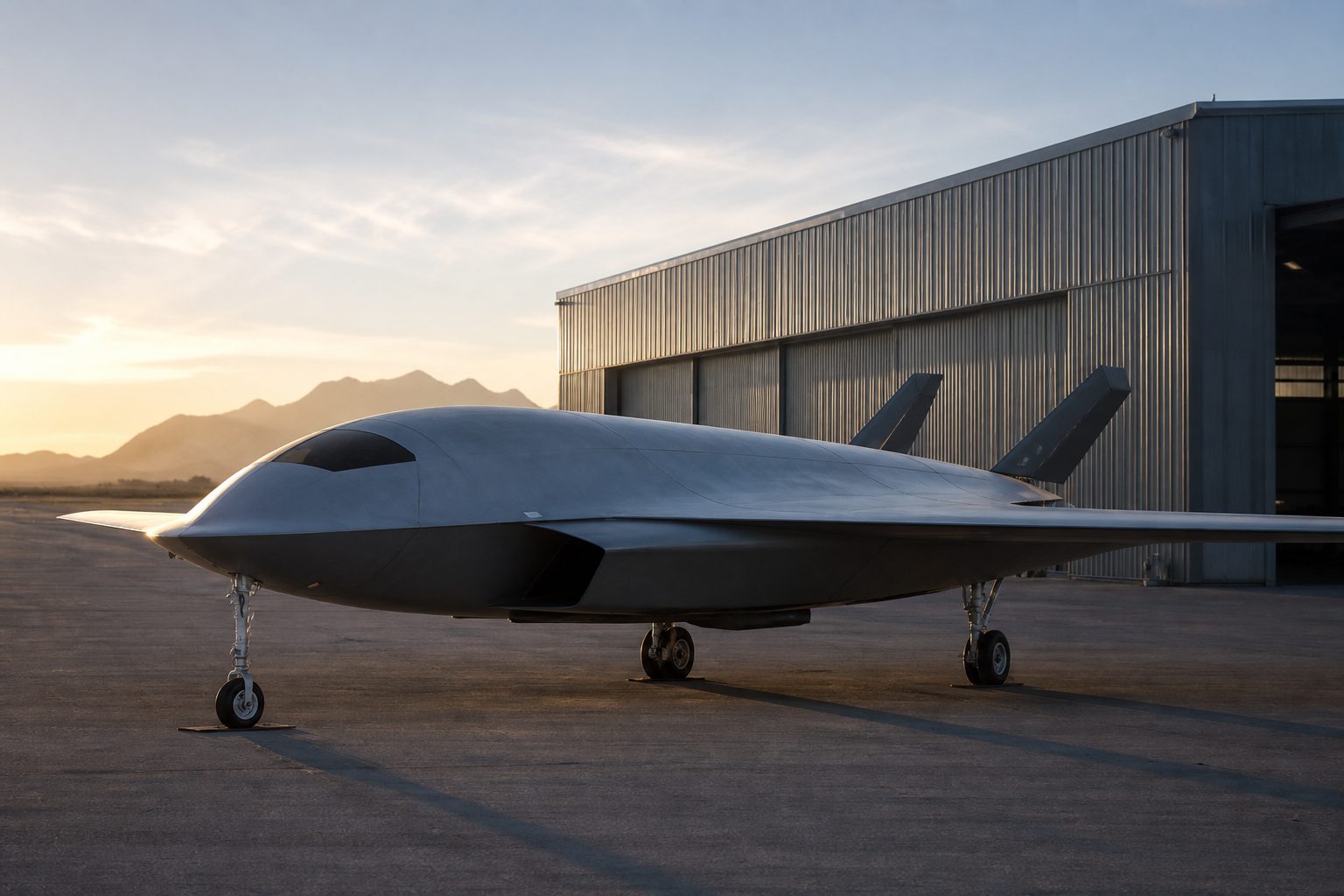
On 24 April 2024, the US Air Force announced that the two companies chosen to design, build and flight-test its Collaborative Combat Aircraft, the autonomous "loyal wingman" drones intended to fly alongside crewed fighters, were Anduril Industries and General Atomics. Boeing, Lockheed Martin and Northrop Grumman, which had all competed, went home with options to remain observers. Anduril was then seven years old, had never built a fighter of any kind, and had been selected on the strength of a prototype it largely paid to build itself. Ten months later, in February 2025, the Army agreed to move the Integrated Visual Augmentation System (IVAS), a programme whose ceiling value had been set at roughly $21.9 billion under Microsoft, to the same company.
Most coverage of defence technology stops at the funding round or the contract ceiling. Very little explains the plumbing. What follows is an examination of the plumbing: the contracting authorities, programme offices and congressional mechanisms that carried three startups, Anduril Industries, Shield AI and Saronic Technologies, from press releases to money in the Pentagon's budget, and the cases where the same system still excludes companies like them. The answer turns out to be less about technology than about which door in the acquisition system a firm manages to walk through, and who is holding that door open and why.
Why a budget line is the whole game
"Programme of record" has a precise meaning, and the precision matters. A technology becomes a programme of record when a service validates a requirement for it and allocates it a funding line in the Future Years Defense Program, identifiable by a programme element number and defended in the President's budget request to Congress. Everything before that point is provisional: prototypes, experiments, demonstration contracts and venture capital, none of which survives a change of administration, a continuing resolution or a new service chief on its own. The space between a successful prototype and a funded line is what the Pentagon and industry have long called the valley of death, and by every serious analysis it remains the normal destination for defence startups.
The structural backdrop is consolidation. Pentagon industrial-base reviews have for years cited the contraction from roughly 51 aerospace and defence firms in the early 1990s to five prime contractors by the 2000s merger wave's end. Analyses of federal procurement data, including Govini's National Security Scorecard series and the Center for Strategic and International Studies' defence acquisition trends work, have consistently found that venture-backed non-traditional firms capture only a small single-digit share of Defence Department contract obligations. The primes still take almost everything. What changed in the past decade is that a handful of specific, legal fast lanes opened, and three companies learned to drive in them.
One caution applies before any dollar figure quoted below: ceiling values are not money. A contract ceiling is an upper bound on what may be ordered, not what has been or ever will be. The $967 million counter-drone integration agreement SOCOM awarded Anduril in January 2022, and the $21.9 billion IVAS ceiling set in 2021, are both not-to-exceed figures. Obligations arrive in tranches, as Congress appropriates and as programme offices order. Sizable percentages of celebrated ceilings have historically gone unexercised.
The lanes that actually carry a startup to a budget line
Six mechanisms, and one informal institution, account for almost every documented case of the three companies reaching programme funding. They are summarised here before being traced through each company's history.
| Mechanism | Legal or institutional home | Typical size | Typical speed | Used by |
|---|---|---|---|---|
| Prototype Other Transaction agreement (OTA), with follow-on production authority | 10 U.S.C. §4022; OT consortia or direct awards | Prototype work from low millions to ceilings approaching $1bn | Months, sometimes under 112 days at the fast end | Anduril (SOCOM counter-UAS) |
| SBIR/STTR Phase I-II, then STRATFI/TACFI bridge, then Phase III | Small Business Administration programme; AFWERX/AFVentures | Phase I roughly $50k-$100k; STRATFI bundles commonly cited at $3-15m; Phase III is uncapped by statute | Phase I decisions measured in weeks at AFWERX's fastest; the full chain runs years | Shield AI, and indirectly most others |
| Defense Innovation Unit (DIU) Commercial Solutions Opening | DIU, Office of the Secretary of Defense | Prototypes usually single-digit to low tens of millions | Publicly targeted at 60-90 days from problem statement to award | All three in various forms |
| Middle Tier of Acquisition (Section 804, FY16 NDAA) | Rapid prototyping / rapid fielding authority | Programmes sized to field in two to five years | Years, but faster than JCIDS plus FAR | CCA programme structure |
| Competitions with separable software lots | Ordinary FAR competitions designed to split hardware from autonomy | Tens to hundreds of millions | Ordinary | Shield AI (CCA mission autonomy), Palantir (TITAN) precedent |
| Congressional adds, report language and APFIT | NDAA provisions, committee marks, appropriations | APFIT awards in the tens of millions per year; plus-ups up to $900m-scale for DIU | Annual cycle | The whole field |
| Exercises as de-risking theatre | Project Convergence, Talisman Sabre, REPMUS, fleet experiments | N/A | N/A | All three |
OT agreements: the fast lane with a ceiling
Other Transaction authority, codified at 10 U.S.C. §4021 and §4022, lets the Pentagon sign prototype agreements outside the Federal Acquisition Regulation: no cost-accounting standards, no mandatory auditing regime of the FAR sort, and no requirement that the awardee be a traditional defence contractor. The critical provision for startups is §4022(f), which permits a follow-on production transaction, or even a production contract, without further competition if the original prototype was competitively awarded and successfully completed. That single clause is the bridge across the valley of death in statutory form.
Usage statistics need careful handling. Defence OTs peaked at roughly $16 billion of obligations in the COVID-era years, but the bulk of that was Operation Warp Speed vaccine work. Strip that out and annual prototype OT obligations sit in the single-digit billions: a fast lane, but a narrow one relative to a contract-obligations base in the hundreds of billions. GAO has repeatedly faulted the department's OT oversight and data quality, and critics note that much consortium OT money still flows to the established primes, which are consortium members too. The honest reading is that OTAs are quick, flexible and structurally friendly to non-traditionals, and that most OT money still does not build new industrial competitors.
The exception is instructive. SOCOM's January 2022 award to Anduril, a ten-year prototype OTA with a ceiling reported at about $967 million to integrate, assess and field counter-small-drone systems as a systems integrator, was not a research grant. It was an operational command writing an operational requirement and handing the integration role to a five-year-old company over incumbent bidders. That is what an OTA looks like when it works as designed.
SBIR's real prize is Phase III
The Small Business Innovation Research programme is usually described through its small early awards, but its strategically important feature is Phase III: an uncapped, sole-source-eligible award that any programme office can issue to a firm for work deriving from its earlier SBIR efforts, using ordinary programme money rather than SBIR set-asides. Phase III is, in effect, a standing legal exemption from full-and-open competition that lives inside the small-business statute. Air Force bridging tools run through AFWERX, the Tactical Funding Increase and Strategic Funding Increase (TACFI and STRATFI), exist specifically to keep Phase II companies alive until a customer can issue a Phase III.
Shield AI's ascent ran substantially through this lane: early SBIR work on its Nova indoor drone and the Hivemind autonomy stack, AFWERX-structured bridging, then sole-source-eligible Phase III money from services that had seen the product operate. The Air Force's own open-topic reform under former acquisition chief Will Roper compressed Phase I decisions from months to weeks and made the early game fast. The hard part was never Phase I speed. It was persuading a programme office to write a real Phase III.
DIU: pitch to prototype in weeks
The Defense Innovation Unit's Commercial Solutions Opening process, pitch a commercial prototype, get picked on a short written submission, sign an OT prototype agreement, is routinely described by DIU as roughly a 60-90 day path from problem statement to award, with follow-on production OTs available after successful demonstrations. DIU's significance was amplified when Congress, in the FY2024 appropriations cycle, increased its funding nearly tenfold to roughly $1 billion against a request of about $115 million, one of the largest single congressional plus-ups for an innovation office on record. That number matters for the section below on congressional mechanics: the money was not requested by the department. It was added by appropriators who had decided the office should be bigger than the Pentagon wanted it to be.
Exercises are procurement by other means
The informal institution completes the set. The Army's Project Convergence, NORTHCOM's Global Information Dominance Experiments, Talisman Sabre in Australia, NATO's REPMUS trials off Portugal and the Navy's fleet experimentation all serve as venues where a product can run against real military data links, real operators and real adversaries' tactics before any contract exists. Anduril's Lattice software, Shield AI's Hivemind and V-BAT drone, and Saronic's autonomous boats have all been documented at such events by the services and the companies. The function is not marketing, or not only marketing: a programme office that has watched a system mesh with existing command-and-control under exercise conditions can write a requirement that describes it, and can defend that requirement to the comptroller. The exercise performance is the de-risking evidence a Phase III or production OT gets hung on.
Which programme offices will write a requirement a startup can answer?

The pattern across the three companies is that their big wins came from offices that deliberately broke the requirement into something a software-first firm could legally and credibly bid for, and lost, or did not win, where requirements were written around the primes' industrial structures.
SOCOM's counter-UAS office chose an integrator-of-systems requirement, which valued software and integration speed over platform pedigree, and awarded through an OTA. A non-prime could answer it.
The Air Force's CCA programme office made the most consequential structural decision in recent fighter acquisition: it split the buy into interchangeable air vehicles competed in increments, with mission autonomy competed separately. The Air Force confirmed in 2024 that it had issued separate autonomy awards, reported to include Shield AI and RTX's Collins Aerospace, so that the software flying the two selected airframes, Anduril's YFQ-44A Fury and General Atomics' YFQ-42A, would not be owned by the airframe builders. Both vendors' aircraft entered flight testing during 2025. Designing software separability into the requirement is what let a non-prime autonomy company onto a fast-jet programme at all, and the increment structure keeps a permanent second chance on the calendar for firms that lose a round.
The Army's PEO Soldier ran IVAS as a conventional single-vendor programme under Microsoft for years. What got Anduril in was not a restructure of the requirement but the recognition, on both sides, that the programme needed a faster hardware iteration cycle and lower-cost production than the incumbent was delivering; Microsoft and Anduril announced the transfer jointly in February 2025, with the Army's agreement. It is a programme-of-record win achieved by transfer, not competition, and it shows a second route to the budget: being the obvious successor when a giant's programme falters.
The Navy illustrates both halves of the answer. Its large and medium unmanned surface vessel requirements were initially answered by the traditional yards and system houses, and the Large USV effort subsequently slipped and was restructured amid cost and concept criticism, including from GAO. New entrants only reached meaningful money once the Navy's requirement documents changed shape: the creation of PEO Unmanned and Small Combatants, the standing-up of unmanned surface vessel squadrons from 2022, and the Chief of Naval Operations' September 2024 Navigation Plan, whose "Project 33" set a target of integrating robotic and autonomous systems for routine use by 2027 under a "hybrid fleet" concept, all moved demand toward smaller, cheaper, commercially built craft. That is the opening Saronic sailed through. Founded in Austin in 2022, it delivered 24-foot Corsair-class boats into Navy experimentation on its own capital, expanded its range down to six-foot and up to 60-foot hulls, bought a Louisiana shipyard (Gulf Craft, in 2025) to show it could build at volume, and was reported among the builders selected as the Pentagon disclosed maritime picks for the Replicator initiative. Whether Saronic holds a formal line item yet in the way Anduril holds SOCOM's counter-UAS integration role is a distinction worth preserving: its boats are in the budget through Replicator buys, experimentation and prototyping vehicles, and its factory-scale production contracts are the next test.
Exclusion by structure remains common. The Army's Future Tactical UAS competition ran for years from the 2019 demonstrations, in which the V-BAT's forerunner competed, before selecting incumbent-adjacent air vehicles; requirements that specify extensive platform heritage, existing depot infrastructure or classified integration stacks that only incumbents hold security and data rights for tend to produce incumbent winners whatever the statute says. The mechanism question and the exclusion question have the same answer: the programme office decides, at requirement-writing time, whether a non-prime can legally and credibly bid.
What happened to everyone else?

The reason the three-name list is short is that the default outcome has not changed. AFWERX has funded thousands of SBIR awardees; STRATFI and TACFI have bridged hundreds; the number that have crossed into sustained programme funding is a small fraction of those totals, a gap CSIS and GAO analyses describe as persistent even as prototyping tools multiplied. The Replicator initiative, announced by Deputy Secretary of Defense Kathleen Hicks in August 2023 with a promise to field thousands of attritable autonomous systems within 18 to 24 months, functioned as a selection event in itself: its disclosed aerial picks through 2024, AeroVironment's Switchblade 600, Anduril's Ghost-X and ALTIUS, and Performance Drone Works' C100, read as a list of firms that had already been through the lanes above, and its later maritime disclosures reportedly included Saronic's boats alongside other non-traditional builders.
The valley of death, in other words, was not filled in. It was given a few working bridges, and the firms that crossed them share recognisable traits: they shipped hardware before anyone ordered it, they owned the autonomy software rather than licensing it, they showed up at the exercises where requirements quietly form, and they converted exercise performance into Phase III or production OT paperwork quickly. The companies that did not scale are mostly not technology failures. They are paperwork failures: firms whose contracts ended at demonstration.
Where does Congress fit in this machinery?

Every lane above is a creature of statute, which means each is one mark-up away from expansion or extinction. The record gives clean examples in both directions.
Congress protecting entrants. The FY2024 DIU plus-up, bringing the office to roughly $1 billion, was an appropriations decision taken against the department's own request. The Accelerate the Procurement and Fielding of Innovative Technologies programme (APFIT), created by Section 834 of the FY2022 NDAA, reserved tens of millions of dollars a year to pull mature small-vendor prototypes into production, precisely the valley-of-death gap. The 2022 SBIR/STTR Extension Act renewed the programmes for three years while adding foreign-risk due-diligence requirements aimed at Chinese influence over awardees. And the Commission on Planning, Programming, Budgeting and Execution Reform, whose final report arrived in March 2024, recommended structural changes, from consolidated budget lines to continuing-resolution relief, that would disproportionately benefit companies without primes' cash reserves.
Congress cutting entrants off. As of 30 September 2025, SBIR and STTR authorisation expired. SBA closed new solicitations and agencies ceased issuing new SBIR work, while a reauthorisation fight played out in the Senate between a clean extension and a reform package aimed at so-called SBIR mills, firms that harvest repeated early awards without commercialising, complete with award caps and harder commercialisation tests. Reported warnings through late 2025 from small contractors described paused revenue and layoff exposure at exactly the firms' most fragile stage. Whatever eventual fix Congress lands on, the episode demonstrated the asymmetry: a single lapsed statute can halt the on-ramp for hundreds of companies at once, while keeping an incumbent's production line running requires no new law at all. The FY2025 full-year continuing resolution inflicted a quieter version of the same physics; spending continued, but new starts were frozen government-wide, and for startups new starts are the entire game. The July 2025 reconciliation act then moved in the opposite direction, adding on the order of $150 billion of defence spending, with large allocations for missile defence and shipbuilding alongside expansion of autonomous-systems funding, showing how fast money can also arrive when Congress moves by that procedure.
There is one more congressional mechanic with a longer pedigree. When Palantir sued the Army in 2016 over its exclusion from the DCGS-A2 intelligence programme, it won at the Court of Federal Claims on the statutory commercial-item preference, forcing the Army to consider buying a commercial product before building its own. The downstream chain ran prototype OT to the Army Vantage production award in 2019 (a ceiling reported near $458 million) to Palantir beating RTX for the $178.4 million initial TITAN deep-sensing vehicle contract in March 2024. The commercial-item statute that litigation enforced is the same preference that makes software-separable competitions winnable by non-primes today.
Does anything in Europe move this fast?
The honest comparison is that no European institution yet combines speed of award with a statutory bridge to production. Each of the main candidates does half the job.
NATO's DIANA, operational since 2023, runs challenge programmes that pay grants, on published scales of roughly €100,000 initially and up to €300,000 for second-phase companies, plus access to a network of test centres. It is genuinely useful as validation and networking. It awards no contracts and holds no procurement authority; the NATO Innovation Fund's €1 billion venture vehicle takes equity, not product. A DIANA alumnus is one validated demo ahead of where it started, not one production line.
In Germany, the Cyber Innovation Hub der Bundeswehr has piloted commercial digital tools since 2017 on a small budget, the 2022 procurement acceleration law loosened some rules, and the BAAINBw procurement agency remains measured in years for conventional programmes. The instructive German data point is not an institution but a firm: Helsing, the AI strike-software company, won the AI work on the Saab-led Eurofighter electronic-warfare upgrade in 2023, delivered HF-1 strike drones to Ukraine under German funding reported in the thousands of units, and was valued at €12 billion in a June 2025 round. Helsing's speed-to-revenue ran through battlefield validation and direct government purchase, not through a German SBIR analogue, because there isn't one.
The UK has moved furthest institutionally. DASA has run themed grant competitions since 2016 on timescales of months, and in 2025 the Ministry of Defence consolidated innovation activity into UK Defence Innovation (UKDI), launched with a ring-fenced annual budget reported at about £400 million and an explicit mandate to shorten the distance between prototype and frontline use. Even so, no UK body possesses anything like a §4022(f) production bridge or an uncapped Phase III; the onward purchase still has to fight through ordinary procurement each time.
The verdict from the comparison is structural, not a matter of national cleverness. The US system is the only one in which a statute lets today's sole-source prototype become tomorrow's sole-source production. Everywhere else, crossing the valley requires re-winning the competition at a bigger size. And behind all of it sits the mechanism none can legislate: Ukraine's battlefield has become Europe's real de-risking theatre, converting drone and AI software performance directly into orders for the firms brave and capable enough to operate there, Helsing above all.
What actually separates the three that crossed?

Set the evidence in a row and the shared pattern is short enough to state plainly. Anduril, Shield AI and Saronic each shipped operational hardware before a contract paid for it: towers on the border that Customs and Border Protection designated a programme of record in 2020, drones flying autonomous sorties years ahead of any fighter programme, boats built on investor money and handed to the Navy to test. Each owned its autonomy layer, which is what made them biddable when the Air Force deliberately split software from airframe, and what made Microsoft's IVAS succession choose Anduril in 2025. Each treated exercises as the true audition, and each converted performance in those venues into the specific statutory bridges, OT follow-ons, sole-source Phase IIIs, Replicator selections, that carry a company over the valley. And each spent conspicuously on the industrial signals the system respects: Anduril's Arsenal-1 factory outside Columbus, Ohio, announced in January 2025 at nearly $1 billion with a projected 4,000 workers; Saronic's Louisiana yard acquisition and its Port Alpha shipyard plans; valuations that crossed $30 billion, $5 billion and $4 billion respectively by mid-2025, making them too large for a comptroller to treat as experiments.
None of this abolishes the ceiling-versus-obligation problem, and none of it yet answers the harder questions: whether Anduril can deliver IVAS hardware at the quality and volume a decade of soldier complaints demands, whether CCA increments two and three keep the door open or close on today's winners, whether Saronic's boats become a Navy line item after Replicator sunsets, or whether the next SBIR shutdown simply closes the on-ramp behind them. What the record does show is that the separation between these three and the much longer list of well-funded also-rans was not primarily about drones, AI or boat design. It was about which authority signed, which office wrote the requirement, and which paragraph of an NDAA stood guard while they crossed. The press release is the easy part. The budget line is the whole game.
Sources / References

- U.S. Air Force, "Department of the Air Force selects two companies to build and test production-representative Collaborative Combat Aircraft," 24 April 2024, af.mil.
- 10 U.S.C. §4022, "Authority of the Department of Defense to carry out certain prototype projects," Legal Information Institute: https://www.law.cornell.edu/uscode/text/10/4022
- 10 U.S.C. §4021, Other Transactions for research, Legal Information Institute: https://www.law.cornell.edu/uscode/text/10/4021
- National Defense Authorization Act for Fiscal Year 2016, S.1356 (Section 804, Middle Tier of Acquisition), Congress.gov: https://www.congress.gov/bill/114th-congress/senate-bill/1356
- U.S. Department of Defense, "Other Transactions Guide," Office of the Under Secretary of Defense for Acquisition and Sustainment, November 2018 (revised December 2021).
- Sydney J. Freedberg Jr., "SOCOM awards Anduril $967M counter-drone contract," Breaking Defense, 27 January 2022; U.S. Special Operations Command award announcement, January 2022.
- Microsoft, "Advanced IVAS partnership with Anduril," blogs.microsoft.com, 11 February 2025; U.S. Army IVAS production award to Microsoft (ceiling up to $21.88 billion), March 2021.
- Air & Space Forces Magazine and Breaking Defense reporting on Air Force CCA mission-autonomy awards to RTX/Collins Aerospace and Shield AI, August 2024.
- DARPA, Air Combat Evolution programme page: https://www.darpa.mil/program/air-combat-evolution; DARPA AlphaDogfight Trials results (Heron Systems), August 2020; Air Force Research Laboratory announcement of Secretary Kendall's X-62A VISTA sortie, May 2024.
- Shield AI company announcements: Hivemind autonomous flight of the General Atomics MQ-20 Avenger (early 2025); V-BAT U.S. Coast Guard ISR services award reported at up to roughly $198 million (2024).
- Saronic Technologies company releases and reporting: $175 million Series B at a $2 billion valuation (July 2024); $600 million Series C at a $4 billion valuation (February 2025); Gulf Craft shipyard acquisition (2025).
- Australian Department of Defence, Ghost Shark XL-AUV programme announcements: first prototype delivered ahead of schedule (April 2024); commitment to acquire the vehicles at a value reported around A$1.7 billion (2025).
- Deputy Secretary of Defense Kathleen Hicks, Replicator initiative announcement, 28 August 2023, defense.gov; subsequent DoD disclosures of selected systems (2024-2025) as reported by DefenseScoop and Defense News.
- Defense Innovation Unit, Commercial Solutions Opening process and portfolio materials: https://www.diu.mil; FY2024 DIU appropriations plus-up to roughly $1 billion, as reported by Defense News (2024).
- SBIR and STTR Extension Act of 2022, Pub. L. 117-183, Congress.gov: https://www.congress.gov/117/plaws/publ183/PLAW-117publ183.htm; Small Business Administration SBIR/STTR programme: https://www.sbir.gov (programme lapse coverage, Federal News Network and SBIR community reporting, October 2025 onward).
- National Defense Authorization Act for Fiscal Year 2022, S.1605 (Section 834, APFIT), Congress.gov: https://www.congress.gov/bill/117th-congress/senate-bill/1605
- Commission on PPBE Reform, final report, March 2024: https://www.ppbereform.senate.gov
- Chief of Naval Operations, "Navigation Plan for America's Warfighting Navy" (Project 33), September 2024, navy.mil.
- U.S. Government Accountability Office reporting on Other Transactions use and oversight, and on the Large Unmanned Surface Vessel programme, gao.gov.
- Center for Strategic and International Studies (CSIS), Defence Acquisition Trends series; Govini, National Security Scorecard series (federal contracting data analysis).
- Palantir Technologies v. United States (DCGS-A2 litigation), U.S. Court of Federal Claims, No. 16-784 (2016); Army Vantage production award (December 2019); Army TITAN award to Palantir ($178.4 million initial), March 2024.
- U.S. Customs and Border Protection, Autonomous Surveillance Towers programme designation as a programme of record, 2020, cbp.gov.
- Full-year FY2025 continuing resolution (Pub. L. 119-4, March 2025) and the July 2025 budget reconciliation act (Pub. L. 119-21), Congress.gov.
- NATO DIANA challenge programme materials: https://diana.nato.int; NATO Innovation Fund (€1 billion) public materials.
- UK Ministry of Defence announcements establishing UK Defence Innovation (UKDI) with a ring-fenced budget reported at about £400 million per year (2025); Defence and Security Accelerator (DASA), gov.uk.
- Helsing company announcements and reporting: Eurofighter EK AI contract with Saab (2023); HF-1 strike drones for Ukraine under German funding; €600 million funding round at a €12 billion valuation (June 2025).
- Anduril Industries, Arsenal-1 factory announcement, Columbus, Ohio, January 2025; company funding rounds as reported by CNBC and TechCrunch (2024-2025).
Comments (9)
Continue exploring
Mamdani's 9/11 Records Release: What New York Officials Knew About Ground Zero's Toxic Air
Twenty-five years after the attacks, Mayor Mamdani released 170,000 pages of NYC 9/11 records. Here is what they reveal about the…

The wall of mud that crossed a border: inside the August 26, 2026 Nepal-Tibet flood disaster
Before anyone understood what was coming The clearest record of the disaster's first seconds comes from a fixed security camer…

Three Mile Island Can Restart in 2027. The Grid May Not Take Its Power Until 2031.
Constellation plans to restart Three Mile Island in 2027 to power Microsoft data centers. PJM says the grid may not take its full…
Saying six mechanisms account for almost every documented case is a strong claim - what about the companies that reached programmes of record before these fast lanes opened?
In my experience, a non-traditional vendor can absolutely get pulled into a programme of record as a subcontractor to a prime without ever touching one of these six mechanisms directly.
The exercises-as-de-risking-theatre line is fascinating and I want to understand it better. Does participation in something like REPMUS or Project Convergence actually move the needle on getting a programme element number, or is it more of a credibility signal that helps a startup win an OT agreement later? And how does the Pentagon decide which non-traditional firms get invited to those events in the first place?
This tracks with what I've seen in the autonomous maritime space. Saronic's rise looks structurally similar to what Anduril pulled off in air, and the same six mechanisms are clearly visible in their story too. The interesting question is whether the Navy creates a maritime equivalent of the CCA lane or keeps routing everything through DIU and traditional PEOs. Until that happens, even a good prototype still has to find a programme element number to survive a CR.
How would a two-person team without Anduril's funding realistically even approach the DIU CSO pipeline - is there a minimum company size that the scoring actually requires?
The line 'ceiling values are not money' deserves to be pinned to the top of every defence procurement article, since most reporting on the $21.9 billion IVAS figure clearly treats the ceiling as if it were obligated spending.
Could you do a follow-up specifically on the exercise lane? The article mentions Project Convergence and REPMUS but doesn't really explain how a fleet experiment translates into a funded programme of record versus just another demo slide deck.
The table in the lanes section was the most useful part for me - having typical size and speed next to the legal home makes it obvious why SBIR chains take years while §4022 OTs can move in months.
Even with §4022(f) follow-on authority, getting a programme office to actually commit to a production OT still seems like a hard political sell - who at the service is realistically empowered to make that call?