On the morning of October 3, 2026, Elon Musk replied on X to a post about a semiconductor scoop with eight words: "Just discussions, but something may come of it." The scoop, published the previous evening by Tim Culpan, the veteran chip correspondent who spent two decades at Bloomberg before leaving to run his own publication, reported that Taiwan Semiconductor Manufacturing Company was exploring ways to participate in Terafab, the Musk-backed semiconductor complex planned for Texas. Culpan's assessment went well beyond a supply arrangement. "The most likely scenario is for TSMC to try to own and operate the new factory," he wrote, while noting that "these plans are not set in stone, with other variations on the cooperation also being considered" [1].
Musk's confirmation matters because of what TSMC is and what it has never done. In nearly four decades since founder Morris Chang invented the pure-play foundry, TSMC has grown into a company that books roughly two-thirds of global foundry revenue [8]. Its commercial proposition is neutrality: TSMC manufactures other firms' designs, sells no branded chips of its own, and serves hundreds of customers from shared fabs [7]. Nothing in its disclosed history resembles a fab reserved for a single customer.
A TSMC-owned Terafab dedicated to Tesla, SpaceX, and xAI would be exactly that, and it would be the first fab of its kind built around a private actor rather than a government. That fact touches three consequential questions at once: whether the foundry model survives a customer rich enough to buy his own version of it, what "self-sufficiency" means when the new capacity is foreign-operated, and what happens to Intel, the company publicly slated to supply Terafab's process technology under agreements that, by the official record, do not yet exist. What follows works through what the record establishes, what a dedicated TSMC fab would change, and the substantial reasons it may never happen.
What Terafab actually is, on the record
Terafab was announced by Musk on March 21, 2026, at the defunct Seaholm power plant in Austin, as a Tesla-SpaceX venture with the stated goal of producing more than one terawatt of AI compute capacity per year [2]. Musk framed the demand in absolute terms: all fabrication facilities on Earth together, he said, produce about 2 percent of what Tesla and SpaceX will need for vehicles, robots, and orbital AI infrastructure, and "we either build the Terafab, or we don't have the chips, and we need the chips, so we build the Terafab" [2].
The project has two parts. The first is a prototype "Advanced Technology Fabrication" facility at Tesla's Gigafactory Texas site, which broke ground in April 2026 and is designed to run every step of chip development under one roof: design, fabrication, packaging, and test, with a 2-nanometer-class process target and Tesla's fifth-generation AI chip, AI5, among the first products the pilot facility is designed to produce, in small batches during 2026 and volume production in 2027. Its initial output target of 100,000 wafer starts per month was later walked back by Musk to "maybe a few thousand wafers per month, but it's really intended to try out ideas" [2].
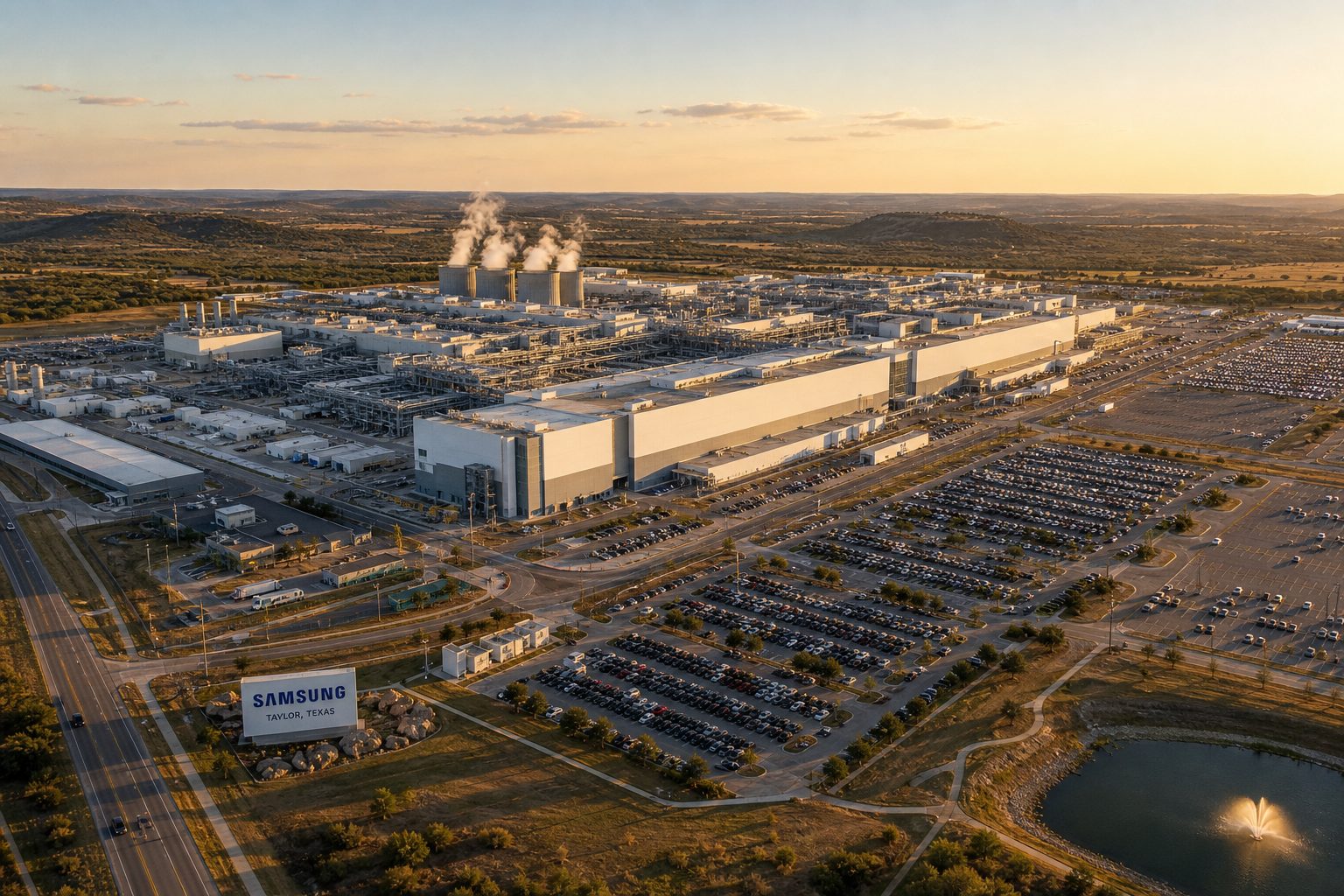
The second is a permanent plant in Grimes County, Texas, at the site of the former Gibbons Creek coal station, southeast of Bryan-College Station, where Texas A&M's university system is separately building a semiconductor institute due in 2028 [2]. County filings in May 2026 described an initial outlay near $55 billion and as much as $119 billion across all phases. In August 2026, Tesla and SpaceX said they would invest about $16.8 billion in a first phase. County commissioners approved a full property tax abatement in June 2026. Texas filings in early September 2026 listed a construction start of December 1, 2026, and completion by the end of 2028. SpaceX has said the site will draw power from on-site natural gas generation and large battery arrays and create at least 1,800 permanent jobs, in a footprint of up to 100 million square feet that would make it one of the largest factories in the world [2].
Intel joined in April 2026, with Musk announcing that the full-scale plant would use Intel's 14A process, a 1.4-nanometer node, alongside a division of labor in which Tesla runs the prototype work and SpaceX leads the initial full-scale build. His endorsement carried a caveat about maturity: by the time Terafab scales, he said, 14A "will be probably fairly mature or ready for prime time" [2].
One more piece of the record outweighs all the numbers. SpaceX's initial public offering registration, filed in May 2026, states that Terafab is at a very early stage, that Tesla and SpaceX have agreed only to a general framework, and that financial terms, intellectual property rights, and the continuing participation of both Intel and Tesla remain subject to later agreements [2]. Independent analysis of the project reached a similar structural read: Terafab looks more like a foundry engagement in which Musk's companies serve as committed anchor customers than a greenfield fab Tesla is building for itself, closer to a dedicated capacity agreement than a technology license [3]. Every consequential number in the project traces back to Musk and companies he controls, and several have already changed.
Why TSMC has never reserved a fab for anyone
Chang founded TSMC in 1987 on a deliberately narrow promise: the company would manufacture other firms' chip designs and sell nothing of its own, so it would never compete with the people who trusted it [7]. That promise let thousands of fabless companies hand over their most valuable intellectual property to a shared factory, and it underwrote the modern chip industry. Neutrality is not a courtesy of the foundry model. It is the product.

The economics reinforce the neutrality. A leading-edge 300-millimeter fab requires $15 billion to $20 billion in construction and tooling before a single production wafer runs, and 3-nanometer-class wafers sell for roughly $17,000 to $22,000 apiece, which makes utilization the dominant driver of unit economics for operator and customer alike [3]. Diversified demand protects that utilization. Dedicating the machinery to one customer group concentrates the risk on a single actor's forecast.
When fabs have been dedicated in the past, the customer has been a state. Sandia National Laboratories has operated its own microelectronics fabrication facility for US nuclear weapons programs for decades [16]. The Pentagon's Trusted Foundry program accredits plants such as Texas Instruments' DMOS6 in Dallas and SkyWater's Minnesota fab to build sensitive defense chips on protected lines [11]. GlobalFoundries, which makes radiation-hardened chips for space and defense at its Vermont fab, signed a 2024 agreement worth up to $3.1 billion with the Department of Defense to expand trusted capacity in New York and Vermont [12]. Intel's Arizona fabs host the Defense Department's Secure Enclave program, worth up to $3 billion, on top of RAMP-C, the Pentagon's prototyping effort on Intel's 18A node [11]. The pattern is consistent: when a leading-edge line is reserved for one buyer, the buyer has been a government paying a premium for control and guaranteed supply.
Commercial history contains partial precedents, and each stops short of the Terafab scenario. A 2000 agreement filed with the SEC shows QuickLogic buying equity in Tower Semiconductor in consideration for committed "Base Capacity" in a fab Tower had not yet built, a customer-underwritten expansion of the kind TSMC has never needed [5]. GlobalFoundries began life in 2009 as the captive manufacturing arm of AMD, its former parent, and spent years diversifying. Apple, TSMC's largest customer at roughly a quarter of revenue by most accounts, has long anchored the launch of new nodes and exercises enormous influence over their timing [7][8]. The novelty claim needs that qualification stated plainly: influence is not exclusivity. No TSMC fab has been reserved for Apple, and every Apple node has gone on to serve other customers.
The Terafab scenario would cross the remaining line. It would be the first time a foundry's leading-edge process roadmap is co-authored around the needs of one private customer group spanning three very different demand profiles: automotive-grade inference silicon for Tesla vehicles and robots, radiation-tolerant chips for SpaceX satellites, and training accelerators for xAI data centers. A roadmap is a set of choices about which reliability requirements get optimized, which packaging is offered, and when a node is deemed ready. Those choices would now have one author. If TSMC does it for Musk, it invites the same question from every customer with the balance sheet to ask it. Microsoft, Google, Amazon, and Meta already design their own accelerators. The foundry model could fragment into a set of private clubs, and the quiet asset behind TSMC's two-thirds share of foundry revenue is what would erode [8].
The wafer math behind a captive fab
Whether any of this is economically coherent depends on volumes, so work the demand side. These are back-of-envelope estimates, not company disclosures; the assumptions matter more than the precision.
A 300-millimeter wafer provides roughly 70,000 square millimeters of silicon. A large AI accelerator occupies most of a reticle field, around 700 to 850 square millimeters, so even at good yields a wafer yields a few dozen flagship chips. Tesla's vehicle business, at about two million cars a year at its recent delivery peak, needs roughly that many inference chips, which at AI5-class die sizes amounts to something on the order of a thousand wafer starts per month. Musk has talked about millions of Optimus robots a year, and even multiplied several-fold that moves the number by thousands, not tens of thousands [14]. SpaceX's satellite program, presented in June 2026 as the AI1 design [2], implies onboard compute for thousands of spacecraft, which at generous payloads adds hundreds to low thousands of starts. The load-bearing volume is xAI: a million dual-die training packages a year, the scale Musk has publicly pointed toward for xAI's Colossus buildout and said he wants to grow well beyond [14], works out to a few thousand wafer starts a month.
Sum the plausible late-decade demand and the Musk ecosystem supports something like 5,000 to 15,000 wafer starts per month at the leading edge. That is a real business: roughly the scale of a leading-edge fab phase of the kind TSMC builds when it expands in Taiwan or Arizona. It is not what Terafab's public numbers describe. The original 100,000 starts a month, at $20,000 a wafer, would represent about $24 billion a year in output from a single site, more than a quarter of TSMC's total 2024 revenue of about $90 billion [3][7]. The long-term goal of one million wafer starts per month [2] would exceed the output of any semiconductor complex ever built, likely several times over. The International Energy Agency put total global data center consumption at about 415 terawatt-hours in 2024, an average draw near 47 gigawatts [10]; Terafab's stated goal of a terawatt of AI compute capacity per year [2] is, whatever the units mean precisely, more than an order of magnitude beyond the average power draw of every data center on Earth combined. Musk's own revision of the pilot target to "a few thousand wafers per month" [2] matches the demand math almost exactly.
The structure only works with committed volume. At $17,000 to $22,000 per wafer and $15 billion to $20 billion of capital per fab, underutilization degrades unit economics for both sides, which is the same cost-recovery logic behind Intel Foundry's years-long struggle to attract external leading-edge customers at scale [3]. A dedicated TSMC fab would need take-or-pay commitments, in effect converting TSMC's diversified revenue base into concentrated exposure to one person's forecasts. The honest description of the resulting facility is that it would be xAI's fab, with Tesla and SpaceX as anchor tenants.
Which chips Tesla, SpaceX, and xAI would actually need
The three companies impose three different reliability regimes on the same production line.
Tesla's AI5 is an automotive part, which brings AEC-Q100, the Automotive Electronics Council's qualification standard: operation across temperature grades spanning -40°C to +125°C and beyond, zero-defect supply expectations, and qualification programs that can outlast the chip design itself. Tesla's silicon history explains why Terafab exists at all. The company has designed its own chips since the first FSD chip, fabbed at Samsung from 2019, ran the Dojo D1 training chip, reportedly built at TSMC, and then scaled Dojo back after Musk publicly called it a long shot, while also referencing a compute tile called Raptor [14]. What it has never had is manufacturing. AI5's stated schedule, small batches in 2026 and volume in 2027 [2], would make it the pilot fab's qualification vehicle.
SpaceX's case is stranger and more interesting. Space electronics traditionally means radiation-hardened chips on old, stable process nodes from a small specialized supplier base. SpaceX built its launch business largely by rejecting that approach, using commercial-grade parts made survivable through redundancy, radiation testing, and rapid iteration [14]. Terafab's stated aim of chips "optimized for operation in space" [2] implies a third path: baking radiation tolerance into the design rules of a leading-edge commercial process. That is roadmap co-authorship in its purest form. If SpaceX can specify how a process behaves when a heavy ion strikes it, it is no longer a customer of a shared roadmap. It is a co-author, in a domain no leading-edge foundry has treated as a priority.
xAI's needs are conventional by comparison: training-class accelerators with high-bandwidth memory and 2.5D advanced packaging, the scarcest commodity in the industry. Here Terafab's stated scope collides with TSMC's model. Terafab promises integrated circuits, memory, packaging, and test under one roof [2]. TSMC is a logic foundry; the high-bandwidth memory that training chips require comes from SK hynix, Samsung, and Micron, and TSMC has always procured it externally. A TSMC-operated Terafab would realistically mean logic and advanced packaging on site, with memory still imported unless the memory ambition shrinks or partners are brought in. Packaging is in fact part of TSMC's announced US footprint, which includes two advanced packaging facilities [6].
Why TSMC might say yes, and what it would cost
The case for TSMC is straightforward. AI demand has outrun supply for three years, with TSMC executives describing leading-edge capacity as very tight and the most advanced packaging effectively sold out [7]. A customer group willing to underwrite an entire site converts scarcity into committed volume, at a location that would diversify TSMC's US footprint beyond Arizona. The first Arizona fab entered high-volume production in late 2024 with yields comparable to Taiwan, by TSMC's own account [7], the company has already committed $165 billion of US investment across additional fabs, two packaging plants, and a research center [6], and Taiwan's government relaxed its long-standing requirement that TSMC's overseas fabs run a generation behind its Taiwan plants as part of the Arizona approvals [15]. A second US pole in Texas would extend the hedge that runs in both directions: TSMC reduces its exposure to one island, and the US gains capacity on its own soil. In Taipei, every offshore fab feeds a quiet anxiety about the erosion of the silicon shield, and a Texas Terafab would deepen it.

The costs are less visible. TSMC's customer list includes Apple, Nvidia, AMD, Qualcomm, Broadcom, and MediaTek [7][8]. Priority access to new nodes is precedented; Apple routinely anchors them. Exclusivity reverses the logic, and it would put TSMC in the position of helping one compute player, xAI, move away from buying chips from another major TSMC customer, Nvidia, whose GPUs power xAI's Colossus clusters today [14]. That is awkward but manageable. Less manageable is the precedent: once one private actor co-authors a process roadmap, every hyperscaler with a custom silicon program has grounds to demand the same, and four decades of accumulated neutrality begins converting into a web of bilateral relationships, each with its own negotiations, its own politics, and its own demand risk. There is also allocation. New fabs do not create their own supply of extreme-ultraviolet lithography tools, process engineers, and packaging capacity; they draw from the same finite pools everyone else uses. A Musk fab would be additive once running, but it consumes scarce inputs on the way up.
Then there is institutional identity. TSMC was built on refusing this kind of entanglement, and Culpan's own phrasing, "variations on the cooperation also being considered" [1], reads like a company that has not decided whether it wants to own a fab or simply supply one.
Would a captive fab make the US self-sufficient?
Two different things get called self-sufficiency, and a captive Terafab serves only one of them.
The first is capacity on US soil. The CHIPS Act appropriated $39 billion for commercial fab incentives; by January 2025 the Commerce Department had funded 19 companies with $30.7 billion in awards and $5.5 billion in loans across 40 projects, with a dozen companies still awaiting final awards as of mid-2026. FY2026 is the final year of CHIPS appropriations, and the 35 percent investment tax credit for semiconductor manufacturing applies only to projects that begin construction before December 31, 2026 [4]. Note the calendar: Terafab's filings put its construction start on December 1, 2026, four weeks inside the deadline, and Grimes County has already granted the abatement [2]. Whether Congress extends the credit and any successor funding is a live question the Congressional Research Service has flagged for lawmakers [4]. A TSMC-owned Terafab would more likely lean on the uncapped tax credit and local abatements than on CHIPS grants, because federal grants for a fab reserved for the world's richest person's companies would present a political question the program has never faced. Nothing in the program's rules requires open-market sales, but nothing in the politics rewards subsidizing exclusive capacity either.
Under any structure, the capacity effect is real but bounded. The US share of global fab capacity fell from 37 percent in 1990 to roughly 10 percent today, and announced projects were projected to roughly triple US capacity between 2022 and 2032 [9]. A dedicated fab at the five to fifteen thousand wafer starts per month the demand math supports moves the number modestly, and its output, by definition, serves three companies rather than the broader electronics base or the Defense Department.
The second meaning is control of the technology, and there the ledger is harsher. A TSMC-run Terafab would put wafers in Texas while the process design kits, recipes, tool configurations, and operating knowledge remained TSMC's, inside a company in which a Taiwanese state development fund is a major shareholder. The Defense Department's own leading-edge path runs through Intel, via RAMP-C on 18A and Secure Enclave in Arizona [11], not through Terafab at all. And the concentration cuts in the direction few policymakers discuss: the Pentagon already buys launch services and satellite connectivity from SpaceX, and a dedicated leading-edge fab would extend that single-actor dependence from orbit down to silicon. Capacity up, controlled technology flat, concentration up.
The regulatory picture is, by contrast, the easy part. A US fab making US-designed chips for US deployment largely sits outside the geographic licensing frictions that complicate shipping leading-edge silicon from Taiwan, and Washington already shapes TSMC's customer list through export controls, as the 2020 Huawei cutoff showed. Exclusivity to three vetted American companies would be the simplest customer list on Earth to police. CFIUS scrutiny of a Taiwanese-controlled fab is a manageable question; expect national-security conditions attached to anything the government touches.
Where this leaves Intel
If the TSMC scenario materializes, the company most directly displaced is Intel, which spent the spring and summer of 2026 as Terafab's named manufacturing partner.
The arc is short. Intel joined in April 2026; Musk picked Intel's 14A for the full-scale plant; and independent analysis called the win the most commercially significant external validation Intel's leading-edge roadmap had received, reading the arrangement as Intel-operated dedicated capacity rather than a technology license [3]. SpaceX's IPO registration had already disclosed that Intel's continuing participation was subject to agreements that did not yet exist [2]. Then came Culpan's report that TSMC was the most likely owner and operator of the new factory [1], a widely followed semiconductor news account summarizing that reporting as saying collaboration with Intel on Terafab "is not making progress" [1], and pushback from Intel-focused accounts, including one calling the story "bs" and arguing that "most of the people hired for TeraFab so far are Intel folks" [1]. Two public versions of Intel's role are now in circulation. Only one of them carries the authority of a regulatory filing, and it says nothing is settled [2].
What Intel loses if the TSMC version prevails is the marquee external customer for 14A, the proof point Intel Foundry has lacked under chief executive Lip-Bu Tan while external wins accumulated slowly [3]. What it keeps is considerable: an 18A node in volume production since late 2025 by the company's own account, the Defense Department's leading-edge programs [11][13], a roughly ten percent US government equity stake, acquired through the August 2025 conversion of Intel's remaining CHIPS incentives, that carries approval rights over a defined set of major corporate decisions [4][13], and an ecosystem seeded with its former process engineers, a flow analysts have described as spreading Intel know-how across US fabs while thinning Intel's own bench [3]. There is an irony here worth naming: Washington holds an equity stake in the company that may lose Terafab to a Taiwanese rival. Nothing about a TSMC-owned plant would necessarily eject Intel from the project, since the Austin prototype remains a Tesla facility and Musk has a record of running parallel suppliers. But the 14A commitment was the crown jewel of the arrangement, and it is what a TSMC operation would most plausibly replace.
The deeper issue is the strategic trade Terafab exposes: proven foreign versus strategic domestic. By Terafab's filed completion date at the end of 2028, and a realistic ramp in 2029 or 2030, TSMC's roadmap nodes will carry years of volume history, with N2 in production from late 2025, A16 from late 2026, and A14 planned for 2028 [7]. Intel's 14A would be newer and unproven at external scale. Musk's April assessment that 14A would "be probably fairly mature or ready for prime time" by scale-up [2] is a bet on a roadmap, not a description of one, and a project wagering tens of billions on a 2029 ramp has strong engineering reasons to prefer the process with the longest production record. A country that wants a domestic leading-edge ecosystem has equally strong reasons to prefer the opposite outcome. The tension does not resolve itself. It only determines who absorbs the execution risk: TSMC's shareholders, Intel's, or Musk's.
Why it may never happen
The strongest evidence for skepticism is that almost nothing is signed. Musk's word is "discussions" [1]. Culpan's reporting says the plans are "not set in stone" and that variations are being considered [1]. The most detailed public disclosure, SpaceX's IPO registration, describes a framework only, with no settled financial terms, no settled intellectual property arrangements, and no committed participation from Intel or Tesla [2].
The project's numbers have been unstable since birth. Press framing around the announcement put an Austin facility at $25 billion [3]; county filings later showed $55 billion initially and $119 billion across phases, while the companies committed $16.8 billion for a first phase [2]. The pilot's output target fell from 100,000 wafer starts a month to "maybe a few thousand" [2]. The process plan pairs a 2-nanometer-class pilot with a 1.4-nanometer full-scale plant that has not been built and whose supplier may be changing [1][2]. Musk's silicon track record includes reversals, from the Dojo scale-back to supplier shifts between Samsung and TSMC over the years [14].
Lead times argue for patience as well. TSMC's first Arizona fab took roughly four and a half years from announcement in May 2020 to volume production in late 2024 [6][7]. Terafab's filings promise construction start to completion in two years, December 2026 through the end of 2028 [2], fast for the shell alone, before a single tool is qualified and a single wafer ramped.
And a simpler outcome sits in plain sight. TSMC could serve Musk's companies for years out of Arizona and Taiwan under long-term capacity agreements before any dedicated Texas fab exists. Nothing in the reporting rules that out [1], and it is the version that costs TSMC the least neutrality. The dedicated part of "dedicated foundry" is the least settled element of the entire scenario.
Signals to watch through the end of 2026
- TSMC's third-quarter earnings call, expected mid-October, for any change in capital expenditure guidance or new US expansion language [7].
- Intel's October earnings call for any restatement of its Terafab role, and any 14A customer news [13].
- SpaceX's IPO process, and whether updated risk factors describe Terafab partners in more concrete terms than a "general framework" [2].
- Texas permitting around the December 1 construction date, and whether it slips [2].
- Congressional movement on extending the 35 percent credit's December 31 deadline and on funding beyond the CHIPS Act's final appropriations year [4].
- Equipment signals, meaning orders and shipment commentary from lithography and packaging toolmakers, which historically reveal fab plans before press releases do.
The foundry model was Morris Chang's answer to a fragmented industry: pool the manufacturing, share it, trust it. Musk is proposing the inverse: pool the demand, own the manufacturing, and let the roadmap follow. If TSMC takes the deal, every customer with tens of billions of dollars in compute ambitions will know the door opens. If it does not, Terafab will test whether Intel's 14A can carry the weight that Musk and, in a different way, Washington have placed on it. Either way, the plant filed for Grimes County, if it rises, would be the first leading-edge fab in the industry's history whose process roadmap answers to a single private customer. That is not a footnote in a supply agreement. It is a new species of industrial power.
Sources / References
- Tim Culpan, "Elon Musk Confirms TSMC-Terafab Talks," Culpium, October 3, 2026. https://www.culpium.com/p/elon-musk-confirms-tsmc-terafab-talks
- "Terafab," Wikipedia, accessed October 3, 2026; the entry consolidates Musk's March 21, 2026 announcement, Grimes County and Texas regulatory filings, Tesla and SpaceX statements, and SpaceX's May 2026 IPO registration. https://en.wikipedia.org/wiki/Terafab
- Silicon Analysts, "Terafab, Intel 14A and the US Fab Startup Playbook," July 6, 2026. https://siliconanalysts.com/analysis/us-fab-startups-gary-jiang-terafab-14a-licensing-model
- Yong W. Kwon, "Semiconductor Fabrication Facilities Funded by the CHIPS Act: Project Status and Considerations for Congress," Congressional Research Service, R49031, July 14, 2026. https://www.congress.gov/crs-product/R49031
- QuickLogic Corporation and Tower Semiconductor, "Foundry Agreement for Share Holders," SEC exhibit, agreement dated December 11, 2000. https://www.sec.gov/Archives/edgar/data/882508/000091205701008596/a2041996zex-10_20.txt
- TSMC, announcement of increased US investment to $165 billion, March 2025; tsmc.com.
- TSMC, quarterly earnings presentations and technology disclosures, 2024 through 2026, covering Arizona fab production status and yields, the N2, A16, and A14 roadmap, 2024 revenue of roughly US$90 billion, and customer concentration; tsmc.com.
- TrendForce, quarterly global foundry revenue rankings, 2025-2026; trendforce.com.
- Semiconductor Industry Association and Boston Consulting Group, "Emerging Resilience in the Semiconductor Supply Chain," May 2024; semiconductors.org.
- International Energy Agency, "Energy and AI," April 2025; iea.org.
- US Department of Defense, RAMP-C program materials (2021), Secure Enclave award disclosures (September 2024), and Trusted Foundry program documentation; defense.gov.
- GlobalFoundries, announcement of a definitive agreement with the US Department of Defense, September 2024; globalfoundries.com.
- Intel Corporation and US Department of Commerce announcements on the conversion of remaining CHIPS incentives into a US government equity stake, August 2025, and Intel public statements on 18A production and the 14A roadmap, 2025-2026; intel.com, commerce.gov.
- Public statements by Elon Musk on X and in Tesla and SpaceX appearances, 2019-2026, together with contemporaneous reporting on Tesla's chip suppliers, the Dojo program, xAI's Colossus clusters, the AI5 chip, the Raptor compute tile, and Starlink satellite architecture.
- Reuters and Taiwanese media reporting on Taiwan's Ministry of Economic Affairs approvals for advanced-node production at TSMC's Arizona fabs, 2024 and 2025; reuters.com.
- Sandia National Laboratories, published descriptions of its microelectronics fabrication facilities; sandia.gov.
Comments (4)
Continue exploring
The Best Coding Model in August 2026: Why the Answer Depends on the Job
The question sounds simple: which coding model is best, Codex, Gemini, Claude, or DeepSeek? The evidence does not support a…
Can a Satellite Network Be Sovereign if SpaceX Owns It? Hungary's 4iG Deal Will Test the Answer
Hungary's 4iG and SpaceX are building Starlink Mobile and "Sovereign Solutions" services, so the real question is what…
China's Supply Chain Chokepoints: What De-Risking Costs, and Whether It Works
Export controls on minerals, medicines, circuit boards, and legacy chips have turned supply chains into instruments of coercion…
If TSMC actually owns a single-customer fab for Musk, the "neutrality is the product" line the industry has run on for almost forty years is finished, and every other hyperscaler will start demanding the same arrangement.
The framing that Terafab looks more like a foundry engagement than a greenfield fab Tesla is building for itself does match what we see in our own supplier conversations. The piece is also right that every consequential number traces back to Musk and that several have already changed, and the walk-back from 100,000 wafer starts a month to "a few thousand" is a roughly fiftyfold swing that should not get buried. I am less sure about the "first fab built around a private actor rather than a government" angle, since the full property tax abatement and the adjacent Texas A&M institute due in 2028 make the public footprint pretty substantial. Still, the structural read otherwise holds up.
The SpaceX IPO disclosure that financial terms and IP rights are still unsettled makes that $119 billion all-phase number read more like a headline ceiling than an actual budget.
We have ridden out two Intel node ramps in the last decade and "fairly mature or ready for prime time" by late 2028 is not how 14A is shaping up based on what we are seeing. Betting a 100 million square foot plant's 1.4-nm output on a node that has not even hit high-volume manufacturing yet is the kind of schedule you write in a press release, not in a fab plan.