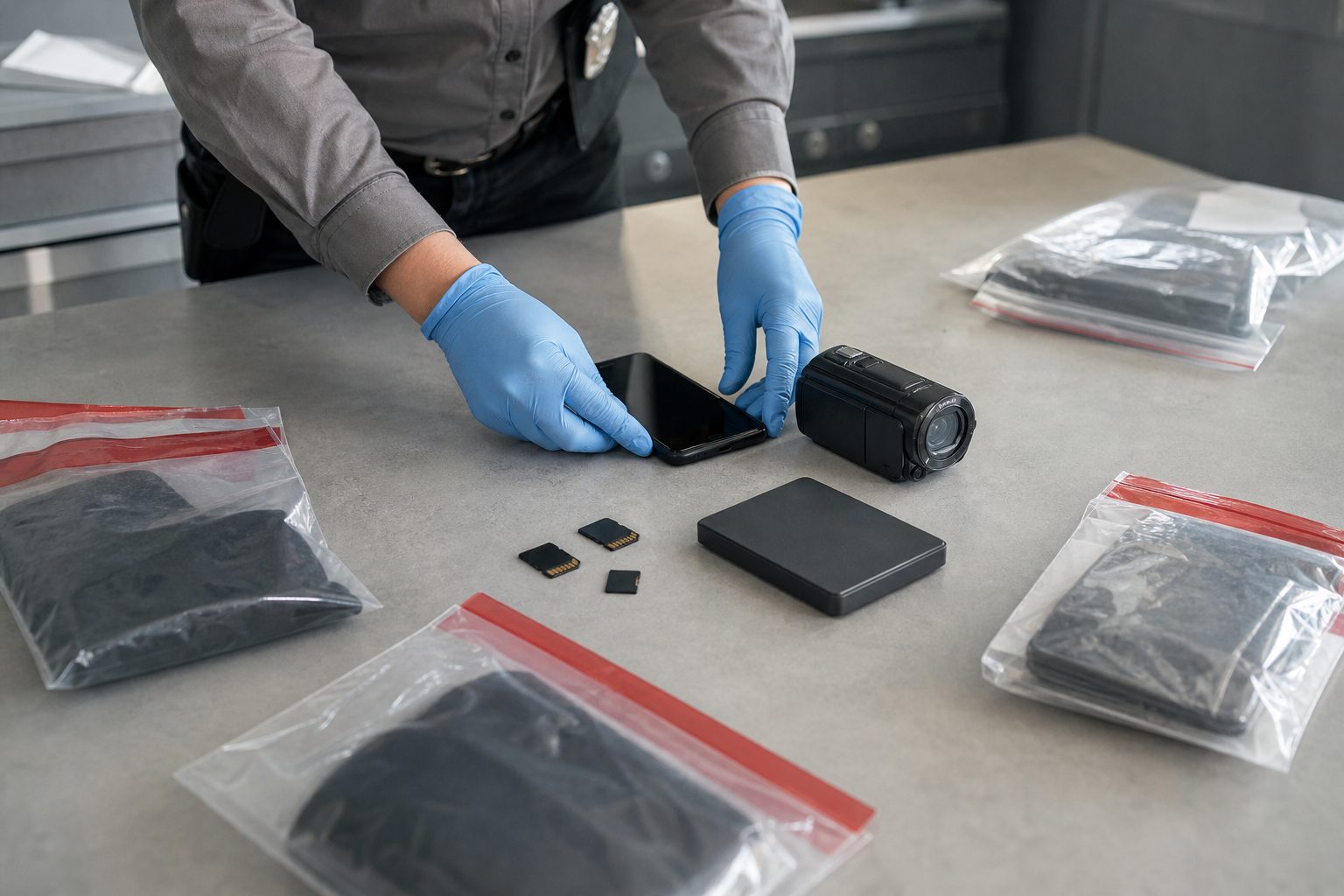
Protest videos can disappear in several ways. Platforms may remove them or restrict their reach. Authorities may block internet access, demand takedowns, seize devices, or pressure people to delete recordings. Users may erase footage to protect themselves. Even when a video survives, reposting can strip its metadata, compress its frames, and detach it from the person, place, and time it originally documented.
Yet disappearance rarely means that every trace is gone. Copies may remain on phones, in private messages, cloud accounts, journalist archives, screenshots, takedown notices, court files, or other witnesses’ recordings. The harder question is whether those fragments can be authenticated and assembled into a reliable account of what happened.
The answer is conditional. Independent investigators can sometimes reconstruct events with considerable confidence, but they usually cannot prove everything a video appears to show. A surviving clip may establish that a particular action occurred at a particular location while leaving the identity of the people involved, the sequence before the recording began, or the reason for a platform’s removal unresolved. The strongest findings come from several independent lines of evidence, preserved with enough information to show where they came from and how they changed.
How protest evidence disappears
Restrictions on protest documentation take different forms, and each leaves a different evidentiary problem.
Governments can disrupt the flow of footage by shutting down networks, throttling connections, blocking platforms, filtering keywords, or targeting individual accounts and livestreams. The International Review of the Red Cross identifies these measures as tools that can suppress documentation while making it harder for witnesses to communicate with journalists and investigators. The effect is not necessarily a total blackout. A connection that works intermittently may still allow some files to leave the country while preventing others from uploading. (International Review of the Red Cross)
In Iran’s 2022 “Woman, Life, Freedom” protests, a United Nations communication recorded restrictions on Instagram and WhatsApp beginning on September 21, limiting the circulation of images and videos to domestic and international audiences. (United Nations special procedures) During Turkey’s March 2025 protests, Amnesty International reported restrictions affecting major social and messaging services, including Telegram, while independently verifying footage posted during the affected period. (Amnesty International)
Authorities can also use legal or administrative pressure. During Hong Kong’s 2019 protests, the government said journalists could be investigated under existing law, while reporters described obstruction, assault, and restrictions on access. Police also requested the removal of social-media postings, citing public-order, national-security, privacy, and other legal rationales. (Hong Kong government statement on media reporting; Hong Kong government statement on social-media postings) A Congressional Research Service report described the treatment of journalists and the recording of demonstrations as a major civil-liberties issue during the same protests. (Congressional Research Service)
Police do not need to destroy a recording to damage its evidentiary value. A device can be confiscated before the owner backs up its files. A password request can expose other people pictured in the phone. A livestream can end before the most important event. In the United States, people generally have a First Amendment right to record officials performing their duties in public, provided they do not interfere, according to the Committee to Protect Journalists. But the practical protection varies by jurisdiction and circumstance. (Committee to Protect Journalists)
The Reporters Committee for Freedom of the Press advises that journalists’ unpublished recordings and documentary materials may receive protection from government search or seizure under the federal Privacy Protection Act, although the safeguards depend on the circumstances. It also identifies live streaming, minimizing locally stored data, and demanding judicial process for password requests as measures that can reduce the risk of losing the only copy. (Reporters Committee for Freedom of the Press)
Platforms create a separate layer of uncertainty. A video may be removed because it violates a moderation rule, because a rights holder complained, because it was reported as graphic content, or because a platform responded to a government request. A removal does not by itself establish that the video was false. Nor does continued availability establish that it is authentic.
Human Rights Watch documented how videos from Syria and Yemen were removed by platforms or users, creating obstacles for war-crimes investigators. It also warned that material can be blocked before upload or removed without leaving a trace, meaning investigators may not even know that evidence once existed. (Human Rights Watch)
That distinction matters. An investigator can sometimes count surviving videos. It is much harder to measure the footage that was never uploaded, was removed before anyone preserved it, or was deleted by a frightened witness. The visible archive can therefore be systematically incomplete.
What survives after the original upload is gone
A social-media post is only one version of a recording. The file may have passed through a phone, an editing application, a messaging service, a cloud backup, a journalist’s computer, an archive, and several mirror accounts.
Each step can leave a different trace. The original file may retain device information, creation time, location data, encoding details, and an unbroken sequence of frames. A repost may preserve the account that uploaded it, the upload time, captions, comments, and distribution history while stripping the camera’s original metadata. A screen recording may preserve what appeared on an interface but lose the source file’s technical history.
WITNESS describes this as a preservation problem rather than a simple search problem. When platforms remove posts or governments cut communications, the durable record is often distributed across eyewitness phones, livestreams, journalists’ copies, archives, and contemporaneous testimony. The strongest surviving evidence is redundant, independently preserved, forensically examined, ethically handled, and connected to identifiable people and places through a documented chain of custody. (WITNESS)
The first task is therefore to trace a file backward and sideways:
- Who first recorded it?
- Where did the earliest available copy come from?
- When did each account upload or repost it?
- Did the file pass through an editing program?
- Are there other copies with different compression histories?
- Do witnesses describe receiving it directly?
- Was the same event captured from another position?
Bellingcat’s collection protocol combines source tracing, geolocation, software analysis, corroboration, and structured descriptions. It also emphasizes preserving discovered material to evidentiary standards. (Bellingcat Justice and Accountability Unit)
Archives can also preserve evidence about a missing video. Takedown notices, user notifications, transparency reports, appeals records, and “tombstone” pages may show that content existed even when the file itself is unavailable. Research summarized by Cambridge University Press points to the Lumen Database as an example of how notices can preserve a residual record of removal requests. (Cambridge University Press)
Those records can answer questions about timing and institutional action. They generally cannot prove that the removed video was accurate. A takedown record shows that a platform or claimant acted. It does not, by itself, establish whether the underlying content was true, misleading, unlawful, or wrongly removed.
Metadata helps, but it does not settle the case
Metadata is information about a file and its creation or processing. It may include a device model, serial number, creation and modification times, codec, frame rate, filename, editing history, or GPS coordinates.
The value of metadata depends on its origin. Information from a camera-original file can help establish provenance. Metadata attached by a social platform may describe the upload or transcode rather than the original recording. A time stamp can be misconfigured. A location field can be absent, inaccurate, or altered. A file can be genuine while its caption is false.
The American Bar Association’s discussion of digital forensics describes metadata as evidence of provenance, not conclusive proof of what happened in the scene. It also notes that deepfake assessment may examine facial or bodily artifacts, unnatural motion, audio anomalies, inconsistent compression, and signs of synthesis, but that no single detector or probability score should decide authenticity. (American Bar Association)
The Scientific Working Group on Digital Evidence recommends beginning with the camera’s original file or earliest native export, preserving it byte-for-byte, calculating a hash, and recording the chain of custody. A hash is a digital fingerprint used to detect later changes to a file. It does not prove that the camera captured a truthful scene. It helps show whether the preserved file remained the same after investigators acquired it. (Scientific Working Group on Digital Evidence)
The distinction between integrity and authenticity is central. The UK government’s statutory code of practice defines integrity as whether a file is complete and unaltered since acquisition. Authenticity asks whether it accurately represents the event it is claimed to show. A file can have strong integrity while showing the wrong place, the wrong date, or an event presented with a false description. (GOV.UK)
Re-encoding complicates the picture further. Social and messaging platforms commonly strip metadata, resize footage, and recompress streams. A 2026 evidence-rules agenda document prepared for the U.S. courts notes that investigators should distinguish camera-original material from later transcodes and preserve every received version. (United States Courts)
Compression analysis can still reveal useful clues. Researchers may identify double encoding, inconsistent quantization, blocking, or regions with different processing histories. But heavy compression and low resolution can erase manipulation traces or create artifacts that resemble editing. File-container structures, such as MP4 indexes, timestamps, and encoder signatures, may also reveal something about a file’s lifecycle even when the visible sequence appears continuous. (APSIPA Transactions; video integrity research)

The result is a hierarchy of conclusions. Investigators may be able to say that a file has not changed since acquisition. They may be able to say that its visual content is consistent with a particular camera or processing history. They still need other evidence to establish where and when the event occurred.
Where this story sits
5 related pieces
Read it →
Hover a story · click to read
 No. 86 · Nov 1, 2026When Protest Footage Is Restricted, Who Can Verify It?
 No. 76 · Oct 21, 2026Who Controls Your Feed During a Crisis? France's October 2026 Crackdown Shows a Global Pattern
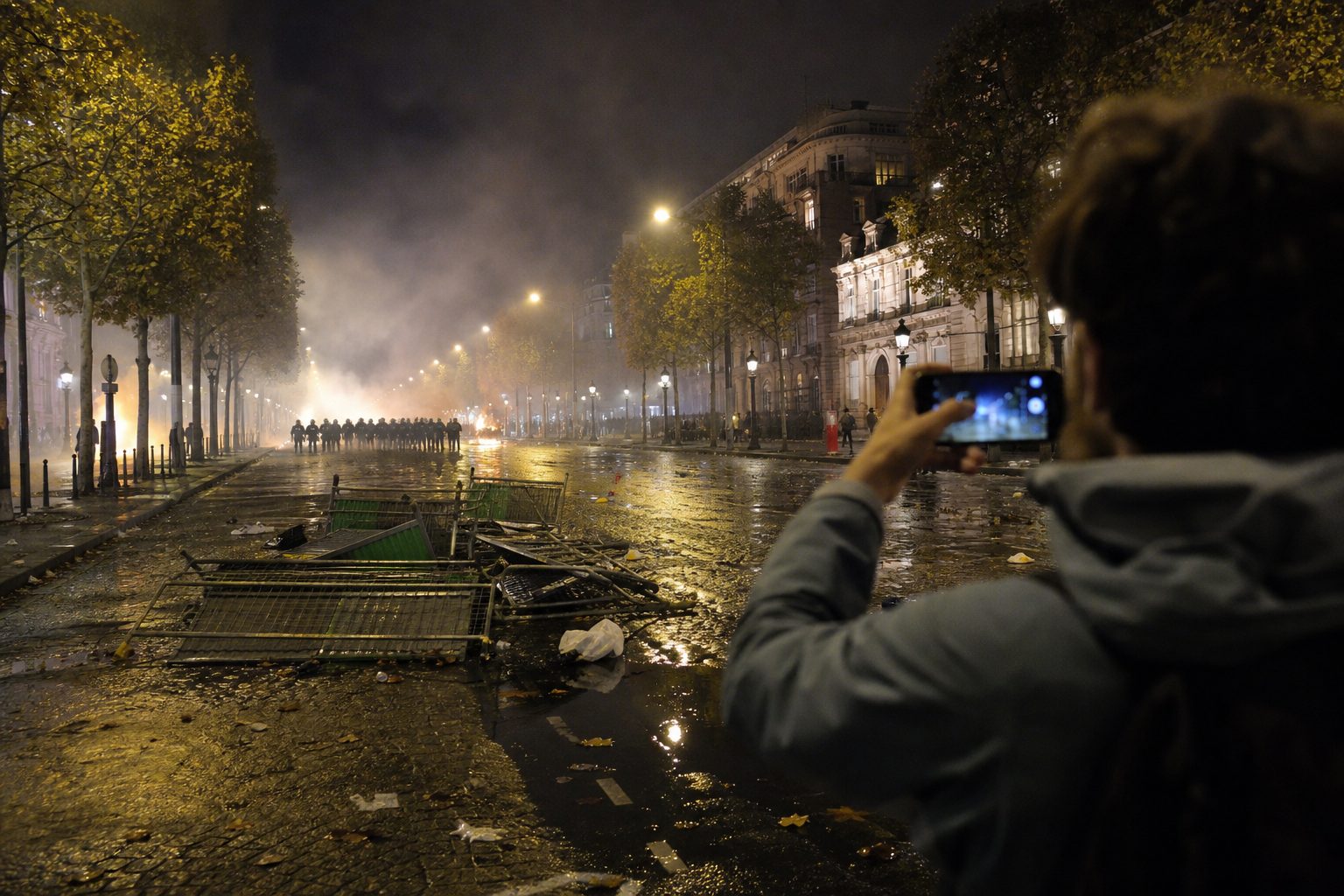 No. 79 · Oct 22, 2026Sorting France’s October 2026 Protest Videos: Real, Misleading, or AI-Made?
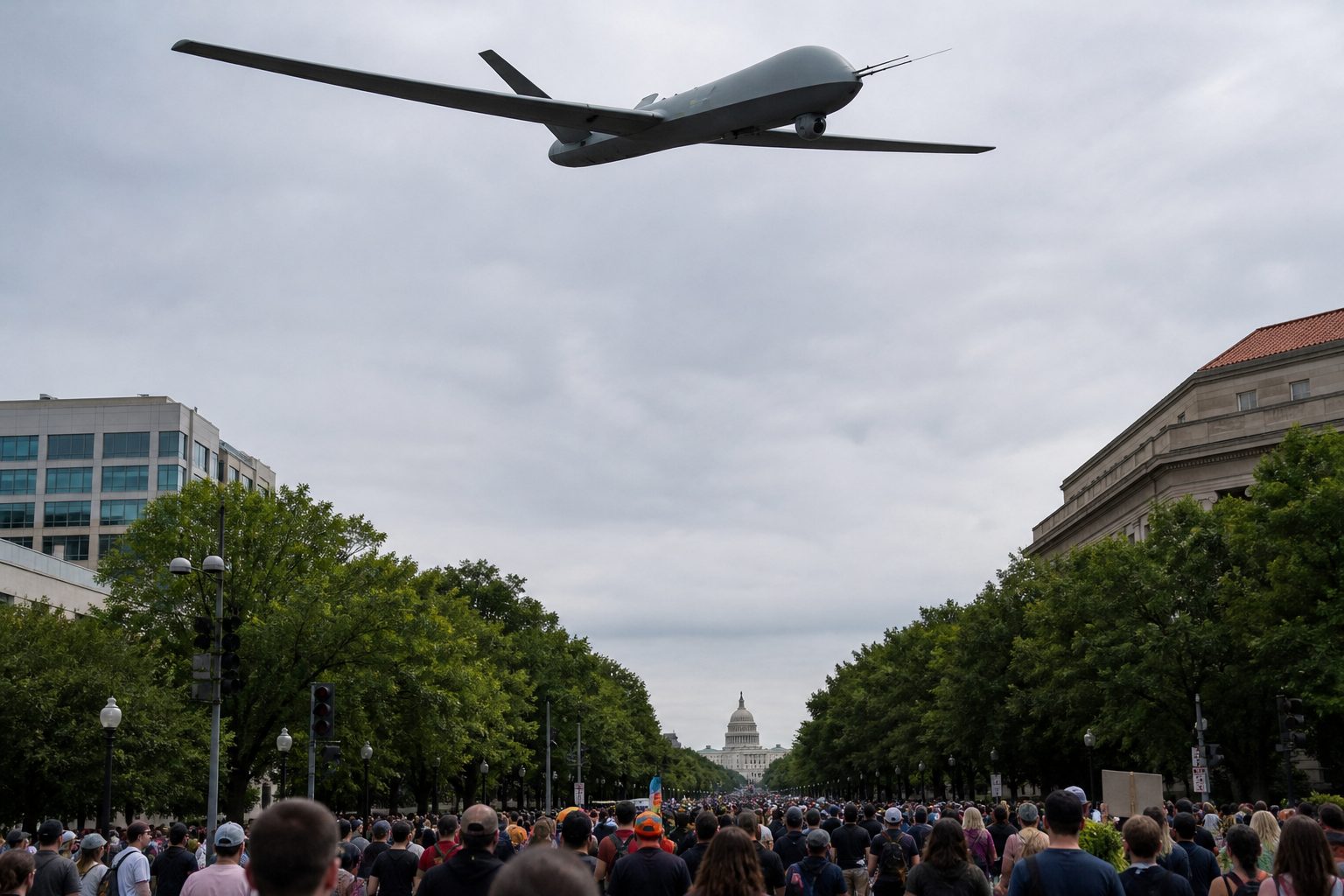 No. 77 · Oct 21, 2026Police Drones at Protests: The Tools, the Limits, the Records
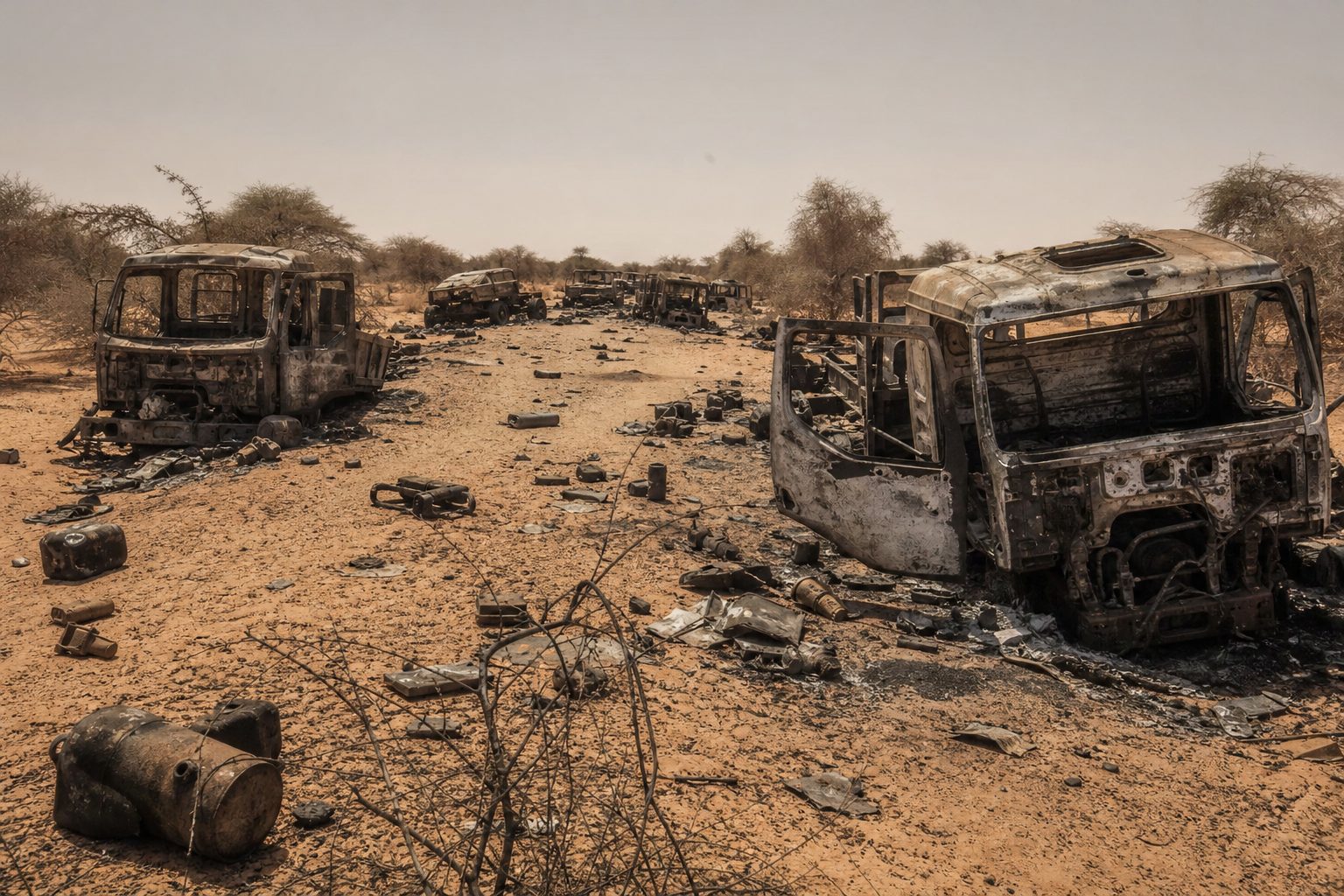 No. 65 · Oct 11, 2026Wagner's Sahel Drone War: What Three Years of Evidence Actually Show
How investigators establish time and place

Geolocation begins with details that appear ordinary: a roofline, road junction, sign, tree, traffic light, storefront, building gap, hill, shadow, or pattern of windows. Investigators compare these details with maps, satellite images, ground photographs, and other recordings.
WITNESS describes geolocation as a process of matching architectural details, road layouts, rooflines, terrain, signs, shadows, and visual anchors against independent references. (WITNESS Media Lab)
Bellingcat’s investigation of footage from the 2013 Rabaa protest in Egypt used vehicle dimensions, gaps between buildings, and a possible rooftop billboard to narrow the camera’s position within the protest camp. (Bellingcat)
Time can be tested through several independent signals:
- the upload and repost sequence;
- weather, shadows, and daylight;
- sounds of calls to prayer, traffic, or nearby events;
- public transport movements;
- construction or damage visible in the background;
- eyewitness accounts;
- contemporaneous news reporting;
- emergency-service or hospital records;
- other videos from the same location.
None of these is infallible. A video may have been recorded earlier and uploaded later. A repost may acquire a misleading caption. A witness may misremember. Weather data may fit several dates. The task is not to find one decisive clue in every case. It is to see whether separate clues converge without depending on the same original claim.
The OHCHR guidance on commissions of inquiry recommends combining eyewitness accounts with videos, photographs, medical or pathology records, official documents, satellite imagery, and other open-source material. Satellite imagery generally cannot show the incident itself, but before-and-after comparisons can establish buildings, vehicles, damage, occupation, and a defensible date range. (Office of the UN High Commissioner for Human Rights)
When a collection becomes stronger than a clip
A single video usually has a narrow field of view and a short duration. A collection can reveal sequence, movement, and contradiction.
Researchers studying deaths during the Euromaidan protests used hundreds of eyewitness videos, synchronized their timing, and compared the resulting reconstruction with witness testimony, medical reports, media accounts, and location data. The method did not make every recording reliable. It allowed investigators to compare overlapping perspectives and test competing accounts of movement and force. (Euromaidan case study)
This kind of reconstruction works because different sources fail in different ways. One camera may show a police line but not what happened behind it. Another may show the person before the confrontation. A medical record may establish an injury without showing who caused it. A satellite image may establish that a building or road existed, but not the exact moment of an assault. An official document may preserve a dispatch time while omitting actions that witnesses captured.
The goal is not to make every source tell the same story. It is to identify where the sources independently agree, where they conflict, and what each can actually establish.
This also explains why missing footage can matter without making reconstruction impossible. If a critical moment was filmed only from one position and that file disappeared before preservation, investigators may be able to establish the surrounding sequence but not the action itself. A reliable report must say so.
Who controls the evidence?

Surviving evidence is rarely held by a neutral institution. It may be controlled by a protester who faces arrest, a journalist protecting a source, a platform responding to legal demands, a police department holding seized devices, an archive with limited resources, or a researcher who has access to original files that others cannot inspect.
Control creates both practical and ethical problems. A source may have an incentive to preserve evidence that supports a political claim and ignore material that complicates it. A government may release footage selectively. A platform may disclose its removal decision without releasing the underlying content. An archive may have the files but lack the authority to republish them.
Access can also create new danger. Protest videos may identify faces, clothing, locations, vehicles, homes, organizers, or bystanders. Police may use footage to identify participants. A publication that helps establish an abuse may also expose the person who recorded it.
A guide on secure activist archives argues that protest footage should be treated as sensitive evidence rather than automatically as public cultural property. It recommends attention to surveillance, doxxing, prosecution, account compromise, subpoenas, and changing platform policies. (Open Archive)
The Digital Archiving Resources project similarly recommends shared control through explicit agreements among creators, affected communities, custodial archives, and researchers. It describes restricted, reviewable, risk-based access as a way to preserve evidentiary value without treating maximal public access as the default. (Digital Archiving Resources)
A 2026 study on sharing large video datasets proposes graduated access: metadata or low-risk derivatives first, followed by supervised viewing or restricted access to originals. It recommends clear rules for authentication, confidentiality, copying, citations, retention, and responding to new threats or creator withdrawal. (SAGE journal study)
These safeguards do not eliminate bias. They make the conditions of access visible and reduce the chance that preservation itself becomes a form of exposure.
What successful reconstruction does not prove
The existence of independent corroboration does not automatically prove a legal conclusion. It can establish that a person was present, that a weapon was fired, that a building was damaged, or that a sequence occurred at a particular place and time. It may not establish who gave an order, whether the force was lawful, or whether an official knew what happened.
Courts and commissions assess the weight of evidence under particular legal rules. Their conclusions may differ because they apply different standards, have different access to witnesses and original files, or evaluate different questions.

This is why investigators should separate several claims that are often collapsed into one:
- The video file exists.
- The preserved file is unchanged since acquisition.
- The video depicts the claimed location and approximate time.
- The event shown occurred as described.
- The people or institutions involved have been identified correctly.
- The conduct violated a law or policy.
- A particular person or institution is legally responsible.
A strong video may support the first three claims and still leave the others unresolved.
The same discipline is needed when a video is manipulated. The Meta Oversight Board’s decision concerning protest footage paired with pro-Duterte chants illustrates how a real video can be placed in a false context. Fact-checking had to examine not only the images but also the audio attribution and surrounding circumstances. (Meta Oversight Board)
A video can therefore be authentic as a file and misleading as a post.
What remedies exist when evidence is removed or seized?
Remedies depend on who restricted the evidence and on the jurisdiction involved.
For government action, possible routes can include court challenges, public-records requests, suppression motions, legislative investigations, public inquiries, professional complaints, and claims under constitutional or human-rights law. Their usefulness depends on timing. A legal remedy obtained months after a protest may not restore a deleted file or reverse harm to an exposed source.
For police seizure, the relevant records may include property inventories, incident reports, search warrants, warrant returns, custody logs, and forensic extraction records. These documents can establish what authorities took, when they took it, and whether the original device or a copy remains available. They do not guarantee that the recording was preserved correctly, which is why chain-of-custody documentation matters.
For platform removals, users may have appeals, notice-and-action procedures, transparency reports, legal-request disclosures, or access to copies stored elsewhere. These tools are uneven. A platform’s public explanation may disclose the policy category but not the internal decision, ranking effect, or material that was removed. Researchers therefore need to distinguish between evidence of a removal and evidence about the underlying content.
The broader policy problem is that commercial platforms are not dependable archives, while state archives may be inaccessible or implicated in the events being investigated. Preservation cannot be left entirely to either.
The practical response is redundancy with restraint: preserve original files when safely possible, retain later versions rather than overwriting them, record provenance, hash acquired files, document access, and limit publication of identifying material. The aim is not to make every recording public. It is to ensure that a defensible record can survive long enough for qualified investigators, courts, journalists, and affected communities to examine it.
The answer is a chain, not a single witness
When protest footage is restricted during a crisis, independent investigators can often establish more than the surviving clip alone suggests. They can trace copies, compare compression histories, locate scenes, synchronize recordings, inspect metadata, consult witnesses, examine medical and official records, and compare before-and-after satellite imagery.
But they cannot recover evidence that was never preserved. They cannot treat a platform’s removal decision as proof of falsity. They cannot turn a file’s technical integrity into proof that its caption is true. They cannot publish identifiable footage safely merely because it may be historically important.
The most reliable account is therefore a chain of evidence with visible links: where the file came from, what happened to it, how investigators tested it, which independent sources corroborate it, who controls the original, and what remains unknown.
That standard is slower than viral judgment. It is also the difference between a recording that circulates and evidence that can withstand scrutiny.
Sources and references

- WITNESS, “Ethical Guidelines for Using Videos in Human Rights Reporting and Advocacy”.
- Committee to Protect Journalists, “Know Your Rights Guide for Journalists Covering Protests in the US”, July 2024.
- Reporters Committee for Freedom of the Press, Press Rights at Protests, March 2024.
- Bellingcat Justice and Accountability Unit, “Collection Protocol”.
- Congressional Research Service, “Updated October 18, 2019”, October 18, 2019.
- Hong Kong Government, “LC Urgent Q2: Police’s Handling of Media Reporting in Demonstrations”, June 19, 2019.
- Hong Kong Government, “LCQ14: Police’s Requests for Removing Postings on Social Platforms”, December 11, 2019.
- United Nations Special Procedures, communication on Iran.
- Amnesty International, report on Turkey’s March 2025 protests, June 2025.
- Human Rights Watch, “Video Unavailable: Social Media Platforms Remove Evidence of War Crimes”, September 10, 2020.
- International Review of the Red Cross, “Freedom of Assembly Under Attack”.
- Cambridge University Press, “Facts and Where to Find Them: Empirical Research on Internet Platforms and Content Moderation”.
- GOV.UK, Forensic Science Activities: Statutory Code of Practice, Version 2.
- Scientific Working Group on Digital Evidence, Best Practices for Digital Video Authentication.
- American Bar Association, “Digital Forensics, Deepfakes, and the Legal Process”.
- United States Courts, Evidence Rules Agenda Book, 2026.
- APSIPA Transactions, “An Overview on Video Forensics”.
- “Efficient Video Integrity Analysis Through Container Characterization”, arXiv.
- WITNESS Media Lab, “When Eyewitness Footage Cannot Be Verified”.
- Bellingcat, “The Process of Video Verification: Rabaa, Egypt, August 14th 2013”.
- Office of the UN High Commissioner for Human Rights, Commissions of Inquiry and Fact-Finding Missions on International Human Rights and Humanitarian Law.
- “Reconstructing Human Rights Violations Using Large Eyewitness Video Collections: The Case of Euromaidan Protester Deaths”.
- Open Archive, Preserving Truth to Power.
- Digital Archiving Resources, “How to Preserve Change: Activist Archives & Video Preservation”.
- Golann, Bougher, Hall, and Espenshade, “Sharing Big Video Data: Ethics, Methods, and Technology”, 2026.
- Meta Oversight Board, “Protest Footage Paired With Pro-Duterte Chants”.
The reading behind this research
What the desk leaned on for this piece. Each link goes to the retailer, where the price is shown.

The article notes a seized phone can expose others pictured in it; a separate camera keeps protest footage off the device holding your chats.
View on Walmart
SanDisk 64GB iXpand™ Flash Drive Flip
The article notes phones can be seized before files are backed up; a plug-in drive copies footage off a phone with no internet connection.
View on Walmart
Samsung T7 Portable SSD 1TB Titan Gray, Up-to 1, 050MB/s, USB 3.2 Gen2 (MU-PC1T0T/AM)
The article says a seized phone can take the only copy; a fast external drive lets you copy footage off a device so it isn't the sole copy.
View on Walmart
The article notes a livestream can end before the key moment; a spare battery keeps a phone recording and uploading when its charge runs low.
View on Walmart
Joby GorillaPod Magnetic 325 Flexible Mini-Tripod
The article notes live streaming can protect the only copy; a steady phone mount makes keeping a long stream running hands-free easier.
View on WalmartPaid links. Calibre Code USA may earn a commission from purchases made through these links. This does not affect what we write or what we recommend.
Comments (7)
Continue exploring
Sorting France’s October 2026 Protest Videos: Real, Misleading, or AI-Made?
Real violence, old footage, misleading captions, and AI-generated scenes mixed together online during France’s October 2026…
Police Drones at Protests: The Tools, the Limits, the Records
From a Reaper circling Los Angeles to the 15,000-euro French fine for drone-filming protests: what police drones can actually…
Wagner's Sahel Drone War: What Three Years of Evidence Actually Show
Russian jets, Turkish drones and untested air defenses have reshaped the war in Mali, Burkina Faso and Niger since 2022, but the…
I agree that continued availability does not prove authenticity; in our newsroom, we have found that an original file’s capture time can conflict with the uploader’s claimed timeline, so we now preserve both the file and the surrounding message history.
The section on how platforms create a separate layer of uncertainty was the most useful to me. It clearly separates removal for graphic content, rights claims, moderation rules, and government requests instead of treating every disappearance as censorship. That distinction matters when interpreting a takedown notice alongside a surviving copy. I am still unsure how often platforms provide enough detail to make that comparison possible.
The distinction between a video’s disappearance and the survival of traces is fascinating—what concrete workflow would you recommend for investigators assembling phone files, screenshots, takedown notices, and witness recordings into one verified timeline?
How is a small local newsroom supposed to apply the article’s “several independent lines” standard when it has one reporter, one phone, and no forensic budget? In an intermittent shutdown, waiting for perfect metadata could mean publishing nothing while witnesses are pressured to delete files. The article needs a practical minimum standard for teams working with two imperfect clips and a few messages.
The discussion of metadata is sound, but it understates how quickly ordinary phone settings can alter it before any platform gets involved. Automatic cloud backups, screenshotting, screen recording, and messaging apps may all create legitimate copies with different timestamps and compression levels. Those differences should not automatically be treated as signs of tampering, especially when witnesses are trying to protect their identities.
The article’s emphasis on preserving provenance connects with the recent push for C2PA-style content credentials, which aim to record how media is created and altered without treating a credential alone as proof of truth.
I am not fully persuaded by the article’s suggestion that independent investigators can sometimes reconstruct events with considerable confidence. What evidence shows that these reconstructions are reliable when the missing footage may include the beginning of an encounter, the identities of participants, or the reason a platform removed a clip? A few matching videos can still reflect the same limited vantage point rather than truly independent confirmation.