
In a single week this November, Microsoft 365 faltered, the FAA suffered a system failure that disrupted air travel, JPMorgan Chase was hit by disruptions, United Airlines stalled, Apple services stumbled, and even an NSA communications network went down. The sequence was unnerving enough that, as the Council on Foreign Relations observed, it triggered fears that America was facing a coordinated cyber offensive (CFR).
On November 18, 2026, the White House answered. Director of National Intelligence Jay Clayton and National Security Adviser Marco Rubio said investigators found no indication of a coordinated cyberattack, foreign interference, state-sponsored activity, or any single malign actor behind the outages. The available explanations were technical and independent of one another: vulnerability-patching and upgrade problems, a Microsoft server issue, an FAA router failure, and software problems in financial systems (White House). Senate Intelligence Committee Vice Chair Mark Warner, a Democrat with access to classified briefings, said the same thing: no evidence connecting the incidents to a cyberattack, foreign interference, or coordinated effort (Warner statement).
That should settle it. It doesn't, quite. Because while this particular cluster of outages appears to be coincidence layered on fragility, three distinct threats behind the public's anxiety are real, documented, and growing. Foreign governments have verifiably planted themselves inside American critical infrastructure. AI tools have verifiably been used to run intrusion campaigns with minimal human labor. And influence operations have verifiably exploited these very outages to manufacture panic.
The question is not whether America is being targeted. It is. The question is by whom, how, and whether the November disruptions tell us anything about it. Here is what the evidence supports for each theory, and what it doesn't.
What actually broke in November, and why
Start with the incidents themselves, because each theory rises or falls on what investigators found.
Testifying before Congress, senior intelligence and homeland-security officials said the outages showed no common malicious signature. They attributed the incidents to software updates, aging infrastructure, misconfigurations, and cascading dependencies rather than a shared attacker (CBS News). The NSA disruption, according to reporting, was linked to emergency patches for a PHP vulnerability that had been discovered with AI assistance, meaning the defensive fix itself destabilized the system (Reuters via Investing.com).
That last detail matters more than it first appears. A second line of expert analysis holds that AI is not attacking these systems directly but is accelerating vulnerability discovery, which pressures organizations into rushed remediation and raises the probability of human and integration errors (Axios). In that reading, AI contributed to at least one outage, not as a weapon but as a destabilizing force on defense.

History supports the mundane explanation as the default. When the FAA's Notice to Air Missions system failed on January 10 and 11, 2023, triggering the first nationwide ground stop since September 11, many suspected an attack; the FAA found no evidence of a cyberattack or malicious intent (Department of Transportation), and subsequent reporting traced the failure to contractors unintentionally deleting files in a system that mixed newer software with aging infrastructure (Washington Post). When AT&T's wireless network collapsed nationwide on February 22, 2024, the cause was a misconfigured network element introduced during routine maintenance (ABC News); the FCC found the error propagated through downstream systems, triggered automated protective shutdowns, blocked more than 92 million calls, and affected over 25,000 attempted 911 calls (FCC).
But the historical record also includes the opposite case. In November 2023, a LockBit ransomware attack struck the U.S. broker-dealer arm of China's largest bank, disrupting communications and leaving more than $9 billion in Treasury-backed trades without corresponding settlement funds (U.S. Treasury). The Financial Stability Oversight Council flagged a detail that should worry anyone reassured by the November 2026 statements: escalation to the financial sector's core incident-response group began nearly 12 hours after the attack started affecting processing (FSOC 2023 Annual Report). Real attacks happen, and recognizing them quickly is not guaranteed.
So the November outages, on current evidence, were unconnected technical failures. The three theories are about what else is happening in the background. Each has a different enemy, a different motive, and a different evidentiary standing.
Theory 1: Foreign governments are already inside the walls
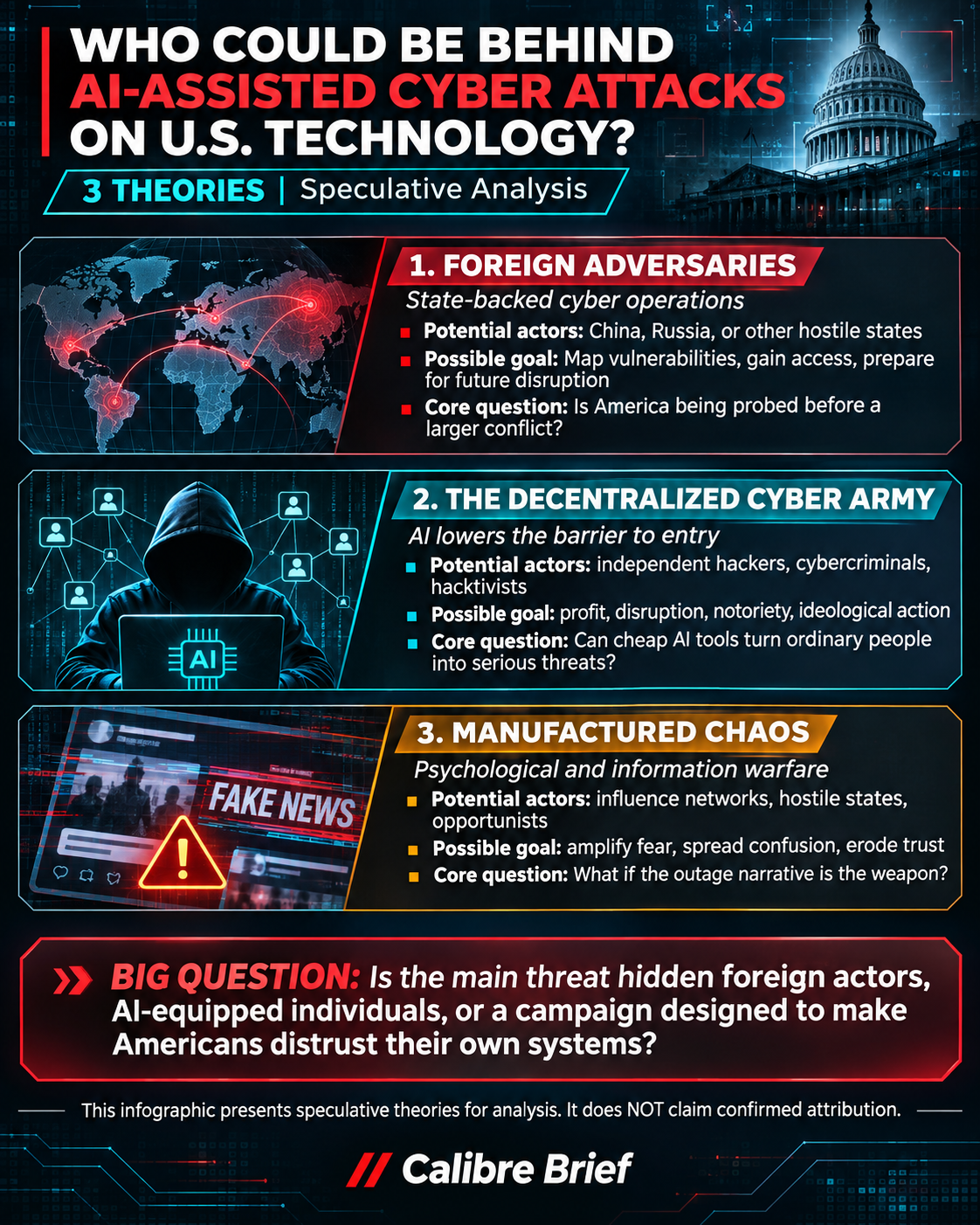
This theory is not speculation. It is the subject of some of the most alarming official advisories the U.S. government has ever published about peacetime cyber activity.
In May 2023, the NSA and partner agencies publicly documented that a China state-sponsored actor, known as Volt Typhoon, was targeting U.S. critical-infrastructure networks using "living off the land" techniques: operating through legitimate built-in administrative tools rather than malware, which makes the activity far harder to detect (NSA). A February 2024 joint advisory from CISA, the NSA, and the FBI went further. It found Volt Typhoon embedded in communications, energy, transportation, and water systems, and assessed that the access was intended to enable movement toward operational technology and possible disruption during a major U.S.–China crisis, not ordinary espionage (CISA joint advisory). The agencies emphasized targeting of both continental U.S. networks and territorial ones, including Guam, the hub of American military power in the western Pacific (NSA).
Translated from advisory language: a foreign state-sponsored actor spent years quietly establishing positions inside the systems that move America's water, power, and transportation, and the U.S. government's assessment is that the purpose is to be able to turn things off during a conflict.
A separate China-linked campaign, Salt Typhoon, pursued a different objective. Attackers compromised telecommunications providers' networks, backbone routers, and trusted inter-provider connections to sustain long-term access for espionage (CISA). The Director of National Intelligence's 2025 threat assessment described China as developing cyber capabilities for stealing sensitive information while pre-positioning asymmetric options that could be used during conflict, explicitly citing Salt Typhoon (ODNI).
Russia belongs in this theory too. The FBI has documented Russian government cyber actors conducting reconnaissance of industrial-control-system protocols and applications, indicating interest in environments where digital access could produce physical effects. The warning signs the FBI lists are telling: unexplained authentication activity, anomalous administrator behavior, unusual remote access, and unexplained equipment or service failures (FBI). Foreign operators, the bureau notes, seek durable covert access through internet-facing vulnerabilities, stolen credentials, compromised routers, and legitimate administrative tools, while avoiding detectable malware (FBI).
Where does AI fit? The Government Accountability Office warns that AI can make cyberattacks more adaptive, efficient, harder to detect, and better at identifying weaknesses in high-impact systems (GAO). And in November 2025, Anthropic disclosed what it assessed as a Chinese state-sponsored espionage campaign that used its Claude Code tool against roughly 30 entities, including technology firms, financial institutions, chemical manufacturers, and government agencies (Anthropic). Anthropic's full report assessed that the AI performed approximately 80 to 90 percent of tactical operations, including vulnerability discovery, exploitation, lateral movement, credential theft, and exfiltration, with humans mainly selecting targets and providing intermittent direction (Anthropic full report).
What the theory explains: verified, sustained, state-directed pre-positioning inside American infrastructure, with AI beginning to augment the tradecraft.

What it does not explain: the November 2026 outages. The signature of Volt Typhoon-style operations is silence. An actor whose entire strategy depends on remaining undetected until a crisis gains nothing from a noisy week of consumer-facing disruptions, and investigators found no attacker's fingerprints on these incidents. The honest statement is uncomfortable in a different way: the most dangerous adversary is the one you would not notice, and the FBI's own list of warning signs includes "unexplained equipment or service failures." That is why unexplained outages deserve investigation. It is not evidence that any particular outage was an attack.
Where this story sits
5 related pieces
Read it →
Hover a story · click to read
 No. 106 · Nov 16, 2026Are We Being Lied To? America's Cybersecurity Crisis and the Threats Hiding in Plain Sight
 No. 91 · Nov 5, 2026Three Elections, Three Continents, One Message: Can Governments Win Back Trust?
 No. 63 · Oct 7, 2026After the Indictment: Three Years of Named Cyber Attributions, Measured
 No. 107 · Nov 16, 2026What November's Bank Outages Reveal About America's Digital Financial Plumbing
 No. 103 · Nov 16, 2026No Hackers Required: The Week America's Critical Systems Started Failing
Theory 2: A decentralized cyber army armed with AI
The second theory swaps the enemy. Not a state, but anyone: criminals, hacktivists, or lone operators who could never have threatened a major institution before, now equipped with AI agents that do the skilled labor for them.
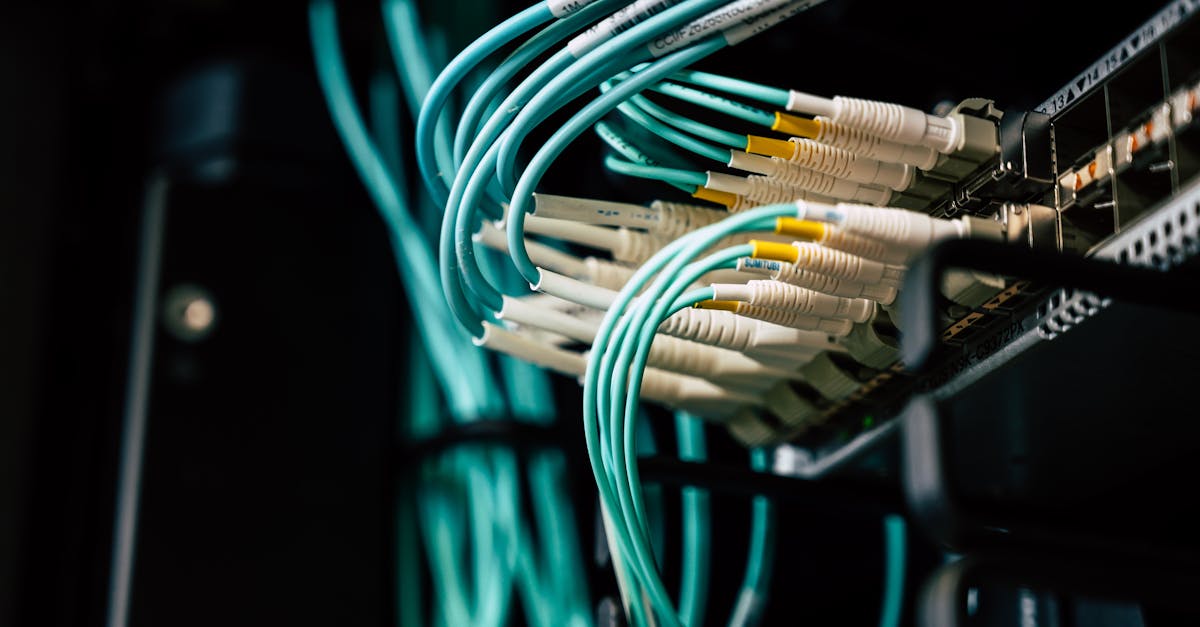
The capability evidence has been building for two years. Academic research published in 2024 established that large language model agents could autonomously discover and exploit web vulnerabilities, though the open-source models tested generally underperformed GPT-4 (arXiv). By December 2024, the open-source HackSynth framework demonstrated autonomous penetration-testing workflows with both proprietary and open models, though its evidence remained benchmark- and lab-based rather than operational (arXiv).
Then the lab results met the real world. In August 2025, Anthropic reported disrupting a data-extortion campaign in which a criminal operator used Claude Code to automate reconnaissance, credential harvesting, network intrusion, data selection, and even ransom-note generation against at least 17 organizations, reportedly including healthcare providers, emergency services, government bodies, and religious institutions, with demanded payments sometimes exceeding $500,000 (Anthropic). OpenAI, meanwhile, identified Russian-speaking criminal operators using ChatGPT to develop malware loaders, remote-access trojans, credential stealers, evasion mechanisms, and command-and-control infrastructure (OpenAI).
The GAO added an unsettling data point of its own: in covert testing, major generative-AI platforms produced feasible information for planning attacks against targets including the electrical grid, demonstrating practical planning capability even without autonomous execution (GAO).
So the barrier to entry has genuinely dropped. But by how much? Here the evidence urges restraint.
Anthropic's own investigation of the espionage campaign found that the model frequently hallucinated results, overstated its discoveries, and claimed to have obtained credentials that did not actually work (Anthropic full report). Independent security researchers questioned the "90 percent autonomous" framing altogether, arguing that human operators supplied the goals and orchestration while the model executed bounded tasks (Ars Technica). The Center for Strategic and International Studies draws the same distinction across the field: fully autonomous AI-directed attacks remain largely aspirational, while the nearer-term and very real risk is AI improving reconnaissance, phishing, vulnerability discovery, and other established techniques (CSIS).
What the theory explains: a documented, accelerating shift in who can mount serious intrusion campaigns. The extortion case is the template: one operator, AI doing the work of a team.
What it does not explain: the November outages, again. Criminals who breach banks and hospitals announce themselves with ransom demands, data leaks, or extortion. None of the November incidents produced any, and fact-checkers found no evidence that AI-driven attacks caused this outage cluster, even while judging AI-assisted cyberwarfare a genuine strategic danger (PolitiFact). The "AI cyber army" remains, on current evidence, AI-assisted humans rather than autonomous digital weapons. The distinction matters because it defines the defense: the attacks still follow human patterns, use human infrastructure, and make AI-characteristic mistakes.
Theory 3: Manufactured chaos, where the attack is on your perception

The third theory requires no breach at all. In this version, adversaries do not cause the outages. They exploit them, amplifying unrelated failures into the appearance of a coordinated national attack, because frightened citizens who distrust their institutions are themselves a strategic outcome.
This is the one theory for which the November 2026 incidents provide direct evidence.
As the outages unfolded, online narratives asserted that artificial intelligence, foreign governments, emergency-alert tests, and preparations for a nationwide blackout were all connected. NBC Chicago documented a surge of AI-generated "doomsday" videos flooding social media, and researchers warned that convincing synthetic content makes rumors hard to distinguish from genuine reporting (NBC Chicago). Stateline reported that the outages, combined with emergency-alert activity, became raw material for doomsday conspiracy theories (Stateline).
Then came the amplification data. An analysis reported by Axios found that suspected bots made up approximately 31 percent of conspiracy-related posts about a Bank of America outage and 28 percent of posts linking Chase's disruption to the other incidents. The analysis detected some foreign-influence activity but could not determine how many accounts were operated by foreign governments or state media (Axios).
Read that carefully, because the uncertainty is the finding. In the post categories measured, those tied to the bank outages, roughly three in ten conspiracy posts came from suspected automated accounts. Some foreign-influence activity was present. But whether this was a directed state operation, opportunistic engagement farming, or some mix of both is unresolved. Calling it a coordinated foreign psychological-warfare campaign would outrun the evidence. Calling it organic public anxiety would understate it.
The psychology does half the work regardless of who runs the bots. Fact-checkers noted that temporal proximity does not establish causation, yet a rapid sequence of disruptions makes a single hidden explanation feel psychologically compelling (PolitiFact). Humans are pattern-seeking; a week of coincidences looks like a plot. Bots and synthetic video simply pour fuel on a fire the brain has already lit.
What the theory explains: the gap between what investigators found (unrelated technical failures) and what millions of people came to believe (a coordinated attack). That gap was actively widened by automated amplification and AI-generated content.
What it does not explain, yet: who benefits and who directed it. Attribution of influence operations is as hard as attribution of intrusions. The Congressional Research Service notes that investigators must correlate malware, infrastructure, tradecraft, targeting, intent, and intelligence from multiple sources before naming an actor (CRS). The honest status of Theory 3 is: the manufactured-chaos mechanism demonstrably operated in November 2026; its authorship remains undetermined.
So which theory is true?
All three, in different senses, and none of them in the sense the November panic assumed.

The outage wave itself was, on all publicly available evidence, a cluster of independent technical failures hitting a brittle, interdependent system (White House; CBS News). The most defensible AI connection runs through defense, not offense: AI-accelerated vulnerability discovery pushing organizations into rushed patches that break things (Axios; Reuters via Investing.com).
But dismissing the public's underlying fear as mere conspiracy thinking would be its own mistake, because each theory describes a verified threat:
- Foreign states are inside American infrastructure. Volt Typhoon's pre-positioning in energy, water, communications, and transportation systems is established by joint government advisories, and its assessed purpose is disruption during a future crisis (CISA). This threat is real and patient, and its defining feature is that it will not look like anything until the day it does.
- AI has lowered the barrier for non-state attackers. One operator ran an extortion campaign against at least 17 organizations with an AI agent doing most of the technical work (Anthropic). The agents are flawed, human-steered, and prone to hallucination (Ars Technica), but the trajectory is one-directional.
- The perception layer is now a battlefield. Whatever their origin, automated accounts measurably amplified the belief that America was under coordinated attack when it was not (Axios).
Which leaves the unsettling possibility from the start of this article partially vindicated, just not in the expected way. The hypothetical asked whether America's next cyberwar might already be underway without anyone recognizing it. For Theory 1, that is literally the design of the threat: access that stays invisible until activated. For Theory 3, the inverse occurred in plain sight: a cyberattack that never happened was made to feel real to millions of people.
The practical lesson sits in the FAA and AT&T case files. Aging systems, deleted files, and botched configuration changes have repeatedly produced nationwide disruptions that initially looked like attacks (Washington Post; FCC). Every one of those failures does double damage: the outage itself, and the erosion of the public's ability to tell an accident from an act of war. A country whose infrastructure fails often enough, loudly enough, hands its adversaries a propaganda weapon they did not have to build.
America's real exposure, as of today, is the combination: genuinely fragile systems, genuinely embedded foreign actors, genuinely proliferating AI attack tools, and an information environment where nobody can be sure which of those is responsible for the screen that just went dark. The enemies are real. The confusion about which one is acting at any given moment may be the most exploitable vulnerability of all.
Sources / References

- Council on Foreign Relations, "The Real Reason Why Everything Seems to Be Crashing" — https://www.cfr.org/articles/the-real-reason-why-everything-is-crashing
- The White House, "'No Indication of a Cyberattack': DNI Clayton and Secretary Rubio on Recent Tech Outages," Nov. 18, 2026 — https://www.whitehouse.gov/releases/2026/11/no-indication-of-a-cyberattack-dni-clayton-and-secretary-rubio-on-recent-tech-outages/
- Sen. Mark Warner, "Senate Intel Vice Chair Warner Statement on Network Outages" — https://www.warner.senate.gov/newsroom/press-releases/senate-intel-vice-chair-warner-statement-on-network-outages/
- CBS News, "'No indication' recent outages are related to coordinated cyberattacks, officials say" — https://www.cbsnews.com/news/network-outages-cyber-malicious-activity-homeland-security-hearing/
- Reuters (via Investing.com), "Tech outage wave reaches US government; Trump says all is 'fine'" — https://www.investing.com/news/world-news/trump-shrugs-off-spate-of-usoutages-says-things-like-that-happen-5032857
- Axios, "Tech outages tied to AI patching, Twenty co-founder says," Nov. 19, 2026 — https://www.axios.com/2026/11/19/twenty-future-of-defense-axios-cyber-threats-joe-lin
- NSA, "NSA and Partners Identify China State-Sponsored Cyber Actor Using Built-in Network Tools When Targeting U.S. Critical Infrastructure Sectors," May 2023 — https://www.nsa.gov/Press-Room/Press-Releases-Statements/Press-Release-View/Article/3406058/
- CISA/NSA/FBI, Joint Cybersecurity Advisory AA24-038A on PRC state-sponsored compromise of U.S. critical infrastructure, Feb. 2024 — https://www.cisa.gov/sites/default/files/2024-02/aa24-038a-jcsa-prc-state-sponsored-actors-compromise-us-critical-infrastructure_1.pdf
- NSA, "NSA and Partners Spotlight People's Republic of China Targeting of U.S. Critical Infrastructure" — https://www.nsa.gov/serve-from-netstorage/press-room/Press-Releases-Statements/Press-Release-View/Article/3669141/
- CISA, Joint Cybersecurity Advisory on countering China state actors' compromise of networks (Salt Typhoon), Aug. 2025 — https://www.cisa.gov/sites/default/files/2025-08/CSA_COUNTERING_CHINA_STATE_ACTORS_COMPROMISE_OF_NETWORKS.pdf
- ODNI, DNI opening statement on the 2025 Annual Threat Assessment — https://www.odni.gov/3524/dni-gabbard-opening-statement-ssci/
- FBI, "Russian Government Cyber Actors Targeting Networking Devices, Critical Infrastructure" — https://www.fbi.gov/investigate/cyber/alerts/2025/russian-government-cyber-actors-targeting-networking-devices-critical-infrastructure
- FBI, "Russian Government Employees Charged in Hacking Campaigns" — https://www.fbi.gov/news/stories/russian-government-employees-charged-in-hacking-campaigns-032421
- GAO, "AI and Cybersecurity: Technologies Can Magnify Cyberattacks and Enhance Cyber Defense" (GAO-27-108458) — https://www.gao.gov/assets/gao-27-108458.pdf
- GAO, "Artificial Intelligence: Covert Testing Used Common Platforms to Create Viable Attack Plans" (GAO-27-108814) — https://www.gao.gov/assets/gao-27-108814.pdf
- Fang et al., "LLM Agents can Autonomously Hack Websites," arXiv, 2024 — https://arxiv.org/abs/2402.06664
- "HackSynth: LLM Agent and Evaluation Framework for Autonomous Penetration Testing," arXiv, Dec. 2024 — https://arxiv.org/abs/2412.01778
- Anthropic, "Detecting and countering misuse of AI: August 2025" — https://www.anthropic.com/news/detecting-countering-misuse-aug-2025
- Anthropic, "Disrupting an AI-orchestrated cyber espionage campaign," Nov. 2025 — https://www.anthropic.com/news/disrupting-AI-espionage
- Anthropic, full report, "Disrupting the first reported AI-orchestrated cyber espionage campaign" — https://www-cdn.anthropic.com/d7dd50dd1185f59be051
The reading behind this research
What the desk leaned on for this piece. Each link goes to the retailer, where the price is shown.

Jackery Explorer 300 Portable Power Station
The article blames outages on aging infrastructure and cascading failures; a charged backup keeps phones and lights on when the grid is next.
View on Walmart
When Microsoft 365 and Apple services both stumbled in one week, an offline copy of your files was the only kind that stayed reachable.
View on Walmart
TP-Link Archer AX1500 4 Stream Dual-Band Wi-Fi 6 Wireless Router
The article pins one outage on a plain FAA router failure and aging gear, a reminder that old home routers fail quietly too and are worth replacing.
View on Walmart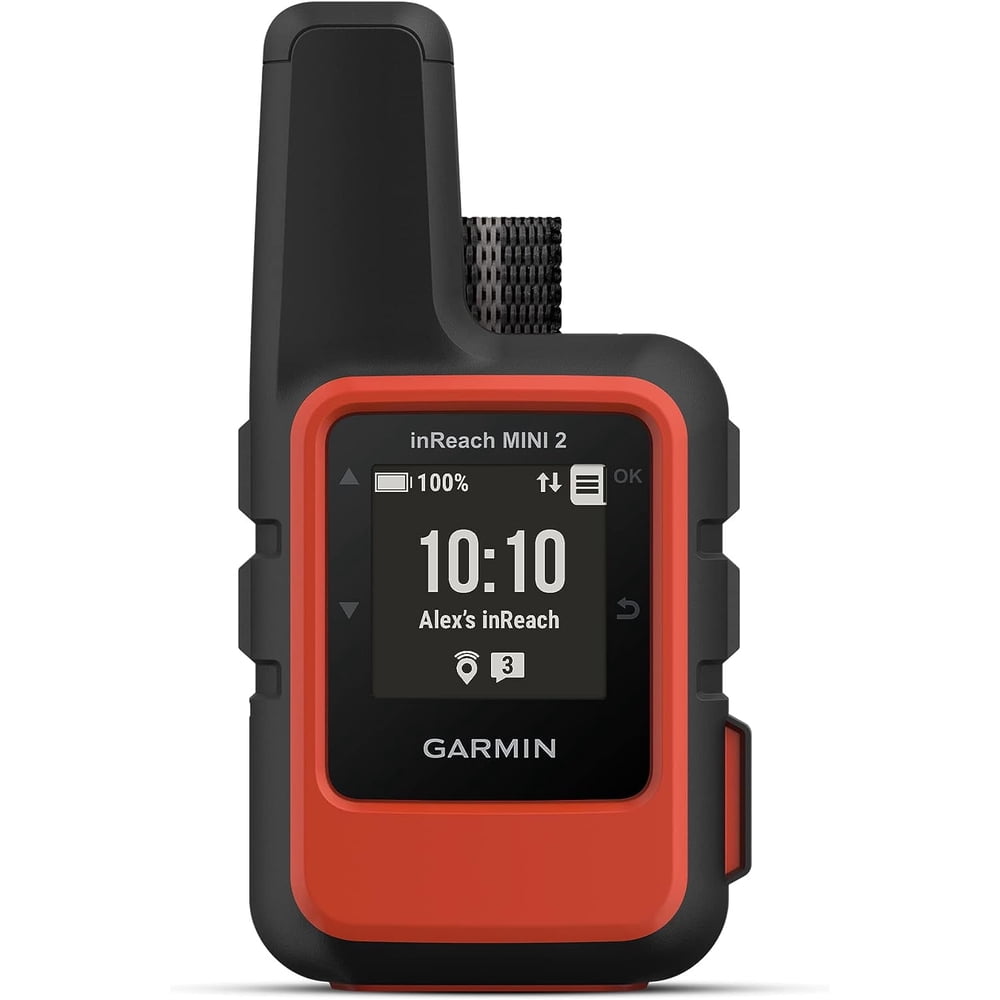
Garmin inReach Mini 2 Satellite Communicator
When the AT&T outage blocked 92 million calls and 25,000 attempts to reach 911, a satellite link that skips cell towers would still have worked.
View on Walmart
AT&T Prepaid® Combo Physical SIM & eSIM Kit
The 2024 outage the article cites, which blocked 92 million calls, shows why a cheap second line on a different carrier than your main one can help.
View on Walmart
This Is How They Tell Me the World Ends by Nicole Perlroth
Explains the market for software flaws behind the article's point that foreign governments have planted themselves inside U.S. infrastructure.
View on WalmartPaid links. Calibre Code USA may earn a commission from purchases made through these links. This does not affect what we write or what we recommend.
Comments (2)
Continue exploring
After the Indictment: Three Years of Named Cyber Attributions, Measured
Named indictments from LockBit to Lumma have not delayed the next attack; the data shows faster rebuilds, leaner crews, and a…
What November's Bank Outages Reveal About America's Digital Financial Plumbing
Major U.S. banks suffered simultaneous access failures on November 16, 2026; the evidence shows no cyberattack or systemic…
No Hackers Required: The Week America's Critical Systems Started Failing
In the second week of November 2026, five separate pieces of digital infrastructure failed within seven days. GitHub stalled…
At a regional hospital where I worked, an outage first blamed on a faulty software update turned out to involve stolen credentials and ransomware. It was not a misconfiguration, and the initial “routine failure” explanation delayed containment, so the article’s claim that mundane causes are the default feels too reassuring in practice.
I wonder how the article’s point about AI-driven vulnerability discovery and rushed patching applies to a small team without dedicated security staff. Would fewer systems reduce the risk, or would limited review capacity make a destabilizing fix like the PHP patch even more likely?