
On November 17, 2026, CNN reported something the National Security Agency almost never allows the public to learn: NSA Net, the agency's highly classified internal communications network, was down. Six people familiar with the matter described the network as inoperable. The sources said there was no evidence of a cyberattack, and the agency had not publicly identified a cause, confirmed how long the disruption would last, or said whether it was related to anything else that had gone wrong that week (CNN, Nov. 17, 2026).
That last question matters, because a great deal had gone wrong that week. Four days earlier, the Federal Aviation Administration ordered a nationwide ground stop, halting flights across the country after a communications meltdown at its en-route control centers. The day before that, Microsoft suffered a roughly 24-hour global outage across Outlook, Teams, and its other cloud services. The Associated Press summarized the stretch bluntly: separate failures in aviation, cloud software, banking, and airline operations within days of one another, with officials unable to establish a common cause (AP).
So the question readers are actually asking deserves a direct answer attempt: if the agency responsible for America's most sensitive electronic intelligence cannot keep its own network running, how fragile is everything else, and is the public being told enough to judge?
The honest answer, based on what can be verified today, is uncomfortable in a different way than the conspiracy-minded version. There is no public evidence connecting these failures to each other or to an attack. There is, however, years of documented government evidence that the infrastructure underneath American national security has been aging toward exactly this kind of week.
What actually happened to NSA Net
Start with what is established, because for this incident it is a short list.
CNN's reporting, attributed to six people familiar with the matter, establishes that NSA Net was inoperable as of November 17 and that sources saw no evidence of a cyberattack (CNN). The outage's duration, technical scope, and operational consequences remained unclear in the available reporting. Public reporting does not establish whether the disruption was confined to NSA headquarters at Fort Meade, affected multiple facilities, or impaired intelligence collection and processing rather than only internal messaging (reporting summary).
The NSA itself has said nothing. As of this writing, the agency's public press-release index contains no statement explaining the outage or announcing restoration (NSA Press Room). No authoritative restoration time can be confirmed from public sources.
Everything beyond that, including when exactly the failure began, what component failed, and whether analysts lost access to intelligence databases or merely to email, is currently unknown to the public. That gap is worth holding onto, because it shapes every judgment that follows.
What is NSA Net, and why does a single network matter so much?
NSA Net is not the agency's public website, and it is not the ordinary internet. It is the NSA's classified internal network, used by agency personnel to communicate classified information (NSA/DOJ legal authorities document). Defense Department budget documents have described NSA Net as supporting access to mission-critical intelligence databases, message sets, voice, facsimile, and digital traffic (DoD Comptroller). Federal court records likewise identify it as one of the intelligence community's classified records systems (U.S. District Court, D.D.C.).
In plain terms: it is the plumbing through which much of the NSA's daily classified work flows. Whether an outage of that plumbing is an inconvenience or a crisis depends entirely on which of those functions failed and for how long, and that is precisely what has not been disclosed. If only internal messaging went down, the operational consequence may be modest. If access to mission databases or the processing of intelligence traffic was interrupted, the consequence is categorically different. The public record does not yet distinguish between those scenarios.
This has happened before, and the NSA eventually explained it
The strongest reason to resist both panic and complacency is that there is a precedent with a documented ending.

From January 24 to January 28, 2000, the NSA suffered a network outage that the agency later described, in a declassified document, as a 72-hour disruption to intelligence processing attributed to a software anomaly (NSA declassified document). Contemporaneous reporting in The Washington Post said engineers traced that failure to an outdated routing protocol, with NSA systems strained by operational demands (Washington Post).
Two lessons from 2000 apply directly now. First, the world's premier signals-intelligence agency has gone dark before for mundane technical reasons, not because of an adversary. Second, even in that case, intelligence processing, the agency's core function, was interrupted for three days. A boring cause does not mean a harmless outcome.
The 2000 incident also sets a disclosure benchmark. The agency eventually acknowledged the failure and characterized its cause. The question for 2026 is whether it will do so again, and how quickly.
Where this story sits
5 related pieces
Read it →
Hover a story · click to read
 No. 107 · Nov 16, 2026What November's Bank Outages Reveal About America's Digital Financial Plumbing
 No. 100 · Nov 14, 2026When Microsoft Went Dark: How One Network Failure Disrupted the World
 No. 99 · Nov 13, 2026America's Skies Shut Down: The Communications Failure That Grounded a Nation
 No. 103 · Nov 16, 2026No Hackers Required: The Week America's Critical Systems Started Failing
 No. 112 · Nov 21, 2026Banned on Paper. Still Plugged Into America.
Is the NSA outage connected to the FAA, Microsoft, and the rest of the bad week?

This is the question driving public anxiety, so it deserves a careful look at each incident on its own evidence.
The FAA ground stop had a specific, documented mechanism
On November 13, the FAA imposed a nationwide ground stop after communications problems hit multiple Air Route Traffic Control Centers (FAA statement). The agency's own explanation is unusually concrete: legacy telecommunications equipment became unstable after data flooded its network at roughly 1,000 connection attempts every four to five seconds (FAA Q&A). The surge affected communications and radar feeds at 17 of 22 en-route control centers and forced the cancellation of approximately 12,462 flights (AP).
Investigators focused on newly installed routers at an Arkansas facility, with the FAA, its contractor L3Harris, and federal officials continuing to examine the failure (Axios). CBS reported that investigators were also examining Cisco 600-series routers dating from 2001 to 2006 and an obsolete FAA telecommunications network built on older TDM technology, a circuit-based transmission standard that long predates modern networking (CBS News).
Microsoft's outage had its own explanation
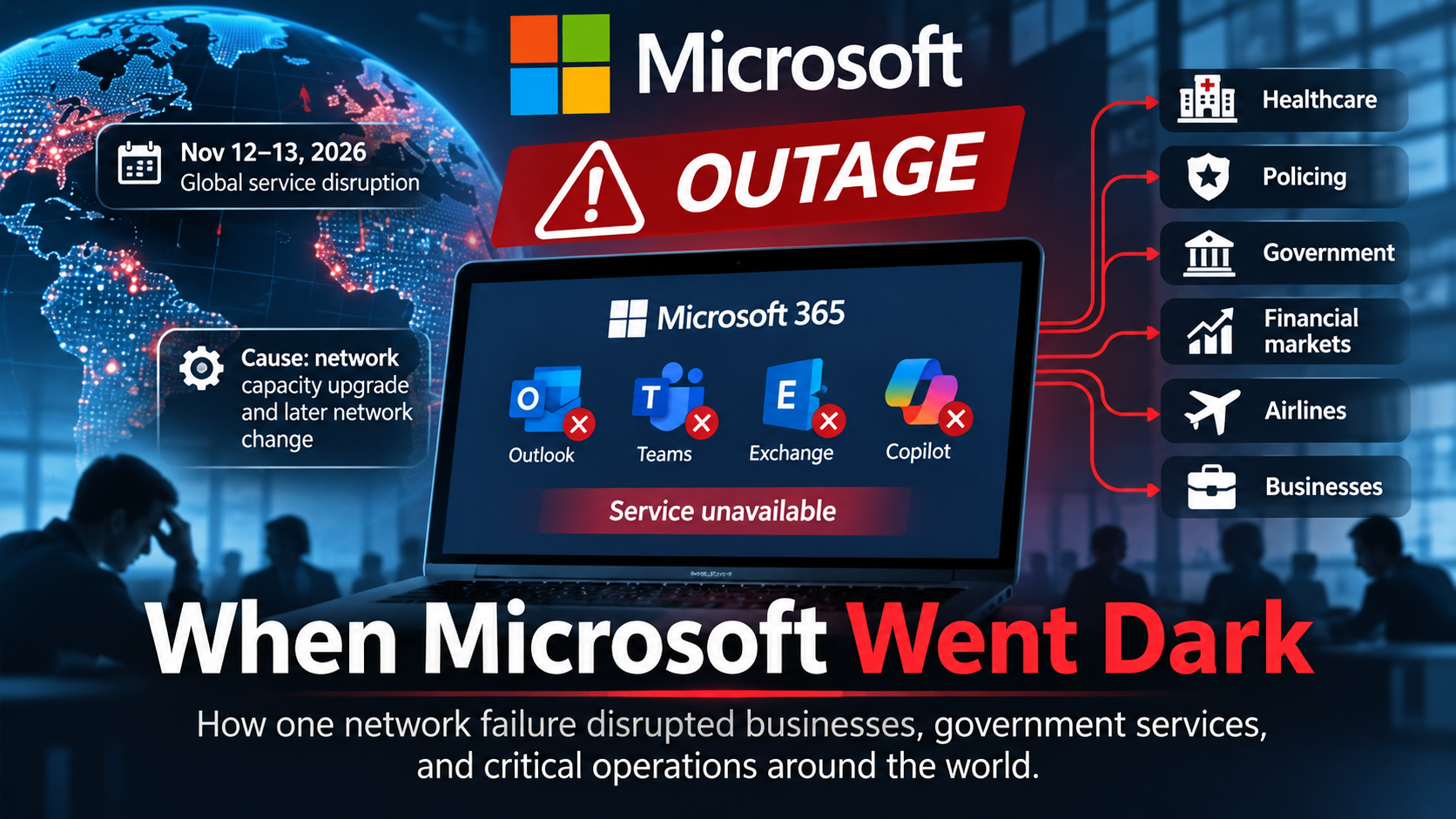
Microsoft's November 12 to 13 outage knocked Outlook, Teams, Copilot, and other Microsoft 365 services offline worldwide for about 24 hours. Microsoft reported no evidence of malicious activity (Windows Central), and available reporting attributes the disruption to overloaded or unavailable backend infrastructure during an upgrade, not to anything involving the NSA (Microsoft Q&A).
What the evidence does and does not show
Each incident with a public explanation points to a different internal failure: a flood of connection attempts destabilizing decades-old FAA telecom equipment; a Microsoft backend failure during an upgrade. The same week also produced trouble in banking and airline operations, but officials have not established a common cause across any of these events (AP). No publicly available evidence links the NSA outage to any of them, and classified networks such as NSA Net are designed to operate separately from the public internet infrastructure the other incidents involved.
That is not proof of independence. It is an absence of evidence of connection, which is a weaker statement, and officials investigating the FAA failure were still, days later, unwilling to call their own investigation closed. But as of today, the "coordinated attack" theory has zero confirmed technical evidence behind it, while the "aging systems failing separately" theory has specific documented mechanisms behind at least two of the incidents.
What officials have said, and where their statements collide
If the technical picture is incomplete, the official messaging has at times been contradictory, and the contradictions are worth stating precisely rather than dramatizing.

On the day of the ground stop, DHS Secretary Markwayne Mullin first said officials had no indication of a "nefarious" attack but could not rule out a cyberattack or artificial-intelligence involvement (ABC News). At a later White House briefing, Mullin said there was "zero evidence" of a cyberattack and characterized the problem as mechanically driven (White House).
Those two statements are not strictly incompatible. "We cannot rule it out" and "we have found zero evidence" can both be true at different stages of an investigation. But the shift in confidence came fast, and it came while the root cause was still unknown. Transportation Secretary Sean Duffy told ABC on November 15 that officials still lacked the root cause and were investigating with the FAA, the FBI, and L3Harris, even as the administration's public attribution to legacy equipment grew more definite (ABC, This Week transcript).
The White House said the NSA, CISA, the FBI, and the Office of the Director of National Intelligence participated in a whole-of-government call on the aviation failure. Yet no publicly released NSA or Pentagon statement has supplied an independent technical explanation of that incident, and the NSA has released nothing at all about its own (ABC transcript; NSA Press Room).
The pattern that emerges is not evidence of a cover-up. It is evidence of officials expressing more certainty in public than their own investigators possessed, which corrodes trust in exactly the moment trust is most needed.
What would actually prove a cyberattack?

Since the question hangs over every incident this week, it is worth defining the evidentiary bar, because "could be an attack" is a statement that is always technically true and almost never useful.
Establishing a coordinated cyberattack across these incidents would require some combination of: forensic artifacts such as malware, unauthorized access logs, or manipulated configurations recovered from the affected systems; a demonstrated technical dependency linking the failed systems; attribution evidence tying intrusions to a common actor; or an official finding from the investigating agencies, which in the FAA's case officials said include the FBI.
None of that exists in the public record for any of these incidents. The FAA has described an internal traffic-flood mechanism. Microsoft reported no malicious activity. CNN's sources on the NSA outage reported no evidence of a cyberattack. Mullin's early hedge about artificial intelligence was never supported by any disclosed finding.
What does exist in the public record is something different, and arguably more damning in slow motion.
The warnings were already in writing
The Government Accountability Office, Congress's audit arm, has spent years documenting the condition of the infrastructure underneath American national security. Its findings describe a systemic resilience problem spanning intelligence facilities, enterprise networks, utilities, and legacy IT rather than any single weak network.
At the Joint Intelligence Analysis Complex at RAF Molesworth in England, which supports U.S. European Command and Africa Command, GAO found original electrical and mechanical infrastructure 25 years old and beyond its intended design life. Officials reported that unanticipated power and cooling failures caused frequent analyst downtime, wasted thousands of personnel hours, and exposed the two combatant commands to intelligence blackouts. In one incident, a roof leak reached a power-distribution panel, caused a fire, disabled heating, ventilation, air conditioning, and sewage systems, and disrupted roughly 200 personnel for an estimated 30 hours (GAO-16-853).
Across Defense Department-owned utility systems, GAO identified 4,393 equipment-failure disruptions from fiscal years 2009 through 2015, with contributing factors including equipment operating beyond its intended life, poor condition, and inadequate maintenance. Those disruptions produced more than $29 million in reported financial impacts, including a week-long operational shutdown at one Army facility (GAO-17-27).

More recently, GAO warned that critical decades-old federal legacy systems can contain known vulnerabilities, unsupported hardware or software, and failure risks capable of interrupting operations (GAO-25-107795).
Read against that record, a week in which investigators probing a nationwide grounding were examining routers from the early 2000s, and in which a classified intelligence network went dark, looks less like an anomaly and more like an audit finding arriving in real time. Whether NSA Net's failure specifically fits this pattern is unknown, but the pattern itself is not speculative. It is documented, repeatedly, by the government's own auditors.
What can stay classified, and what the public is owed
No reasonable person expects the NSA to publish a network diagram of NSA Net or a forensic timeline of a classified system. The technical architecture, the specific missions affected, and the detailed vulnerabilities legitimately remain secret; disclosing them would hand adversaries a map.
But the 2000 precedent shows that acknowledgment and characterization are possible without compromising sources and methods. The agency eventually confirmed that outage, described its duration, and attributed it to a software anomaly. The equivalent today would be modest: confirm whether an outage occurred, state whether there is evidence of malicious activity, indicate whether core intelligence functions were maintained through backup means, and commit to congressional oversight review.
That last point matters because continuity is not optional for this agency. An organization whose mission includes warning the country of attack must be able to operate through its own failures. Whether NSA Net's backup communications and continuity-of-operations procedures worked as designed, or whether they were tested and found wanting, is exactly the kind of question the House and Senate intelligence committees exist to answer behind closed doors, with an unclassified summary owed to the public. As of now, there is no public evidence either way: no evidence that safeguards failed, and no evidence that they worked.
A fragile week, honestly measured
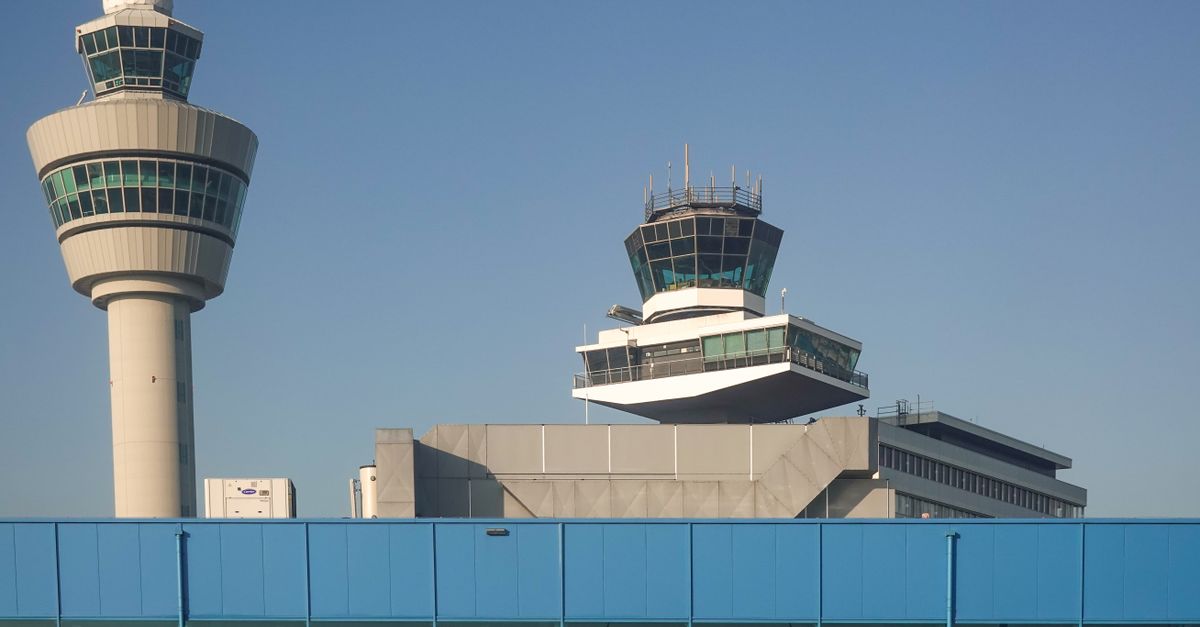
Strip away the speculation and the week of November 12 to 17, 2026 looks like this. A global cloud provider failed for a day during an upgrade. The national airspace shut down because a flood of data destabilized legacy telecommunications equipment, with investigators examining routers dating from 2001 to 2006. Banking and airline operations stumbled separately. And the National Security Agency's classified network went down for reasons nobody outside the government, and possibly nobody inside it yet, can state with confidence.
No verified evidence connects these events. No verified evidence shows an attack. What the evidence does show, in FAA technical statements and years of GAO audits, is that critical American systems, civilian and military alike, have been running on aging equipment that auditors warned was operating beyond its design life, and that when such systems fail, they fail large.
The unanswered questions are now concrete: what failed inside NSA Net, when it began, whether intelligence functions were sustained through backups, when service was restored, and whether the agency will acknowledge any of it. Until the NSA, the Pentagon, or congressional overseers say more, the most defensible conclusion is also the least cinematic one. America's digital defenses did not fall to an enemy this week. Several of them appear to have stumbled on their own, and the country learned how little it is positioned to know when the stumbling happens behind a classification barrier.
The 2000 outage eventually produced a declassified explanation. The measure of accountability for 2026 is whether this one does too, and how long the public has to wait.
Sources / References
- CNN (via public mirror), "Highly classified US national security communications network goes down, sources say," Nov. 17, 2026. https://www.reddit.com/r/u_Danciusly/comments/1xynm5c/cnn_highly_classified_us_national_security/
- Public reporting summary on scope of NSA Net disruption, Nov. 17, 2026. https://www.reddit.com/r/Intelligence/comments/1xynsmv/highly_classified_us_national_security/
- Associated Press, "Could everything be broken? Grounded jets, bank trouble, Microsoft outage, AI chaos make some wonder." https://apnews.com/article/ea5f7a1f95a38f65dd57e58cfc17672b
- Associated Press, "Scrutiny of FAA intensifies after communications meltdown leads to nationwide grounding." https://apnews.com/article/023aa7d681da357310274f750da7ad4e
- Federal Aviation Administration, "Nationwide Ground Stop: Questions and Answers." https://www.faa.gov/newsroom/nationwide-ground-stop-questions-and-answers
- Federal Aviation Administration, "FAA Statement on Nationwide Ground Stop." https://www.faa.gov/newsroom/faa-statement-nationwide-ground-stop
- Axios, "What we know about what caused the FAA's nationwide ground stop," Nov. 16, 2026. https://www.axios.com/2026/11/16/faa-flights-ground-stop-router-cause-reasons
- CBS News, "FAA lifts nationwide ground stop that disrupted thousands of flights; White House says no indication of 'nefarious act.'" https://www.cbsnews.com/news/faa-issues-nationwide-ground-stop/
- ABC News, "Nationwide ground stop lifted after more than 4 hours as Trump administration blames old, overloaded tech." https://abcnews.com/US/nationwide-ground-stop-ordered-airports-faa/story?cid=social_twitter_abcn&id=138121848
- The White House, "ICYMI: After Nationwide Ground Stop, Trump Administration Prioritizes Safety, Calls for Full Modernization Funding," Nov. 2026. https://www.whitehouse.gov/releases/2026/11/icymi-after-nationwide-ground-stop-trump-administration-prioritizes-safety-calls-for-full-modernization-funding/
- ABC News, "'This Week' Transcript 11-15-26: Transportation Secretary Sean Duffy & Sen. Chris Van Hollen." https://abcnews.com/amp/Politics/week-transcript-11-15-26-transportation-secretary-sean/story?id=138148566
- Windows Central, "Microsoft apologizes for major network outage that knocked Outlook, Teams offline." https://www.windowscentral.com/microsoft/we-are-deeply-sorry-microsoft-apologizes-for-major-outage-that-knocked-outlook-teams-and-microsoft-365-offline-for-24-hours-insists-it-wasnt-ai-that-caused-it
- Microsoft Q&A, "Is Microsoft Experiencing an Outage." https://learn.microsoft.com/en-us/answers/questions/6069133/is-microsoft-experiencing-an-outage?page=1
- NSA/DOJ legal authorities document describing NSA Net (hosted by ACLU). https://www.aclu.org/sites/default/files/field_document/CNO%20Legal%20Authorities_0.pdf
- Department of Defense Comptroller, reprogramming action describing NSA Net functions. https://comptroller.defense.gov/Portals/45/Documents/execution/reprogramming/fy2011/prior1415s/11-16_PA_ISR_TF_and_JOUN_PART_II.pdf
- U.S. District Court for the District of Columbia, Case 1:14-cv-00805-TSC, filing identifying NSA Net as a classified records system. https://www.govinfo.gov/content/pkg/USCOURTS-dcd-1_14-cv-00805/pdf/USCOURTS-dcd-1_14-cv-00805-0.pdf
- National Security Agency, Press Releases & Statements index (retrieved Nov. 17, 2026). https://www.nsa.gov/Press-Room/Press-Releases-Statements/Press-Release/
- National Security Agency, declassified document on the January 2000 network outage. https://www.nsa.gov/portals/75/documents/news-features/declassified-documents/nsa-60th-timeline/2000s/20000204_2000_Doc_3987529_Q5.pdf
- The Washington Post, "Test of Strength," July 29, 2001. https://www.washingtonpost.com/archive/lifestyle/magazine/2001/07/29/test-of-strength/344fa870-068f-4b10-9311-901e516ff3c1/
- Government Accountability Office, GAO-16-853, "Joint Intelligence Analysis Complex: DOD Did Not Fully Use Best Practices to Analyze Alternatives." https://www.gao.gov/assets/690/689599.pdf
- Government Accountability Office, GAO-17-27, "Defense Infrastructure: Actions Needed to Strengthen Utility Resilience Planning." https://www.gao.gov/assets/gao-17-27.pdf
- Government Accountability Office, GAO-25-107795, "Information Technology: Agencies Need to Plan for Modernizing Critical Decades-Old Legacy Systems." https://files.gao.gov/reports/GAO-25-107795/index.html
The reading behind this research
What the desk leaned on for this piece. Each link goes to the retailer, where the price is shown.

TP-Link Archer AX55 Wi-Fi 6 Router
The article points to aging network plumbing behind the NSA outage; an old home router is the same kind of quiet failure point on a smaller scale.
View on Walmart
Netgear Nighthawk M6 5G Mobile Hotspot
The article's week of separate failures in aviation and cloud services shows why a backup cellular link is worth having when one network goes down.
View on Walmart
The article notes Microsoft's cloud services went down for about a day; a local copy of your files means an outage like that doesn't lock you out.
View on Walmart
Anker Prime 20000mAh Power Bank
The article notes a week of failures across aviation, cloud, and banking with no shared cause, so keeping your phone charged when systems drop is practical.
View on Walmart
The Shadow Factory by James Bamford
Explains what NSA Net and the agency's internal systems actually do, context the article says the public lacks for judging the November 17 outage.
View on WalmartPaid links. Calibre Code USA may earn a commission from purchases made through these links. This does not affect what we write or what we recommend.
Comments (7)
Continue exploring
America's Skies Shut Down: The Communications Failure That Grounded a Nation
Communications failures at multiple FAA control centers forced the first nationwide ground stop since 2023, exposing fragile…
No Hackers Required: The Week America's Critical Systems Started Failing
In the second week of November 2026, five separate pieces of digital infrastructure failed within seven days. GitHub stalled…
Banned on Paper. Still Plugged Into America.
Chinese carriers stripped of US telecom licenses lawfully kept data-center space, equipment, and network links for years…
How would the article’s resilience lessons apply to a ten-person security team that cannot afford separate networks for messaging, databases, and voice?
The article is right to distinguish a messaging outage from a loss of access to mission databases, but that distinction also exposes a practical problem: continuity plans depend on knowing which NSA Net services share the same failure domain. If the public cannot tell whether voice, databases, and intelligence processing have independent fallbacks, it is difficult to assess whether the recommended restraint is backed by real redundancy or simply by limited information.
Our classified messaging system went down during a routine maintenance window, and the operational impact was immediate even though databases and collection tools remained available. Analysts lost coordination across teams, approvals stalled, and several hours of work had to be reconstructed from local notes. That experience makes the article's suggestion that an internal-messaging outage might be modest feel much too optimistic.
The article treats NSA Net as a single network, but the cited functions may not fail as one unit. Authentication, transport, messaging, database access, and intelligence processing could have separate dependencies and different failover behavior. A report that calls the network “inoperable” might therefore describe a total outage, a control-plane failure, or simply the loss of a common access layer. That distinction matters more than the label, especially when the 2000 outage is being used as a comparison.
The plumbing through which much of the NSA’s daily classified work flows” is an excellent way to make the stakes of an otherwise opaque network outage understandable.
The main takeaway is that NSA Net being inoperable is confirmed, while almost everything about its scope and consequences remains unknown. The simultaneous FAA, Microsoft, banking, and airline failures make the timing unsettling, but they do not establish a shared cause. Practically, agencies should publish at least the eventual failure category and restoration timeline so outsiders can distinguish a routine outage from a systemic resilience problem.
I agree with the article's broader point that aging infrastructure can explain a frightening outage without requiring a cyberattack. In my previous infrastructure role, an outdated routing dependency caused failures well beyond the component being serviced. We had modern monitoring, but it did not reveal the problem until users were already affected. I am cautious about drawing a direct parallel to the NSA, but the 2000 example makes the maintenance risk credible.