America revoked their telecom authorizations. So why were they still connected? Because the revocations never required disconnection. When the Federal Communications Commission stripped China Telecom and China Unicom of their licenses and rejected China Mobile's application, it removed their right to sell regulated telecom services. It never ordered them to pull equipment, vacate data centers, or cut network links. A bipartisan House investigation found the carriers still embedded in U.S. infrastructure years later.
Key takeaways
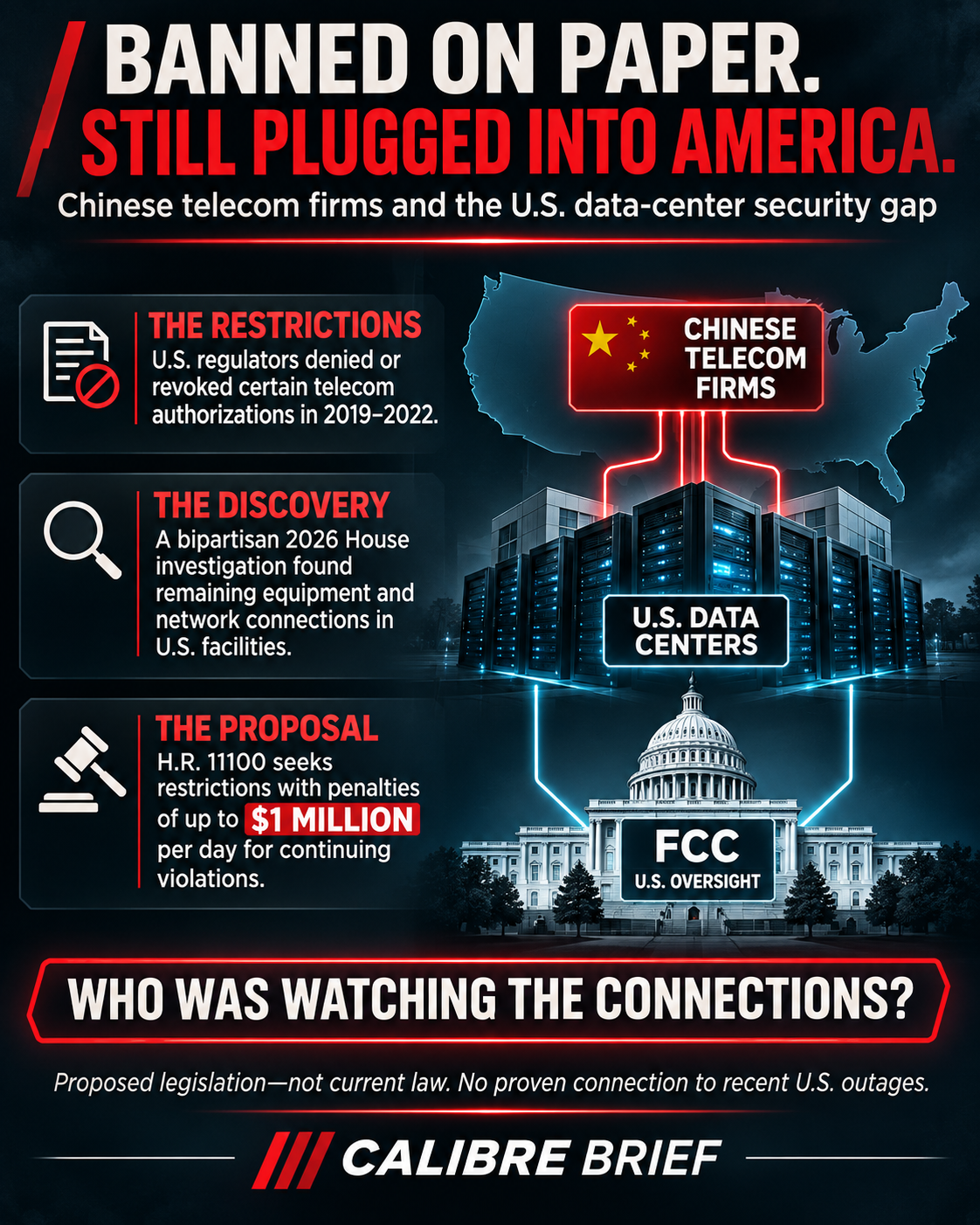
- FCC actions between 2019 and 2022 ended the carriers' service licenses but did not require equipment removal, data-center departures, or termination of private network links.
- The August 2026 House report "Stranger Pings" found China Mobile USA present in U.S. data-center and interconnection facilities, with key approvals coming from Hong Kong.
- Investigators found routing overlaps with servers linked to the Salt Typhoon espionage campaign, but stated the evidence did not prove the carrier's U.S. staff knew about or joined it.
- H.R. 11100 would bar covered Chinese firms from U.S. data centers and cloud services under $1 million daily fines, but it was introduced only on November 19, 2026, and key definitions remain unwritten.
Why a revoked license didn't unplug anything
The FCC regulates who may sell telecommunications services in the United States through authorizations issued under Section 214 of the Communications Act. Between 2019 and 2022, citing national security concerns, it denied China Mobile USA's application for international service and revoked the authorizations of China Telecom Americas and China Unicom Americas, without requiring equipment removal, data-center departures, or termination of private network links.
The China Telecom revocation, issued in October 2021, covered both its domestic and international service authority. But a Section 214 license governs regulated carrier services, such as selling phone and data transit to customers. It does not govern owning routers in a colocation facility, leasing data-center space, running private interconnections with other networks, or offering cloud-style services that fall outside common-carrier rules.

Those activities stayed legal. The House Select Committee on the Chinese Communist Party put it plainly in its 2026 report: revoking a carrier's federal authorization does not necessarily remove its equipment, interconnections, cloud offerings, or data-center presence, and the FCC lacks clear authority to compel removal of what remains.
What the House investigation found inside the data centers
The committee's bipartisan report, titled "Stranger Pings" and released in August 2026, mapped what the banned and denied carriers kept. It found China Mobile USA present in U.S. data-center and interconnection facilities, connecting to carrier backbones, internet exchanges, and private networks used by major technology companies.
Who was actually running these operations mattered to investigators. China Mobile USA appeared to be largely a sales organization, with key approvals for facilities and network connections handled through its Hong Kong headquarters. The committee concluded the U.S. subsidiaries were not meaningfully independent from their Chinese state-owned parents. Some of the transmission hardware in use was identified as Huawei-made, equipment the U.S. government has separately paid carriers to rip out of American networks.
The commercial relationships drew scrutiny too. The report described a four-year, $480,000 contract supplying data-center space and network connections to a firm called CloudRadium, which the committee connected to infrastructure repeatedly associated with malicious cyber activity. It also examined China Unicom's relationships with Integrity Technology Group and i-SOON, two Chinese firms U.S. authorities have publicly tied to state-backed hacking.
Where this story sits
5 related pieces
Read it →
Hover a story · click to read
 No. 103 · Nov 16, 2026No Hackers Required: The Week America's Critical Systems Started Failing
 No. 108 · Nov 17, 2026The NSA Went Dark: What Is Happening Behind America's Digital Defenses?
 No. 70 · Oct 16, 2026Day 30 Without Supply: Why America's Older Weapons May Outlast Its Newest Ones
 No. 19 · Aug 29, 202617,000 Cracks and a $76 Million Bribe Trail: The Coca Codo Sinclair Reckoning
 No. 107 · Nov 16, 2026What November's Bank Outages Reveal About America's Digital Financial Plumbing
What a rack and a cable can actually do

A network presence inside U.S. data centers is not an attack. But it is position. Interconnection points are where networks hand traffic to each other, which means a carrier sitting at those points can see, route, or potentially misdirect the data flowing through them. This is not hypothetical worry: a 2020 Senate investigation recounted research detailing incidents between 2016 and 2017 in which the Chinese government allegedly used China Telecom to misroute traffic through its points of presence. The company denied intentional hijacking, attributing several incidents to routing errors propagated by other networks.
The modern context is Salt Typhoon, a Chinese espionage campaign that affected major U.S. carriers including AT&T, Verizon, and Lumen, with stolen call-record data and communications involving prominent political figures. The Treasury Department sanctioned a Chinese company associated with the campaign in January 2025.
Here the committee was careful, and the distinction matters. Reviewing routing data from September 22 to 25, 2024, investigators found China Mobile International appearing at least 192 times in routes to 58 address groups that CISA linked to Salt Typhoon servers. The committee expressly said this did not prove China Mobile USA employees knew of or participated in the campaign. Proximity to malicious infrastructure is a documented fact; complicity is not.
Would $1 million a day close the gap?
On November 19, 2026, Representative Pat Harrigan, a North Carolina Republican, introduced H.R. 11100, with California Democrat Dave Min as an original cosponsor. The bill would prohibit covered Chinese entities from operating in U.S. data centers or providing cloud services to Americans, with penalties of $1 million for each day a violation continues. The prohibition would reach beyond the carriers themselves to affiliates and American business partners dealing with covered entities.

That design targets the exact gap the FCC's existing tools miss: it regulates physical and commercial presence, not just licensed services. But the bill is at the introduced stage, referred to the House Energy and Commerce Committee, and reporting indicates Harrigan expects consideration may slip into the next congressional session. Publicly available summaries do not yet establish its precise definitions, enforcement procedures, compliance deadlines, or appeals process, details that will determine whether fines are enforceable or litigated indefinitely.
The House committee's own recommendations went wider than one bill, calling for expanded FCC authority over domestic interconnection, foreign-adversary infrastructure, routing security, monitoring, and potential rip-and-replace actions. In other words, closing the gap likely requires rewriting what the FCC can regulate, not just punishing one list of companies.
The outage scare, and what to watch next

The bill arrived during a run of high-profile American technology failures involving Microsoft, Apple, JPMorgan Chase, United Airlines, Workday, the FAA, and an NSA network, which bot-amplified posts framed as a coordinated Chinese cyberattack. No public evidence links the incidents to one another, to a foreign government, or to Salt Typhoon. Secretary of State Marco Rubio said there was "zero" information tying the outages to a malign actor; the affected organizations pointed to software releases, security upgrades, and implementation failures. The outages explain the political moment, not the security gap, which predates them by years.
Three things will show whether the gap actually closes. First, the published text of H.R. 11100 and any Energy and Commerce markup, which will reveal who counts as a covered entity and how fast disconnection must happen. Second, whether the FCC pursues rulemaking on interconnection and data-center presence along the lines the committee recommended, since an agency rule could move faster than legislation. Third, whether data-center operators and exchanges begin dropping these tenants voluntarily now that the relationships are public. Until one of those happens, the companies banned on paper remain, lawfully, plugged in.
Sources / References

- House Select Committee on the CCP, "Stranger Pings: Chinese Telecom Companies Infiltrate U.S. Infrastructure" (Aug. 2026). https://chinaselectcommittee.house.gov/media/reports/stranger-pings-chinese-telecom-companies-infiltrate-us-infrastructure
- Select Committee on the CCP (Democrats), press release on "Stranger Pings." https://democrats-selectcommitteeontheccp.house.gov/media/press-releases/stranger-pings-chinese-telecom-companies-infiltrate-us-infrastructure
- Government Executive, "House probe finds gaps in U.S. effort to remove Chinese telecom risks" (Aug. 2026). https://www.govexec.com/technology/2026/08/house-probe-finds-gaps-us-effort-remove-chinese-telecom-risks/415211/
- Nextgov/FCW, "Chinese telecom firms kept footholds in US networks despite federal crackdowns, House probe finds" (Aug. 2026). https://www.nextgov.com/cybersecurity/2026/08/chinese-telecom-firms-kept-footholds-us-networks-despite-federal-crackdowns-house-probe-finds/415190/
- Defense One, "Chinese telecoms kept footholds in US despite crackdowns, probe finds" (Aug. 2026). https://www.defenseone.com/threats/2026/08/chinese-telecoms-crackdowns-probe/415208/
- Federal Communications Commission, Order on Revocation and Termination, China Telecom (Americas) Corp., FCC 21-114 (Oct. 2021). https://docs.fcc.gov/public/attachments/FCC-21-114A1.pdf
- Federal Communications Commission, national security actions summary. https://docs.fcc.gov/public/attachments/DOC-396816A2.pdf
- CongressIndex, H.R. 11100, 119th Congress (introduced Nov. 19, 2026). https://congressindex.com/bill/119/hr/11100
- The Civics Project, HR-11100 bill summary. https://www.civicsproject.org/united-states-of-america/bill/119/1/hr-11100
- AOL/Fox News, "$1M-a-day China tech crackdown proposed amid cascade of US cyber disruptions" (Nov. 2026). https://www.aol.com/articles/1m-day-china-tech-crackdown-203729000.html
- The Express Gazette, "GOP Lawmaker Proposes $1M Daily Fines for Chinese Firms in US Data Centers" (Nov. 2026). https://www.express-gazette.com/us-politics/gop-lawmaker-proposes-1m-daily-fines-for-chinese-firms-in-us-data-centers-240904
- Jingletree, "$1M-a-day China tech crackdown proposed" (Nov. 2026). https://jingletree.com/1m-a-day-china-tech-crackdown-proposed-amid-cascade-of-us-cyber-disruptions-310708.html
- SANS NewsBites, Vol. XXVIII Issue 58 (Aug. 2026). https://www.sans.org/newsletters/newsbites/xxviii-58
- U.S. Department of the Treasury, "Treasury Sanctions Company Associated with Salt Typhoon" (Jan. 2025). https://home.treasury.gov/news/press-releases/jy2792
- U.S. Senate Permanent Subcommittee on Investigations, "Threats to U.S. Networks: Oversight of Chinese Government-Owned Carriers" (2020). https://www.hsgac.senate.gov/wp-content/uploads/imo/media/doc/2020-06-09%20PSI%20Staff%20Report%20-%20Threats%20to%20U.S.%20Communications%20Networks.pdf
- CBS News, "The U.S. is investigating a China-backed hack of telecom companies." https://www.cbsnews.com/news/us-investigating-hack-major-telecom-companies-by-china/
- Axios, "Exclusive: Bots fueled tech outage conspiracy theories" (Nov. 19, 2026). https://www.axios.com/2026/11/19/tech-outages-bots-conspiracies
- Associated Press, "Rubio says there's 'zero' information that US outages are linked or caused by a malign actor" (Nov. 2026). https://apnews.com/article/ec4d88860b54e280c6e6c19dce7899ae
The reading behind this research
What the desk leaned on for this piece. Each link goes to the retailer, where the price is shown.

Encrypts your traffic before it crosses the internet exchanges where the report found China Mobile USA still connected to carrier backbones.
View on Walmart
This Is How They Tell Me the World Ends by Nicole Perlroth
The article says network presence is position, not attack; this book explains how states turn that kind of access into real spying and sabotage.
View on Walmart
The Hacker and the State by Ben Buchanan
Explains how states use network position for espionage, which fits the report finding China Mobile USA still linked to U.S. data centers and backbones.
View on WalmartPaid links. Calibre Code USA may earn a commission from purchases made through these links. This does not affect what we write or what we recommend.
Comments (8)
Continue exploring
Day 30 Without Supply: Why America's Older Weapons May Outlast Its Newest Ones
A 30-day cutoff of rare earths, chips, energetics and titanium would ground America's newest combat systems while older ones keep…
17,000 Cracks and a $76 Million Bribe Trail: The Coca Codo Sinclair Reckoning
A Quito court sentenced Lenín Moreno to five years in prison for taking bribes tied to Ecuador's largest hydroelectric plant. The…
What November's Bank Outages Reveal About America's Digital Financial Plumbing
Major U.S. banks suffered simultaneous access failures on November 16, 2026; the evidence shows no cyberattack or systemic…
The central lesson is that revoking a Section 214 authorization ends regulated service rights without removing infrastructure, so future orders must address equipment, colocation, and private links explicitly.
The Huawei finding fits the FCC's separate rip-and-replace effort, and the contradiction is blunt: Washington is paying carriers to remove this equipment while revoked firms could still retain infrastructure in U.S. facilities. A licensing decision that leaves the hardware and links untouched is not much of a security remedy.
How would H.R. 11100 determine which private interconnections must be terminated when the article says the FCC lacks clear authority to compel removal? It would be useful to know whether the bill covers only data-center leases or also backbone and cloud relationships.
The proposed H.R. 11100 remedy could be difficult to implement while its definitions remain unwritten. Regulators would need a precise way to identify covered firms, facilities, and cloud services before imposing fines of up to $1 million per day.
The phrase “A network presence inside U.S. data centers is not an attack” is an important qualification. It keeps the argument from overstating what the House findings prove. Still, the combination of Hong Kong-controlled approvals, Huawei hardware, and interconnection access makes the unresolved exposure difficult to dismiss.
The section explaining why a revoked license did not unplug anything was the most useful because it clearly separates selling regulated service from owning routers, leasing space, and maintaining private interconnections. That distinction makes the regulatory gap behind the China Telecom and China Unicom findings immediately concrete.
The article concludes that the licensing gap left a meaningful security foothold, but the evidence presented is not yet conclusive. Routing overlaps with servers associated with Salt Typhoon are concerning, yet the investigators explicitly said they did not prove that U.S. staff knew about or participated in the campaign. What additional technical or operational evidence supports treating the data-center presence as an active security risk rather than an unresolved exposure?
A rack at an interconnection point creates access and visibility, but the article moves quickly from that possibility to national-security concern. The 2020 examples involved alleged misrouting, with the company attributing several incidents to errors propagated by other networks, so they do not by themselves establish malicious control today.