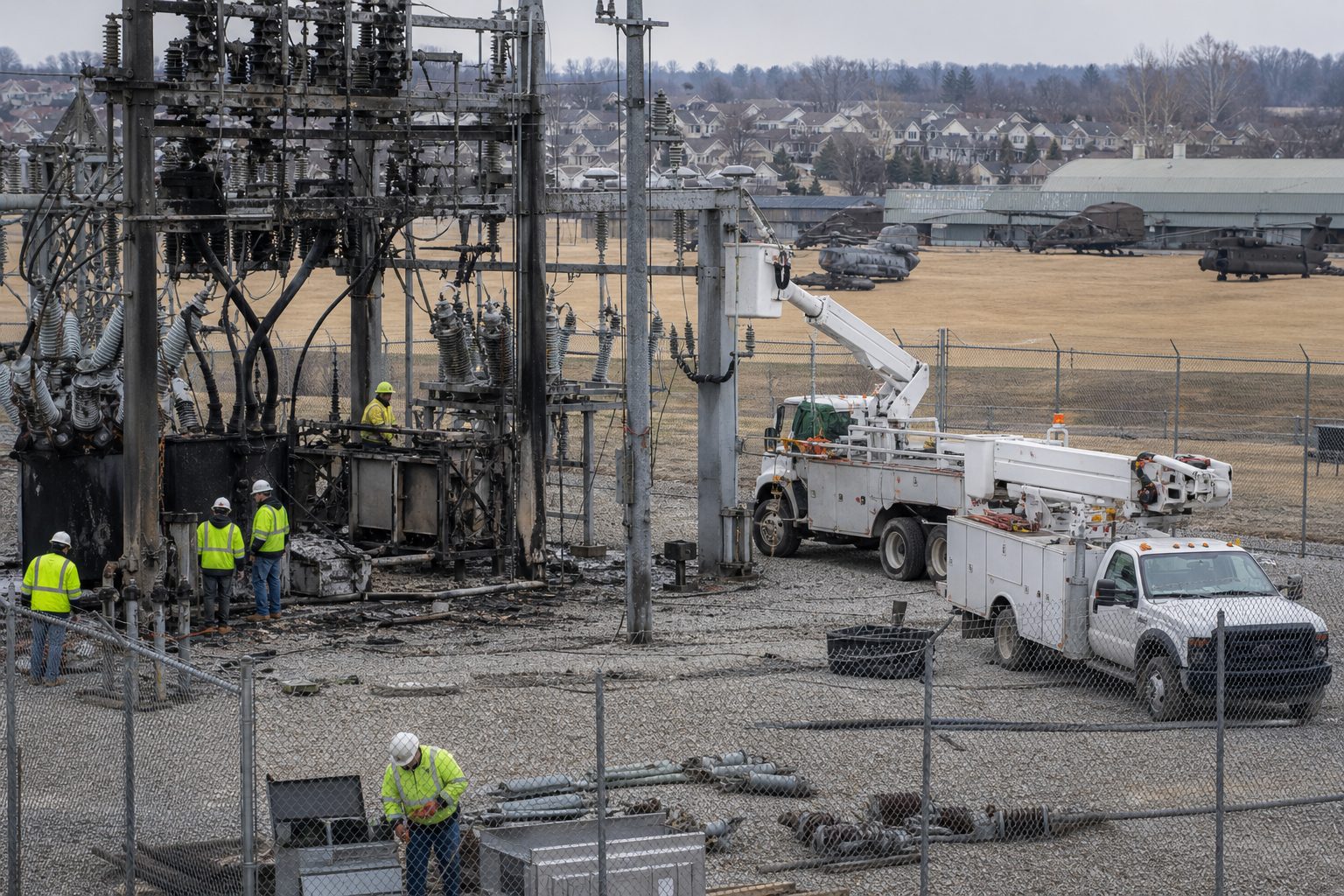
The Pentagon is developing a plan to keep American military installations operating through prolonged failures of electricity, communications, fuel deliveries, water systems, and supply chains. The initiative, called FORTRESS America, was announced on September 30, 2026, as part of a broader effort to prepare for cyberattacks, sabotage, infrastructure failures, and major conflict. (U.S. Army)
But one of its most striking details remains only partly confirmed.
Reporting published in October described a goal for some installations to operate for as long as 90 days without outside support. The figure came from documents reviewed by Fox News and subsequent reporting, not from a publicly released Pentagon requirement. Reporting has also discussed 30-, 60-, and 90-day resilience targets, but the public record does not establish that every base must meet a uniform 90-day standard. (Fox News, Defense News, TWZ)
That distinction matters. FORTRESS America is real. The 90-day figure is best understood as a reported planning target, not a fully published rule.
The larger question is harder to answer: if military installations must prepare to function when civilian infrastructure fails, what happens to the communities outside their gates?
FORTRESS America is a resilience program, not a single exercise
FORTRESS America is designed to coordinate several efforts across the military rather than create one nationwide drill. A Pentagon program office was being organized to coordinate implementation across the military departments and relevant defense-policy offices. (DefenseScoop)
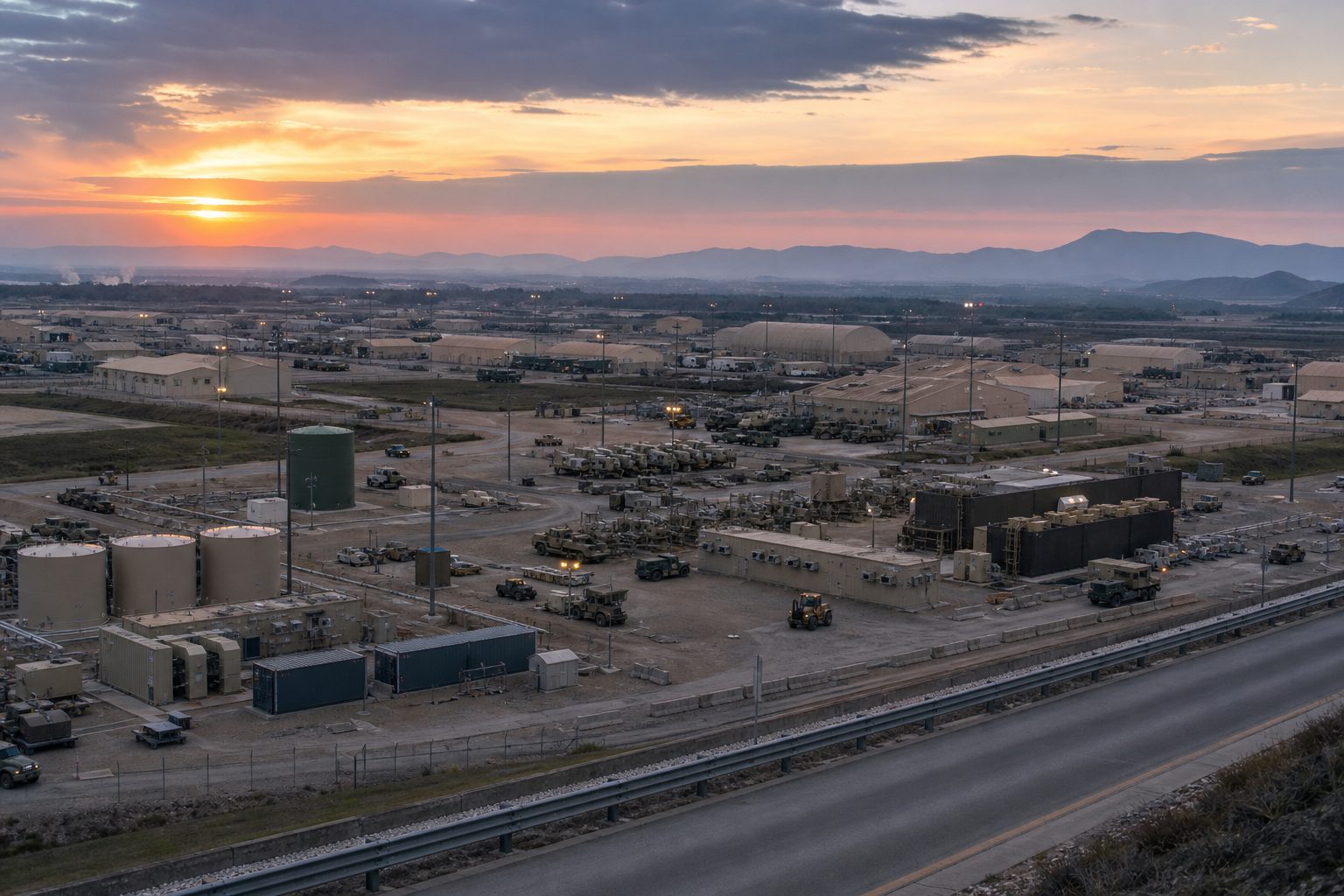
Public descriptions identify five broad priorities:
- Independent energy and resilient utilities
- Domestic and secure supply chains
- Strategic reserves of essential materials
- Installation hardening and cybersecurity
- Resilience in space and the electromagnetic spectrum
The priorities are connected. A base cannot continue flying aircraft or operating command centers if it has electricity but no fuel, fuel but no communications, or communications but no water and wastewater services. The Center for Strategic and International Studies described the initiative as covering energy independence, defense-industrial resilience, stockpiles, installation security, cyber resilience, and resilience in space and the electromagnetic spectrum. (CSIS)
The objective is not to make every installation completely independent forever. It is to preserve essential military missions during the period when civilian systems are damaged, disconnected, or overwhelmed.
That is a narrower goal than keeping an entire region functioning.
Why military bases need civilian infrastructure in the first place
American bases may look self-contained, but most are deeply connected to the communities around them.

Installations routinely purchase electricity, natural gas, water, wastewater treatment, telecommunications, and rail services from civilian providers outside the fence line, according to an Army Cyber Defense Review analysis. (Cyber Defense Review)
A Government Accountability Office review found that 62 of 63 surveyed installations relied on surrounding communities for at least some combination of electricity, roads or bridges, and telecommunications. (GAO)
Those dependencies create obvious weak points. A base may have generators, fuel tanks, emergency communications, and other backup systems, but those systems do not automatically replace the civilian networks that support housing, transportation, medical care, schools, food distribution, and public safety.
The military has been testing this problem for years. Army exercises have deliberately disconnected installations from commercial electricity to test emergency generation, fuel supplies, infrastructure, and command decisions. (U.S. Army)
More recent “black start” exercises conducted by the U.S. Army Corps of Engineers have examined what happens after prolonged power loss. The tests consider whether bases would run short of potable water, suffer sewage overflows, lose communications, close childcare facilities, spoil commissary food, or compromise medical operations. (U.S. Army Corps of Engineers)
The exercises test whether systems that appear to be separate actually depend on one another.
What the 90-day target does and does not mean

The reported 90-day concept has attracted attention because it sounds like a national blackout warning. The evidence does not support that interpretation.
The public descriptions instead point to a planning benchmark for essential military functions. The target may include electricity, water, fuel, communications, transportation, medical supplies, spare parts, munitions, and other materials needed to keep an installation operating without ordinary outside support. (TWZ)
The reporting reviewed for this article describes a goal for installations to sustain essential operations independently. The public FORTRESS announcement, however, does not clearly establish a uniform 90-day rule for every base. (Fox News, Defense News)
That leaves several possibilities:
- Some installations may receive 90-day planning targets.
- Others may be assigned shorter or longer standards based on mission and location.
- The benchmark may apply only to mission-essential services.
- The target may remain a planning objective while the Pentagon determines cost and feasibility.
An installation that can keep its command center, aircraft operations, and security systems running is not necessarily an installation that can provide normal services to every person who lives nearby.
Where this story sits
5 related pieces
Read it →
Hover a story · click to read
 No. 36 · Sep 5, 2026The Army Is Turning Military Land Into an AI Compute Platform
 No. 13 · Aug 26, 2026America's Invisible Clock: What Happens If GPS Timing Fails?
 No. 82 · Oct 27, 2026When a Prime Minister Orders an Attack, Who Can Stop It?
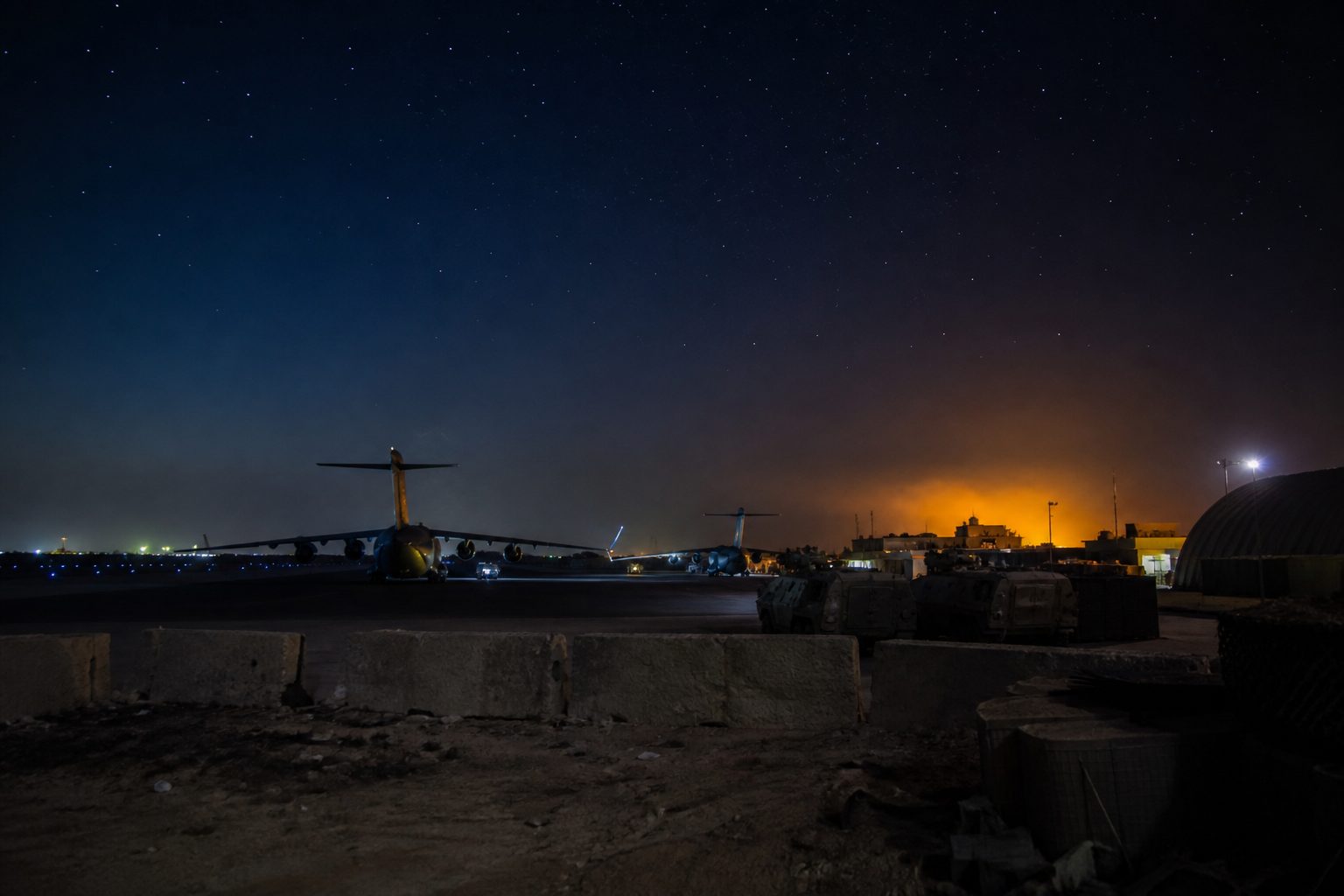 No. 21 · Aug 30, 2026The air base decides: Niger's 24-hour mutiny and the technology of regime survival in the Sahel
 No. 39 · Sep 6, 2026Isar's Spectrum Reached Orbit. The Test of European Space Sovereignty Starts Now.
The threat is real, but the timeline is not
The Pentagon is responding to several types of risk at once.

The Defense Department’s assessment of China’s military capabilities identifies military command systems, logistics nodes, defense contractors, and civilian infrastructure as potential targets whose disruption could delay mobilization or degrade command and control. (2025 China Military Power Report)
The risk is not limited to electricity. In 2026, the FBI warned that malicious cyber actors had compromised internet-facing programmable controllers used in the water and wastewater sector in at least seven states since July 27, degrading some operations. (FBI)
Water systems are especially important because they depend on electricity for pumping and treatment. FEMA describes energy, water, transportation, fuel, and communications as interdependent systems capable of producing cascading failures across communities and jurisdictions. (FEMA)
Military planners are also concerned about physical attacks and small unmanned aircraft. The Congressional Budget Office’s analysis of counter-small-drone systems identifies radar, radio-frequency detection and defeat, acoustic and infrared sensors, kinetic interceptors, directed energy, and continuing software and hardware upgrades as possible parts of a layered defense. A representative system could cost about $74 million to acquire and install, with roughly $5 million per year in sustainment. (CBO, CBO)
Those figures do not represent the cost of FORTRESS America. They illustrate how expensive even one defensive layer could become if applied across many installations.
None of this proves that officials expect a nationwide attack or grid collapse soon. It shows that the Pentagon is planning around a class of disruptions that could occur during a major conflict, a coordinated cyber campaign, sabotage, severe weather, or a combination of events.
What bases are likely to change

FORTRESS America could involve different projects at different installations.
Possible measures include islandable microgrids, larger battery systems, on-site generation, expanded fuel storage, geothermal power, hardened communications, protected control systems, and stockpiles of medical supplies, blood, munitions, spare parts, and other critical materials. Some reporting has also discussed portable nuclear reactors, although that remains an option under consideration rather than an established nationwide deployment. (TWZ, PetersWorld)
The program also calls for reducing dependence on vulnerable foreign supply chains. Public descriptions mention domestic production of rare earths, specialty metals, semiconductors, and propellants. (U.S. Army, PublicNow)
Energy resilience is likely to come first because power supports nearly everything else. The Air Force has already used energy-resilience exercises that disconnect bases from the grid and test commanders, backup systems, units, and mission continuity. The Pentagon has also considered public-private partnerships and pilot installations. (Air & Space Forces Magazine)
The public descriptions reviewed for this article do not identify a complete installation-by-installation project list, a program-wide budget, or a comprehensive list of FORTRESS contract awards. That makes it difficult to measure how quickly the initiative is moving or how much it will cost.
One narrow cost benchmark is available. The CBO estimate for layered counter-drone defenses suggests that protecting 100 installations could require approximately $7.4 billion in acquisition costs and $500 million annually for sustainment, assuming the representative system applies. That is an extrapolation, not a FORTRESS budget. (CBO)
The civilian problem is not solved by a stronger base fence
A military installation that remains operational during a regional outage may become an island of capacity inside a failing civilian network.

That could help nearby residents in some circumstances. Bases may have medical personnel, emergency managers, fuel, communications, engineering support, and logistics capacity. Military-civilian coordination could speed recovery if officials establish clear agreements before a crisis.
But the opposite is also possible. A base could reserve fuel, water, communications bandwidth, and transportation for mission requirements while nearby communities face shortages. FORTRESS is designed primarily to preserve military operations, not to guarantee uninterrupted services for surrounding populations. (Defense News)
The vulnerability is especially significant because many service members and military families live off base. A recent GAO report on remote and isolated installations noted that civilians outside bases generally remain dependent on municipal utilities, commercial supply chains, local schools, hospitals, police, fire departments, and state emergency-management systems. It also noted that roughly two-thirds of service members live off base. (GAO)
That creates a practical contradiction. The military may be able to keep a runway open while the roads leading to it are blocked, keep a command center online while local telecommunications fail, or maintain a hospital while civilian hospitals lose power and staff.
Base resilience and community resilience are therefore related but different goals.
What the public should watch for

The clearest sign of progress will not be dramatic language about worst-case scenarios. It will be measurable implementation.
Useful indicators include:
- Public release of the FORTRESS program memorandum and installation-specific standards
- Named pilot bases and published resilience projects
- Contracts for microgrids, fuel storage, hardened communications, cyber protection, and counter-drone systems
- Exercises that include local utilities, hospitals, water systems, counties, tribes, and state emergency agencies
- Confirmed changes to military procurement and stockpile requirements
- New cybersecurity advisories involving power, water, transportation, or defense suppliers
- Utility plans for military loads and surrounding civilian customers during extended outages
- Public after-action reports showing whether exercises exposed failures
- Appropriations language identifying FORTRESS funding and performance measures
The most important question is whether military planning remains inside the fence line. If installations depend on surrounding roads, water systems, telecommunications, and fuel networks, then a resilience plan that excludes those providers will protect only part of the mission.
The evidence currently supports a measured conclusion. FORTRESS America reflects an effort to address longstanding dependencies in military readiness while preparing for cyberattacks, sabotage, infrastructure failures, and major conflict. The 90-day figure is significant, but its exact legal or operational status remains unclear. It is not evidence that a nationwide collapse is expected on a known timetable.
It does reveal something more immediate: the United States has built military power on top of civilian systems that can fail together. The Pentagon is now trying to create bases that can keep fighting through that failure. Whether the communities around them can keep functioning will depend on decisions made outside the base gates.
Sources and references

- U.S. Army, “Hegseth delivers ‘State of the Force’ address, outlines series of new initiatives.” https://www.army.mil/article/295897
- DefenseScoop, “Pentagon memo outlines plan to operationalize new ‘FORTRESS America’ program office.” https://defensescoop.com/2026/10/07/pentagon-memo-operationalize-fortress-america-program-office/
- U.S. Army Cyber Defense Review, “Ensuring the Cyber Resilience of Critical Infrastructure Serving Domestic Military Installations.” https://cyberdefensereview.army.mil/Portals/6/Documents/2025-vol10-iss2/CDR_V10_N2_SI_Cyber_Resilience_Power_Projection.pdf
- U.S. Government Accountability Office, “Climate Resilience: DOD Coordinates with Communities, but Needs to Assess the Performance of Related Grant Programs.” https://www.gao.gov/products/gao-21-46
- U.S. Government Accountability Office, “Military Installations: Remote and Isolated Locations Face Challenges Delivering Critical Support Services.” https://www.gao.gov/assets/gao-26-108231.pdf
- U.S. Army, “Cutting the Cord to Test Energy Resilience.” https://www.army.mil/article-amp/234514/cutting_the_cord_to_test_energy_resilience
- U.S. Army Corps of Engineers, “USACE Black Start Exercise Brings Light to Readiness.” https://www.usace.army.mil/Media/News-Releases/News-Release-Article-View/Article/4338757/usace-black-start-exercise-brings-light-to-readiness/
- FEMA, “Power Outage Incident Annex.” https://www.fema.gov/sites/default/files/documents/fema_incident-annex_power-outage.pdf
- FBI, “Malicious Cyber Actors Targeting Water and Wastewater Sector Internet-Facing Programmable Logic Controllers, Causing Operational Disruptions.” https://www.fbi.gov/investigate/cyber/alerts/2026/malicious-cyber-actors-targeting-water-and-wastewater-sector-internet--facing-programmable-logic-controllers-causing-operational-disruptions
- U.S. Department of Defense, “2025 Annual Report to Congress: Military and Security Developments Involving the People’s Republic of China.” https://media.defense.gov/2025/Dec/23/2003849070/-1/-1/1/ANNUALREPORT-TO-CONGRESS-MILITARY-AND-SECURITY-DEVELOPMENTS-INVOLVING-THEPEOPLESREPUBLIC-OF-CHINA-2025.PDF
- Congressional Budget Office, “Options to Counter Small Unmanned Aircraft Systems.” https://www.cbo.gov/publication/62262
- Congressional Budget Office, “Options to Counter Small Unmanned Aircraft Systems.” https://www.cbo.gov/publication/62563
- CSIS, “Reshaping Defense: Secretary Hegseth’s Latest Initiatives, Point by Point.” https://www.csis.org/analysis/reshaping-defense-secretary-hegseths-latest-initiatives-point-point
- TWZ, “90 Days No Help: Fortress America’s Goal To Make Bases Resilient Bastions In A Crisis.” https://www.twz.com/nuclear/90-days-no-help-fortress-americas-goal-to-make-bases-resilient-bastions-in-a-crisis
- Fox News, “Pentagon’s FORTRESS initiative preps US bases for 90-day survival.” https://www.foxnews.com/politics/inside-pentagons-doomsday-plan-keep-america-fighting-global-war-erupts
- Defense News, “Pentagon Weighs 90-Day Base Self-Sufficiency Standard.” https://defensenews.us/news/pentagon-base-self-sufficiency
- Air & Space Forces Magazine, “Pentagon Starting with Resilient Energy for ‘FORTRESS America’.” https://www.airandspaceforces.com/pentagon-resilient-energy-fortress-america-project/
- PublicNow, “Secretary of War Pete Hegseth’s State of the Force Address, As Delivered.” https://www.publicnow.com/view/4C08EC5E1684FC43C6F13809EF41F672AE9235E9
- PetersWorld, “FORTRESS America Base Hardening Plan and Who Pays for It.” https://petersworld.org/fortress-america-base-hardening-plan/
The reading behind this research
What the desk leaned on for this piece. Each link goes to the retailer, where the price is shown.
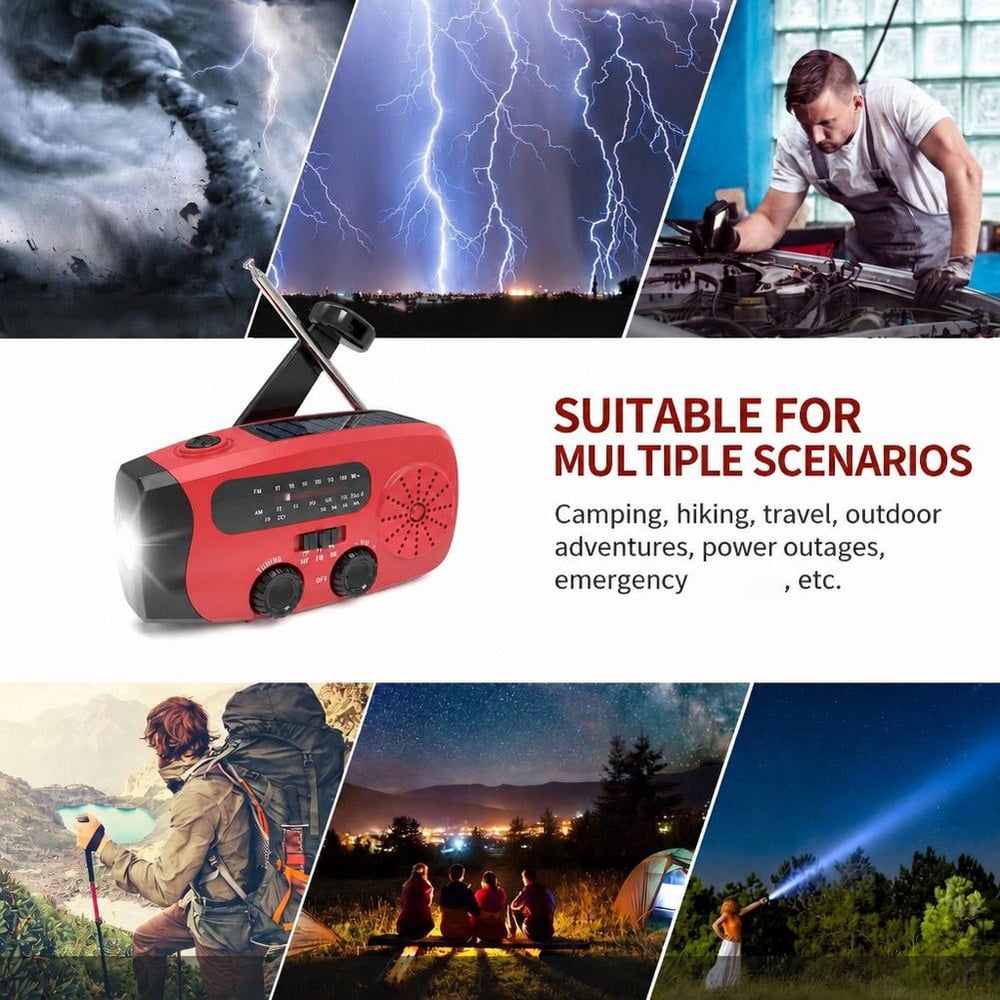
OADUKQ Emergency Hand-Crank Solar Radio, Red ABS, US Version 1-Piece
A hand‑crank solar radio gives off‑grid communication during power loss, matching the article’s point on independent energy and resilient utilities.
View on Walmart
It offers battery backup that keeps vital home electronics running during grid outages, echoing the article’s call for independent energy resilience.
View on Walmart
Mountain House 3-Day Emergency Food Supply, Freeze-Dried Survival & Emergency Food, 18 Servings
It provides a 3‑day food reserve, helping households fill gaps if civilian supply chains stall, echoing the Pentagon’s 90‑day resilience goal.
View on Walmart
Matches the article’s call for independent energy and resilient utilities for base self‑sufficiency.
View on Walmart
Reliance Aqua-Tainer Water Storage Container 7 Gallon
Provides a compact way to store water for the 90‑day independent water supply target in the Pentagon’s resilience plan.
View on Walmart
It offers a two‑band radio that works when civilian networks go down, matching the article’s focus on emergency communications resilience.
View on WalmartPaid links. Calibre Code USA may earn a commission from purchases made through these links. This does not affect what we write or what we recommend.
Comments (5)
Continue exploring
When a Prime Minister Orders an Attack, Who Can Stop It?
Reports that Israel’s military chief sought written authorization for possible Iran action reveal how law, intelligence, and…
The air base decides: Niger's 24-hour mutiny and the technology of regime survival in the Sahel
When mutinous soldiers attacked Niamey's Air Base 101 in August 2026, Russia's Africa Corps, not Niger's own army, settled the…
Isar's Spectrum Reached Orbit. The Test of European Space Sovereignty Starts Now.
Isar Aerospace's Spectrum finally delivered satellites to orbit from Norway, proving a private European rocket can fly. The…
The discussion of black-start exercises fits the broader move toward utility microgrids that can island critical facilities during grid failures. I have followed several of those projects, and the recurring problem is that electricity is restored before water, telecommunications, or fuel logistics are dependable. The article’s treatment of sewage, childcare, and commissary operations reflects that less visible sequence of failures.
The objective is not to make every installation completely independent forever” is the key clarification here. It keeps the reported 90-day figure from being mistaken for a promise that every base can function in isolation indefinitely. I also like that the article connects energy, water, communications, supply chains, and civilian services instead of treating resilience as a generator problem alone. That is a much more useful way to frame the program.
The article is right that bases are not genuinely self-contained, as the 62-of-63 installation finding makes clear. In my work supporting continuity planning for a regional hospital, generator capacity was only one concern; fuel contracts, municipal water pressure, wastewater, and staff transportation were equally limiting. A facility can remain powered and still become nonfunctional within days if those surrounding services fail. That same dependency appears to be central to FORTRESS America.
The distinction between a reported 90-day target and a binding requirement is fair, but it does not make the figure inconsequential. A planning target can still shape procurement and funding even when installations are not held to one uniform standard.
How would the five FORTRESS America priorities translate to a small installation or a regional Guard facility with little room for fuel storage and fewer specialized staff? Would the 30-day target be more realistic there than the reported 90-day benchmark?